

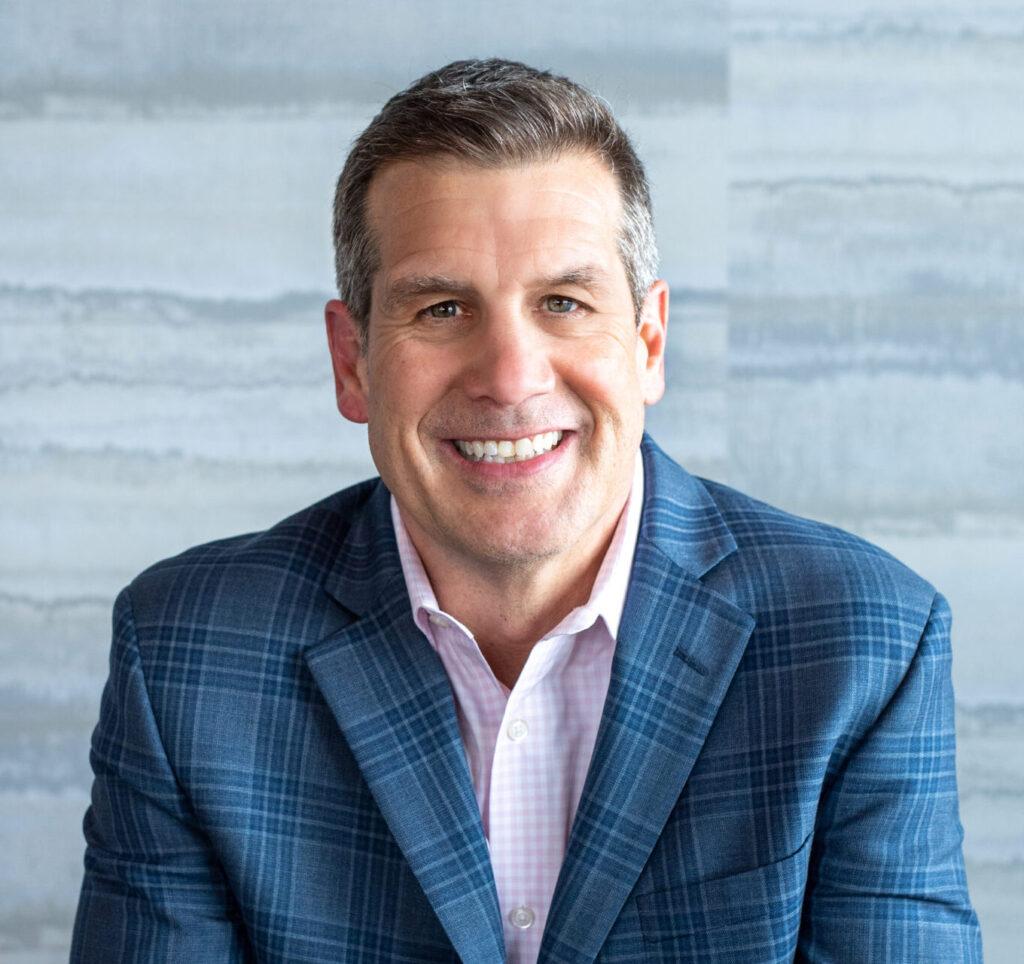
Ed Molitor is a coach down to the very smallest molecule of his DNA.
Whether he’s a husband and father at home or working with a client in the business world, he is an energized, passionate, and near-obsessive coach who is fully invested in showing up with all he’s got to help you show up with all you’ve got. His approach is one that insists on presence. He knows no other way to catalyze change except by getting on the court with you, playing side-by-side, and encouraging you to keep pushing, especially when the going gets tough.
In the last 29 years, Ed has developed his leadership skills in both athletics and business. From working as an NCAA Basketball coach at Texas A&M, DePaul NIU, and Lewis University to becoming the Vice President of a national recruiting firm, Ed Molitor has experienced the potential and pitfalls of leadership at every level.
As the founder and CEO of The Molitor Group, Ed guided emerging and established leaders across biopharma and biotech to apply the proven lessons of coaching in their pursuit of inspiring and driving their team’s performance.
Today, he continues to have high impact in leaders and organizations, as EVP of Strategy and Coaching Excellence at CoEffex.
Through personalized training, workshops, keynote speeches, his writing, and as a podcast host, Ed seeks to empower individuals and their organizations to achieve victory through a focus on transformation, fundamentals, compassion, mental toughness, and vision.Ed graduated from St. Ambrose University with a B.S. in Business Administration and a minor in Economics, where he was a member of the Men’s Basketball team serving as the co-captain his Senior year.
Before St. Ambrose, he studied business at Creighton University, where he played on the Men’s Basketball teams which included a 1989 MVC Regular Season and Tournament Champions, NCAA Tournament, and a 1990 NIT Tournament.
Leading with Competitive Character: Building Connected Teams That Perform and Care — featuring Will Lumpkin, Vice President of Sales at Agios Pharmaceuticals
Big personalities can be an absolute game changer for your team. I mean, think about it. They bring confidence, intensity, conviction, competitive fire. Big personalities are willing to challenge the status quo. The goal is not to make these personalities smaller. The goal is actually to help their impact become greater.
So here's what you have. You have three incredibly talented individuals, three extremely different personalities, and three uniquely different sets of needs. And Phil understood something we all should recognize as leaders. You cannot coach every person the same way and expect to get their best. Great leaders refuse to trade their people for performance.
Now, they may customize how they coach each person, but they do not compromise the standards everyone is responsible for protecting. Talent earns opportunity. It does not earn immunity
Every team says they want to win, but winning takes more than just stockpiling talent. It takes trust, discipline, hard conversations, and leaders who know how to coach people through pressure. I'm Ed Molitor, and this is The Athletics of Business, where the lessons of high-performing teams, elite athletes, and high-impact coaches become the playbook for more impactful leadership, stronger cultures, and sustained success In this past week, I had two separate conversations, one with a potential client, one with a client from the past three, three and a half years about the same thing, and that was basically, in a nutshell, managing big personalities, and leaders' ability to do that in such a way that they channel that personality into success and into performance, and it doesn't jeopardize the culture and the environment.
So on one of the conversations, I said there was no better example for me that I've got to witness firsthand that I remember so vividly that has done it than Phil Jackson and the Chicago Bulls. And we just started talking, and all of a sudden, I, you know, when we, when we clicked off the call, I, I started doing some, some research because something very specific, three very specific days stick out in my mind.
And I was still coaching college basketball at this time. Matter of fact, I was at Lewis University. I was an assistant there. And on October 5th, okay, I'll never forget this. I was driving down to Champaign, Illinois, to do a school visit with the son of one of the University of Illinois, um, men's basketball co-assistant coaches, Anthony Coombs.
His dad, Mark Coombs, was an assistant at the, at the U of I. And as I was driving down there the night before the visit, it came across the radio that Michael Jordan was at the White Sox game, and the rumor was he was going to announce his retirement the next day from basketball with the intention to join the White Sox organization to pursue a career in professional baseball.
I lived on the road, and I would listen to ESPN Radio all the time, you know, driving from school to school, home visit to school visit to, to gym to gym. So I could not get to my hotel quick enough to turn on the TV and see what ESPN said about it. But listened to, listened to ESPN Radio, and I felt this knot in my stomach.
I mean, hell, they just won three in a row, right? Like this was, this was the single greatest time to live in Chicago, and it was 1993, okay? October 5th, 1993. The next day I'm sitting in the classroom, and he-- I, I don't know if he's a Champaign Centennial. I, I believe he was. I'm sitting in a classroom with the young man and his entire class, and the teacher rolls in.
Back then they, you know, you had TVs on those stands. Rolls the TV, extends the cable cord, screws it back into the back of the TV, and we watched Michael Jordan's press conference, and that was October 6th, 1993. Now, fast-forward to March 18th of 1995. I am now back in Champaign, and on Friday night on the 17th, okay St Patty's Day, I watched Kevin Garnett and Ronnie Fields and Michael Wright lose to Thornton in one of the best upsets in high school basketball.
And the very next day, the same day that Peoria Manual beats Thornton, and this has nothing to do with the story, I just love telling stories, beats them in the state championship that same day was when Michael Jordan, uh, had the press release that said, "I'm back," and he announced his return to the NBA, to the Chicago Bulls 17 months later.
Now, I'm back on the road. I'm actually not that far. I'm right outside Chicago in Maywood, Illinois, leaving Oak Park High School to go over to Proviso West to look at a kid. And I'll never forget exactly where I was, in traffic, in my white Honda Civic, okay? And it comes across ESPN that the Bulls, again, it's October 2nd now, 1995, almost two years to the day when MJ announced his retirement, announced the Bulls have acquired the rights in a trade with the San Antonio Spurs to Dennis Rodman.
I almost literally drew, drove my car into the pickup truck in front of me. I was stunned. Went about my business, went home that night. I was living, at the time I was living across from Wrigley. I'm sitting in the, in the living room with my two buddies, and we had some friends over, having a couple beers, and the argument ensued, A, would Rodman sign with the Bulls, 'cause he really didn't do it for three days.
He, uh, he signed on October 5th. And B, if he, if he did sign with the Bulls, what kind of impact would he have? And I mean, it was... I wish we could've had cameras in there because it was, it was made for TV. It was a made-for-TV conversation. A- and I just remember saying to my buddies, "I don't know if there's room."
Vividly remember this. I was sitting on a chair right inside our bay window, said, "I don't know if there's room for another big personality on the Chicago Bulls," okay? Now, fast-forward 2026, here I am this week having this conversation with a potential client, then another one with a current client, and I started thinking about the significance of being able to manage big personalities and how you make it a positive, right?
And how you reframe the challenges into opportunities and levers that you can pull in order to achieve massive success, not just individually for the big personality, but collectively for your team and organization as a whole. I mean, let's, let's call it what it is, right? Big personalities can be an absolute game changer for your team.
I mean, think about it. They bring confidence, intensity, conviction, competitive fire Big personalities are willing to challenge the status quo. That's something we talk about a lot when we, we talk about the constraints that we're working inside of, right? Big personalities push the pace. They say what others may only be thinking.
And then when the game's on the line, when pressure rises, when you've got to perform to hit your numbers, they're usually the people that want the ball in their hands, right? They're usually the people that say, "You know what? I've got this." Now, that is the upside, okay? The challenge is that those same individuals can dominate conversations.
beyond frustrating you, they can very easily consume an incredl- incredible amount of your time and energy. Now, if you manage them well, if you coach them well, if you lead them well, they can become one of your greatest competitive advantages.
If you coach them poorly and manage them poorly or avoid leading them altogether, they can slowly fracture your culture. And I see that often, right? The path of least resistance with leaders. The, the challenge of having a difficult conversation. Now, here's the deal, and I think this is a profound statement, not because I wrote it, because I heard it somewhere and I relate it.
All right? The goal is not to make these personalities smaller. The goal is actually to help their impact become greater. Think about that. The goal is not to make these personalities smaller. It is actually to help their impact become greater. So let's get back to Phil Jackson, right? And, and his ultimate coaching challenge Michael Jordan, Dennis Rodman, Scottie Pippen.
spend some time around the NBA, spend some time at the highest levels of any sport, and it is brutal survival of the fittest and it's a drive to win.
And oftentimes, and I don't want to get off on too much of a tangent here, oftentimes they're driven by that hatred for losing as opposed, uh, for their desire to win, okay? And then there was Scottie. Scottie was an elite player. He was. Was he jealous of MJ? Did he envy him? Did he feel like he should share the spotlight with him?
Probably, right? Probably. But he had to navigate that pressure of performing besides Jordan, right? And he was always fighting to receive the respect and recognition that he believed he had earned. And many would argue, and I would agree with them, that he absolutely lost a lot of respect when Jordan was retired and he refused to go in the game because Phil wrote the play off for, uh, the last shot for Tony Kukoc, um, to get.
And then, okay, there was Rodman. Dennis was a lot of things Y- besides eccentric, he was unpredictable. I would argue that he was predictably unpredictable. He was emotional, he was unconventional, but you know what? He was, and is to this day, one of the all-time greatest rebounders and defenders that the game has ever seen, and he had an unbelievable basketball IQ.
you cannot coach every person the same way and expect to get their best. Okay, you're probably sitting there thinking, "Well, wait a minute.
Standards are standards. Expectations are expectations." Put a pin in there for a second. We'll get there, okay? He did not try to strip away the qualities that made MJ MJ, Pippen Pippen, and Dennis Dennis, what made them exceptional. He worked to understand them, to connect with them, and to channel their individual intensity toward a shared mission, mission, which many of us would call a singleness of purpose.
Phil challenged MJ to trust his teammates. He gave Scottie room to express his frustration without allowing that frustration to separate him from the group. He provided Rodman with freedom that would never have worked for most players, but he, along with Rodman's teammates, also established clear expectations and consequences.
And, and, you know, with Dennis, Phil adjusted certain team procedures and communicated those accommodations openly, so the rest of the team understood the difference between thoughtful leadership and favoritism, right? Like wearing a dress to a game, coloring your hair, going to Vegas for 48 hours in the middle of a season, okay?
But think about this. Again, he wanted to do those things so the team understood the difference between thoughtful leadership and favoritism, and that distinction is critical. Fair leadership does not always mean treating every person exactly the same It means giving each person what they need to succeed, what they need to succeed while holding everyone accountable to the same mission, values, and standards.
There is a massive difference between customizing your coaching and compromising your culture. I mean, think about it. You could just look at, at Bill Jackson's success, and you can squeeze so much from that. So recently I wrote a newsletter on that, and, and these are the conversations again that I've been having.
So I wanted to share that with you. Okay, so let's look at five things. Let's look at five powerful lessons that all of us as leaders, okay, can really tap into as we manage big personalities. Number one, build a team first environment. Big personalities naturally occupy space. They speak with confidence, they move quickly, uh, they challenge ideas, they influence the energy in the room.
Sometimes before the leader even has a chance to do it, and I think it's so significant for you to be, right? Sometimes you have to be that thermometer, not just a thermostat. You need to get a sense of what that energy in the room is because they have the ability to influence it. Do not, let me repeat this, do not waste your energy trying to shrink, shrink their presence.
Instead, build an environment in which the team's mission is bigger than any individual's ego. If I had a dollar for every time I was sitting in a gym growing up and I heard my dad say, "Son, you're a part of something bigger than yourself. You're a part of this team. You're a part of this program." Okay?
Now, the other thing with building a team first environment, invite passionate debate. Encourage people to challenge ideas, bring strong opinions to the table. Remember, psych safety does not mean everyone agrees or that every conversation feels comfortable. It's not about kumbaya moments. It means that people can speak honestly, challenge respectfully, and remain connected Not only when the conversation gets difficult, but especially when the conversation gets difficult.
The boundary must also be clear. Once a decision is made... So we make this decision, even though we didn't agree, and we debated. We stayed connected while we were having a little bit of discomfort and healthy tension, but once we make that decision, everyone aligns and moves forward. When we walk out of this room or when we click off the Zoom call or Team call, we are absolutely aligned.
Your strongest personalities should influence the team. They should, but they can't be allowed to become bigger than the team. No matter how much they perform, no matter how much they produce, nobody is above or bigger than the team, the culture, the organization. All right? So let's go to the second lesson.
discover their motivating currency. Look at the Bulls for a second again. Three different personalities, all coached uniquely different by Phil Jackson, right? You cannot coach every high performer or big personality with the same playbook. What do I mean by that? Well, some people are motivated by autonomy.
Others want recognition. They want responsibility. They want to compete. They want to be challenged intellectually. Many want financial rewards. Some want the opportunity to leave a legacy. Now, all these aren't mutually exclusive, but the point is this, is that there are a lot of different things that drive your big personalities and your high performers.
So your responsibility as a leader, our responsibility, okay, is to discover what is their currency. What drives them? What makes them feel valued? Think about the things we talked about, like the three things people want. I've been talking about this for years, that people want today in the workforce, right?
They want to know that they're valued. They want to know that the work that they are doing is meaningful and important, and they want to be coached. Okay? So what makes them feel valued? What are they working toward? What is it they fear losing? And what, how, what does that fear do to them, right? We could go deeper with each one of these, but you get the idea.
And how do they want to be experienced by others? Don't assume you know the answers. Don't. And oftentimes that's something that we do. We think we're smarter than we really are, and I'm not saying we're not smart, but we think we have so much experience with this person that we absolutely know, know what makes them tick.
But do we? Have we asked the right questions? Have we really observed, quietly observed? Have we dug deeper? So don't assume you know the answer simply because you have worked with someone for a long time. Ask better questions and then have the discipline to truly listen. And I'm not talking just about being an active listener.
I'm talking about being an engaged listener, okay? How do the things that they're telling you How do their answers to their questions truly make them feel and those emotions? What are the behaviors that come on the other side of those emotions? Big personalities want to know their capabilities are recognized and their perspectives matter.
I think you'll agree with me. When people generally see understood, they become far more open to being challenged. Why? Because there's that trust factor there, right? Like that relationship piece, you are absolutely nailing it, and we all know that everything begins and ends with trust, and it is the foundation of every positive relationship, positive culture, and positive coaching experience.
create space for private truth. Think about Rodman, think about MJ, think about Pippen, think about their unique struggles, their unique fears, their quirky personalities, okay? Create space for private truth.
I think someone else who is amazing at this, and he's one of my all-time favorite coaches, is Gregg Popovich. Okay? His ability to have those conversations, his ability to be vulnerable with his, his players and allow them to be more vulnerable with him. See, calling out a dominant personality in front of the team can turn into an important coaching moment into a battle for status and control.
You could have an opportunity in the moment to say things in a certain way to get a certain response from your big personality, from your high performer, but you do it in such a way that instead they're gonna put a wall up, they're gonna stand their ground, and it's gonna be a battle, and it doesn't do anybody any good.
Not him, not her, not you, not them. Because once someone feels backed into a corner, the conversation is no longer about growth. It becomes about defending their reputation, and big personalities will go to war for their personalities. That is why intentional one-on-one conversations matter. Years ago when I had Porter Moser, now head coach at University of Oklahoma, on the podcast, he was at Loyola.
I think this was post their Final Four run, and he talked about something he called the pullback. So when he saw a player struggling, or he felt like a player was misunderstanding him, or he was misunderstanding the player, before they walked or as they were walking off the practice floor, he would pull them back.
Okay? And that was a pullback conversation. They'd go sit down in the chairs, and then they'd have a conversation. Okay? Private truth allows you to challenge the behavior Without diminishing the person. You know, one of the things I always a- as a player, I didn't mind. Listen, I grew up in a gym. I grew up with the, you know...
My father, an incredible man, an incredible coach, just was driven by his values as a coach, and he had this ability to challenge his players and get them outside of their comfort zone intentionally every single day. And he would get after kids, not in a demeaning way, not in an awful way, but he would challenge you physically, mentally, and emotionally, and make the practices harder than the games.
But the things I noticed were when he was in the coach's office after practice and the player would come in and sit down, and they'd shut the door behind them. I would either go sit in the back of the office out of sight, but I would always listen. But the point I was getting at was like I, I, if you want to yell at me, yell at me.
That's fine, 'cause I'm going to listen to what, why you're saying what you're saying, not necessarily what you're saying. But man, did I love, did I love the opportunity to just have a conversation, to be able to ask questions so I understood better, to be able to seek my mind. And when I got the feeling that the coach, and it's this way in the business world, when I got the feeling that the person on the other side cared, then I would absolutely open up, right?
See, 'cause here's what, here's what that private one-on-one conversation does for your, your big personalities. For everybody, but we're talking about managing big personalities. It allows them to attack the right challenges, take ownership, and deliver results without running over the people around them.
Because if it comes a battle of you versus them, they're absolutely going to do everything they can in their power to prove the way they think they should, prove that they are right. Okay? So don't tell them to dial it back, rein it in. Don't do that. Give their intensity somewhere valuable to go. Now, that does not mean softening the message, dancing around the issue, or avoiding that difficult feedback with of- many of us often do.
Okay? Strong personalities usually respect leaders who are willing to be honest with them, who lean into the difficult conversation because they know when they get to the other side of it, things are going to be more productive, more efficient, more effective. Be direct, be specific Here's another key.
Connect their behavior to the impact they want to have and that you want them to have. Okay? For instance, your point was important, but the way you delivered it caused people to shut down. If you want to have greater influence with this team, we need to work on how you bring others into the conversation.
Is there some clarity there? Yeah. It's very specific. It's not soft, but it's not harsh, right? And it has accountability. And most importantly, and this is what's really key, how many times have we walked out of a meeting and be like, "God, I hope they understood what I was saying." Like, let's see what happens next.
define the lanes. Big personalities often possess a tremendous bias for action. They want things to get done.
They see an issue, they want to solve it. They recognize an opportunity and immediately pursue it. They become frustrated when others do not operate with the same sense of urgency, self-confidence, or intensity. Especially when you have those big personalities that are doers, right? They just wanna do. They wanna produce because they know they're a worker and know they can.
That energy is not the problem. Unfocused energy is the problem. Think about that. Unfocused energy is the problem. Unfocused ener- energy that is misdirected or it is spent in the wrong place on the wrong things for the wrong amount of time. So give these individuals meaningful ownership. Put their talent and competitive fire to work on something important.
But at the same time, and this is, this is so critical, at the same time, you have to define the boundaries. What do they own? Where do they have the authority to make decisions? Where is the collaboration required? What does success look like? Have you clearly defined success? And then what happens when they cross into someone else's lanes?
One of the worst things that a big personality can have, and one of the worst things that you can deliver as a leader, is ambiguity, because that gives dominant personalities room to overreach, and that will, over time, when done repeatedly Erode your culture. See, clarity allows them to attack the right challenges, take ownership, and deliver results without running over people around them.
And you know what else it does? It allows you to course-correct. It allows them to increase their level of self-awareness, wh- which we absolutely know is a competitive advantage. You can't simply tell them to dial it back. No one in the history of mankind has ever changed the way they are simply because they were told that they needed to do so.
protect the standards, especially with your stars. Here's where leadership courage is truly tested, right? You know, you've, you've heard the saying before. Matter of fact, I read it today. Oh, man, where did I read it? It was either in the Wall Street Journal or The Athletic.
I, I just can't, I can't quite remember, but it's, you know, there's, there's... Your standards aren't your standards until they cost you some. Okay? So oftentimes when we realize that our standards or our values are gonna cost us something, we back off and we back down. Okay? So again, protecting your standards is where leadership courage is truly tested.
The fastest way to lose the trust of the team is to allow a big personality, high performer to operate under a different set of culture standards. Now, because you're, you're, you're probably sitting here like, "Well, there was
different standards for,
for Robin." No. No, no, no, no, no, no. No. The standards that Phil Jackson talked about were, "You do this, but for the team, we expect you to do this.
When you show up, you are locked in. When you practice, you are there physically, mentally, emotionally, no matter how late you were out or how early you got in." I mean early, I mean like 6:00 AM, right? The same for MJ, the same for Scottie, the same for the other guys on the team. Okay? So the fastest way to lose a trusted team again, allow the high performer to operate under a different set of cultural standards.
And you know why? It's called the power of, you know, w- um, of watching. Everybody's watching. They're always watching, and as a leader, you have to model the very things that you expect of your team members. They notice when the person delivering the biggest numbers is permitted to interrupt colleagues, disrespect teammates, ignore commitments, or, and we've seen this time and again in the business world, the ones that are crushing their numbers, huge personalities, and they just keep creating chaos without consequences.
They're also gonna notice when you look the other way, because that, the confrontation and having a challenging conversation is difficult, potentially costly. They will see that. Your teammate, your team members, excuse me, are watching everything you do with these big personalities, with their high performers.
Every behavior you tolerate becomes part of your culture. Many people define culture as the behaviors that you tolerate. All right? I think there's way more to it, but that's how some people do define it. See, if someone consistently delivers results while damaging connection, site safety, communication, and trust, the message the rest of the team, to the rest of the team is unmistakable.
Performance matters more than people. You and I both know it's people above everything. Okay? Performance and doing things the right way for the right reasons are not mutually exclusive. As a matter of fact, you do things the right way for the right reasons, you're gonna elevate everybody's performance, including the big personality.
Great leaders refuse to trade their people for performance Now, they may customize how they coach each person, but they do not compromise the standards everyone is responsible for protecting. Talent earns opportunity, it does not earn immunity. No personality, no title or performance level can be allowed to become more important to the culture.
One of the things I spend a lot of time on in our ninety-day LICP leader enroll coaching program is how are you showing up in all of the challenges? How are you navigating change? How are you navigating adversity? How are you navigating all the different personalities on your team, underperformance, ambiguity, chaos, complexity?
How are you doing that on a day-to-day basis? That's why it's a ninety-day program, 'cause we have the ability for three months to deal with reality in real time and to strengthen your coaching behaviors, right? And to strengthen your coaching activities. So before you manage their personality, you have to manage your own.
See, managing a big personality requires self-awareness. Again, I just said it. Self-awareness is the competitive advantage. The first personality you must manage is absolutely your own. Think about these questions,
okay?
How do you respond when someone challenges you? Do you become defensive? Do you withdraw to avoid conflict?
Do you try to win the conversation and double down on your approach, your attitude, your demeanor? Do you over-correct simply to demonstrate who is in charge? Or, or the alternative, do you remain composed, curious, and confident enough to coach the person in front of you? See, great leadership requires us to ask some very difficult questions.
Now, if you listen to the podcast for a while, you know one of the things I love to do is ask meaningful, powerful, impactful questions. And by powerful, I mean I don't try to sound smart when I ask questions. I try to be curious. And if you say something, I'm probably gonna follow that up with another question, not because some textbook told me to, not because I watched a three-minute YouTube video when I decided to get into executive coaching after years of coaching basketball, leadership in the business world.
No. That's... No. I am genuinely, sincerely curious To find out what you're thinking, how you're feeling, what you know, and how I can help. And sometimes those questions are going to be difficult. Can I listen without surrendering authority? Can I provide autonomy without abandoning accountability? Can I distinguish productive intensity from destructive behavior?
I am asking myself these questions as I reflect, right? Can I confront someone I deeply value when their impact is hurting t- the team? If you are a great leader, a great coaching leader, you think about the people that have had the biggest impact on your life, they're what? They're the people that care the most.
And sometimes for us as leaders, it's hard to confront them because we know them so well, we know how that's going to make them feel. Can I coach the person rather than react to the personality? See, the measure of leadership is not whether difficult personalities suddenly become easier to manage. It is whether we create the environment, connection, conversations, expectations, and standards that allow their strengths to elevate everyone around them.
One of the things I used to talk to my teams about a lot, and I talk to my clients in the business world about, is competitive character. I had a, a podcast episode, gosh, not too long ago, with Will Lumpkin. Will is the Vice President of Sales at Adios and had a great football career. Played at Indiana.
Will Lumpkin, he's been on twice, and he talks about competitive character. It's something that he and I share. I, I used-- I love talking about it, and I think it connects so well to the conversation around big personalities, right? Man- the ability to manage them. See, competitive character for me, it's not simply about wanting to win, wanting to succeed, or wanting to be bold and big.
It's about performing at a high level when it matters most, consistently, ethically, and under pressure. Big personalities do not need to be broken down. They do not need to become less confident. They do not need to become less driven. And they certainly don't need to lose that competitive fire because of the way that you manage or lead them or coach them, okay?
What they need is leaders with the courage, awareness, and skill to help them compete for something bigger than themselves. That is how individual talent becomes collective strength. That is how big personalities become difference makers, and that is how connected teams perform and care
Thank you for listening to The Athletics of Business.
Be sure to give us a rating and review so we know how we're doing. For more information about the show, visit theathleticsofbusiness.com. Now, get out there, think, act, and execute at the highest level to unleash your greatness.