

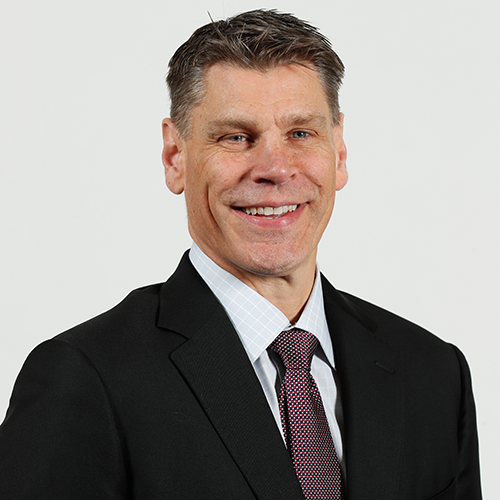
An NCAA Division I men’s basketball coach for thirty years, Porter Moser has been the head men’s basketball coach at Loyola University Chicago since 2011 and is one of only three coaches in school history to win over 160 games on the Loyola bench. Moser has grown a reputation for developing men on and off the court. Porter’s list of accomplishments in his nine seasons at Loyola is impressive. His keen recruiting eye and proven experience in developing men both on and off the court has resulted in three postseason berths including a historic run to the 2018 NCAA Final Four and back-to-back MVC regular-season championships in 2018 and 2019, 14 all-conference selections, two MVC Player of the Year honorees, two Associated Press Honorable Mention All-Americans, two Academic All-Americans, a MVC Defensive Player of the Year, a MVC Sixth Man of the Year and a pair of MVC Freshman of the Year selections. Loyola’s 73 wins over the last three seasons are its most ever over a two-year stretch.
Originally from Naperville, Illinois, Porter currently resides in the Chicago suburbs with his incredible family – wife, Megan, and their four children, Jordan, Jake, Ben, and Max.
The real stories and hard lessons to help you level up your leadership and performance. Now your host, Ed Molitor.
Welcome back to another episode of the Athletics of Business podcast. I am your host and CEO of the Molitor group, Ed Mallator. And joining us today for another incredible conversation. And this is second time on the Athletics of business podcast, my great friend, former college teammate at Creighton. As a matter of fact, we spent two years together assistant coaches on coach Brony staff at Texas A and M University. And we'll just say that was several years ago. Head men's basketball coach at Loyola University of Chicago, Porter Mozart, who is also an author and just released his book all in driven by passion, energy and purpose, which absolutely just describes him as a coach and as a person and always has ever since I've known him.
And I have a whole long list of things here that I could tell you about Porter and the things that his program has have accomplished at Loyola University. Things such as that magical run to the 2018 Final Four, back to back Missouri Valley regular season championships, the 14 all conference selections, the two NBC player of the year honorees to AP honorable mention All Americans, the Academic All Americans defensive player of the year award. I could go on and on. You get the picture. But heres what Im most proud of, and I really, truly believe. And you listen to Porter talk, this is what hes most proud of has been his ability, the reputation he has built for his ability to develop these young men both on and off the court, in the academic world, in the community, in their personal relationships and their life.
And, well talk a little bit about that inside of this podcast. And what are some of the other things were going to talk about. We're going to talk about why, how you think is so important, especially right now when we are in uncharted waters. And what do I mean by that? When we recorded this podcast, we are in the throes of the COVID-19 corona virus. And if you know Porter, if you follow Porter, if you've read things about him, it is no shock to you that he is finding the good in this, the positive in this, while being empathetic and understanding the reality of how awful the situation is. But he's so committed to his personal growth, to his team's personal growth during this time, and he's very intentional about that.
And he'll tell us about all the different things he's doing the coaching clinics he's doing, the podcast he's listening to. He shares books that he's reading. And speaking of that, not only will he share books that he's reading, but he will share why he's able to pull so much out of them and do something with it, not just finish a book from COVID to cover, from front to back, and put it back on the shelf. Okay? And something he'll talk about right now is why it is so important to embrace all the resources that we have at our disposal and to use them to build deep relationships. And then hes going to talk about how he has reframed the adversity caused by this COVID-19 and embrace all the blessings that have presented themselves.
And a lot of thats wrapped around the time that he gets to spend with his family at home. So, with that being said, and I know ive said this before about Porter on episode number two, but get a pen, a notepad, and take notes and listen to not just what he has to say, but how he has to say it. He just uses authenticity. He's very genuine, he's very sincere. And you will be a better person for listening to this conversation. Porter, welcome back to the Athletics of Business podcast. I appreciate you. I appreciate you taking the time to join us again today.
Great being here, Eddie. Good talking stuff with you, talking motivation, ball, friendship, all those fun things.
Well, I'll tell you what, it's not time right now. Normally, you don't time stamp podcast, but we're. We're right in the throes of the coronavirus, the COVID-19 pandemic. And it's gotta be a challenge for you. Cause you can't see your team, you can't see your staff in person. You can't do the workouts, you can't do the recruiting face to face. Tell us a little bit about what your world is like right now and how you're continuing to make strides to keep things at that championship level.
Well, the first thing is, we're all in uncharted waters, you know, going through this. And you got to start every morning counting your blessings. I'm telling your mindset on how you think, it's in my book, it's in everywhere that I've ever thought. It's been one of my favorite quotes. It's in my office, on the wall. It's how you think is how you feel. How you feel is how you act, and how you act defines you. And I know we're in uncharted waters. It's so easy to just start ripping off the things that stink. And if you start your day off with your gratitude journal and just think about things you're positive with, here's a great takeaway for me, Eddie. You know my kids. I've got four kids within five years of each other, all right? No twins.
And growing up as they were younger, they're always around. It's chaos. They're here. You might say, oh, my God, I need a break. And then they hit their teenage years and they're on teams, they're with their friends, they're out the door. My daughter's a freshman in college and it's been ripping and roaring for like four years now. And all of a sudden now I got three meals a day with all four kids. I mean, that's a blessing.
It is a blessing.
So we'll get into what I'm doing with my team, but I just think it's a time. There's a lot of things that you go, but I think you got to start the day off with your positivity journal. Here's another thing. I don't need to do any psas because Sister Jean did her PSA, but once she did hers, everyone else from Loyola can just take a step back.
Some things don't change, right? Yeah.
But I will say this, the best PSA I've seen, and it made me really trigger, was what Matt Damon said. He did that movie contagion and they had them and he said something, and then Megan and I were talking about it. He said something about, past generations have been asked to do worse for their countries. We started talking about it. Think about this. Past generations have been like, all right, you're 18. Start enlisting, you're going to war. I mean, think about what the country's asked our ancestors and our parents and our grandparents to do. They're asking us to stay home. They're asking us to stay 6ft apart from each other. What's that compared to saying, all right, go at your 18, you're going to enlist. But back to our guys. What we're doing, we're taking the opportunity to become more connected.
Now it's through technology. And thank goodness technology is what it is. So we've been doing Zoom meetings and where we all talking amongst each other. We've assigned accountability partners. So working out because everyone doesn't have the same resources at their house, every workout or health club, every weight room, every gym is closed. Everybody's got different resources at their house. But you got to find a way. There's a lot of apps that you can do hIIt workouts. There's if you got dumbbells, whatever you can run. So we got accountability partners that are pushing each other, and we're changing those every week. We sent everybody a book and everybody's three. Everybody's reading in the book. And then we, on Fridays, we talk about some of it. Our first one was the mamba mentality, Kobe Bryant's book.
We have a Zoom link for them to do without the coaches because, you know, when we played, man, it's one thing having a Zoom meeting with your coaches, another one having a Zoom meeting without your coaches.
Yeah.
So we did that to stay connected and you just gotta continue to with your team to find ways to build relationships. I'm taking the time to, every day I call three of them and just check in personally, one one with them and try to facetime them. And you rotate that, you know, throughout the week, being able to talk to everybody a week and really just digging in, you know, what are you doing with your siblings? And I'm asking, I'm talking to them about spending time with their siblings and what do you guys do as a family and just to get to know them better.
Well, and you think about that, and this is what I was talking about the other day. I was fortunate to be on a LinkedIn live, and when we get to the other side of this situation we're in, right. When we get to the other side, what you're doing right now is going to determine what you look like. Right. And what skills, all of a sudden, you sharpen and what skills you develop and what you're doing is exactly what I was talking about in terms of deepening the relationships at a personal level. So all of a sudden, when we come out of this, we're going to better for it. We're not just going to go through it, we're going to grow through it. Right.
And just to be able to do that and get that deeper emotional attachment, because you and I know that the level of relationships, I mean, the relationships and athletics, unless you're in it's very hard to understand what it's like. You know, the highs are higher, the lows are lower. And for you to take it to the next level in a time when supposedly were not being able to do that, I think is going to pay huge dividends when this is all said and done, no question.
And Eddie, I just literally wrote that down. I love what you just said. I'm going to pose that question when we get off? I'm going to send it to my players this time. Are you going to go through it or are you going to grow through it? I don't know if you just made that up.
No, I'd love to take credit. I've heard. Yeah, well, anything is when you think about it, how many things in our world, it's like, are we going to play not to lose or are we going to play to win? You know, we all know what happens when we play not to lose, right? Are we going to attack this with everything? Are we going to run to the fight? Are we going to actually grow through this and get better? And I think that's huge because I think you become closer on an individual basis, but then collectively, I love the fact you have all the zoom stuff going on with your team. I've talked to several coaches at your level. Low d one, mid d one, and you're not low d one.
But I'm seeing different guys at that level and they're talking about how hard it is to connect with their guys. I'm like, this has got to be the time where you have to figure it out and find a way to connect with them.
Well, think about it. A lot of us, we have so many resources to get better with your x's and o's, with synergy, with all the video. Like, God, when you and I worked together 30 years ago, were like dubbing VCR tapes back and forth.
We were carrying VCR's around. Yeah, we had stacks of them.
So, I mean, now you see. So you spend time getting better with your x's and o's. You spend time recruiting. I mean, how much time do you spend time recruiting? Recruiting, calling, recruiting. Sometimes spending time on relationship building gets put on the back burner. One positive takeaway from this is a great time to build relationships. Now it's going to be via technology, and that's never as good as face to face, but at least it's time. Time spent information is knowledge, you know, time and finding out more about the people so you can connect with people. I think that's a huge thing. And then the other takeaway is what you and I have already touched about here is, I think it's a great time for self improvement, self development.
I just think sometimes you get going so much and you say this, oh, I didn't have time for this. I don't have time to dig in and study another team defense for. Watch ten tapes on another team and you get done with the season. Next thing you're thrown into recruiting and campus visits. Then it's camps, then it's summer recruiting, and then they're back in the fall and it just, you start to get a cycle that just goes so fast. And right now we got no excuses to say it's going too fast. We're all kind of confined.
Isn't it funny? It goes back to what you're saying about the family. It's almost like a reset button. It's almost like we're getting ready to clutter in our lives and it's a reset button. I want to ask you this. This is a competitive advantage for you because you've always been a lifelong learner. I mean, this is an extension of the habits you created and developed a long time ago with what you're doing now. Do you see that as a competitive advantage? When the dust settles from this and you start moving forward?
I think it's only competitive advantages of what you just talked about. If you grow from it, like you said, what are you going to look like on the other end? I just think it's a great time for self improvement.
What are some of the things you're doing?
Okay, so one of the things is I've done a ton of podcasts but I haven't spent there 45 minutes and listen to a podcast. Like when I go to work, I love my job. I drive down Lake Michigan down through Sheridan into Loyola. It takes me about 23 minutes and I either make phone calls or I listen to music. And some people listen to podcasts while they're driving to work. I don't do that because when I listen to podcasts I like to write notes. I like to do that. And the next thing I know I find myself too busy. So I've been doing two a day. I carve out an hour and 15 or whatever. How long the podcast and I do two a day and I started a podcast journal and it's a variety of topics and I just. It's not all basketball.
Some are self improvement. I did one the other day about corporate and public speaking because I've been doing a lot of corporate speaking. So I wanted to see what one of the best corporate speakers were doing. We've been doing a lot of stuff like that. I got a group of like twelve coaches, number of head coaches in division one. We're doing Zoom clinics every two, three days and each one of us are taking turn presenting now. How cool is technology? Like we can be on a Zoom clinic. And all of a sudden we can share the screen and start showing clips of whatever topic we are. I'm doing that. My coaching staff and I are meeting through Zoom in the morning.
We have different projects that we've assigned to each other, taking a couple teams and breaking down whether we love this part of this team's defense. So each of my assistant has projects that we're doing to get better. I just think you've got to continue relationship building. You know, calling the guys, I mean, spending time with that. I mean, exercising, getting in a great routine, exercising some mutual friends that we both have that work from home regularly. I've talked to them and I've talked to you about this, Eddie, is don't wake up and be in your sweats and go to work and get in front of the computer, because the next thing you're going to lounge around, you're going to walk around, you're going to go to the refrigerator. It's going to be like a weekend with nothing to do.
Wake up, work out, shower, get dressed like you're going to work and get your day going. And it just mentally gets you. I've been doing that every single day. I love it.
It's a big game changer. It is. Hey, before I forget, can you share some of the podcasts that you listen to? Our listeners would love to. I mean, you know, we talk about being lifelong learners. We have some, you know, we're currently, and I didn't tell you this, Porter and I should. We're currently being downloaded in over 45 countries. It's incredible what's happened with this podcast and constantly getting emails. Because if I don't ask you this now, I'll get barrage with emails to go back to you and ask you what podcast you've been listening to. So if you could share a couple of them with us, I know our listeners would love to hear.
Well, I love all John Gordon's. I listen to a lot of stuff with him and he's got a variety of topics. Actually, the public speaker one was with him, the one that we did that with Grant Baldwin. I've done Ted talks. There's a great one with Donald Davis called Reflections. I got that off an article talking about Virginia basketball and how they related their hardship and they parlayed it and they told a different story the following year. And I love that Ted talk with Donald Davis about reflections because it's really good and it's how you view what happened to you. It kind of goes into my book, how you react from things that don't go your way. I did one with Tim Miles. Tim Miles has some good ones. He had one on scheduling with Kevin Pauga from Michigan State.
It's really thought provoking about how to build your schedule with that. I listened to a couple with Urban Meyer, one with Ken Coleman coaching you with Brennan Sur. Are all really good. Been doing a couple with him, John Gordon. Here's another one that I can't recommend enough, one of John's and I was just texting with him yesterday because I was one that I listened to yesterday was the one with Kurt Warner. Lessons for success.
Yes. That was awesome.
That brings in faith. It brings in hardship. I tied that one in with the Ted talk, the Donald Davis one. Reflections I had a really good parallel between my story. What I heard there with Kurt Warner hurt. I'm just saying that some hard times that you go through in life can completely change you in a positive way on how you react from them. And you can tell a different story. You can have something. And I'm just going to really quickly summarize. The Kurt Warner thing is Kurt Warner talks about how he is at northern Iowa and then he finally got a tryout with the packers and they brought four quarterbacks and he went as a free agent and get drafted. And out of the four quarterbacks, he was the one that got cut. And he looked at that.
Then he went to stock shelves in the grocery store. That's what he went to. And then he went from there to, he got a call for doing an arena league. Never thought about it being arena quarterback, but he went there and he goes, I really honed a lot of skills. Everything in arena football is short situations, everything. And he went from there. And then his story continues and he looks back on the blessing of getting cut. He said, you know what? Brett Kafar took every snap for like eight years after that. He's like, no one got better. I didn't get Odin got better playing behind. I went and got better. And then my story. So it's how you look at things and how you want your story told, right. That's a great parallel with that reflections one.
And I just think there are great ways that I can better telling my story and helping my players get to a certain point. I got a great one in a podcast from John Gordon. It was with Martin Rooney. He has a book called Coach to Coach. And he had a simple definition, we've all heard definitions of coach. And this can be a coach can be someone in the business world. Anything. And he said a coach's job is to take someone where they want to go, but they can't get them there themselves.
That's it. Right.
That's very simple, thought provoking to get someone. So if they're not there as a coach, stop blaming everything. What ways can you keep looking to get them where they want to go?
Think about how powerful that singleness of purpose is. I mean, it just breaks it down to its most simple form, doesn't it?
Oh, it's a very simple definition. We've all got 25 definitions of a coach. That one is really get them where they want to go. They can't get themselves. So your job is to help them get there. And if they don't get there, take ownership as a coach, take ownership as a leader, take ownership as a parent that help them get there. Now you got to find ways to get them there. And I think that's the fun part of being a leader. A coach, a business leader, a parent is finding ways to help them get there.
And let me ask you this, and I want to get back to the whole idea of your story, right. Because your story is what drove the book all in. And we're going to talk about that here in a minute. But before we get to that, I want to spend some good time on that. Before we get to that, we had Kevin Eastman on the podcast, obviously. Just unbelievable. Kevin and I could have talked for three. Well, Kevin could have talked for 3 hours. I would just shut up and listen. I mean, he's amazing, and you've had some incredible conversations.
There's something about going to the final four of the doors that opens for you, and you have done an amazing job at developing some great relationships and picking the minds of some of the great leaders in business and in athletics, in being a lifelong learner. Can you share some of the things you've learned from some of the conversations you've had?
I just think when I, you know, Kevin, I've known him through the coaching profession for years, and then we've gotten a little deeper into a lot of stuff. He's gotten out of coaching, and his purpose now is helping others and through motivational speaking, his books, and I've dug in deeper the last couple of years with him. His book resonated with me, and I was fortunate enough to be the head coach at Loyola, went to the final four at 48 years old, and I think the thing coming out of the other end of that is I feel like there's so much to gain and learn still and to do things creatively and differently and better. That's the one thing that. About being your best self is constantly learning. And to me, that energizes you.
I think if you don't take that attitude, I just think you get stale and stagnant. Now, there's certain things that are non negotiables with me of the way I operate, but there's ways that I want to be open to trying to do it better the other way. Kevin, I had him speak to our team, and were talking. It kind of goes into being your best self, and were kind of looking at it down the stretch, too. You got some big games coming up, and you start worrying about the end result instead of the process. And Kevin said, doc Rivers walked in. They had a three game stretch, and they really. It was three really important parts of it.
And he said, doc walked in, and he said, boston versus Boston at Charlotte, Boston versus Boston at Miami, Boston versus Detroit in Boston, or Boston versus Boston. So, like, it was versus themselves to be, like, they're challenging them to be their best selves, and the result should take care of ourselves. I always thought that was powerful, how we talked to our team about that.
Well, and it's funny that resonates. Not funny that it resonates with you, but you use some great words that I love, and obsessed is one of them, and you're obsessed with always getting better. Right. And being a lifelong learner. And Kevin talks about it was. I'm sorry, I was looking up the episode. It was episode 65 on the Athletics of Business podcast, and if you haven't listened to it, I mean, it's pure gold. But he always talks about how it's my best versus the best. Right. And you have to focus on becoming the best version of yourself in your best self. But he said the word that all the superstars use is better. They just want to get better. Raylan wants to get into the gym and get better.
Kevin Garnett wanted to get better when he worked LeBron out after his senior year in high school, it was about getting better. Can you talk into that, about how significant that is for you? Because when you tell me about these conversations you have, you always go into them with the purpose and prepare for the conversation. Can you talk about that a little bit?
Yeah. It has to go with the term I call just takeaways. I remember sitting with John Gordon. We're talking about books and things you learn. He says, you know, it's one thing of reading a book and highlighting it, but then the takeaway and execution are the key parts. The takeaway from something and then the execution of your takeaway, I just think, are just so critical to getting better, you know? Cause you can get somebody that's reading the books and highlighting and doing notes, but then what are your takeaways? What are you taking away from whatever it is, Eddie, I'm telling you, like, the takeaway, I literally wrote down stopped. I love that. Are you getting it through this time, or are you growing through this time? I love that phrase.
When I worked for Rick Mageris, he had a lot of little teaching phrases that resonated with you know, three to the rim. All our players know is what that is. You know, just. And then they can coach each other. I just love that little phrase that you wrote down, you know, are you going to get through or grow through? So, takeaways, you got to find takeaways in everything, you know. That's what's being a lifelong learner is if it's a podcast, if it's a conversation, it's the film session. If it's a practice, I'll end practice and I'll ask our guys, give me two or three takeaways from today's practice. We'll have our a follow up film session the next day. Our film sessions are literally not called film sessions. They're called get better tapes, and that's how we phrase it. They're called get better tapes.
And sometimes the get better tapes are very heated, but how we wrapped our head around it and how we packaged it was. This is a get better tape. Getting better is about takeaways. Are you constantly a person who's trying to find takeaways, positive or negative? You can learn from the negative, and it's a takeaway. That's what I don't want to do. That's a recipe for failure. That's a takeaway. So takeaways can be a variety on.
The spectrum with the takeaways on the get better tapes. And I absolutely love that. And I think in this 1st, 2nd in terms of the business world, right when you run the feedback loop at the end of the week or you sit down with someone and you're talking to them, you've got to integrate positives in there, don't you, in terms of the get better tapes? Or is it all things that you could have done better, or is it, do you support what you're doing by showing them the positives and reinforcing some things that brought success?
We have a flow of our get better tapes. So it starts out with things we could have done better. And a lot of times those are negative. And these are 10, 12, 14 clips of things that we really messed up on that we could have done better. Then we have a segment where no matter what, we show every single charge in our film session. If someone takes a charge and someone gets a 50 ball, a loose ball, those are shown every single time just to completely you achieve what you emphasize. So charge, toughness, those are always. Then we have our intangibles of our culture wall. We have all those phrases on our culture wall. Three to the rim jump. Second, no arm checkoffs, six I, six arms and transition d. All those little things that we have.
If we got that into the game, we show that, and then we continue to emphasize until it becomes a habit. So we have a flow in our get better tapes, but unequivocally there's going to be negatives. I mean, you're never going to play a perfect game. You're always striving to get better, and that's how we start. But I kind of like how we pull them back in as we leave that get better tapes. We've been doing this for a number of years now. Sometimes it's not the most ideal because we do it before the next practice starts. And I think timing's a lot with that. So sometimes you're like, we got to get going, we got to practice, we got to get the next game. And you blow off that part of it.
We absolutely are sticking to our get better takes no matter what. I remember in the NCAA tournament, we got done with Miami. I mean, the media was crazy. We had all this going on. You had 48 hours to get ready for Tennessee. And literally our guys mantras. We wanted, what could we have done better than that Miami game? And it's not ideal sometimes. Cause, like, then you gotta go get Reese, you gotta get stretched, and you come from the film session to the court. So what? So what? That's a small price to pay than the mindset you build from your guys about that whole process of getting better. And that's how we always framed it with the get better tapes.
That's awesome. Speaking of takeaways, let's talk about the book. I think this is a great time to talk about the book all in. And what are some of the takeaways we can expect? I know I'm really fired up to talk about this. What can you share with us, Brian?
Well, first of all, I mean, this is my book, and I tell you I didn't set out to write a book along my journey. I never said, you know what? I'm going to write a book. The first time I ever thought about it was working for Rick Mageris. I started journaling and I got hundreds of pages of things that I learned, stories. And I remember when we was in college, we read a book called playing for Night by Steve Alford. And I remember growing up in Chicago in the Indiana program, and I remember how fascinating that book was. I read it cover to cover. Everybody always asked me, what was it like to work for Rick Mageris? So I was going to write a book, coaching for Mageris or coaching with Mageris.
But then I got approached after my journey with the Loyola Jesuit press, and they just talked about my journey. And I was like, man, who the hell is going to want to read my book? And then talking with John Gordon and Kevin Eastman, I think that was something that gave me some confidence to do it. And the takeaway from my book is that I didn't come from a blue blood coaching tree. You know, I did work for Coachman Jarrett's, but that's not how my 1st, 1820 years started. I wasn't a college all american. You know, I didn't have a household name. I had failure. I got fired. And it starts out Eddie. John Gordon really works closely with Davos Sweeney at Clemson, and he did an exercise called hero hardship. Defining moment. And the book starts out with my defining moment.
And I show how defining moment carries me through in. My defining moment was at Creighton as a freshman basketball player. I came in all state, everything. Best player on my team since I was probably born. I just like all of us in college, and all of a sudden I was the 8th or 9th guard. I went through that. And that first year was so incredibly hard for me. I felt my identity was based on being a basketball player, and I felt I had no purpose. And I felt like my likability. All this was tied into being a star basketball player. And all of a sudden I wasn't. So I was lost. I was completely lost. And I remember the conversations of transferring and transferring is going to do this, and the grass is greener on the other side. And it was really hard.
And I was getting no results. And I remember through my faith, family and friends, I decided to stay. And then the results didn't come immediately. It wasn't like, all right, I made my decision, I'm going to fight through it. Boom, the magic dust was sprinkled. I persevered and it got better. It didn't. The next summer, the next fall, the next winter, it still, I wasn't playing. It wasn't until mid January of my sophomore year. I got to play and I started, and I kind of started pretty much the rest of my career. I went to the NCAA tournament. I got into coaching, met my wife and went to the final four. And everything goes back to where I can't imagine if I would have quit.
And then it was not only making that decision not to quit, it was to persevere and then to persevere even through tough times when the results weren't coming. And I look back on the different parts of my journey. Illinois State when I got fired, then I worked for coachman Jerusalem. It was four years of my life and very hard, but very rewarding. I love my time with them, but it wasn't easy. It wasn't easy. The results didn't come right away. And then I got to become a head coach at Loyola. The results didn't come right away there. And I keep going back to my book starts at my defining moment. I kind of take you through my journey on you can have failure in your life. It doesn't have to define you.
It's your mindset of how you look at failure and the story you want to tell from your failure. The story you want to tell from your failure, what is that going to look like? And I just didn't want that to define me. And I talk about relationships, my parents, my mentors, my friends, the people that have helped me. I've talked about my takeaway from the final four, and that whole Loyola is the relationships. When you're younger and you're career driven, you focus so much about your trajectory, you know, as a young coach, and I was so locked in on the trajectory, how am I gonna get here? How am I gonna get there? This is where I gotta be. This is. And when I got older, God, it was so much about the journey and the relationships, and that made my trajectory better.
And that was such a takeaway, focusing on the journey and the relationships along my journey and focusing on that, my trajectory went even higher than I ever thought of opposed to when I was younger. Just focus on the trajectory.
So if someones sitting here right now listening and theyre younger and theyre in their career, and theres a great book by David Brooks, the road to character. And he talks about resume, virtues versus eulogy, virtues. And we spend so much time early in our careers trying to figure out a resume virtues. Whats going to get us the next job, whats going to get us the bigger paycheck? Whats going to get us the better title? And when all, everything went down at Illinois State and you pivoted and went and worked for coach Majeris at St. Louis, I don't want to say when the light bulb went on, but what was a defining moment inside of that? Like, what was it that you, it made sense for you, right? It clicked.
I talk about that in my book, too, about decisions in my journey, decisions that I've made in my journey. Remember, the first big one I made was leaving Texas A and M when coach Brony got fired and I had a chance to become an assistant coach at two different places. One, ironically, was at Loyola in Chicago, coming home, friends, family, the prestige of being here in Chicago, the fun it would have been in Chicago. I knew everybody. It would have been a comfortable decision to come back as an assistant coach. And the other one was to go to Arkansas, little Rock, to work for wimp Sanderson. So I interviewed it both. I was offered both. And I remember saying, just spending a day with wimp, who's a legendary hall of fame coach, he had this crazy resume.
If you ever looked at his resume, I'm like, God, after spending a day talking ball with him, I don't know one person in Little Rock, Arkansas, not one. And I said I just felt I was going to learn more. And I made my decision based on where I was going to learn the most. And it actually was a little bit less pay, less comfortable, less everything. I just felt I was going to grow and better learning from a guy like that. And then I ended up becoming the head coach there. So that decision failed after one year, right?
Two. Two years. Okay, I'm sorry. Two years.
Illinois state, I go to illicit when that all happened. I had three athletic directors in four years. I had such bitterness in my heart, and I talk about that in my book. I'm not sitting here saying I'm holding it out and have bitterness. I had bitterness in my heart. It was there. It was real. And I remember having a chance to go at a low, low division, one head coaching job, and I almost did it because my ego, I can still do this. And then I got talking with Coach Majeris about stepping back to become an assistant coach. And I just remember, you know what? I looked at Coach Mageris as one of the best bastleminds in the game and I said, what if I'm going to go learn from a guy day in and day out, being in that film.
I've heard him in a clinic, but that's not the same as being with him every day. Game planning. So I made the decision on where I was going to learn the most. I had to put my ego on check. It was actually a little less money, again, than not being a head coach. But I just made that decision of where I'm going to learn the most that brought me to Loyola. And I just think it's critical in your process, your journey to look at major decisions. I have a chapter on that because I had the opportunity after the final four a number of times to go to some other jobs as a head coach. And I talk about I'm not necessarily going to never leave, but I got a great purpose going on right now.
And I think that's part of my book is all in driven by passion, energy and purpose. And I think that word purpose, and I've just looked at my decisions in my life on where can I learn the most, have the biggest purpose and it's helped me tremendously and it's. It's paid off tremendously in making those kind of decisions.
I've got like five questions on deck I'm going to ask you, but you just triggered something. How important is it for you as you looked at those other jobs? And you have a singleness of purpose. You operate with conviction, which I love. So let's say a job comes in, it's a big name job, the money's phenomenal, it's great. But they don't align with your values and your vision for where you want the program to be. And not only that, how you want the program to get there. Is that a deal killer for you?
Yeah, I mean, I've had that, and sometimes it wasn't because of our values didn't align, because I've had a situation where our values did align, but it just wasn't the timing, the purpose.
Right.
But I will say that it's just like recruiting. So the answer to your question is yes, it's just like recruiting. I can spend a lot of time recruiting player, but if all of a sudden the character traits and the vision of being a total student athlete, doing both and want to be part of, if they don't align, those are non negotiables.
And if that feels not there, right. You just get that.
I. Non negotiables when I recruit. I have certain non negotiables when I'm looking at if another job comes up. So I'm very fortunate I'm in that position. But, like, you know, I was the same way as when I was looking for a job, when I was out of a job. There's a factor in there that you have to make a livelihood and put food on your table, right? You might have to take a step back and do some things, you know, a job or something. So I get that aspect of it. But you constantly want to be driving towards where your values align. But I think that have been a situation like, it's not ideal, but I got to do this for a while. I got to provide, so I get that. I'm sensitive to that.
But you constantly want to be moving and not change who you are, right? You have to do something, but you don't have to change who you are and the values and the faith you have as a person right?
Now. Let me ask you, and it's funny because you go to a final floor and everyone talks about, oh, my God, they're an overnight success. Porter's an overnight success. You went through a grind, and your journey, which you talk about in the book, has been absolutely amazing. And one of the things I've always admired from you, when we play together at Creighton, when we work together at Texas A and M, is when you make up your mind to do something. Okay, you hit the ground with your feet running, right? You go and you're going to do it. But as you built Lyola up, there are some times it's like, what's going on? You know? It's like just when you get here, something else comes up. There's more adversity.
Can you talk about your ability to maintain and keep your focus and stay dialed in on what your purpose and mission are, even though when unexpected things come up at unexpected times, that could serve to many people, could serve as distraction. Right. And yet you maintain that consistency of your process.
There's a couple things that come to me in mind. The very first, and at the top of it is my faith. You know, it was interesting. I'll just tell you a fun little story when I was at Creighton, and it's in my book, just constantly going over to St. John's Church and having us placed where I could to sit and be quiet. And I always said to myself the term God's plan. I had God's plan, that God's got a plan for me. It was interesting during that final four run, we're playing Illinois state in the championship game of the NCAA tournament, and I remember I had my mega boom and were kind of bringing it in. We were stretching, rolling out. We just found out we had already won. We're back at the hotel. We're going to roll out.
And Illinois State ended up winning. I remember walking into that room with my nugget, but sitting down and playing Drake's song, God's plan. And everyone's looking at me, laughing. I'm like, not that God's plan was to have back on him.
You have sister Jean in your corner. Okay?
Yeah. But God's plan was to stay resilient. So my faith is a big part of it. The second part is your mindset. I've been very lucky. I talk about, in my book, there are certain takeaways I had from each one of my parents. And you knew both my parents, Eddie. My mom's takeaway was her positive attitude. And on all my shirts, I have a bad initial to monogram. My middle initial is Andrew, so my honor p a m is Pam. So it's not real masculine to have Pam monogrammed on shirts. So I changed it because when I was younger, my dad would give me detailed advice on sports. My mom would give me this broad statement when I'd walk out the door, put her PMA. PMA. PMA. And PMA was positive mental attitude.
She was my inspiration of just always staying positive on how I looked at different things. So now all my shirts and everything says PMA in there because of my mom. So I think that mindset of how you think is how you feel. How you feel is how you act. How you act defines you. I just think that your mindset is another thing. And the last one I tie into those three, I got to know Eric Thomas. Eric Thomas. If you don't follow Eric Thomas, he's another one with podcasts and different things. But Eric Thomas became a friend of the program, motivational speaker, just phenomenal. And he talks about, your want has got to be greater than the negatives pulling you in the other direction. You know, your want has got to be greater.
And through adversity and through struggles that I've had, what I want and where I want to go has always trumped that. And I'm blessed that I feel that way. Your want whatever you want. Everybody wants this. But when it gets a little tough, your want has got to be greater than the toughest roads in your journey. And just for Illinois state, I didn't want that to be the end of my journey. I didn't want that to be the end of my purpose. I didn't want that to be what defined me and I spent four years having to go back to being assistant on someone that worked just 16 hours days. But I wanted it. I wanted to learn. I wanted to grow. I wanted to better.
And I think that's helped me along the way, is you got to decide what you want, and that want's got to be greater than all the pitfalls, the struggles, the adversity. Your want has got to be greater than all the harder things, right?
That's awesome. So, Porter, we'll put a link for the book on our show notes, as well as all your social media and the Rambler social media. But can you share where folks can find you if they're listening, if they don't have a chance to look at the show notes right now? You know where you're at on Twitter? Well, the book where you're at on Twitter, and now you're on Instagram.
Instagram. You can just find me any of those places you're at.
Porter Moser?
Yeah.
Okay.
And I do think it's a good book for, like, my nieces and nephews have read it. I've had a lot of. They send it out to, like, all the principals of catholic schools. I think it's good for if you have a high school student in there. I've had a lot of parents tell me that they. They read it. They made their. Their child read it. Nobody in my family got into coaching. Just something I went on my own journey, and I didn't, like I said, I have a normal. A lot of pitfalls, right? And I talk about my faith. I talk about energy. I talk about how perseverance in their values. So I think it's, It's a good story for, I think, high school kids coming up to be. That are going to be in college athletes, too.
Well, you know, something that was interesting, you said to me once, and you said it on your interview with John on the podcast recently, was when John came in, it was after you're at the final four, and John was in Chicago, and you guys spent time together, and you talked about the book, and he said, write a book that you would want your kids to read or that your kids would want to read. And it's funny, because when I will present the companies or I do keynotes, I'm going to talk to them in an authentic way, like my kids, when they're 20, 25, 30 are sitting in the audience, and you focused on writing a book. What you're talking about right now that your kids would want to read, and that would be great for that.
So at what age do they bust it out? I'm assuming Jordan's already read it.
Oh, yeah. They all have. And that was the most rewarding thing. So your takeaway, that John Gordon podcast was. It was absolutely true. I have that in the. In my notes. When I read with John, he's like, when he said that, it just resonated with me. And then when Kevin was giving me the confidence, like, you know what? I'm like, who the heck's gonna wanna read my journey? So I'm like, you know what if I do this? I had that starting point of my kids reading it. I got some texts that I've saved the rest of my life. It's a text from my daughter Jordan. She was on her way. She's on the women's basketball team here at Loyola, and they were on a bus trip to one of their games, and she just.
Right when she had it, she's, oh, my God, I'm on, like, chapter four. And she started listening her takeaways, and I got emotional and had some goosebumps. Having your own child have some takeaways of a book you wrote on a.
Bus with the lyle of women's team, by the way, going to road trip.
Texting me her takeaways after, like, four or five chapters. And it just, you know, if no one reads it, that made it all worthwhile. That's your number one role. Your number one, Adam. Being a me, being a spouse and a man of faith.
So where can they go find the book online?
Where can they go grab Amazon? It's the easiest place to go.
Okay.
It's now no one going to bookstores, but it was in bookstores and everything. And it's actually. The old press has done a great job with it. I mean, getting it out over everywhere, but, yeah, you should be able to get it anywhere.
Awesome. Fantastic. Well, hey, Porter, this was a lot of fun. I appreciate your time. I know even though we're confined, you're still busy. You've already been on how many shows today? Is this your third interview today?
Today's my. Three or four. Today. Yeah.
Okay. All right.
With a friend.
That's right. And I know you're adding in the athletics of business podcast to that list. So when you're talking on another podcast later. Right. But, hey, I appreciate it. It's been blast. Porter, take care.
Thank you for listening to the athletics of business. Be sure to give us a rating and review so we know how we're doing. For more information about the show, visit theathleticsofbusiness.com. Now get out there. Think, act.