

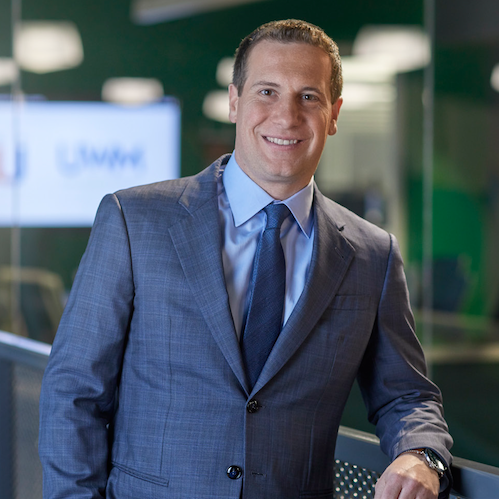
Mat Ishbia is the President & CEO of United Wholesale Mortgage (UWM), the #1 wholesale mortgage lender in the nation.
Beyond the mortgage industry, Mat is the majority owner of the Phoenix Suns (NBA) and the Phoenix Mercury (WNBA), bringing a competitive, team-first mindset to leadership at the highest levels of business and sport.
Focused solely on growing the wholesale channel, Ishbia has taken UWM from a two-man broker shop to a 5,800+ person mortgage powerhouse.
Prior to joining UWM, he played for and coached with Tom Izzo on Michigan State’s men’s basketball team and received a 2000 National Championship ring. His college basketball background, leadership style, and dedication to a team-focused business approach have enabled him to gain record-breaking wholesale market share and rapidly grow UWM into a leading lending operation.
Welcome to the Athletics of Business, a podcast about how the traits and behaviors of elite athletes and remarkable business leaders frequently intersect. The real stories and hard lessons to help you level up your leadership and performance. Now your host, Ed Molitor.
Welcome back to another episode of the Athletics of Business podcast. I am your host and CEO of the Molotor Group, Ed Molitor. And our special guest today, Matt Ishbia, absolutely screams the Athletics of Business brand. Everything about him, everything about his journey, about where he's been and what he's done and what he's doing now, is what the Athletics of Business is all about. Matt is the President and CEO of United Wholesale Mortgage, the number one wholesale mortgage lender in the nation. They're focused solely on growing the wholesale channel. He has taken uwm from a two man broker shop. Think about this. From a two man broker shop to a 5800 plus person mortgage powerhouse. As a matter of fact, they're probably growing as I am recording this intro.
Prior to joining uwm, he played for and coached with Tom Izzo on Michigan State's men's basketball team and received a 2000 national championship ring. His college basketball background, leadership style and dedication to a team focused business approach have enabled him to gain record breaking wholesale market share in and rapidly grow UWM into a leading lending operation. And as you dive into this conversation, you know exactly what I'm talking about here. Matt is Coach Izzo in the mortgage industry. Very genuine, very authentic, very passionate, a ton of positive energy and putting his people first. We're going to talk about some of the keys to Matt's success as a walk on for Coach Izzo and how they have contributed to his massive success in the business world.
And Matt's going to share with you what is the one thing you can do right now, like literally right now that will improve your organization, why it is so important to think big and at the same time dominate the goal that is in front of you. And you'll get fired up when you hear Matt telling the story and how he wants to dominate the goal that's right in front of him, which ties into the next thing we'll talk about and what does it mean to have an incremental vision. And Matt is very intentional about helping his leadership team raise their level of self awareness through self evaluation. And something Matt's going to share with us as we look behind the curtain.
He's going to talk about what they call your time and why your time has been such a key factor in driving the amazing culture at United Wholesale Mortgage. Enjoy. Matt, thank you so much for joining us today on the Athletics of Business podcast. I am truly humbled to have you here.
Oh, I'm glad to be here. I really appreciate you inviting me out and excited to talk with you now.
Matt, let's just jump into it, okay? From one walk on to another, you are still. I mean, you move fast, a ton of energy, a ton of positive energy. You understand the whole concept of being a part of something bigger than yourself. How much of the way you run your organization comes from your journey as a walk on at Michigan State and playing for the great coach Izzo.
Oh, I mean, I'd like to say so much and not say it's all, but it's pretty much everything, you know, Like, I'm so big on team. I learned so much from my time there at Michigan State. And, you know, growing up, I've always been a team sports guy, whether it's baseball, soccer, basketball, football, everything I could do. But at Michigan State, really taking so many of those sports learnings and team learnings and applying them to business has been really a big part of my company success and our success here. And I can't thank Izzo and that basketball program enough. It's put me in the position I'm in and I'm proud to hopefully spread some of that positivity back, because like you said, positivity, energy. I think that's key to anything in life, not just business.
Well, I love your story. So you averaged 23 a game your senior year in high school. Okay. I mean, an outstanding player in a great area, great basketball. And you made a choice. You had other options, but you made a decision that you wanted to be a part of Michigan State basketball and go there. And that was something very intentional. Yet I've got to admit, that's where a lot of your humility comes from. Or that was a result of your humility. And I love the story that your dad bought you a used car before he went to Michigan State. But you decide, you know what? I'm not bringing that with me. I don't want anyone to think that I feel like I'm better than or I act like I'm better than. I want to be a part of that program.
Can you talk about your whole journey from your senior year and what you experienced at Michigan State?
Yeah. You know, so senior year, I played on a great AAU team with guys that played in the NFL and played in the NBA and some great players. And in high school, I was a very good player, as you mentioned. And it just really came down to, you know, everyone would tell you, go where you can, be the star, go where you can play. And for me, maybe it's a smaller division. One player where I feel I can get some playing time. And my perspective was always try to be around the best, compete against the best, play with the best. And they raised my level and hopefully I'd raise their level. And that's really where Michigan State came in.
When I had the opportunity to be part of that team and that program as a walk on originally, being around those guys, I always joke I had to be the hardest working guy and be my best version of myself to be the worst player on that team. But that was really what it was about for me is just competing and trying to be the best. And to me, it's not satisfying just being the best around this group. Like, how do you play against the best and be around? And that's why I tried doing business too, is you're always trying to compete. And so that was my experience in Michigan State and I got a chance to be on that team and worked my way up and eventually earned a scholarship from Coach Izzo.
But really the truth was just being around that team and those players, being around what? You know what? I thought I was a hard worker in high school. I thought I was a hard. I knew the game of basketball, and you get a whole nother level when you're around Tom Izzo and Mateen Cleaves and some of these guys. And it was just a great experience.
Darren Mateen had practiced every single day. And you knew your job was to somehow make him better. What was that like?
You know, Mateen is an all around winner. It was to try to push him and get under his skin. And to his credit, I always tell a story as I was playing against him one of my first months in practice. And Mateen's a Big Ten Player of the year. Coming off Big Ten Player of the Year. This is the first year went to the Final Four, so he hadn't been to the Final Four yet. And I'm playing against him in practice and he swings the ball through and I grab his arms, you know, and knock him. And you know, when coaches are, hey, get your hands off him. And Mateen said, hey, in the games they're going to hit my hands too. Leave him alone. He's good.
Like, pointing out that, like, he wasn't like that spoiled superstar, that's like, yeah, get this walk on off me. Coaches he's hitting my hands. He was trying to get so everything starts with him. And so playing against him every day. He's an unbelievable player, Unbelievable basketball mind. That's probably underrated in so many respects. And my time was to just score on him a couple times or make a great pass and talk a little trash or deflect the ball, just make it hard on him so that in the games when he's playing against those other great players, that it wasn't so hard. And I can make it a little easier on him. And me and him built a great bond, whether it's in practice. I'm always a scout, team point guard, so I know what thumbs down means for that team.
And I'm yelling it from the bench and I'm talking in the timeouts. Me and him have built a great relationship, and to this very day, we're very close friends.
So you're yelling it from the bench. Right. So you basically were an extension of the coaching staff. Being this scout team point guard, you had to know the opponents as well as you knew yourself. Let's talk about you win a national championship, you play in three Final Fours. @ the end, you thought about going into coaching, right? What was it that pulled you towards coaching that actually is probably pretty key to your success now in the business world?
Well, everything pulled me towards coaching because that's what I knew, you know, I was around Izzo, you know, and I played for four years. My fifth year, I got a chance to coach with Izzo and Coach Garland and all these great coaches there. I spent a lot of time with Brian Gregory when he was an assistant there, all of this Dan Heath, all these great coaches. And so that was just the natural next step for me because I love to compete. And all I knew was compete. And the way I did that was basketball my life. So I was so close to going into that world. And when I am going to the business world, I was able to realize, and this is something that I talk to college kids and I talk to athletes about all the time.
Is that basketball or football or soccer or swimming, whatever you're competing in, is that what you love? Or is it that you love to win, you love to compete, you love to get better, you love being part of a team. If it's the second half of that, which is most likely what it is for most of us, you can do it in business, you can find it in business. And so almost went into coaching. I was very close, and I love basketball this day. I watch plays, I watch things I see what the coaches are calling. I love it. But I went into the business world.
So you become a student assistant for a year, and you almost go to Cleveland State, and then you decide to get in the mortgage industry, something that probably was a little bit of the unknown to you. What was that like getting outside your comfort zone?
It was completely different. Like, I didn't know anything. You know, I didn't even know how to spell mortgage back then. It's like I didn't know anything about mortgages. And so learning it from the ground up. But it was a challenge, you know, and I love challenges. And it's like you learn, and then you find, like, gosh, why are they doing it this way? What about this? And I just, you know, when I got here, there was 12 people at the company, and now we're, you know, 5,800 people and growing and focused, and it's, like, all about getting in the weeds. And so everything I learned at Michigan State, basketball, tied to those things. And it's like. But it was. It was scary, you know, because you don't know. As a kid, I'm 22, 23 years old.
All I knew my whole life was sports and basketball. And to go outside that world into something as boring as mortgage, it's like, mortgage, like, that sounds stupid. What am I doing? Right? But I love it. And I found my passion was not just basketball. It was competing. It was trying to get better every day. All those things.
Well, and like I mentioned before, we started recording a ton of props to you, because when we got fired at A and M in 98 and I went into the mortgage industry, I felt like I was moving from a transformational industry or transformational job. Right. Where I was able to make a positive impact on young men's lives on and off the court to something that was transactional, the way our organization was run. But the way you do things at United More. I mean, it's. Everything is about making a difference. It's about having an impact. And when you first got into it. Can you walk me through how you. You learned every piece to the business? I mean, everything from underwriting to closing to everything.
Yeah. And that was the thing is, you know, did every job. I. You know, my first job out of college was taking the faxes off the fax machine and walking it to an underwriter.
Right.
And I would look at the documents and look at the 1003 and try to understand what the heck this even means. And, you know, it's. The 1003 is the loan application and then look at the income docs and I would just learn. Then I just got into underwriting, then it got into closing and then sales and then secondary marketing and really learn the business. Just like anything you want to be great at, anything, whether it's basketball, football, business, anything, you got to get in the guts of it. You got to be in the weeds. And that's really what I learned. And I did that for years and years. Not like a two month rotation learned in the business. But yeah, I got into it and dove all in and put all my passion, all my heart into it and all my work ethic.
And then eventually you start learning some things.
Well, being so intentional about your growth, did you know why you were doing it? Did you have a vision that one day this is what United Wholesale Mortgage was going to be once you were in a position to take over?
No, I had no idea. You know, so unfortunately like, you know, we had 12 people. If you asked me two years ago, I wouldn't have said we'd ever be this big. Right? You know, I've been here 17 years now. And so the vision was incremental. It's like a basketball player, like an eight year old kid. You know, some people say I want to go to the NBA. Some people say I want to be the best player on my team. And then when I'm the best player, I want to be the best player in the league and I'm the best player in the league. I want to be the best player in my county and then best player in the county and state and then.
And so that's kind of how I built it here was I have big goals but at the same time I dominate the one in front of me every single day. Rather than, you know, hey, I'm going to have a hundred billion dollar mortgage company one day. Like that never even crossed my mind. It was like, hey, we're one of the top 500 wholesalers. We're not top 500. How do I get the top 500 then how do I get to the top 450 and then four and then eventually I'm number one and then number one five years in a row and six years in a row. And so it's like you keep trying to one up yourself, but I kind of set little goals as I go with a big vision ahead. But the vision I had was nothing to this size.
I didn't think that big. And it was kind of more methodical through the process each day.
And I love this story you get the number one for the first time. There's no such thing. I mean, it's not in your vocabulary, the word complacency. And you tell a little bit of story about when your wife looked at you, said, when is it enough? Okay, and you were here, and now you wanted to go here, right? I mean, you beat him by X billion dollars one year. You wanted to double. Can you walk us through that? Like, how were you able to not just sustain the success, but keep growing it?
Yeah, no, absolutely. And so it's like you set a goal, and over time, it grew to where I want to be the number one wholesaler in the country. We're top 10. It's like, how do I get to number one? And it was this quest, and, like, and my wife, you know, she knew every single day. My dad and my friends, they knew, like, he wanted number one. Number one, number one. All he talked about. And then finally, in 2015, we have a big fourth quarter. We barely passed the number one wholesale lender. We're the number one lender. And I remember sitting at that dinner, and I was very excited, and I love hitting goals. And at the same time, she's like, okay, so now you did it. And so I want to be number one by more. I got to widen the gap.
And then so the next year, instead of winning by a couple hundred million or, you know, we won by 9 billion the next year. And then people said to me, well, you did that. I said, well, what's next? I want to double the number two guy. And then I want to triple them. And we've done this. Double them. Then we tripled them last year. We, you know, then I said, forget this. Let's go for, you know, we keep raising the bar. And we have a mentality here called never relax. The never relax mentality is you never, you know, wherever you are, if you don't push to the next level, someone's going to come get you. And actually, at Michigan State, on our national championship rings, it says, never relax. It was Izzo's. One of our.
It was kind of our theme for that year, which is always, push to get better. We're never going to relax. We're going to keep driving. Because as soon as you think you got there, someone's running by me. Someone's hungry like I used to be. And so I got to stay hungrier than everybody else. And that's kind of the mentality there.
Well, and I love. I love the beginning of your book when you're telling the story Right. It's the end of the third quarter, you were down a few and you're going in the fourth quarter and you give the big time out, give the talk. I had a gut feeling where you're going with that. I did not read ahead, but I had a gut feeling. But then you talked about that. So here's a question for you. Was it more challenging for you to get to that point of putting yourself in position to become number one, or is it been more challenging, has it been, excuse me, more challenging for you to stay at top?
So it's been different challenges. Honestly, I think it's harder to get to number one. I know a lot of people say the reverse. So, you know, people say it's hard to get there, but it's harder to stay there. I think it's been harder. It was harder to get there because everything was stacked against me all the way. Like, we had no money. I didn't come from money. We didn't have any banks giving us any. We were just trying to. And now that our size, people kind of not bow down to us, but kind of defer to us and give us the benefit of the doubt. Where back then I got no benefit of the doubt. I got kind of looked at funny every day, you know, with these crazy goals. And so to me it was the climbing the mountain.
But, you know, but that's partially where I'm a little different, is I'm also like, I'm still driven at the same pace, if not even bigger now because that widened the gap. And so I think as soon as you stop having a goal is when people start saying it's hard to stay on top. Because if your only goal is to be number one and you get to number one, then it's like, well, then it's harder to stay on top than it was to get there. But for me, it's, I have another goal, it's the next one, it's, you go by, it's double them, it's 100 billion, it's quadruple them. And were eight times the size of number two lender last year, you know, and it's like, yeah, and, you know, this year we had 32% market share, was an all time record.
So this year I said, let's get the 40% market share. It's never been done. 32 was never done. But we keep kind of resetting the goals and that's kind of what keeps me driven to where I feel like I'm still on my way to the mountaintop. Not that I'm already there and relaxing.
How are you able to grow so significantly without, for lack of a better term, without ever getting out over the tips of your skis, Right? Like, you're growing, you're pushing yourself, you know, outside your comfort zone. You're being quick but not in a hurry yet. You're still having this exponential growth.
It's constantly being in the weeds and grinding. So the way I look at it is I don't have the education that some of my competitors. I definitely don't have the money that some of our competitors have. But if I get in at 4am and they get in at 7, that's three hours a day, 15 hours a week, 60 hours a month. I'm out working them, and I'm going to outwork them every single day consistently. And that's what Tom Izzo did at Michigan State. He would outwork everybody. And so my perspective is, how do you do that all the time? How do you keep growing? You just got. You got to just put the time and you got to put the effort in. And it's easy to say. It's easy to say and say, oh, I get in early.
It's easy to say it, and it's fun to say it on a podcast. But when it's 3:12am and I'm putting my suit on February 9th in the morning, nobody's like, high fiving Michigan, Michael. Yeah, no one cares. Like, no one cares at that point. And so the drive and the constant focus to get better every day and push yourself and at the same time, never relaxing, never to credit to my team is I got a lot of superstars around me, and I learned a long time ago that you're not as good as you think you are. And a lot of people around you are the ones that make you look good. So if I can make them better and they can make me better, and that's when two plus two equals six rather than four.
And we kind of continue to grow because of it.
That's awesome. Now, I believe, I've always believed that a team is a direct reflection of their head coach. Right. So let's talk about your culture that you built there, a culture we're fighting for. Like, we like to talk about in how that reflects you in the way you do things.
Culture is everything. And we have a similar saying with your team is a reflection of leader, you know, and anytime I have a team, I have 640 people that lead teams at our company. So, you know, and we call them Captains. So we use the basketball terms. As you can imagine, you have to lead six or more people to be considered a leader. And anytime a team is struggling, first thing I look at, it's the leader. Anytime a team is winning, it's usually the leader. Because, you know, if a team is struggling, they say, oh, my. I had one of my leaders say, hey, but my team members, Jenny isn't doing this. And then Steve isn't a great of this. And I go, well, did I force you to keep them on your team? Did I tell you couldn't coach them?
Did I tell you couldn't replace them? Did I tell you couldn't hire? I didn't tell you any of those things. So then your team is a reflection of you. That's on you as the leader. And so for me, leadership drives everything in life and success and business, everything. And so you can't be a great leader without great people around you. But at the same time, I think there's even a Bill Belichick saying, I have someone said to me one time that, you know, great players can't overcome bad coaching. So you have to have great coaching to make it so your players can thrive.
And so my job is to create an environment and a culture to where people can be the best version of themselves, be the 8, 9, or 10 out of 10 of themselves, where everyone else, maybe other places that are five of 10, like, I got to bring the best out of everybody and not just me, but my leaders to do it to their teams. And so it's a big part of it is, I agree with you completely. Leadership drives success in those respects.
And one of the really cool things about you folks, one of the things I love, and I think it's very powerful, is we know three things about the work today's workforce. They want to know that they're valued. They want to know that the work they do is important. And they want to be coached. They want someone to take that journey alongside them. How did your relationship with Coach Izzo and other coaches in your life, not just Coach Izzo, impact and influence the way you coach your leaders and the way they coach their teams?
Yeah, it's a great question. And so there's a couple things when you're leading or coaching people. So first off, people do want to be coached. You know, people think, oh, well, they don't want to be. And one thing that you mentioned at the very beginning of that was, I always tell people when I speak like, you want a one way to get your company better Right now, like the easiest, fastest thing is every morning before you do anything, send an email of congratulatory or kudos or thank you to someone like recognition people. Like, I like being told I'm doing a good job too. Take 30 seconds and send that email or a voicemail or make a quick phone call. It means so much to someone. And so I'm really big on recognition.
And so recognition is a big piece of it that really drives success. And with Izzo and you know, the other part is where Izzo is such a winner is if you want to be a great leader, recognize your team, but hold them highly accountable. And Tom Izzo is the best in America at holding people accountable, but not in a jerk way necessarily. Like, I know people see him yelling, but he loves you. You know, honesty from love. And there's a difference than like some other coaches mentality where they just beat on you, beat on you. That doesn't work in business. And quite honestly, but a player's coach doesn't win ever. A lot of people like, I don't get paid for people to like me. What I want to do is have them respect me, work hard and like me.
Of course I want them to like me, but if they just like you, then you got another friend and your business is going to struggle. And so Izzo was great about finding out what Matt Ishpia is capable of and pushing me to be the best version of Matt Ishbia. He didn't yell at me for not dunking the ball.
Right.
He would yell at Jason Richardson for that. But he did yell at me if the ball was on the floor and I didn't dive head first and get my, you know, my chin bloodied. He knows Matt Ishby can do that. And so same thing at my company. You know, we want to hold everyone accountable to being the best version of themselves. You're the best person answering the phones. You're the best janitor, you're the best underwriter, you're the best salesperson. I got to be the best CEO, that's got to be the best chief marketing officer. We all got to play our role. And so accountability and recognition, you do those two things consistently, you're going to be a winning leader in my book.
Well, it's a lot like, you know, Coach Popovich talks about, hug them and hold them right. You know, hug them and let them know they're doing well, but hold them accountable. And I like why you need to. Yeah. You know what's great about when Coach Izzo loses his mind during a game and all of a sudden the media jumps on this bandwagon like he's losing that. He's, you know what's awesome about it? Because you know, about 10 players are going to come forward with great Tom Izzo stories about how much he loves them and how much they love him. That's the one thing it's like if I see him on SportsCenter all of a sudden going nuts, I mean, I'm going to, you know, espn.com the next day to see all the great coaches, those stories and there's so much to that.
You know, we're talking about being the best version of yourself, right? Can you talk into how significant self awareness is in becoming the best version of yourself?
Oh, it's key. It's key. Actually, I literally ran a meeting this morning with my 50 top leaders and I talked about self evaluation and self awareness of how you're doing as a leader and ask your team to evaluate themselves because you can't evaluate yourself and you can't say, I'm doing good at these four things and not as good a year. You're not going to be much of a successful person. And as a leader, you have to coach them on how to self evaluate and how to be self aware. And if you're not self aware and aren't self evaluating, then you can't. Then they're not going to do it either.
And so I think it's really important to be aware of how you're doing and being able to say, gosh, you know, I'm really good at coaching and speaking at this event, but I'm not as good at focusing on this and I got to focus on that to get better. And most people aren't the best at that, to be honest with you. Most people don't like to. They like to recognize the things they're great at, but they don't recognize, like, gosh, I kind of fall short on these two areas because it's good to fall short. Everyone falls short. If you don't know you're falling short and don't do something about it, then that's the problem. Everyone's, I'm falling short at things all the time, but at least I'm aware, hopefully.
And if I'm aware of it, then I say, okay, I don't want to mess up on that. I'm going to go focus more time on it.
Right? Is it hard for you sometimes to pause for yourself, right. To do a check on yourself because you're going so fast. You work so hard. There's so many different moving pieces in your industry. Is it a challenge for you?
Yeah, it's a pause and evaluate myself. You're saying, yes, it's a challenge because I'm such a goer. I want to go so fast all the time and to say, hold on a second. Hey, Matt, let's think about. That's why it's a lot of times it's early in the morning or it's on a weekend where you say, okay, what are the three things you're doing the best right now as the CEO and what is like, two things you should change? And then I think about it, and then I go talk to a couple of my top people and say, hey, am I any good at these things? They say, you know, you can probably get better at that. And they validate it for me, and then probably throw a couple more at me, too, that I probably get better at.
But you got to take the time because it's like, it's just like, how about this? Another example is like, you know, it's one thing to be a great NBA player, a great college player. You go to Michigan State and you're a great player. If you're not evaluating and getting better every day, you are going to lose. It's not like Kobe Bryant or Michael Jordan or Isaiah Thomas went to the NBA and then they just stopped working out. Or Michigan State just. Mateen Cleaves gets there and he's like, oh, I'm already a superstar. I'm done. Like, you have to keep working. And that's the same thing in the business world. People think, oh, I'm the CEO or I'm getting better every single day. And you have to constantly evaluate and find out where you got to improve.
At, and you take it to the next level. Really? Right. As you keep improving, you're actually taking that work ethic to the next level. And, you know, you talk about self awareness, and then you start talking about asking questions, right? Asking your people, hey, am I good at this? Speaks to one of the pieces to our puzzle. When we talk about authenticity, you know, we break authenticity down into honesty, integrity. And the third one is vulnerability. So you being able to ask your people, hey, how significant is vulnerability to your success? There's.
Yeah, it's critical. You know, you have to be vulnerable, and you have to be able to ask people, and they have to be open to telling you, right? Because if you're one of those people that, you know, says, hey, how am I doing, but every time they tell you defend it and you fight with them. Oh, no, that's not what. You know, you have to be vulnerable and be okay that I'm not a perfect human being. I'm trying to be perfect in all things that can be, but there's no such thing as perfect in everything. And so you're always trying to get better.
And the key is if you have people around you that you trust and that aren't trying to put you down, just, you know, and at the same time, they actually care about you, then asking them for their feedback is critical. And so being vulnerable around those people that care about you and want you to succeed is critical because that's how you get feedback and you get. You go from there, and you know that it's true. And therefore, they only want the best for you. And that's where Izzo was so great. He only wanted us to win a championship. He only wanted Mateen and, you know, Jay, Rich, or Pete, you know, to go to the NBA or be successful. He was very genuine with what it is. And if people actually care about you, they can tell you.
And that's why I called it honesty from love.
Right? And, you know, we talk about, you know, invulnerability, people. If you make yourself vulnerable as a leader, right, and you show others that you trust them because you are opening up to them a little bit, they're going to, in return, do that at a higher level for you. They're going to make themselves more vulnerable. One of the things I learned in coaching, ironically, was not ironically, really, was that when they make themselves more vulnerable to me, I get a better view of what their world's really like and what makes them tick. Therefore, I can put them in a better position to be successful. And do you find that happening in your world?
Absolutely. You just did on it. So I say it a little differently, but I like the way you said it. You know, like, find out what makes them tick, find out what they want. Like, what's. What's important. So we have a thing at our company called your time, where a leader sits with their direct team member for 25 minutes every month. I don't care if you're best friends with them. You're sitting down and you're finding out what matters to them. They're telling you, they talk about their personal and professional goals. And every time I find out that, oh, this one of my leaders, she wants to go to a cooking class, she wants to do this, and this one wants to lose weight and this one.
And when I find out what matters to them, I can mold my leadership style to help them become the best version themselves. You can't lead everybody the same way. Not all 12 players in your basketball team are the same. Not all people that report to me at my company are the same. Everyone's a little different. So you got to find out what makes them tick, which is your wording, and then find out how to help them become the best version of themselves.
Well, now all of a sudden, the conversations you have with them. Right. The touches you get, it's more crafted around what the world really is. Not the usual, hey, how's your morning going? Or how are things? Or how's it. I mean, it's very specific. And that's got to make a huge difference.
Absolutely. It's a big deal when you show that you care and they appreciate it and they respond back in a positive way.
And one of the things you talked about that I'd love, if you can dive into being accessible as a leader, how significant is that?
You know, it's so critical because people think, you know, I don't have some executive wing. Like, I'm my office right here, and there's hundreds and hundreds people, literally four feet from my desk, and then all the way through four feet from my office. Like, we are accessible. I walk the floor. I'm available. I go and have lunch in the cafeteria with random people that I haven't met at the company. And just, you have to be accessible so that people who see you as a real person, which you are, and I am, and everyone is, but that you care about them and that we're all on the same thing. You're shoulder to shoulder with them. And so always available. My door stays open. I walk the floor.
You know, a lot of times, instead of calling someone to come to my office, I'll walk to their office and take different routes so that I can say hello to more people and touch different people and check in with them. And you got to do those things. You know, you can't be the place if you're a leader of a company. You know, the CEO, he goes in his own entrance, comes out this whole way, only shows up at certain things. People. Like, that's not a leader. That's some. That's someone that's feared, not someone that you're. That's leading, you know, and that's just. That doesn't work. You're trying to really build a successful program, successful business, whatever it may be.
And that's not how you're wired, right? If you tried doing that, you'd be so far outside of your normal way of reality. Can you now as a walk one of the things that we had to do, right? We had no options. We had to find a way to make ourselves invaluable without being most valuable. With all the different types of roles you have in your organization, how significant is that for not folks not only to do that, but for those folks to be rewarded by their captains.
It's so critical. Invaluable without being the most valuable. And the way you think about it is everyone's got to be the best version themselves at their role. You know, at Michigan State, you know, my job was to be the best third string point guard in America, to be the biggest cheerleader on the bench. So like Mateen, like I'm the first one out to high five Mateen or Charlie or whoever it may because that was my role and I was gonna be the best in the country at that role. And so everyone's gotta love it, embrace it. And when you love and embrace your role and dominate your role, the next opportunity comes up, right? And for me, it turned out to be business. For my person, that's the best person with a positive answering the phones. They become the leader of the phone team.
Next thing you know, they become a leader of all client service and they're guiding our client experience, process and leading technology. It all happens based on that. And so dominate your role, know your role and embrace it. Not everyone's the star player, not everyone's the head coach. And what you have to do is you have to be the best at your role and then your role will evolve. And if you do a great job and a lot of times people say, well, hey listen, if you paid me more, I do this or if you did this, I would do that. How about you go do that, be a winner and then you'll get paid more. Go like perform the task sometimes, like you don't have to be at our company, captains are leaders, as I said earlier.
But you know, you don't have to have the title to be a leader. Leaders are leaders. Go lead. You know, someone says, I want to have next leadership job. If I was the captain, I would do X, Y and Z. I said, why don't you go do X, Y and Z right now anyways and then you'll get that captain's job, go be a leader. And sometimes you have to kind of go all in with some of those things and just Dominate your role and not sit there and look at what's my title, what am I supposed to be doing? And just like Michigan State, if I would have just followed what everyone else did, other walk ons, that I would just sit there and mope on the bench instead of cheering my team on, would I not be pushing?
Would I be complaining about playing time? That's what other walk ons do. That's not what I did. I said I'm going to be the best third string point guard and be the best part of this team.
Because you think about it, a lot of people when they hear about successful walk ons and the great walk on stories, those that got playing time and those that earned a scholarship eventually, really to me the measure of a great walk on is what type of impact he has on his team or his or her team, I should say, you know, did they make that team better each and every day? Did they embrace their role and not complain? I think that's huge.
Absolutely. And people don't talk about that because that's not the media story. People aren't going to be like, this guy really does a great job in practice and he's making an impact. Like that's. They don't talk about that. But you ask the players on the team. They do, yeah, they know all about it. And even the same thing with the trainers and the managers, like everyone's got a role. Like people that were the managers on our team who don't get any credit or the trainers or you know, the doctor, they don't get any credit. But they're all critical to us winning a championship. And everyone's got to be their best version of themselves and play their role to a team.
So how do you talk about this a little bit? I thought it was because really your role, how well you execute your role is your true value to the organization. But yet you and I both know as walk ons, we knew what our role was, but we still had this dream, right, of playing and getting four or five, six minutes here and there. You still have to have the ability to embrace your role, execute your role and keep working towards your ultimate goals or your ultimate ambitions or dreams or however you want to word it. How do you inspire your people inside the organization? How do your captains inspire their people to lock into the roles, execute it, yet keep working towards and investing themselves in terms of professional growth?
Yeah, well, you know, you have to have your goals this year and you have to have your one or three year goals and start planning towards things you Know, and as a walk on, you know, although you might have the goal of one day starting, but at the same time, that did not diffuse or modify my mind off of what my role was today. And someone's role at a business might be one day I want to be the CEO or one day I want to start my own business, or whatever your goals are, which are fantastic. But that doesn't mean you can't. You got to sit there and daydream about what could be in the future instead of dominating what you can do today. And so I think you have to have. You can dream big, but you got to dominate every day.
There's actually a quote I like. Are your work habits today aligned with your dreams of tomorrow? My dreams are to be the CEO and do this well. Are your work habits aligned with that? Don't wait till you get to that role to do that. Start dominating each day. And so, yeah, I mean, I think everyone's gotta, you know, kind of self evaluate and look at yourself and say, are you doing those things? And the quite honest answer is most people aren't because if they were, they'd be at the level they want. You have to actually drive. It's hard and it's not doing it for like a month. Someone's like, I've been working my butt off for four months. I'm like, okay, in like 40 more months we'll be talking about something, right? There's oper. It doesn't just happen overnight. You've got to grind.
I've been doing this 17 years. No one knew anything about what I was doing until about, until 11 years in or 12 years in, when we finally became number one. We were irrelevant for 12 years of grinding. Nobody cared about me, nobody cared about anything for 12 years of grind. It's not like 12 days. I've been doing this for 12 straight months. It's not enough.
It's like the five year overnight success, Right? Everyone thinks you're an overnight success when you've been getting beat up for five years. Speaking of that, you're in a very fast paced industry and one of the things we learned as players was when you change direction, change pace. In other words, there's a lot of opportunity in your space to fail just because so many things are happening. How do you run that feedback loop? Learn from it, but yet move on and just change direction and go with it.
Yeah, you got to be open to change. I tell people all the time here, if you don't like change, you're not going to like it here, because we're going to always change. And I make mistakes all the time. But the quinosole, I don't know if it's a big mistake or small because I've changed back so quickly. You have to be able to be open to changing. Instead of, you know, the old saying, you know, cut, measure 12 times and cut. Once I look at it, I cut it and I look and I measure right. I try to figure it out. You got to just go, you got to go. And that's one. You know, if people ask me ever, what are my two biggest strengths as a leader or what are two things that have got me to where I'm at?
One is competitiveness, which drives my work ethic, which drives all things. The second one is decisiveness. I decide, and I'm not afraid to fail. I will make changes. I will try something new, and people will laugh at me. I've done so many things in this business where people thought you're completely crazy. And quite honestly, on like, 16 of the 20, they're right. And the other four are like, the gold. Why we're the dominant company.
Home runs. Yeah.
Right. You know, and so 16 of them. No one even asked me about those 16. But these other four, like, oh, how'd you think of that? I'm like, because I screwed up 16 other times, and this one worked, you know, and that's how I think.
Well, and speaking of change, there's so many things out of your control in your world. So many things, insignificant things. How do you get so many people? I mean, you're up to. Are you up to 6,000 employees now? Just about at 6,000.
At 5,800 right now, yep.
So you're 5,800 and growing. How do you get so many people to focus on and dial in, to control the controllable? You know, don't worry about what's outside of our control.
Well, it starts with leadership all the way through. So my job as a leader is to get my leaders all aligned, you know, and then they have to get their leaders. And we have coaches, by the way, I have leadership coach. You know, one of my leadership coaches is. He's one of the best. The best leadership coach around. Mateen Cleaves.
I saw that. That's awesome.
He's doing a great job. He coaches my leaders. And so, because it's hard because the people that are entry level don't think that they know who I am, and they'll hear me speak and I'll be at different events and Talking to them, and I'll shake hands. But the reality is they work for their leader. And so you have to create that environment where those leaders are trained and coached on that, because there's so many people and so many layers. And that's how companies that grow fast or just grow, they lose that culture, they lose that family feel. And so we do everything in our power to keep it that way, to keep that family, to keep people working together, people hustling and feeling good and working together. And it starts with the leaders. And you have to invest in leadership.
I mean, the amount of leadership training we do at our company, I have multiple leadership coaches because I can't talk to everybody. And I know that Jenny over there, that leader is going to talk to them, and so I got to teach her how to talk to them so that it's aligned with how we believe in our company.
Because you want them to be an extension of you, and you want to be using a common language and a shared language. So how does that work? Do you mentor the leadership coaches? Do you have someone who does that for you? Are there meetings? How does that work?
Yeah, well, so those leadership coaches are in all of our things, all of our Monday morning meetings in leadership, and I belong with other leaders. We put together kind of our belief system. We call them our how we do it behaviors. There's 12 behaviors that all our leaders do. It's how we do it is what we talked about. You know, and it's. Some of them are like, we breed positivity. And what does that mean? What does we breed positive? What are the actions you should be taking to breed positivity? Right. We burn the boats. What does that mean? That means we're all in.
We're loyal.
Like, what action should you show? And so there's 12 behaviors that everyone's. All 600 captains are. And they're measured on it. Right. And they're surveyed. Their teams are surveyed on it. And I have different technology that we track. Whether they're like, we are experts as one, which means we get in the weeds, or you have to shadow a team member. Like, we have different things that show me that you're doing these 12 things. And if they're not that great, they work on the ones they're not as great at. And so we've defined those things. We coach on those things. We lead. We do training for people that aren't leaders so that when they're ready to become leaders, they're ready. I mean, we would do a boot camp for leaders we do. We call leadership initial training.
I mean, we do so much because that's the game. People is our business. People is really everyone's business. People's the business. And if you don't invest in your people, you're not going to win.
So at what point as you started to scale, at what point did you realize we need leadership coaches? We need to get everyone speaking the same language, and we really need to lock into this development.
You know, it happened probably about six or seven years ago. We still weren't even number one at the point. But I would sit there and I'd be like, well, why isn't she doing this? And then, like, my top leader would be like, well, she doesn't know that's how you think. I'm like, well, of course that's how I think. Of course we're gonna outwork everyone. Like, what is she doing?
Right?
And I'd be like. And then a month later, I'd be like, why isn't he talking positive? What's he. Well, he doesn't know. So I said, okay, how about I take some time and write down how we do it here and then teach on it and coach on it. And sometimes you have to take a step back and say one of our things. I'm a thumb pointer. Like, I wasn't doing a good job. I was just saying things rather than, okay, let's take the time, sit back, and then teach, show why, come up with what we do, and then make sure there's a consistent vibe across all of our leadership here at our company.
That's awesome. Now, you just mentioned one of your six pillars. Okay, You're a thumb pointer, not a finger pointer. Talk a little bit about that.
Yeah. You know, I came from Michigan State basketball. I remember Brian Gregory, when assistant coach, you know, quit pointing your fingers and start pointing your thumbs. Right? You know, we're always. You know, it's easy to say, oh, gosh, you know, in our business, like, oh, well, the sales guy didn't do a good enough job of this, and the processor didn't do good this. Well, maybe if I would have done a better job setting expectations for the borrower. Maybe if I, like, you can be accountable. And it's so much easier to live in a world where it's like, everyone, like, says, hey, my bad. I could have done that. Like, hey, bad pass. You know, think about it. In a game, you know, Mateen throws a pass and it goes out of bounds. And Mateen's like, my bad.
And Pete's like, oh, no, man, my bad. I should have been cutting quicker, you know? And Israel's like, I should have slowed it down. My bad. Like, everyone takes accountability rather than be like, mateen, what the heck are you doing? Like, it's easy to finger point. Everyone in the world finger points, right? Like, everyone wants to blame everyone else. Like, oh, well, the world likes to commiserate and tell everyone else sucks, and that's why it happened to you. Instead of saying, you know, maybe you suck, maybe you could have done something different. Maybe you could have changed the outcome. And so very big on thumb pointing, not finger pointing. And being accountable. It's all about being accountable.
Well, being accountable and you talk about. It's all about people, right? Can you talk a little bit into that in terms of how you bring the joy, you bring the fun into the workplace, but yet you still hold people to a certain standard and you still hold them accountable in a positive way.
Yeah, well, that's what the real thing is. If you hold them accountable, you're being a jerk. No, it's not. Not if you. We call it building up leadership capital here, which means I'm going to recognize you for doing a good enough job. I'm going to do all these positive things, say all these things, recognize you for doing a great job 23 times. And then when you're not doing a good enough job, it's okay to hold you accountable because I built up my leadership capital where therefore, when I'm not just yelling at you, the only time I speak to you this week is yelling at you. And so that's not how you do it. You don't yell. First off, as a leader, you talk, you coach, you point out where they get better, you figure out so then they don't make that same mistake again.
And so leaders are afraid to hold people accountable. And I believe building up leadership capital gives you the right to hold them accountable because I've told you 31 times how great you're doing. So when I'm telling you on number 32 that I think you dropped the ball and you got to do one through four better, it's not like Matt's a jerk. It's like, okay, he's telling me this because he thinks I didn't do as good of a job, he always tells me I do a good job. And too many leaders don't. That's why I talked earlier about recognition. Too many people don't like to recognize people. They think, oh, that's their job. Of course they did a good job. No Tell them they did a great job. People like to hear that.
Now, in terms of people in relationships, right, being relationship driven, not transaction driven, You've built a culture there. I talk a lot about leaving your jersey in a better place. Right. And having. Building a culture worth fighting for. I've got to believe that your people are your best recruiters, just like a great college basketball program. But your people are your best recruiters. And not only that, they're the ones that are going to protect your culture the most. Right. And the things are often. And you're thinking about bringing someone on that might not really fit, they're going to tell you that. Can you talk about how important that is to lean into your people, to not just drive this culture, but to protect it?
Absolutely. You know, I don't care if you have 10 people or 6,000 people, you can't run. Your culture is not what you say it is. It's actually what the people make it. And so your job is to help try to cultivate a culture, but the people are going to live it, and if they believe in it and they're all in, they will make it happen. And like you said, you know, some 67% of all our new hires, we get about 400, almost 500 applications a day to come work at our company. So 500 people apply a day. 67% of them are from team members that work here telling their friends and family about it. And so we know right away that those people have kind of been already vetted. They're already screened as an opportunity because we know what we want here.
And so your people are your steward of the culture. And if you're not doing something right, it's not going. They will let us know, but they kind of make it. It's not Matt's culture. It's our culture, and I'm part of it, just like everybody else.
You know, can you talk about that? You just said something really significant. It's not Matt's culture. It's our culture. And I truly believe you've got to get an emotional attachment. Right. To get that buy in. You got to get the believing first, then you get the buy in. But how do you folks go about getting the emotional attachment from everybody?
Yeah, it's very simple to say, and it's hard to do. You show people you care about them. You actually have to care and do right by people. We make so many decisions. I made one, you know, an hour and a half ago today. It had nothing to do with money. It was the bad financial decision, but it was the right thing for that person. And nobody's gonna know I did it beside that one person at our company. And that's okay, because you know what? It's not about finances.
Now.
As soon as you start putting the dollars and cents ahead of everything, you will lose. Because they know that they are just here for a business. When you show them that you care about them, you show them every single chance you get, they will reciprocate. And then they all of a sudden, you know, Matt, caring about the business is cool. And that's fun because I'm the CEO and owner. When 5,800 people actually care about the business, you do something really special. And so caring about them so that they care about the business is so key. And so you got to find out what matters to them. You got to know what's going on. Don't just ask them how their weekend was and keep walking.
Ask them how the weekend was, find out that their son likes hockey and say, oh, what do you think about the Red Wing season being canceled? Like, the season's over. Like, how's that worry? Remind me next year, bought some tickets. I'll get you a ticket to a game so you can take your son to opening game next year. Showing that you care and not just on the surface, actually going a little deeper. And that's how you get the buy in, and that's how you get people that are all in with your team and that will run through a wall for you, as cliche as that sounds.
And I've heard you talk often about that, the finances, the success, the wins will be a byproduct of the process. Right? Can you talk about that?
Yeah. You know, money follows success. It's not the other way around. So do all the little things. Like, we didn't win a national championship by going on April 3, 2000 and beating Florida. It started in the weight rooms in June, July, August, working on our game. And same thing here. Like, you've got to go and work for it and success will follow. Don't sit there and be like, if I do this, too many people. And I talk to kids, just old people all the time, saying, well, I want to make this amount of money and I'm going to. If I do this, I make this amount of money. And I said, how about you go win. Go, like, add value to who that client is. Who's your client? Go help them be successful. What does your client need? Go do that for them.
Oh, I don't know how to make money. Well, just go do it. And I promise you, if you help your people that are your clients be more successful, what they want, you will make money. Money follows success. They will come back. I don't know how. I don't even know your business. But I promise you, that's how it works in life. And too many people sitting there saying, well, my CFO said if I spend this amount of money, I need to get this type of return on investment. Return on investments. Like, no disrespect to anyone who says it, but it's me. It's like a losing mentality. I don't want return on investment. I want to go win. And so let me go help people. And I don't know what the return is. I don't know what it's. I don't know how to measure it.
All I know is if I do the right thing by people, they'll do the right thing by me, and my business will win. And then if the business wins, we make money.
Well, and you speak right now, and this is a great segue about serving your, you know, serving your clients right. Go see what they want. Go see what they need. We're in a crazy time right now. Normally don't timestamp podcasts, but we have to do that with this first, the COVID 19. You know, and I think half of America now has forgotten we got the COVID because of the other things that we are going through. Can you first talk about how when the COVID hit and the pandemic hit, how you folks were able to grow through the situation, not just go through it, how you kept moving forward and you kept growing through it?
Yeah, well, you know, it starts with the same thing. The first thing we had to do when COVID 19 became a thing and people were starting to get scared around the pandemic and the national emergency was I said to guys, before we talk about business, we're going to take care of our people and our families. And at that point, nobody knew what was going on. Right. It was a little scarier then. Now things have settled down quite a bit, and people feel much more confident in things. But at that point, I said, listen, everyone, go home. Go home. We can work from home. Let's do our best. Let's slow the business down. Like, we're not trying to get any awards for being the biggest mortgage company in April, you know, or March during a pandemic. So let's slow it down.
Let's take care of health and safety first. And then when things Get a little more settled, we'll turn this thing back up and rev it up, and it's okay. Like, it's a moment in time. And so I think people really appreciated the fact that we said, hey, listen, we're a family company, and we're going to act like family right now, which is we're going to put family ahead of everything else, and that's what we're going to do. And so people went home. People work from home. We still have a lot of our people working from home today, and we want that to be until people are comfortable and safe. And we took care of that stuff. And then we said, okay.
You know, around mid May, we started saying, okay, things are starting to level up a little bit and get back to normal, and we start turning up the business again, and we're going to start having a record month and grow. But it wasn't about growing in that month. It was growing for 2021. And the way I grew for 2021 and during the pandemic was take care of my people. So my people wanted to be part of this team in 2021 so we'd win long term.
Right? Okay. And then all of a sudden, were growing through that, and we think we're just turning the corner. And we have this situation now with all the protests, with the riots, with the awful situation in Minneapolis, not situation with the awful events and occurrences in the murder of George Floyd in Minneapolis. And you sent the letter to your team. I saw it on Twitter, and to me, it just grabbed me. It was like, here's someone who has a background of understanding what it means to win with people of different socioeconomic backgrounds, different experiences. Right. Different past. And they were able to came together in our local high school. Coach here is a great friend of mine, said in one of the team meetings via Zoom, he goes, I wish our society could be more like a basketball team. Right.
Where you just figure out a way to win together despite your differences. Can you talk about sitting down, writing that note to all of your people?
Yeah. So the thing is, you know, it's easy, especially with as large as our company is and maybe as visible as we've become, and I become here at our company to stay silent because you kind of toe the line. Some people feel this way, some people that way, and, you know, but that's not enough, and that's not right. And so when I sat down to write that, I basically said, listen, I'm going to get my view. And my marketing and PR people might not like It. And some people might, but I'm going to believe, give my view, because as a leader, you have to step up, and now is the time. And that was the time for me, and that was just the beginning, because that's not the end. That was just one part of it. But we're going to do more.
And staying silent is almost as bad as doing some of the things that were going on. And so my perspective is, speak up, speak out on behalf of your family. And just like I hope people would speak out on my behalf, I'd speak out on theirs, you know, and the basketball team, as you know, that's all I knew. Like, were all one team. It didn't matter. You know, you don't even think like that, but that's still out there. And you know what? It's sad to see. And we need change, and I'm going to do my part.
And.
And part of mine is I have a platform to speak on it, and I have a platform to be able to make change at our company and make change with different people and start conversations, start doing things. And even in my letters, you saw, I put things. You can change. You can actually do things. Today we can all start making our interests. They're not going to change in the world in a day, but we're starting to go in the right direction. And my belief is we all have to make a change. Even if you're not part of the problem, then. If you're not part of the problem, then help the people that are part of the problem and get them aligned and start moving in a positive direction. Train kids, coach kids, help education.
There's so many things we can do better in this country. And so, you know, I was proud to give my opinion on it. And maybe it's not politically correct, but it's how I felt, and that's why I sent it out.
Yeah, no kudos to you. I thought it was awesome. And I've got to imagine that your family, you know, at UWM appreciated that. I've got to believe that you've got some great feedback from some of the folks.
Yeah, people appreciated it. I think it meant a lot to a lot of people that I'm not going to sit there behind a closed door as a CEO and not speak up on big issues. And if I had opportunity and I did decide to speak out on, well.
Hey, Matt, as we begin to wind this up, where can folks find out more about uwm? Where can they find out more about you? Like, whether it be social Media, whether it be websites, do you have some new products that are coming out that you want to put out there?
You know, the big thing for me is, you know, you can follow me on LinkedIn or Facebook or Twitter, you know, that's all good. I appreciate it. But, you know, I'm just a real big proponent of doing right by people. And you know, we, and our mortgage business is all about consumers and helping consumers out and we're not the best lender for everyone. That's why I always tell people, go to findamortgagebroker.com you'll find a local broker in your area and they might work with us, they might work with Wells, they might with Chase. And so while we're doing right now, mortgage industry so busy, 30 year fixed rates in the twos, you know, 2.99, 2.875. It's just never been set before, seen before. So finding a mortgage broker, they'll help you out.
Maybe you'll end up with our company, maybe you won't, but either way, as long as you're taking care of and I'm just honored to be on the show with you and part of this with you.
Appreciate it.
I'm pumped up hearing all this stuff. I got things to think about and I get better every time I'm able to be on part of this. So thanks for including me. And hopefully it's valuable to some people that are watching.
Oh, I think it's beyond valuable and I truly appreciate it now. One last thing though. How do you from here moving forward, how do you keep being different? Right? How do you keep finding that greatness within and keep improving and keep growing when you're having such massive success already?
You know what the way I think about that is I don't know the next big idea, but my people will. And if I keep taking care of my people, they'll come up with the next thing. And so we have a thing called Challenge the why here, which is like challenge everything we do, come up with new ideas, come up with things like, tell me that. Matt, you're full of it on this. This doesn't make sense. I want that, I encourage that. I need that. And so I don't know what the next big thing is. I don't know how I'm gonna come up with the next idea. That's actually a scary thing. Sometimes I think I'm like, gosh, what's the next big thing? What's the next big product? I have no idea.
But if I listen to my clients I listen to my team members, they'll tell me and I'll figure it out. And so as long as you're accessible back to what we talked about earlier, you'll find the next big thing.
Well, I'll tell you what, Matt, thank you so much for being here with us today. I greatly appreciate it.
Thanks for having me. I appreciate you.
Thank you for listening to the athletics of business. Be sure to give us a rating and review so we know how we're doing. For more information about the show, Visit The Athletics of Business.com now get out there. Think, act and execute at the highest level to unleash your greatness.