

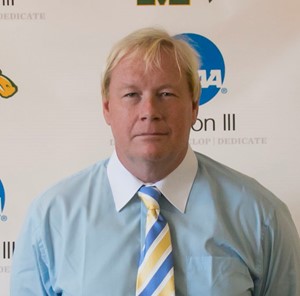
Patrick Murphy was named the Director of Athletics and Recreation at Marywood University in September 2019. Murphy became the Pacers’ first new Athletics Director in 28 years. For the 2020-21 academic year, Murphy will serve on the Atlantic East Conference Athletic Director Executive Committee as Vice-Chair.
Pat came to Marywood with 25 years of athletics experience at the NCAA Division I level. Most recently, he spent 18 years as an associate athletics director at Fairfield University in Connecticut.
Prior to that Pat was the Director of Athletic Business and Financial Affairs at DePaul University in Chicago from 1997-2001. He served as Associate Director of Athletics at Iona College in New Rochelle, New York between 1993 and 1997. Murphy began his athletics administration career in 1991 as the Director of Athletics for Marketing and Development for the University of Maryland Eastern Shore in Princess Anne, Maryland
Throughout his career, Murphy developed a winning bid and proposal to host 12 NCAA Championships events. He served as the tournament director for men’s basketball, women’s basketball and men’s ice hockey regionals. Murphy was the tournament director for the 2014 NCAA Division I Men’s Ice Hockey Frozen Four in Philadelphia.
Welcome to the Athletics of Business, a podcast about how the traits and behaviors of elite athletes and remarkable business leaders frequently intersect. The real stories and hard lessons to help you level up your leadership and performance. Now your host, Ed Molitor.
Welcome back to another episode of the Athletics of Business podcast. I am your host and CEO of the Molitor Group, Ed Molitor, and I am so fired up to welcome a great friend to this 98th episode of the Athletics of Business podcast. How about that 98th episode? We're closing in on 100 today's special guest great friend, met many years ago. Notice I did not say old friend because he is anything but old. But today's special guest is Pat Murphy, Director of Athletics and Recreation at Marywood University. He in Scranton, Pennsylvania. He was named to that post in September of 2019. Now get this. How about this for some pressure. Pat became the Pacers first new athletics director in 28 years. He is also serving on the Athletic East Conference Athletic Director Executive Committee as Vice Chair.
As I mentioned, Pat joined Merriwood in September after 25 years of athletics experience at the NCAA Division 1 level. Most recently, he had spent the last 18 years as an Associate Athletics Director at Fairfield University in Connecticut. And prior to that, which is where I got to know Pat. Pat was a Director of Athletics of Business and financial affairs at DePaul University, had the great fortune of working together and really becoming great friends. He was there from 1997 to 2001. Before that, he served associate Athletic Director at Iona College in New Rochelle, New York between 1993 and 1997. And he began his athletics administration career and we'll talk a lot about his journey and some of the keys to his success inside of this journey.
But he began his athletics administration career in 1991 as a director of Athletics for Marketing Development for the University of Maryland Eastern Shore in Princess Anne, Maryland. One of the cool things Pat has done and he's done many cool things One of the cool things Pat has done throughout his career, he's developed a winning bid and proposal to host 12 NCAA championship events and he served as tournament host for men's basketball, women's basketball and men's ice hockey regionals. Pat was the tournament director. Get this. This is really cool. Pat was a tournament director for the 2014 NCAA Division 1 Men's Ice Hockey Frozen Four in Philadelphia, which is the equivalent of the men's basketball Final Four, obviously. And we'll talk a lot about that. Few other things that we'll talk about.
We'll talk about what has been the keys to communicating with his coaches and athletes during this pandemic and why it is proven so critical to embrace their current situation and to be very conscious of delivering all communication to their athletes in a positive way, which is a reflection of how he communicates to his coaches. And we'll talk about how the coaches and administrators at Marywood University have created, and I love this, the best sense of normalcy in an abnormal situation. As I mentioned earlier, we're going to jump into Pat's journey in his career, and he will share the three keys to success that one of his mentors shared with him very early on in his career.
And we'll talk about how he got his start in the industry, and he'll share a story about how he saved a rejection letter and that landed him a significant job years later. And you really get a true sense of who Pat is as a leader and how he does things when he dives into why he views his ultimate responsibility as developing the people around him and what that looks like so much more. But I'm going to get out of the way. Enjoy this conversation I had with my great friend, Pat Murphy. Pat, thank you so much for joining us today on the Athletics of Business podcast. I got to tell you, a lot has happened since were last together 22 years ago at DePaul, but it seems like only yesterday.
Oh, it does, Ed. And those were great times. And first of all, I want to thank you for the opportunity to be on your show. I listen to your show all the time. I'm a big fan of your show. I'm a bigger fan of you as a human being, and it's great to reconnect with you.
Well, I appreciate those kind words, and it does mean a lot coming from you. And I've really been looking forward to this conversation because there's so much to share. You had an amazing journey in the athletic administration world in college athletics. And obviously, as I mentioned to our listeners in the intro, you and I were together while you were at DePaul University, but you've had quite the journey. And now you're the director of Athletics and Recreation at Marywood University. Can you tell us a little bit about your world right now? Everyone's so concerned with high major athletics, right? And what's going to happen in mid majors and low majors. And I've said this from the get go.
The people that really have to work the hardest at this, they have to get the most creative and have to really tap into their Leadership are the ones at the D2 and D3 levels. So can you take us inside your world?
Yeah, I can. As you know, I've been at both levels. I've been at the Division 1 level for 27 years, and then I've been at the Division 3 level for a year. And, you know, you can almost couple Division one in with this too, Ed, because most of Division one people think of Division one as they think of the Yukons of the world, the Syracuses, the Illinois of the world. But two thirds of Division 1 are mid majors, and mid majors aren't all that much different than Division 2 and Division 3 schools. But obviously with this pandemic, it's caused havoc across the board for everyone. You know, the big thing that we're faced with right now is, you know, the NCAA, through the center for Sports Science, has come out with testing protocols.
And that has really been the tough one because, you know, they're stating right now that prior to competition, you need to test your student athletes 72 hours prior to competition. Well, the cheapest tests that we found out there yet are $23. So if we do 400 student athletes at $23 times on average 20 contests per, you know, we're looking at a bill of 135 to $140,000 a year. That's even before you get on the field. So with that being said, it's made a lot of us take a real hard look financially as to what we can do to create a season. It's more of a hybrid. And what I mean by that is basically a reduced season to try to give the student athletes some sense of normalcy during these crazy times.
Now, you know, the one benefit that we do have is the NCAA has minimums, and if we stay within the minimum amount of contests, then the student athlete does not lose a year's eligibility. So in a way, it's a free year for them.
Well, that's. And that was going to lead to my next question. So you take someone who may be a senior, right, and. Or you have a group of seniors in one particular sport and they don't want to waste that last year together. I mean, they've been through the roller coaster ride, they've been through the journey together. And you and I both know what that's like. You were, you were a great college soccer player at Marshall. I mean, you understand it.
What I don't know about, hey, I was on the field, but go ahead.
Hey, it's a lot more than most can Say, but you know where I'm going with this, right? So in other words, they don't want to lose that year, but they also don't want to sit around and they've got to make that decision. So it's obviously a certain percentage would be the minimum that you are allowed to play or they are allowed to play and they don't lose that years. Am I understanding you correctly?
Anyone that's on the team will not lose a year's of eligibility as long as they stay within the minimum amount of contests just for this year. So if we have a basketball, the NCAA says for, let's say men's basketball, the amount of contest is 12. If they stay within 11 contest that we play, that student athlete or any of the student athletes on the team will have another year's, another year of eligibility.
So at the Division 1 level, how does that work out with scholarships? If you have four seniors and you promise those four scholarships to kids, now those seniors are coming back.
That's a major issue that they're facing. I mean, how do you recruit on the back end of that? Let's say out of the four, three of them want to come back. But you've already kind of promised verbals to an incoming class. I mean, how do you make that work? That's a big issue they're faced with.
Yeah, that's interesting. Obviously that's not something that you have to deal with. So how are you communicating all of this to your coaches? Keeping them engaged, keeping them informed as well as the student athletes? Because it's easy for them to get lost in the shuffle. And the whole mental health issue with the student athletes is so significant. So what's that like in your world?
Well, Ed, I believe in two things strong. I believe in transparency and I believe in great communication. So that being said, the coaches that I deal with on a day to day basis, they're pretty well informed as to exactly what's going on. When I know something, they know something. And the biggest thing that I say to them at this stage is let's stay as positive as we possibly can be. Because at the end of the day, how the student athletes are going to react is based on how they're receiving the message from the coach. And you know, you've been a coach pretty much your whole life, you know how important that is. You know, it's. How is that message delivered is how it's going to be received.
So my biggest thing is let's keep the student athletes engaged and let's give them as much positive interaction as possible.
Has that been going pretty well for.
You to this point? It's been going very well. I'm actually surprised. I expected some issues to come up and it really hasn't at this point. But again, you know, we're only a month and a half into the year. You know, that could rear its ugly head at any time as well. So.
So transparency, literally over communication, positivity. And you've, I mean, over the course of a career, you're going to have adversity. You're going to deal with certain things. What were some of the things that happened in your career that prepared you for this? Because one of the things I talk to my clients about a lot is being prepared. So when the time comes and you don't have time to prepare, you're still ready to go. What are some of the things that have contributed to your ability to lead through this?
Well, first of all, I think you need to accept the fact that you are going to have adversity. In any job, you're going to have adversity. But I always felt that you need to take it head on. You know, you can't hide from it. I'm always of the mindset that adversity is not necessarily bad, especially if you can learn through your adversity. You know, like this pandemic. A lot of times we cannot control what happens or what issues present themselves, but we can control 100% on how we react to it. So, you know, let's focus in on the things we can control through adversity and try to use it as a learning tool and move forward.
Yeah, and that's, you know, a lot of work that we do here is with folks trying to get them to reframe things, right? Reframe situations, reframe the adversity. And I like to think that adversity happens for us, not to us. And I love your approach to this. And how has that trickled down to the athletes? Because I've got to think that's very rewarding for you as the leader, because in essence, you know, you are the leader for not only the coaches in the athletic department, but the athletes themselves. How rewarding is that when you see the impact that can have on them?
Well, first of all, I would like to give all the credit to the coaches because at the end of the day, I don't have direct contact that often with the end product, and the end product being the student athletes. So the fact that our coaches have embraced this situation. And like I said to you before, how they have communicated or how they have sent the message on and how the message has been received, I feel that all the. The accolades need to go to them and what a good job they've done. And I'm blessed to have a staff like. Like we have here at Marywood University.
Well, that's so cool. And you've been very successful in your two years there. I mean, they've had an incredible run. What were some of the things that your coaches did creatively? You know, we've all had to kind of evolve here and do the things and make decisions without all the information. What are some of the things that your coaches or your department have done creatively to keep these folks growing through this whole situation?
Well, the first thing we're allowed to practice.
Okay.
But we're practicing in what I call pods, and I'll tell you how that is. And it's not an ideal situation, but it's the best situation to keep our student athletes and our coaches and staff as safe as possible. So the teams are divided up into 10 people or less. Okay? So we temperature check prior to every practice. If someone has a temperature of 100.4, they get pulled out of that pod. They get tested for Covid. The pod now is suspended to whether that test comes back positive or negative, whether they can return this way. If we have an issue, Ed, we don't have to shut the whole team down, okay? Because it's very important is that we keep the student athletes as engaged as possible and give them the best sense of normalcy that we can in an unnormal situation. Okay?
But that being said, I've told the coaches, I said we need to stay positive. We need to think outside the box. You know, if you come to me and say, you know what, I want to have a cornhole tournament with my men's basketball team. Do it. Why not? You know, make it fun for them, give them something to look forward to. And I know you're involved in this a little bit. Is on the 27th, I'm going to start setting up zoom info meetings, trying to teach some of our student athletes better life skills and things along those lines. So in essence, it's basically forced us to think outside the box and different things that we can do to keep them engaged.
Well, and I love that. I'm really looking forward to that on the 27th. And we'll talk about how champions grow through adversity. But it's funny because everything I see in the Business world and in the athletic world, whether it be podcast guests, whether it be clients of mine, the ones that are having the most success right now are the ones that are going beyond the walls or beyond the boundaries of the athletic field, the university, outside of the business. In other words, they're working on life skills. Right. Because they're working on contributing to the growth of the person as a whole that'll benefit them, not just the organization. So I think that's awesome that you're doing that. How has that been pretty well received by everybody?
Yeah, I think everyone's looking forward to it. And I want to do this several times because, you know what? You know, at the end of the day, a 19 year old is still a 19 year old. They. They think they have all the answers. They don't. You know, before we got on this podcast, were talking about what it was like when were in our 20s, Ed, that, you know, we go back 25 years. You know, at the end of the day, it's not where we start, it's where we end. You know, and along that way, listen, life is going to give you challenges, but I think you need to believe in yourself always. You know what? I had a. I don't want to say a mentor, but he was a good friend, but he acted as a mentor for me.
I don't know if the name Greg White rings a bell to you. Greg White was the men's basketball coach at Marshall University. Legendary player there. But he said one thing to me that has stuck with me through all these years, and he says you can accomplish anything you set out to do in life if you can do these three things. And that is work hard enough, work long enough. And here's the most important one, Ed. Sacrifice enough. You know, but a lot of people can't figure out how to do all three of those things and make it work for themselves. Plus, you know, you have to get a little lucky, too. But I'm a firm believer that I don't necessarily believe in luck, Ed. I think people put themselves in a position to get lucky.
Amen.
Through those three things I said before, Hard work long enough, sacrifice enough, and you will get lucky.
Right. And timing is everything. And it's what you do with the timing. I mean, we both know some people that's, you know, we'll sit and look at folks who have been successful in their career, like, oh, they just, you know, they just got a break. The timing was perfect. Yeah. But they still had to take that and do something with it.
Yeah. And every day we wake up, we don't know who we're going to meet today. You know, I grew up in a small town in upstate New York, and I was ambitious, and I had an idea what I wanted to do for a living, Ed. But, you know, I was a little naive at the same time as that, you know, I graduated with my master's degree and I said, world, here I am. Who's lining up to hire me? You know, and, you know, unfortunately, it didn't quite work out that way. And I remember as a young person, or right out of college, back before we had word perfecting stuff, I'm on a typewriter sending resumes out, hundreds and hundreds of resumes.
And everyone would send back, you know, the form letter stating, you know, well, sorry, you know, we'll keep you on file, Whatever it is. And I remember, and I was so ambitious at the time, and no one could tell me no. And keep in mind, I didn't have a father that was in the business. I didn't have an uncle who was in the business. Right. And I just kept breaking down doors. And I remember paying to go to a convention in, I believe it was Orlando. It was an athletic director's convention in Orlando. And I just happened to sit at the bar edge, kind of like the old days with me and you. And I just started talking to this gentleman. I didn't know who he was, what he was all about.
And I was just telling him, you know, I paid for my own way to come down to this convention. I wanted to meet people, I wanted to network with people. And two weeks go by, I get a phone call from this gentleman asking if I would be interested interviewing at a school. And that kind of started the journey. And the reason I'm segueing into the next thing is, I think it's important, is that was an entry level job. It was at the University of Maryland, Eastern Shore. I've been at three great schools. I've been at Maryland, Eastern Shore, I own and DePaul. But then I went to Iona College. And this is where it gets great. So I'm sitting there interviewing with this gentleman who remains a close friend of mine to this day, Rich Petrone.
And I found out afterwards, he told me that when I interviewed with him, he thought I was a nice guy. He thought my upside was good and all this. He goes, but. But I probably was not going to hire you. And he goes, the reason I hired you was because at the end of the Interview. He said to me, well, Pat, nice meeting you. Is there anything I can do for you? And I opened up my briefcase ad, and I pulled out a handwritten note from him that he had wrote me maybe four years earlier when I was sending all those resumes out. And in his note, he said, if I can ever help you, please let me know. And I said, well, yes, you can help me. You can hire me for this job.
And he tells the story to this day that's the reason I got the job. Now, if I don't get that job, who knows where I end up? But that was basically the springboard to everything else. And the reason I say that is that you never know. Yes. Did I get lucky? Sure. But I put myself in a position to get lucky at that time. And it was timing, and it was probably. God, it was just a lot of things that helped me that day.
How did you know? And I absolutely love that you did this, but how did you know to hold on to those letters? Because I'm assuming that's not the only one you held onto.
No, I had hundreds of them, Ed. I had hundreds of them, and to be honest with you, I don't know. I don't know why I held on to them. The easiest thing would have been just to put them in the garbage, you know, at the end. But I held onto them. And like I said, I went to the interview that day with note in hand, and that's how I got the position.
You know, you look at your resume and all the amazing things you've done, and we're going to jump into a couple of them. But I'm curious, because there had to be some times in your career where. Because I think a lot of folks go through this. I think a lot of folks are going through this now when they take a step back and they look, what am I doing? Why am I not putting myself through this? But how did I get here and how do I get there and what's going on right now? I mean, some of the challenging times. Have there been. Has there been some significant adversity during your career?
Yeah, I mean, you know, everyone deals with adversity, Ed. I mean.
Well, I mean. And I don't mean personally. I mean, in other words, like, okay, right now we're going through an adverse time, right? But sometime when you had a situation, whether it be a tragedy at university or your hands were tied, when you're trying to do something for your athletic department at a university, or something happened, I mean, just something where there Is something that you never expected when you get signed up for this career. You never expected to have to deal with this or have to deal with the situation at the level you were dealing with it at. And in fact, if you did, you know, how did you handle that?
Well, I can tell you a situation that I thought at the time I handled it well, I may not have. I was working at this institution and we had a coach that came down with stage four cancer. Okay. And he had it in the neck area and he was going through radiation and chemotherapy. And we had it lined up where were going to give the associate head coach the coaching duties while the head coach could get through this issue and concentrate on him getting well. And were going to bring in a couple extra coaches to aid the associate head coach being the head coach. Well, the head coach at the time comes to me and says, nope, I don't want to relinquish duties. I want to continue to coach. And at the time I thought, you know, how can I deny him this opportunity?
These are his kids, this is his program. Yes, I want them to get well, but I'm not a doctor, I don't know what's best for him. So I thought to keep him mentally in tune to what he wanted to do would be part of the healing process. But what I didn't know, and I don't know this even to this day, but it kind of got ugly because I think some decisions that were made, basically what happened is the associate head coach felt that this was his time to take over. And it created a lot of animosity back and forth. And I think some of the decisions that made weren't great decisions. And inevitably the head coach ended up firing the associate head coach, even though I told him not to do that because I thought it would divide the team in two.
And it was kind of an ugly situation for a while. I mean, we got through it. But what I didn't know is, and I still don't know to this day, I mean, with some of the medical treatments, you know, the radiation to that part of the head, did it affect decision making process? I don't know. But at the time I thought it was the right decision because, you know, I know if I'm battling something and, you know, it's important to me to keep some sense of normalcy, I would want that. So, you know, to this day, I don't really know if it was the right decision or the wrong decision, but it became a. It became a situation.
Yeah, yeah. And that's hard. I mean, you think you're doing the right thing. It's obviously something that you. That you learn from. And you've been. I mean, you have had many people in your charge since you started this career, and not just so much inside of the athletic departments that you worked at work for. You've also been a tournament director for quite a few events. Can you talk to us a little bit about what that means? Because I don't think people on the really understand how significant of an undertaking that is and what that means to you personally and what it has meant to your career. And I would love to hear that from you.
It all started right there in Chicago, Ed. I was working at DePaul University, and Bill Bradshaw, who's one of my best bosses I ever had, he basically charged me with trying to get the NCAA men's basketball regional to come to the city of Chicago. Believe it or not, at that point in time, Chicago had never hosted a regional.
That blows me away. When you told me that back then, I was. I couldn't believe it. I couldn't fathom that.
Yeah, well, the hard part was, is I'm representing, you know, the ncaa. When they give out these NCAA tournaments, you have to have a whole school, right? Okay. And basically the whole school is responsible for running the event. So the same year were bidding against in Chicago, the Big Ten Conference, and the Big Ten Conference had the United center, and we, as small little DePaul, had the all State Arena. Now, you know, there's a big difference between the United center and the All State Arena.
Minor.
What ended up happening is I put a bid together. You know, these bids are. A lot of emphasis is put on the budgets and the finance and the revenue projections and things along those lines. And believe it or not, we ended up getting it in Chicago over the Big Ten Conference, which was crazy. I mean, I still to this day can't believe that happened. But then I went to Connecticut. I was working at an institution in Connecticut, and now.
Hold one second, though. What was the X factor in that? Like, why do you think that happened? What was it that you guys did differently that made him change? You know, not change, but made them decide to go with you, I think.
And again, this is just my thoughts on this. I don't know this for a fact. I think that our financial package that we put together was competitive. I think there's enough hotels and restaurants and the airports out there in the Rosemont area that, you know, easy in, easy out. Not that would be detrimental to downtown Chicago. But I think it was more along the lines. It was a fairness thing, too. I think the Big Ten has had sponsored several NCAA tournaments of different sorts, and I think that they just kind of basically gave a bone to DePaul, said, let's see what they can do. So I think it was more of a fairness issue.
Yeah. Yeah. That's awesome. Okay. Sorry I cut you off there.
Oh. So then I went out to. I worked at a school in Connecticut, and I said to my superior at the time, I said, you know, I'd done this with the men's basketball. I happen to know a few people within the ncaa, and why don't you give me a shot at going after the women's tournament? Because were playing in an arena called the Webster bank arena, which was, I want to say, roughly 10,000 seats, you know, beautiful, brand new facility. And I put together a pro forma, per se, and people from the NCAA came out and toured the facility. The facility was beautiful. But Bridgeport, as you know, Ed, is not a destination place like Chicago is. Okay. So to get them to come to Bridgeport, I felt that it was going to be tough.
But what I did know Bridgeport had going for it was, it's right on i95. We're an hour outside of New York City. It's accessible by train, road, boat, and all that. And I also knew that the NCAA had a lot of pressure on them because they kept going to Hartford for the NCAA tournament because they know UConn was their big moneymaker. So by moving it to Bridgeport, which was further away, you're still, in essence, giving UConn fans a place to go that they can get to and sell a place out, as opposed to playing it in Hartford, which was always on UConn's home floor. So that worked in our favor. But. But it. These things are hard to get at. I mean, you got to put together a financial guarantee to them.
So let's say in Bridgeport, you know, I was on hook roughly for 350 to $400,000 for this event. So I had to make $400,001 before I'm even turning a profit on this event. But the reason I did it, too, though, is I thought the advertising value that you get is immeasurable. So if I'm at a small university and I'm playing on national television, I got three games on national television. Television using our floor with our logo in the middle of the floor. You can't buy that type of advertising. And that's why I did it. And it turned out we ended up getting more NCAA events to Bridgeport than any city in the country during my tenure there.
Wow. Wow, that's. And that's saying a lot. Well, of all the tournaments you've been a director, all the things that you've ran and you've been involved with, what has been the one that resonates with you the most, you enjoyed the most,
Was the most rewarding, I think, when I was named tournament manager of the 2014 NCAA Division 1 Frozen Four in Philadelphia, Pennsylvania. That will probably, to the day I die, will probably be the biggest accomplishment that I have ever done. People that don't know the Frozen Four is the equivalent that the men's basketball Final Four is. It's just the men's ice hockey programs at the Division 1 level. And it's not just putting on that event, which is a big event, but you're also dealing with the Fan Fest. You're also getting bands in. You know, we're talking about a multi, multi million dollar event that at the end of the day, you need to make it work. And you know, in the NCAA's eyes, yes, they want a nice event, but they also want their money.
So the good thing about that was, which I found, believe it or not, kind of easy, was the fact that the event sold out. Quick switch, 28,000 people there paying whatever they're paying. So we made the revenue nut. So once you hit that revenue thing, Ed, then you can concentrate basically on the players experience and the fan experience because you know your numbers are going to come into where they. They need to be.
Yeah. So with all of that being said, all the different pieces to the puzzle. Right. All the moving parts, what was your primary role or your primary focus? Especially once you covered the nut on what you needed to give to the.
Ncaa, it was creating an environment that was fan friendly, A situation where basically the fans and the players had the best experience that they could have.
And how did you guys go about doing that? I mean, it's. See, and here's why I'm asking this question, because ever since I've known you, Pat, you have this ability to connect with people and to get them to open up and not just converse with you and not just offer up information, but to get emotionally engaged in the conversation. And I think with what you do that is so huge. So in something like the Frozen Four, I've got to imagine you, knowing you had a ton of fun doing this.
Yeah, I did. Like I said, it was fun for me to book Bands at the event. You know, like I said we did at the Wells Fargo center in Philadelphia, they have a. Basically on the premise, they have all three of their stadiums on the premise. Baseball stadium, the football stadium, and the Wells Fargo Center. They also have on that premise a. Let's call it almost like it looks like a strip mall of sorts with all bars and restaurants. So we took that over at. And we had bands out there, and like I said, we had probably 30, 35,000 people at this event, and everyone's having a good time.
And we called it Fan Fest, you know, and as far as the student athletes go, we did a lot of banquets for them and things along those lines to make them feel special, you know, gift bags, you know, anything that we can do to. So that you want the student athlete to leave it, saying, that's the best thing that I've ever been a part of in my life.
Yeah. And I'm sure that was the case. That's pretty cool. Now, are there any more of those on the horizon for you now that you're, you know, you're out of the Division 1, are you able, being at Merriwood, are you able to get your hands involved in some of that stuff?
Not as much. You know, I have had talks with Steve Hagwell, and Steve worked with me on that first Frozen Four in Philadelphia, and he's the commissioner of ECAC hockey, and he's very interested in redoing it again and putting a bid in through Philadelphia. And if that's the case, I would be in the conversation to be part of that again. No promises, of course. You never know. But we've had that conversation, so we'll see what happens. But, you know, it's 2020 now. You know, things have changed in six years. You know, I hate to say it, maybe I'm outdated at this point.
You're just getting started, Murph.
Oh, no, I don't think that's the case.
No. I mean, there's some great things ahead. One of the things that's impressed me on the podcast with some of the amazing leaders I've had on and just relationships that I have, especially during this time, is people's ability to stay present, to navigate the waters for their people, and to sort of stay away from the distractions. How have you been able to do that in your world?
That's a good question. Well, first of all, you're always going to have distractions, Ed. I mean, that's first thing. First of all, I think you need to always be Setting goals. And with those goals, I think you need to establish measurement tools. Okay. Whether it's a quantitative or qualitative tool, because I think you need to assess are you making forward progress in what you want to do or not? And I think this will form the basis forward thinking decisions going forward. Everything I do here, Ed, is I try to plan. So in other words, I have a five year strategic plan. Okay. And within that five year plan, I also have a three year plan that rolls up into the five year plan.
And I have a one year plan that rolls up into the three year plan, which rolls up into the five year plan. It's basically a street strategic roadmap. So I guess to answer your question is you don't want to get off course. No matter what outside variables are hitting you at any point in time, you got to stay the course.
So how do you do that? Because it's so. Like right now, we have to make decisions without all the information, because everything in our world is so fluid. Right? So with your commitment and being intentional about staying the course, which is so critical, but you have to have a little bit of grace and allow yourself the space to evolve and to pivot as well. Not to use a word that's been so, like, pounded on right now, pivot. But I think you know where I'm going with that. So how are you able to decipher like, no, if I make this decision, I alter my course, then I'm getting away from what my plan was, or no, this is absolutely what we need to do. The plan has changed and we're all in on this plan. Now. How do you come up and formulate?
Or is that just kind of a gut instinct thing that you go with?
Well, you know, I think everyone has to rely on their gut to a point. But. But when you have a gut instinct, it's usually because you have outside variables or data coming at you stating that change is necessary. Hey, a year ago, right now, Ed, I had a strategic plan. I didn't expect a pandemic to hit. You know, I mean, I didn't know in my first year on the job as a director of athletics, I'd have to. I'd have to change course. Course in everything that we're doing. But you have to adapt. But it doesn't mean at the end of the day, you can't finally reach what your strategic goal is in year five.
Well, and I'm betting that you viewed this whole pandemic, once you took a step back and took a breath, your Predecessor is there? I believe it was for 28 years and never had seen anything like this. Did you view this, and I'm guessing you did. Did you view this as an opportunity for you to make an immediate impact not by being the star or by having all the answers, but by being able to get everybody together on the same page? Here's what we need to do. I don't have all the answers. I'm going to make myself a little bit vulnerable here. What do you folks think? How are we going to do this together? Is that something that kind of you went through and embraced?
Well, I will say this. I personally don't have a big enough ego, Ed, that I can't sit there and say, or I do say, I don't have all the answers.
Right.
You know, I let everyone else weigh in on, you know, on their thoughts. You know, I, I always felt this way as a leader of any sort, Ed. I think it's part of my job to develop people around me, right. And I care about what their input is into it. So between all of us, let's come up with the best plan going forward. Now, I know ultimately I'm going to be responsible for it, but you know, when I took this job and I opened up my manual ad for dummies, I didn't. There's not a chapter in there on how to deal with a pand, so. And if anyone can tell you that they know how to deal with this, they're lying to you because no one has ever gone through this.
And I wake up every morning and go to bed every night is that at the end of the day, Ed and I want to talk a little bit about this pandemic, we put all these protocol parameters in place so that in that two hour period that I have that student athlete in practice or whatever, I can honestly say they're as safe as they're is going to be. But I only have them for 2 out of 24 hours. So once they leave my controlled environment, where do they go? What do they do? What are they exposed to? So, so this thing can change at any point in time.
And, and the reason you put all these parameters in place is because at some point in time, and I'm anticipating this, we're going to have a problem and someone's going to have a smart father who's a lawyer or whatever and they're going to come back and look, we live in a litigious society as it is, you know, I mean, but I want to be able to say no, we did everything in our power based on the parameters given to us by the center for Sports Science and endorsed by the ncaa. And people will still probably find fault with it. But, you know, at the end of the day, my main focus right now is not winning games. My main focus right now is keeping everyone as safe as can be and as engaged as can be at the same time.
Right. And that goes back to everything we've been talking about at the beginning. And sort of my question was, you viewed it as an opportunity to make an impact by doing the right thing. Right. You didn't try to be a rock star or superstar, say, I've got all the answers. And I think that's what makes you such a great leader. And I think that's what gets your coaches and your athletes to rally together. So, I mean, kudos to you for that.
Well, thanks. I appreciate it. But like I said, time will tell whether myself or any of the athletic directors in this country have made the right decision. You know, what I do know is this disease doesn't seem to be going away anytime soon. So now we got to talk about how are we going to manage this disease to the best of our ability.
Now, let me ask you this. Mentors. To get back to that, you've named a couple. But who are some of the best mentors that you have had? What impact have they had on your career and how have you paid that forward? As you just mentioned, you know, your responsibility is to develop the people around you.
Well, I, you know, I'm very fortunate. I've had some great mentors. And what I try to do, and I try to pattern myself after is I felt that all different mentors brought something to the table, good, positive and negative, you know, and what I'm trying to do is I try to take some of the good things that I bound out of people. You know, we had mentioned them before. My first boss, Dr. Hallie Gregory, I love the fact that he was so empathetic with people. He really cared about them sincerely. And you knew that. And then I had another boss, Rich Petrone, who I'm close with to this day. You know, he had this ability, Ed, that everyone was in the foxhole with him, you know what I'm saying? And you knew he had your back.
You knew he had your back at all times. And Bill Bradshaw, that you work for with me, Bill was a nonsense, tough guy. So I tried to take things that I've learned from each of them and try to pattern that for myself whether that's good or bad? I don't know. Right now, I think I have the support of the staff. I think what I've done, Ed, is, and we mentioned it before, is I take the role of being a leader very seriously. And I think by being a leader, I think part of the thing is I need to do is I need to develop the people that are around me. I need to make sure that they are operating at their peak at all times, and I encourage them to make decisions. You know, this is how you grow.
I mean, I don't believe in micromanaging them. I believe in giving them an assignment and you working it out yourself. I can tolerate mistakes, Ed. I just can't tolerate the same mistakes people make over and over. No one woke up, including myself this morning, including you, saying, hey, you know what? I'm going to make 10 mistakes today. You know, everyone, I think, intrinsically, wants to always do the right thing. So let's give them the tools and help them grow as individuals and professionals. And I take that role pretty seriously. And I feel that I was lucky enough that the mentors I had treated me that way. And I forgot my mentor at Fairfield, Gene Doris, he was a part of the journey as well.
So tolerate mistakes, give them space, Give them the room to grow, figure things out on their own. Where does then the accountability factor come in? Because at the end of the day, we all need to hold ourselves accountable. You and I are cut from the cloth where we will hold ourselves accountable. In terms of the folks that work with you, how does that show up?
Well, I hold them accountable. Okay? But like I said, I can tolerate a mistake. So I'll give my associate AD A responsibility. He's accountable for that responsibility. Okay. And I expect him to do the best that he can with that. At the end of the day, I'm accountable for this department. And I understand that. But you know what someone once told me, too, Ed, is that if you have two heads that think the same way, you can do without one of them. So I want someone telling me why this idea is not a good idea. It could be the janitor. Doesn't matter to me who's telling me it. But I want people to weigh in. I want their ideas, I want their opinions, and I give a lot of responsibility to my staff.
So that's a great quote, right? You know, if you have two heads, I think alike, you can do without one of them. How has that played into the way you have hired for your staffs over the years?
The way I've Hired?
Yeah. In other words, when you sit down with folks and they want to be, you know, they want to work for you, I mean, what. What are the things that you look for, complimenting skills? Not necessarily the same. The same mindset. Right. Like the same values, but not the same skill set. Not the same thought process around certain situations. I mean, how has that played into it?
Well, when I interview people and I sometimes I ask them questions, how would you handle this situation? And I want to see what they come back with. The last thing, I don't need a yes person. I don't need someone sitting in my office telling me how great I am or how good my ideas are all the time. I want someone challenging me too, Ed. I mean, I. I have to grow as well, you know, I mean, like I said, I think you know me pretty well. I don't have much of an ego, but. But I want people that can challenge me and tell me why this is a bad idea, why it won't work. I walked into this position. I've got two associate ads here that are incredible, and they've been here for 20 plus years.
And I rely on heavily on them just to just tell me how to get around campus at times.
That's a great point. Because they've been there, right? They've been there. They're a part of the institution. You came in from the outside replacing someone so well respected, such a great legacy, 28 years. How did you become intentional? Not become. How were you intentional about? Okay, there's certain things that I have to press forward with that are mine. There's certain things I really have to go to my two associate ads with and say, okay, guys, tell me about this. Like, what does this mean? What's this person like? How do we play this? And I don't want to call it a political game, but how do we play this relationship and figure this out through these channels? What was that like? Because that's something. It shows up in every business. It showed up in every university you've been to.
And what you did is not easy to do, especially now with what you've walked into. So can you talk into that just a little bit?
Well, yeah, I would like to see this. One of the things that I did is when I took the job here, I did not press forward with a lot of my own initiatives in the beginning. And my reasoning behind that was because, you know, I'm a big believer in. And keep your mouth shut for a year and listen and observe and see what's going on around You. Because if you come in guns blazing to make change, just to make change, that's a recipe for disaster, too. And I don't want to do that. So for the first year, I kind of just sat back and I kind of watched how the operation ran and saw what people's strengths are, saw what people's weaknesses are. I've seen things where I think we can do some improvement.
And, you know, those are now being addressed basically in year number two. Now a lot of it's had to be tabled just because of, you know, the pandemic. You know, one of the things is I wanted to get a real good corporate sponsorship program up and running at this point in time. But, you know, that's. That's not going to happen because, you know, people's revenue streams have dropped off dramatically and things along those lines. So I didn't really come in guns blazing and I didn't come in making change right away. I wanted to slowly integrate change in. And I think when you do that too, you know, everyone is hesitant for change. So how you bring change in makes a huge difference too, because you don't want to shock the system by immediate change.
That is awesome. Well, Pat, it has been awesome. I mean, go Pacers. I was just sitting here thinking we need to have these conversations in person. I think what we need to do when all the dust settles and this pandemic moves on, we need to get the band back together here in Chicago, maybe grab that rooftop where I first met you on back in 98 in the summer and get the old crew, get back together, hit some of our old spots.
Remember that? Weren't those fun days.
They weren't. Hey, you know what? They didn't suck. Okay? They weren't bad.
They didn't suck.
Friday afternoon, late start, Cubs games. You know, here's something I didn't talk about. The intro. I used to always love when you pop into the mortgage. Our office there at North Avenue. And Wells and I would get the young lady up front, will call back and I answer my phone, she says, you have a Mr. Patrick Murphy here. And it'd be like 2 o' clock on a Wednesday. What's Murph doing in the neighborhood? But no, those were great times and great people. That's what's most important, right? Some phenomenal.
Yeah. And you know, I will say this much, I was listening to one of your podcast and he had Porter Moser on, who I know is a dear friend of yours. And what Porter did was. Was just unbelievable, Ed and He made. He said one thing that resonated so much with me, and he said that when we're younger, we're so intent on our careers and what our next move is going to be and where we're going to go and all this, that we don't enjoy the journey. And, you know, I think the industry we're in lends itself to that to a degree. But being older now, I wish I was more intent on enjoying the journey as opposed to what's the next great opportunity I'm going to get, you know, and that resonated so much with me.
Yeah. And it was a great point, you know, and that's something he and I have talked about since. Talked about before. And it's just. And it's not that. It's not that weren't having fun, but I don't think you really understood the gravity of what were experiencing at the time. Right. And, you know, now we're in position where as leaders, we can hopefully get these younger folks to understand that, because it's not an easy thing to do and it's not a knock on anybody. It's just human nature. But I'm really happy to see where you've landed, how you've evolved, you know.
Thank you. And same. I'm a big fan of yours, Ed. Like I said, you're a great human being and you're always going to be a great human being. And I think what you've done here with this podcast, I'm a big fan. I think they're well done and they're great.
Well, and that's all kudos to the guests. I've had on guests like you that do some incredible work and are willing, more importantly, are willing to share what they've done and how they've done it and why they've done it, which I believe has really had an impact on our listeners. So thank you again, Murph. It's been an absolute blast.
Thank you for listening to the athletics of business. Be sure to give us a rating and review so we know how we're doing. For more information about the show, visit the athleticsofbusiness.com now get out there, think, act and execute at the highest level to unleash your greatness.