

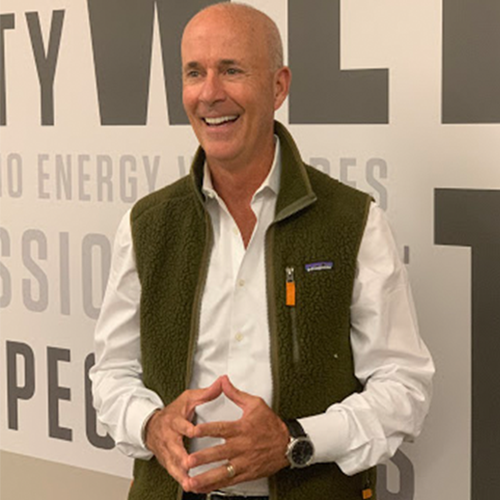
John Sabatalo is the President of Planes Companies – a global moving, warehousing, transportation, and logistics firm – located in Cincinnati, Ohio. He is also President of Global Workplace Solutions (or GWS, for short), a subsidiary of Planes that delivers global project management and workplace services to corporations, healthcare and lab facilities, hospitality companies, governmental agencies, and educational institutions. As one of 13 members of the board of UniGroup – a $1.7 billion transportation company – John plays a key role in transforming the industry. John has been with Planes and GWS since 1991 and has served as President since 2003.
Prior to becoming a leader at Planes and GWS, John enjoyed a very successful career in athletics. In high school, he was a four-year baseball varsity starter and captain and a three-year football varsity starter and captain. He then attended the University of Massachusetts on a football scholarship. Even after he hung up the pads, John’s love for the game never left him: his coaching career began at the University of Cincinnati, where he was recruited to be part of their graduate assistant program. He then spent six years as the offensive coordinator of local powerhouse St. Xavier High School before becoming the school’s youngest-ever athletic director. Following this success, he spent five years coaching football at Lakota High School, where he earned the accolade of the Division I Coach of the Year.
John’s passion for athletics is a fundamental part of his character, as he is affectionately still called “coach” by many to this day. His leadership style mirrors that of a true motivator, as his presence visibly energizes those around him. John’s competitive spirit and his uncanny ability to align business acumen and strategy to the x’s and o’s of the sports world resulted in the birth of the Planes/GWS TEAM culture in 2016. Originally introduced to 50 business unit leaders as part of a six-month leadership series, TEAM rolled out to the entire company in 2017. The success of the rollout – evidenced by the organization being voted a Top Workplace in Cincinnati by its own employees for seven years running – has led leaders of businesses and teams all over the country to seek John’s coaching on the creation of high-performance teams. John is a passionate believer in the importance of culture in transforming teams of people to work with a shared mindset and win together.
John and his high school sweetheart, Lynn, have been married for 41 years. They have two sons, Brian and Stephen, and three beautiful grandchildren. Beyond athletics and business, John’s passions lie in spending time by the ocean and making memories with family and friends.
Welcome to the Athletics of Business, a podcast about how the traits and behaviors of elite athletes and remarkable business leaders frequently intersect. The real stories and hard lessons to help you level up your leadership and performance. Now, your host, Ed Molitor.
Welcome back to another episode of the Athletics of Business podcast. I am your host and CEO of the Molotor Group, Ed Molotor. And mind you, this is not just another episode. This is the 100th episode of the Athletics of Business podcast, which is a significant milestone and it means so much to me because here's what it means. It means we have been on a journey since the summer of 2018, a journey filled with just absolutely incredible guests from the business world, from the world of athletics and folks who have taken time to really share their journey and get intimate with us and get real with us. Okay. And get raw with us. And. And to not hold back, which has added so much value to myself, to you, the listener. And I want to say thank you.
I want to say thank you to the listener and I want to say thank you to all the fabulous guests that we have had. And today's guest is second to none, John Sabatello. This is his encore interview. His first episode was episode number 62 where John talked about the lessons on teamwork from the locker room to the boardroom and why. From the locker room to the boardroom. Let me tell you a little bit about John before we jump right into this incredible conversation. John Sabatello is the president of Plains Companies. Now. It's a global moving warehousing, transportation and logistics firm located in Cincinnati, Ohio. He is also president of Global Workplace Solutions or GWS for short, a subsidiary of Plains that delivers global project management and workplace services to corporations, healthcare and lab facilities, hospitality companies, governmental agencies and educational institution.
Now John is one of 13 members of the Border Unit Group, a 1.7 billion. That's billion with the B Transportation Company. John plays a key role in transforming the industry. And there's a word we love. Transforming. Transforming the industry. John has been with Plains and GWS since 1991 and has served as president since 2003. Now, just in case you didn't listen to episode number 62, go back and listen to it if you haven't. But in case you haven't, let me tell you where John and I really connected. Prior to becoming a leader at Plains and gws, John enjoyed a very successful career in athletics. In high school he was a four year baseball varsity starter and captain and a three year football varsity starter and captain. Okay, just screams leader, doesn't he? He then attended the University of Massachusetts on a football scholarship.
Even after he hung up the pads, John's love for the game never left him. His coaching career began at the University of Cincinnati, where he was created to be part of their graduate assistant program, then spent six years as the offensive coordinator of local powerhouse St. Xavier High School before becoming the school's youngest ever athletic director. And following his success, he spent five years coaching football at Lakota High School, where he earned the accolade of the Division 1 coach of the Year. Now, there's so much more that I can talk about and tell you about with John, but what I want to do is I just want to turn this over to the amazing conversation that I had with John Sabatello of Plains Companies in gws. John, welcome back to the Athletics of Business podcast for your encore interview.
I appreciate you so much and I appreciate your time and really excited to jump into this wonderful conversation.
Ed, I can't tell you what a pleasure it is for you to have me back. I had so much fun the first time. I wasn't sure if there would ever be a second time. But it's an honor and a privilege to be with you today and share my thoughts with you. Looking forward to it, Ed.
Oh, we're gonna have a lot of fun. And the irony of it all, though, not only was there never a doubt in my mind there'd be a second time, as long as you would accept the invitation and be so kind. This will drop almost a year to the day as our first conversation.
Incredible. I know you certainly didn't plan it that way, but look how fast time goes by as well. Look at all that has happened between November of 19 and November. Coming up on November of 20 is amazing. What has transpired.
Well, and we can even just go back to beginning this year when I was very honored and humbled for the invitation to come out and speak to your business leaders at your launch meeting, so to speak, where you had an incredible theme. And I want to talk about that theme and how that led into the start of this year. I'll start fast and finish strong. And the focus of my presentation was change and how to embrace it and how to grow through the change and to really understand where it could take you. I mean, obviously, little did we know what kind of change we're going to go through 2020. But can you talk about that meeting?
Because I love the way that you tie so much into visuals at Plains and you give people something to wrap their Energy and their minds around to really let them know the direction you're heading and to get off to a great start.
Well, no, our whole goal in that January meeting was to start fast because were coming out of a good. A very good 19. So let's start 2020 fast, but more importantly, let's finish it strong. Having you at our meeting was a key component of starting fast and finishing strong. Because, Ed, what you did, you brought an outside perspective and you talked about change, you talked about team and the importance to be able to change and pivot when you had to. And little did we ever know that how relevant your talk was when you focused on change that we would be changing. There's a whole new normal as to how the world is operating today. But for us, not knowing that at that time, not only did we start fast and finish strong, we had our visual. Our visual for the year was a boat.
It was a crew boat, and it was three components that made up that boat. Of course, there was the boat, which was us, the team, the planes team, the GWS team that was in that boat. Then it was the oar. The oar to us, was what generated the power and the energy to propel that boat moving forward. And, you know, the one thing about the oar that we've learned, especially not being a boater, but I learned from people, if you're all not rowing in sync with one another, what happens is the boat begins to zigzag and you don't get to where you want to go as fast as you need to go there. More importantly, when you have people who just don't feel like rowing, the boat starts to go in a circle and you stay in stagnant.
And that was certainly not something we wanted. The other third component of the boat was the compass. That was the coxswain. That's the person that sits at the back of the boat with his back or her back to the past. Okay? We were saying goodbye to the past. And that coxswain was looking at being the compass for that boat or that business unit, okay, Looking to the future on how we are going to meet and obtain our vision and our strategy. And we left. There was some great energy in the meeting. People were all in. You had 50 plus business unit leaders from around different states in that meeting. The energy was electric and people were all bought into the vision and the strategy on where our organization was going to go in the next five years.
Tell me what happened when you first found out about COVID 19.
Well, on March 13, I believe it was Friday. That's when it hit. That's when it became somewhat real. At that time, I called together a SWAT team, people in the organization, and we came together and we talked through it. And that was a time where I've mentioned before, everybody likes being a leader of things when things are going well. You know, I've said it before, when the band is playing, the stars are aligned. Hey, I want to be the leader. Well, there was no band playing, there were no stars aligned, and there weren't a lot of people wanting to jump in line to take the lead at that time because you weren't sure what you were leading, what was going on. So I pulled together a team. We met for almost six and a half hours.
We put together a contingency plan that would go into effect on Monday when everybody came to work. We were going to wait till everybody came to work on Monday, the weekend, over that next 48 hours. That's why they call it a contingency plan. Things have shifted and changed dramatically. At that time I believed it would not be a good idea to bring people, all 250 people that reside under one roof that come to work. And we also had our outlying branches that were affected by this as well. So we had to reach out to them because were all part of this plan where we had to hit the pause button and put together a whole new plan on how were going to attack moving forward. So we only had mission critical people come to our organization.
The most important thing to us was the health and the safety of our employees, bar none. Most important thing we had to do, the last thing we could do is make a bad decision and put the business over. The health and safety of employees. That would not bode well, nor was that ever in our line of thinking.
Can you talk a little bit about the process and not just the physical process, but the mental and emotional process it took to go ahead and put a plan together and then have to change the plan right away. Right. And it was such a fluid situation and the ability to make decisions without all the information but keeping your people front and center and what that looked.
Like to you, that was a tough part. That was where the. You could feel the emotional stress, just this creep inside your body because you were doing something here that you really didn't know was going on. I've never flown an airplane before, but visualize flying an airplane in the middle of the night with no instruments. Where are we going? What's going on? You're making decisions on gut and who makes decisions on gut all the time. You know, sometimes you do, but today it's all about data, having the facts to make good, clear decisions. I benchmark with several of my peers who are in business as to what are you doing? What are you seeing? We would have daily calls with our key executives in our organization here.
I would have daily calls with people outside of our business where were talking at a set time every day as to who's doing what, to share best business practices in something that was such an unknown, it was hard to fathom at that time. And I guess probably the best thing we did was just to hit the pause button and just again keep the mission critical people here that had to be here and the rest working from home. Thank God our business was looked at as an essential business.
Right?
People needed our services. If weren't listed as an essential business, I'm not sure what the optics would look like right now. So we're very appreciative and thankful that people needed our services during these challenging times that continue to get even more challenging as the time went on.
Right? And we keep referencing your people and mission critical people are the only one in the office. And one of the many things that I admire about you is your over communication, but getting to know your people at a very deep level. In our first podcast episode, you. You talked about how at the start of the day, you and John Plains would walk around and you would say good morning to people and you would ask them how you're doing. Now here you are with, I mean, what percentage of your workforce at home and not in the office can you talk about? And I want to get into the compass of communication, how that's shown up and been such a powerful tool for you here in a minute.
But can you talk about how you got really intentional about communicating not only with the mission critical folks that were able to come in, but the ones that were at home working as well?
You know, Ed, that was a key component to allow us to be where we sit today. And that is you never get penalized for over communicating. And if Covid has taught us anything, it's taught us how to communicate better with our people. Thank God for zoom. Thank God for teams. Because not only being able to communicate with them, you. You were able to see percentages of them during certain meetings that you would have. We took it upon ourselves every week. We had a podcast, a message that went out to all 535 people at that time, every week after week after week, for at least the first, I'm going to say almost 10 weeks. And then what we did, went to a bi weekly podcast. Now remember, this is coming from John and I, our divisional leaders were talking with their people every single day.
John and I were talking with our leaders every single day. But the masses, the people that make up this great organization, we connected on a weekly, a bi weekly basis. And then most recently in the last month or so, we started to bring in our other leaders that help and introduce themselves to the entire 500 plus people in our company via our podcast that we would do lots of videos and during our messages we had different themes, different titles and because you know, again, I'm that kind of person that when I'm talking, I want people to see what I'm talking about so they can bridge it bridges the gap between my message and what they actually saw.
So we would have every one of my podcasts that I did, I think almost everyone had a video of some sort, whether it was 90 seconds or whether it was 3 minutes and 30 seconds, something that we showed that would resonate. And I'll tell you, the feedback we got from our team was just, they felt connected. They felt like there was transparency from John and I throughout the rest of the company. How would you like to be at home for seven months and nobody talk to you? You're just doing your job. Just the fear of the unknown in itself is something to be aware of. So we took communication ed extremely serious.
Well, and it goes back to what really is a cornerstone of your foundation of trust, right? Your relationships with everybody. And that trust factor that, hey, you know, John and John are going to be the face that our team needs. We know that they're going to over communicate and that really talks into your overriding principle of team with the trust, empowerment, accountability and mesh. And one of the things that, and you mentioned earlier is everybody wants to lead when things are going really well, okay? But when poop hits the fan in a very significant and a very serious way. And every decision matters and the response to every failed decision matters and the response to every successful decision matters. And like you just said, it's the unknown and what's next.
But you focus on game on, you focus on every single day rising to the level of, you know, what's needed in terms of competing every day when you go into the office, how challenging was that? Knowing the real deal, like knowing what was really in the trenches and knowing what was really ahead of you, knowing what the consequences were for pivoting the wrong way, how Challenging was that for you to bring it every single day as a leader?
It was challenging to the point because you saw such a drop, I mean, significant drop in your business in the month of April, in the month of May, especially those two months, 40 plus 50% drop in our business. It was just a fear of the unknown. You weren't sure where things were going. People throughout the world hit the pause button on activity and the things that were essential to delivering on. Nothing was happening or very little was happening. So I go back to that communication component that we just talked about and we broke it down into four main points. So you've heard me talk about this before. The one point, number one was fierce dialogue. We had to have the courage to talk honestly, openly and compassionately to our people.
They had a feel that were being very transparent with them as to what was going on because things weren't all right. We had to let people go. More people than we've ever let go in the history of our company that will be knocking on a door to being 100 years old next year. We had to make some of the most gut wrenching, unprecedented decisions on people that were good people. But we had a fiduciary responsibility to the other 500 that were doing the right things. That was hard. We had to be trusting and we again had to be transparent. We weren't perfect. You have to demonstrate humility and vulnerability when you make a mistake. We made a mistake here. Here's what we need to do to correct it. We need your help.
We had to do some of those things throughout this journey the last seven months. The guidance and motivation. You got to try to motivate your people during these tough times. We didn't just focus on the business side of motivation. We focused on the personal side. You know, think of the people that were. Now all of a sudden you're working a new normal from home. Your kids are home, schools are shut down. What about daycare? What about when we call them back to work? What are they going to do? Because when they come back to work, if schools were to be shut down, daycares would be shut down. What would they do? We had to show the compassion for our good employees that made our organization what they are today.
But I'll tell you something that we did probably as good, if not better than anything was listening. I've always said great leaders, which I'm certainly not saying we're great leaders. Great leaders are great listeners. We listened to our people. We adapted to certain things that we never thought we would adapt to, but we had to and we did, and it was the right thing. We sent out a survey to all of our people, all 500. We got a very high percentage back, but we asked them several questions. But most importantly, all we cared about was what could we be doing better? Please, what can we be doing better? To connect with you, to keep you in the loop. When the data was presented to me, I looked at the people that presented the data. I said, look, come on, this can't be right.
There's got to be something we can do and better. I'm not interested in what we're doing right. What can we be doing better, Ed? There was nothing at that time. People were so appreciative to have a job, appreciative that were communicating with them, keeping them in the know. Nothing was email. There were no emails being sent out. These communications were all verbal communications that we did, verbal tied in with video that we did. This took a ton of extra effort, but it was worth every single bit of it because the most important people on our team are the people that have made this team what it is today. The Plains GWS team is where it is today because of our people.
And that is why that it is consistently, year after year, voted best Workplace because of your people. And the thing that's awesome about this is that has the, I don't even want to call it a trickle down effect because that minimizes it, but that impacts, directly impacts your clients and your customers because the way you treat your people is the way that they're going to treat your customers.
Well, there's no question, and I'm glad to hear you say customers. You know, our customers, they were going through the same things were. We reached out to our customers, all hands on deck. And this is where zoom and teams came into play, which was a great tool because now we could even connect with our customers, even more so than we had in the past. Believe it or not, you know, a phone call is a phone call. Now all of a sudden you're looking at your customer and you've got a team behind you that the customer can also see. And now they can really understand the depth and breadth of the organization because everybody is connecting via teams or via zoom. So now you're building a better relationship with your customer.
And that was the one thing that we also put front and center because we wanted to be a resource for them, we wanted to be there for them. And were. And we did a lot of different things that helped them during the tough times, we're a company that would go into people's homes and we would actually do surveys of their homes when they would be relocated or we would do a survey of an office relocation. Now all of a sudden we're using virtual. We're doing things virtually that we never thought we could do before.
Right.
And all of a sudden it's like there's a new normal of doing business. It forced us to a new normal faster than we probably would have gotten to if this hadn't happened. So there were some positives that came out of this, but were there for our customers when they had to reconfigure their offices. You know, they got these big massive offices during this Covid times. The deeper we got into it, they're figuring out, you know what, we don't need all this office space. We can work at a more condensed level and still be able to meet our objectives. Having a smaller workforce here and the rest of the workforce work from home. Believe it or not, there were some positives that came out of COVID You know, I believe not to get overly faith based with you. I believe sometimes God had a plan.
I think we all move too fast. I think what his plan was, let's hit the pause button and everybody decompress and kind of level set and refresh. So when this thing clears itself out, maybe we're looking at things, thinking at things a little differently. Look how we've all reconnected with our families, probably more so than we ever have before. Our close friends and connecting with them more so than we ever had before. It's forced us to go back to our roots and appreciate all the things that were taught growing up as kids. Have no question about it.
And every moment matters. Right. I mean, it gives you a deeper appreciation of what we had, but it also gives you deeper appreciation of what we don't need. Right. Like, where's the clutter?
Absolutely. I like toggle back to a video that really resonated with me. And it was the last video that I had shown. And Bill Curry at the time was an ESPN analyst. And Coach Curry comes from obviously the South. He's got that nice southern draw and he really draws you in.
Yes.
And he talked about 9, 11, listening to his words and how we applied it to our huddle. And I went through an exercise with our leaders and I asked them after they watched this, and I asked them to watch this intently because we're going to talk about it. And I wanted to understand from them. What does a huddle mean to you? What does the huddle mean to our culture here? And we got some just great feedback. And I just let them talk. It was about a 15 minute exercise. And then I looked at them and said, okay, excellent. Now let me tell you what I think the huddle means to our organization. I talked about how the huddle stands for unity. It stands for togetherness. It stands for having each other's back. It stands for working together all in.
You can't be one foot in and one foot out. You're either all in or you're not. And I also said, you know what? We opened up our huddle during these Covid times and we've allowed new team members to join us in our huddle. And we've also stepped aside during these Covid times and we stepped aside and we let team members walk away that could not commit to the vision and the strategy of where our team was going. And I said, that's a healthy thing, that's a good thing. And we're so much stronger now that when I look out and I see our huddle, I see a team that truly is. That stands for trust, empowerment, accountability and mesh, and that truly has one another's back.
That huddle, which Coach Curry teed up for us, really resonated with me and our team, and it really has helped us appreciate who we are.
I love how you tied that video into the huddle and what the huddle means to you and not only what the huddle meant to you before, but what it means now with new members in moving themselves from the huddle addition by subtraction. And I love the video. I mean, the video gave. It gave me goosebumps. It still gives me goosebumps. I could watch it right now and I'll still get goosebumps. I would love to tell the audience what the video is about, but I could never do it as well as you. Can you share what that video with Bill Curry is about?
So the video was all about, obviously, it has some pictorials of 911 and how our country was under attack and how we all have mourned that day and had never forgotten that day. But what happened was Curry was a ESPN analyst. They told him at that time nobody was going to be flying to any of these games. So why don't you get in your car and drive up for the Alabama game? So he was driving up, believe it or not, to Birmingham, Alabama. And on his way to Alabama, he stopped at a. I'm going to Use the term that he used, a filling station. That tells you how things are back then. So a filling station. And this filling attendant comes out and he recognizes, and he looks at him and says, hey, Coach, are they going to play that game this week?
And Coach Curry looked at him and said, well, I've got a phone in my pocket here, and if that phone goes off and rings while I'm here, you'll be the first one in the United States to know whether we're going to play that game or not. Well, the phone goes off, and he looked at the filling attendant and he said, well, I've got bad news. We're not playing the game. They've sent me back home. There will be no game. And the filling attendant leaned across the counter with his veins popping out of his neck, but very calmly said, coach, in Atala, Alabama, we play football on Friday nights.
And when Coach left and got back in the car, he was mortified by what the attendant had said, couldn't figure out, even asked God to pray to help him understand why this guy was so adamant that Talla Alabama were playing football on Friday nights. Then it resonated with him. It hit him. It was about the huddle. And in the huddle, it's not just about unity. It's not the color of your skin, it's not your race, it's not what nationality you are. When you're in that huddle, you're in together. And when someone scores a touchdown, people in the stands don't look at one another and say, I can't hug you because your skin pigmentation is this color. People hug one another. They love one another. It's all about the huddle.
So when I saw that clip and how it resonated with who we are at planes and GWs here, it just resonated to me that, you know what? We are a huddle. It gave me goosebumps as well.
I mean, just listen to you tell the story. I mean, it's just unbelievable when you think about it. I think the other message in there, love. And it's what you stand for. It's because it's what we do, and it's because it's who we are. And no matter what happens, we keep moving forward because we know we can lean into the huddle for strength. And we look for positives, right? We look for small victories and success stories. How rewarding has it been for you to see folks step up during this time?
Incredible. You know, we just sent out a memorandum the other day, and it had all the people that we promoted during these Covid times, all the people that have stepped up and we're promoting within our own organization. Doing more with less, but promoting within. And if you could see and feel the people that are here, the mission critical people and people do pop in and out, but if you can see the smiles on their face, the energy that they bring every day because they're all in. And to be able to address your team and know that everybody is all in. Look, I'm not trying to be Pollyanna here. You're always going to have some outliers and we had some outliers and we stepped aside and we let outliers leave. And that happens all the time. But the core of your team is intact.
And it was such a great feeling for me to see that. Wow. You know what? We're building something here that's more special than I even give it credit for. We work hard at the culture. I know that's becoming an over term, but again, if you poll CEOs today, that's one of the one or two top initiatives they have on their docket as their culture. It's number one in everything we do. And I'm telling you, it shows. And some of the conversations that we've had with our people during these Covid times, some very fierce dialogue, straight on conversations. They appreciated so much that were as transparent and as honest as were. Because if you try to hide behind a rock or behind a tree, it doesn't work. You look like everyone else. We don't want to be like everyone else.
We're a special group that really do care and love one another. I've told you before, Ed, I've said it before, good teams like one another. Great teams love one another. I believe that all in 100%.
Well, and you know what was really cool about being there back in January is you could feel that, you know, you talk about the sea, you know, seeing it and feeling it. And you and I both know, like I used to say to our teams when I was coaching college basketball, you know, somebody, a stranger should be able to walk up to the gym door and before they open up the door, they should know on the other side of that door what kind of practice we're having based on the energy they, you know, from what they hear, they open the door, what they see, you know, do they see guys picking each other up? Do they see guys communicating? Do they see guys getting on the floor for loose balls? And I'm telling you, that day I spent with you folks was amazing.
I walked out of there and it was beyond refreshing. I mean, and it's like, you know, when teams are on their way to doing great things. Now, 2020 may not have been what you envisioned, right? But I can guarantee, folks, that the start fast, finish strong, your attention to culture, making it number one, has absolutely shown up every single day in the way you folks grow through this. And when you get to the other side of this, you're going to be a better organization for it. Can you kind of give the vision of what that may or may not look like, even though there's still so many unknowns?
So let me just say this first. That's why I love the title of your podcast, the Athletics and Business, because that's exactly the mindset we brought to Plains and gws. That's the mindset. This is no different. The only difference is I'm not running between the lines on a football field. I'm not on a basketball court. This is our team. This is our field. Every day we bring the same mindset. So when you bring that athletic mindset and you see that become contagious, and you see people buy in due to repetition, you develop a common vocabulary, everybody develops a common speak, and everybody is really, truly wants success, but never at the expense of one another. Think about that. Sure. Have we had some players on our team, whether it was all about them and didn't care about anybody else, Absolutely.
You know, I looked at something the other day, Ed. I learned that the Seal Team 6 kind of their metrics of filling the slots on Seal Team 6, everybody wants high performance and high trust. Everybody wants that. Okay. Everybody wants that person. All right. Unfortunately, that's not reality. So what do companies do? They have people that are great performers, high performance, low trust. And who are the people that get rewarded in the company? A lot of times it's the high performers. And unfortunately, a lot of them, or several, many of them, not a lot, many, or several, have a low trust aspect component to their DNA. What we're looking for here at Plains, I'll take medium performance, low performance, high trust all day long and take that low performer and build him and make that person better.
Take that mid performer, make that person better. Okay? But to have someone who's a high performer and low trust, it doesn't fit. So when you look at the mechanics of our organization and you look at 2020, how difficult of a year it has been, at the same time, I believe our organization has been blessed. We've been able to get through these difficult times to this point. Not sure how much more difficult it's going to be. We're preparing for the worst. We'll hope for the best. But we've learned a lot through Covid. We learned some good things that are going to make us a better company, and that's a good thing. 2020, again, we don't know. 2020, 2021, nobody knows. We're hoping.
We're hoping, obviously vaccines are found, people are going to be more healthy, we create a safer environment, the economy continues to pick up and everyone begins to prosper and pick up how we left off in 2019. Because as I mentioned earlier, we came out of 2019 very aggressive and we're looking forward to a great year. And unfortunately, it's been a challenge. But again, at the end of the day, it could have been a heck of a lot worse and we're blessed that it wasn't.
Yeah. And I believe, I firmly believe this, John. A lot of that has to do with mindset. Right? And your mindset. And mindset is contagious. I mean, there's absolutely no doubt that mindset is contagious. And you are. Your team is a direct reflection of their head coach. You. Okay. You and John. And one of the things, if we can get personal just for a second, because this is something I really, I'd love to do to offer to our listeners. We've talked about as an organization, as a team, how you grew through this adversity. But you and I both know that this is hard. This is lonely sometimes. This is gut wrenching.
The decisions you had to make, the things that could potentially go through, and to be able to focus on what you need to focus on to continue to move forward and do what needs to be done. How did you as a leader, wage your battle inside of your heart and your head and be able to grow through this adversity on a personal level, on an individual level? Because you have a family. You have a family at home, you have a family at planes and GWs. But I would love to hear a couple of the keys to your success and how you've done it.
Well, I think reflection was a big part for me. Just going on long walks, believe it or not, and just reflecting on what's going on and how it's affecting not only me and my family, but the plains and GWS families as well. Look, I've been very fortunate and blessed in my life to have created a lot of success. And you become successful because of the people you surround yourself with because of the people you meet, because of the things you read and learn. You do those things. But not everybody is afforded that opportunity. And I just really worked hard at keeping a positive attitude. I tried to take. We tried to take Covid and we preached it every single day to our people, our team. There's opportunities here for our company. Let's not be like everyone else and look at the negative.
Let's find the opportunities that are out there that people aren't taking advantage of. Now, what are some services out there that relate to what we're doing that could be add ons to what we're doing? It's a nexus to what we do, but it's something new. So I think, Ed, it was a lot of reflection, a lot of praying that we would get through this again. In the middle of this whole thing, you really didn't know what the heck was going on, where things were headed, because, you know, everyone's. Many businesses throughout the United States suffered the same consequences that we have. So we certainly weren't alone.
Right?
But were going to try to find an opportunity with a problem. And that's what we try to do, take a problem and turn it into an opportunity.
Well, I definitely give you a standing ovation and tip my hat to the way you've done things and continue to do things. And, you know, I firmly believe that our personal stories have a lot to do with how we handle adversity and what, you know, those stories have translated into our life. And one of the questions I ask folks that I talk to on the phone that I have coffee with, that are on podcast is there a time in your life, in your athletic career, your personal life, where inside of your reflection and those long walks that you take, that you've looked back upon and drawn from the lessons that allowed you to grow in those situations and to be successful in those situations which you have applied.
Now, whether it's your coaching career, whether it's in your playing career, has any of those incredible habits and behavior shown up?
I am where I am today because of my past. It is the people I grew up with. It's the coaches that have coached me. And it was afforded the opportunity to be a coach myself in athletics. Those life skills and lessons of sacrifice and discipline and positive approach, positive attitude, those type things have made me what I am today. I brought that same energy and mindset into the business world, and that's how I live my life. I don't know any other way. And I'm not asking everyone else to live their life that way. But when you're here in our organization, what we expect is we are a team, we are all in. We do bring positive energy. When you hit that front door every single day, you leave your worries at the door. And we have a goal and a vision to meet.
And that's what I expect. I don't expect everyone to say game on every day, but I will tell you this, you're seeing more and more people end their conversations, emails, texts, with game on. And it shows that we're certainly making progress. Because, Ed, we're certainly not satisfied. Our whole approach is to bring a high level of customer service to our customers that we serve each and every day. And the way you do that is you work together as a team. And that's what we focus on each and every day to ensure that we bring high level service to our customers.
John, I think that is an absolute perfect way to wrap this up. And I cannot thank you enough. And I will put, and before I forget, I will put the Bill Curry video, I'll put a link to that in the show notes. Okay. Along with all the other things that we're going to provide to listener. But John, I can't thank you enough. I mean, you have no idea. 5 pages of notes again. And the impact that you have reaches far beyond planes. As I share this with my clients, I share this with folks on my VIP list and most importantly in my world, I share it with my family. So thank you. I appreciate you my friend.
Likewise, Ed. Thank you. And you be safe and stay healthy.
Thank you, sir. And you know what? Maybe, maybe a year from now I can convince you to go for the three ball and we could you on for a third time.
Hey Ed, it's always a pleasure to be with you. You're a great friend, great people and I appreciate you and appreciate what you do. And again, thanks for having me.
Thanks, John.
Thank you for listening to the athletics of business. Be sure to give us a rating and review so we know how we're doing. For more information about the show, Visit The Athletics of Business.com now get out there, think, act and execute at the highest level to unleash your greatness.