

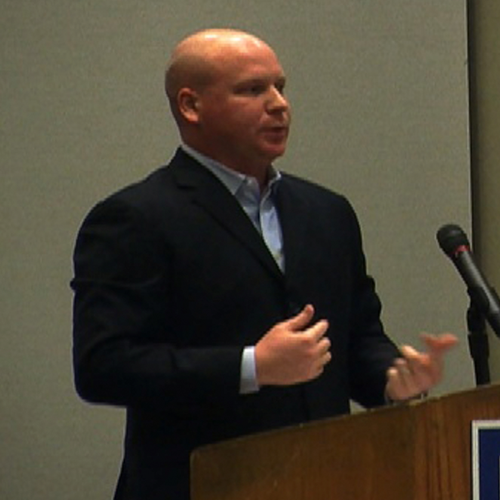
J.J. Konstant was a 2003 graduate of St. Ambrose University, where he was an all-academic conference basketball player and member of the Dean’s List. He attended Marine Corps Officer Candidate School in October of 2003. After being commissioned as a 2nd Lieutenant on December 12, 2003, he spent the next 8 months in Quantico, Virginia training to be an Infantry Officer.
In September of 2004, he was assigned to the 2nd Battalion of the 3rd Marine Regiment in Kaneohe Bay, Hawaii. As the Rifle Platoon Commander for Fox Company’s Third Platoon, he deployed to eastern Afghanistan in June of 2005. There he led his Marines in conducting operations aimed at disrupting Taliban, Al-Qaeda, and other associated terrorist personnel operations. In September of 2005, he received the Purple Heart from the Commandant of the Marine Corps.
In January of 2006, J.J. received The Bronze Star with Combat Distinguishing Device from the Assistant Commandant of the Marine Corps. Both awards were the result of his actions from August 12-19 as part of the now famous “Operation Whalers.”
In September of 2006 1st Lt. Konstant deployed as a Mobile Assault Platoon Commander and Joint Terminal Attack Controller to Iraq’s Haditha Triad in Al-Anbar Province. There he led his Marines in conducting counterinsurgency operations and was again wounded by two separate roadside bomb attacks. He received his second Purple Heart for wounds received on November 9, 2006.
Other military honors J.J. has received include the: Combat Action Ribbon with gold star in lieu of a second award, naval unit citation, meritorious unit citation, national defense service medal, Afghanistan campaign medal, Iraq campaign medal, Global War on Terrorism Service Medal, sea service deployment ribbon with bronze star in lieu of second award, a certificate of appreciation, and two certificates of commendation for his service in each theater of battle.
This is the Athletics of business podcast episode 21 welcome to the Athletics of Business, a podcast about how the traits and behaviors of elite athletes and remarkable business leaders frequently intersect. The real stories and hard lessons to help you level up your leadership and performance. Now your host, Ed Molitor. Welcome to the Athletics of Business Podcast and I am your host, Ed Molitor and I cannot put into words how fired up I am. For today's guest, we are with a true hero, our special guest, JJ Conston. JJ was a 2003 graduate of St. Ambrose University where he was an all Academic Conference basketball player and a member of the Dean's List. He attended Marine Corps Officer Candidate School in October of 2003.
After being commissioned as a second lieutenant on December 12, 2003, he spent the next eight months in Quantico, Virginia training to be an infantry officer. In September of 2004, he was assigned to the 2nd Battalion of the 3rd Marine Regiment in Kanaho Bay, Hawaii as a rifle platoon commander for Fox Company's 3rd Platoon. He deployed to eastern Afghanistan in June of 2005. There he led his Marines in conducting operations aimed at disrupting Taliban, Al Qaeda and other associated terrorist personnel operations. In September of 2005, he received the Purple Heart from the Commandment of the Marine Corps. In January of 2006, JJ received the bronze Star with Combat Distinguishing Device from the Assistant Commandment of the Marine Corps. Both awards were the result of his actions from August 12th to 19th as part of the now famous Operation Whalers. In September of 2006, 1st Lt.
Constant deployed as a Mobile Assault Platoon Commander and Joint Terminal Attack Controller to Iraq's Hadithah Triad in Al Anbar Province. There he led his Marines in conducting counterinsurgency operations and was again wounded by two separate roadside bomb attacks. He received his second Purple Heart for wounds received on November 9, 2006. Other military honors JJ has received the Combat Action Ribbon with Gold Star in lieu of a second Award, Naval Unit Citation, Meritorious Unit Citation, National Defense Service Medal, Afghanistan Campaign Medal, Iraq Campaign Medal, Global War on Terrorism Service Medal, Sea Service Deployment Ribbon with Bronze Star in lieu of second Award, a Certificate of Appreciation and two Certificates of Commendation for his service in each theater of battle.
In October of 2007, JJ completed his commitment to the Marine Corps and returned home to Chicago where he currently lives and works as a future broker. JJ is the main character in Ed Dirac's book Victory Point released in 2009. He was also featured in the National Geographic Channel's Inside the War in Afghanistan Documentary, which first aired in 2012. JJ, welcome to the Athletics of Business podcast. I am humbled, I'm honored and extremely fired up to have you here. And before we even get started, I have to say congratulations on the new addition to the Constant family.
Thanks, Ed. Thanks for having me. And thanks for the sentiment. Now that we got four under the age of six, it's exciting times. I'm back in the fight, so to speak.
Well, you are. You are. And you're. You're a brave man, which we already knew, and we'll get into that. But everybody's doing well. The baby's well, Mom's well.
Everybody's great. Yeah, my wife's a hard charger. She takes care of most of the heavy lifting, and I'm just kind of running interference with the older ones and basically in general support. So it's a man. Very lucky man.
That's awesome. Well, you know, and we'll talk about this. It's. It's pretty amazing, the journey that you've been on. And you date back to your days at, you know, Brother Rice High School, playing basketball for a good friend of my family's and my dad's most certainly Coach Richardson. And were introduced by Sean Jacob, a great friend and a good man. And I had heard your story years ago, and for us to connect like this a few weeks back and getting to know you a little bit, to be able to share your story with my listener is awesome. So. So can you.
Let's just jump right into it, and let's go back to your college days and what it was that you wanted to do when you went to college and what your intent was on your major playing basketball and what your whole plan for life was after college.
Sure. When I graduated high school, I went to St. Ambrose University in Davenport, Iowa, and my goal was to play basketball for four years, get a finance degree, and then I was going to return to Chicago and work at the Chicago Mercantile Exchange. Back then, the floor was very active, and I was lucky enough to get some experiences down on the floor through Kevin Lavin and, you know, my current boss, John Murphy. I've been very fortunate. I was very fortunate at a young age to know that was the direction I wanted to go in. So had it all planned out. But, you know, like, people like to say, man plans and God lasts. Different things were in mind.
So what happened?
I was a Jr. When September 11th took place. So, you know, I was from the south side of Chicago, as, you know, grew up with a lot of guys who were the sons or daughters of police and firemen. So September 11, you know, it hit home when it happened. You know, I remember getting the phone call, turned on TV like so many. I saw the second plane with the tower. And I knew immediately that I would join the military and serve in some capacity. And, and it was just one of those, I guess, you know, people call it a calling. There was just no question. So I came home after my junior of college, went and visited with recruiters, told my mom and dad I was going to do. And they agreed with it, supported it. They just made me promise to finish college.
And I remember arguing with them, saying, but they told me if I don't join now, miss the war. And I tell people that story because 16, 17 years later, you could still join, train and get involved in the same war. So I finished college, went to the Officer Candidate Program in October, right after graduating in May, and, you know, took it from there.
So let's go back to, you know, 9, 11, if we can just for a second, 9, 11. And you knew instantly that's, that's what you wanted to do. And to me, your selflessness and being a part of something bigger than yourself just, you know, that's Valley talks volumes about that. Where did that selflessness and being a part of something bigger than yourself and having a greater cause and a greater singleness of purpose, where did that come from?
Probably my parents. I mean, I was brought up in a community type environment, the south side. You know, everybody's parents kind of looked out for everybody's kids. And my parents were all about the community. Still to this day, they're very active in the church. And you know, I was taught at a young age that money and nice things are great, but you know, we're really here to do something bigger and better. And joining the military, I've said for a long time probably the best thing I could ever contribute. Certainly not going to be a doctor or anybody who comes up with some great philosophies or, you know, a politician. But, you know, joining the military and serving during that time was something that I was very excited to do as it being a contribution for society.
So let's talk about your military service because it is, it wasn't just your run in the mill service. I mean, you saw in. And our listener from the introduction obviously has a snapshot of what you did and what you accomplished in the two Purple Hearts and the Bronze Star. But let's talk about the whole process from the start of when you first joined to Victory Point, if we could.
Sure. So I joined in October of 2003. That's when I got to Quantico, Virginia. The off, the Officer Candidate School is in Quantico, Virginia, as we're enlisted as at Parris Island, South Carolina, or Marine Corps Depot San Diego. So I got the Quantico in October. I was lucky enough to finish that class, probably towards the bottom. I think 250 of us were admitted into that class, and 160 some actually graduated. It's a very competitive school because they want to make sure that everybody that finishes truly wants to be in command of Marines on the battlefield. After completion of that school in December, got a few weeks off, went to what's called the basic school, Basic Officers Course, where everybody trains to be an infantryman.
So over the course of those six months, even the guys who were there to become pilots or lawyers or whatever, they all learn to be infantrymen. Because one of the things that makes the Marines unique is that they want everybody, whether they're going to be in the sky or in the rear or on a ship, to understand exactly what a grunt, what an infantryman goes through, because they feel like they'll better supported that way. During that six months, you're competing for your military occupational specialty, which is your mos. And I was lucky enough to get the one that I was competing FOR, which was 0302 infantry officer, which inferred that if I can complete Infantry Officer course, which was three months right.
After the basic course or the basic school, that was three months of intense training out in the field, and you have to complete it in order to be allowed to go pick up a platoon in my platoon that I was assigned to was in Kaneohe Bay, Hawaii, Marine Corps Base, Hawaii. Probably the greatest assignment you could get in the military, because when I wasn't deployed in Afghanistan or Iraq or training, I was in Hawaii, which. What's better than that?
Right? Right. So during the training at all, did you ever sit there and think to yourself, what in the world did I get myself into? And I'm presuming, knowing you're gonna say no. But there had to be some times that were extremely challenging mentally.
Yeah. During the boot camps, slash Officer Candidate School portion, they get to you. I mean, man, they got it down to a science. There's. I don't care who you are. I saw a lot of professional tough guys brought to their knees in that environment just because they're so good at it. And, yeah, it wasn't really, you know, nothing really bothered me other than they used to do so much stuff and always be threatening to throw us out. And I used to just sit there like, man, I joined up for this, like, I want to serve. Why are you making it so difficult? But that's the way they make you feel like you're really going to fail these things. And you know, at the end you realize as long as you're in it to win it, you're committed, you're going to pass.
But I mean, almost every day you're just thinking, my God, I don't know if I can keep up. And I was a very average Marine. You know, the guys that joined these are top tier individuals who are joining, you know, for one reason, and that's the winning combat. So you're not talking about a lot of pussy footing around. These are hard chargers who are there doing a great job and you're just trying to keep up. And that's the way I felt the whole time, was just let me have a chance to go fight the enemy. And obviously I was lucky enough to get to do that.
So let's talk about that. Let's talk about your deployment and let's go ahead and tell that story.
The first deployment was to Afghanistan, I believe. I deployed in May of 2005 and I was there until January of 06. And that was a very exciting time to be in Afghanistan because of some of the events that would occur. The operation Red Wings, which is largely depicted in Lone Survivor, that took place during that time. June, late June, early July, and then a month later, my platoon was part of an operation called Operation Whalers, which was launched to get the enemy depicted in Lone Survivor that did so much damage to those Navy SEALs right in the army rescue crew from the 160th soar right now.
Your story is told in a great book, Victory Point, by Ed Derek. But let's hear from your words in terms of, you know, I've watched a video, I've listened to some interviews, I've read a bunch of stuff. Let's talk about Operation Red Wings and if you could take us back to when everything went down, what the first thoughts during, you know, going through your head and what emotions you were feeling when all this went down.
Yeah, Operation Red Wings I was not involved in personally, my unit was not involved, but it was a Marine Corps mission. So at that time in Afghanistan, they wanted Navy SEALs to observe the landing zone before you could land helicopters. And there was a specific medium level target Ahmad Shah, whose name I can say everything that's classified about this that were out to get. So those four Navy SEALs were going to observe the LZ for 24 hours. We were going to land helos, I think it was Golf Company, if I'm not mistaken, was going to go in and do a raid, so to speak, clear the village, look to find this guy in any weapons or munitions. Unfortunately, everything went wrong.
So you're kind of back there in the operations center, hands tied a little bit, listening to the radio traffic, getting updates from, you know, our intelligence, getting updates from my boss, Captain Kelly Grissom. And you just kind of tracking all this horrible events event that's happening. And you know, we're all tough guys out there, but it's heartbreaking to get hear about US soldiers and you know, Navy operators going down like that because you know, we're all part of the same team. So you hate to hear about anybody taking losses like that. And it was certainly difficult for everybody, not just myself, to come to terms with.
Right, so. And then once the helicopter went down, is that when the decision was made to send you guys in? How did that go?
No. So the recovery, which was called operation Red Wings 2, I believe that was all run out of the combat operations center in Jalalabad. So the Navy SEAL commanders and other Special Forces operators, slash commanders, they ran that and kept the Marine Corps out of it largely, which probably wasn't the best idea because were the best at hiking up into the mountains and doing that stuff. And they had a hard time, you know, kind of getting to the scene because of the tremendous temperatures and the very difficult terrain. But nonetheless, a month later, or a month plus later in mid August, were asked to run an operation that was Marine Corps designed. Marine Corps ran by our battalion commander and our intelligence and our operations officer and all those leaders were amazing, intelligent individuals.
And were able to go in, run a very marine Corps operation, three platoon plus sized elements. So we're talking about three units of about 50 personnel moved in from three different directions. And the morning of August 14th, the enemy kind of ran out of options and decided to attack my platoon that had my boss, forward air controllers, engineers and snipers with it. So were 45 individuals all together and they attacked us in the Chaque Valley.
What in all of this, and this is going to sound like a very trivial question, but I think it's very significant. You and I have talked about this off the air, talk about the level of teamwork and trust and communication. If you could talk about that a little bit, just to give our listener an idea of what it's really like and how much each of you knew what the other one was going to do and how you had each other's back.
Yeah. So the three things I always talk about when I'm speaking or trying to train coaches or teams is preparation, teamwork, and commitment. And like I told you in our, in the initial interview, what happened, you know, it's so chaotic, it's so loud, it's so noisy. It's paralyzing. And if you don't know what you're going to do, and if you don't have trust in others, and if you haven't enabled your small unit leaders, that being your squad leaders in charge of 10 man groups, or your fire team leaders in charge of four man groups, if they haven't been enabled and trusted to carry out the plan of the day, so to speak, then you've already lost. Because, you know, once the shooting starts, you know, it's. It's like I said, it's paralyzing.
There's no better way to describe it than absolutely paralyzing, because you just don't have the ability to communicate. You know, everything. All the preparation has to be done before. So, you know, that's why we talk about getting lulled into a sense of complacency, whether it be on the battlefield or in business or in sports, because if you're not ready for that one, you know, that one time, you know, I take a police officer, for example, those poor guys might go 20 years and never fire their weapon. And then all of a sudden, they got an hour left in their shift one day and it's game on, you know, so those are unfortunate circumstances. And in the Marine Corps, feel that complacency, sleep, excuse me, sneak in, you're going to run into some of that very same type of. Type of rust.
Right? Speaking of business, jj, you're in a very competitive industry in the finance world, and you have a team of 25 people, and you're always, you always have the, you know, not letting complacency sneak in at the front of your mind. But how do you, in the business world, how do you prepare your team and how do you, on a daily basis, I mean, you and I both, I would believe, we agree that you have to make practice harder than you make games. You have to make training harder than, you know, battle. But how do you do that in the business world?
Well, in the business world, it's. It's all about your, you know, tactics, techniques, procedures. Just like you would say about military training or combat or, I'm sorry, or sports. You've got to have, you know, what you fall back to. You're not going to, you're going to sink to the level of your training. You're not going to rise to the occasion. So you've got to make sure that you've got whatever it is, your procedures in place, your standards set. So everybody knows that this is how we do things. And if we have a mistakes, fine. But if you made a mistake because you violated procedural protocol and that's where the issue comes in. It's not so much that something bad happened, it's that we deviated from the script of what you've been taught and what you've been entrusted to do.
Right. And you said, one of my favorite sayings is that you sink to the level of your training. You don't rise to the level occasion, which some people are like, what are you talking about? Look how they stepped up their game. But they don't.
You don't.
Yeah. You just don't get it. You just don't all of a sudden do things at a high level unless you've already done them.
Yeah. When the lights come on, you don't improve your 40 time and you don't know your vertical doesn't go up to 48. Right.
Well, and that's one of the challenges. I absolutely, if I went into a corporate on site or corporate off site and do some consulting and trust training, and I'll sit in on the training sessions before I speak and present and I look at the level of focus or the lack of level of focus or the level of commitment or communication or the authenticity of the training program. It's so critical for that training to be at the same level of intensity that they're going to see whether they're in sales, whatever their role, whether they're in marketing, whatever their role. How do you do that? I mean, how do you specifically, with your team, keep it at the level you need it to be?
Well, you know, kind of like you have walkthroughs for basketball or rehearsals for the military. You try to go through the different types of meetings or the different type of events that will take place and try to walk through it, talk through it, anticipate issues you might have and make sure that everybody's on the same page. Because, you know, once you go live in front of a client, you've got one chance to make a first impression. If you're clumsy or not prepared, they're gonna know it. So you better put in your work, know everything you can. Which is more difficult in business than it is to get a scouting report or an intelligence report. But you've got to find creative ways to know your customer, know what they want to talk about. You know, be prepared.
We talk a lot about on this podcast about culture and about recruiting winners and getting the right people on your team. How significant is it? I mean, I was just having a conversation with someone earlier today about this. Is there. There is rock star talent? There's people out there that there's no doubt. You cannot deny that they can flat out produce, but they don't fit in. What do you do with someone like that?
I think you give them an opportunity to change their ways, to understand the culture, to learn the culture, to buy in. And a lot of it is belief. If you can show them that you're about everything that you've told them or promised them, then you're gonna have a better opportunity to kind of change their view on things. But in my industry, you've got a lot of people who are coming from the good old days of huge bonuses and, you know, things that are very unreasonable by today's standards. And.
Right.
You got to tell them, you know, what's good for one is good for everybody. But, you know, I'm going to tell you the truth right now. You're not going to get paid 80% of what you bring into the company. It's just not the way it works anymore. So once people see that you mean that, but that you also treat them fairly and compensate them fairly, and everybody's held to the same standard, whether it be, you know, a kid out of college that's hardly making anything, or, you know, 30 years seasoned veteran with a large book of business, all are held to the same standard and all are compensated fairly based on what. What we've laid out in front of.
How important, as a leader, is it for you to be authentic in the sense that you're doing everything that you're asking your team to do?
Yeah. In the military, we say, don't ever ask somebody to do something that you're not willing to do yourself. And I think that's something that's very important. You know, I came up in the industry I'm in now, working nights, missing out on the fun stuff, working with, you know, friends in the 20s when the Blackhawks won the Stanley Cup. I was at work, you Know, my wife was drinking out of this family cup, but that's a whole other issue.
Yeah, it is an issue. There's nothing wrong with that picture. I mean, nothing against your wife, God bless her. I mean, I already know that I was.
But you've got. You gotta pay your dues. And if people know that you understand what it's like to work the nights and what it's like to, you know, have a tough year, and if you're in the trenches, so to speak, if you're leading from the front, which we're always trained to do in the military, then you're in a better position to not just make decisions, but to influence your people because they know that you care in your practice and what you preach.
So when you're working those nights, I'm gonna presume that you had a sense, you know, you had a purpose, you understood the why of what you were doing. It may not have always been great, it may not have always been fun, but you knew there was a reason you were doing it. One of the things that we find a lot with the corporations we work with and the clients that I work with is losing touch of what our purpose is. And all of a sudden, folks feel like, you know what? Maybe I'm not significant. Maybe I'm not important. Maybe I'm not needed. Maybe this isn't the job for me. How do you. When you're in a situation of paying your dues, how do you create your sense of purpose and your why?
Well, you've got to know what your intent is. You've got to understand the bigger picture, the bigger plan. You've got to have a plan for yourself as well as your organization. So as long as you're committed to getting to where you want to be, then you can find value in whatever you're doing. You know, when I was working nights, I just told myself, this will be my experience on these different shifts in these different markets that will lead to me being better able to cover clients, you know, once I get called up to the better shifts, to the more prime US shift hours. So you've just always got to know what you're about, what you're trying to get to. And then whatever obstacles in your way, you just have to move it. You know what?
You find a way to get rid of it or to conquer it or go through it, never around it. And that's the way that you get to where you want to be. You know, you embrace the obstacles. You figure out how you're going to get through it. And that's what happens.
So you just said something that really resonated with me. Because one of the things that the younger generation and I don't want, I'm not going to sit here and knock millennials. That's not what I'm trying to do. But what I want to say is we have taught that generation how to get around things. Not, you know, not intentionally, but the way our society is now, it's, you know, even video games. You take video games, it's how do you get around the enemy? You don't go through them, Right? So when you bring younger folks on, because I know this is something that a lot of the management and upper management that I work with, we talk about. When you bring younger folks on that had that challenge of running to the fight, as I call it, how do you work through that?
The thing that I do is I like to address the difference between, you know, where I came from and where they're coming from pretty much immediately, sometimes even through the interview process, because I need to know. I've got people that are like minded, that are highly competitive, that are able to focus, that are able to lock in. You know, it's not a 9 to 5 job. We've got a lot we have to accomplish. And I just talk about, you know, we're trying to avoid it, but the millennial, you know, we graduate college, we want an awesome job that's about four hours a day. We want to make more money than our parents ever made and we want it now.
Right?
And you got it. You got to explain to these kids, like, hey, you can get to an amazing level in your career, but it starts here. You know, it starts on nice. It starts at this salary. It starts, you know, turning down opportunities to go have fun. If you want to go have fun with your buddies, you probably don't want to work for me because I don't care what you do outside of work, but I'm not going to be owed. You know, if you've got a bros trip to go see your college play down in Texas, right? And something comes up, well, I expect you to prioritize the job.
You know, in the military, where I'm from, a lot of guys used to say, you don't even have time for a girlfriend because that girlfriend is keeping you from training and being the best at your craft, perfecting your craft. And you owe it to those men that you're in command of to be at the absolute top of your game. So don't let anything Distract you.
Let's talk about that. What you just said, you owe it to the men you. You're with. Okay? So, you know, obviously, we live in a time where work and personal life blend. I mean, you're a father of four now. You need. You need to make that work. You understand priorities, you understand the family. You understand that. But yet we still have to help these folks figure it out. We have to figure out the commitment. How do you. How do you, as a leader who's been through, you know, they may look at you and say, jj, I'll never do what you've done, so I can, you know, never be what you are. Which isn't necessarily in the business world. True Christmas, correct?
No. I mean, everybody comes from different places. I certainly don't expect military service or an athletic background out of everybody I hire. But you don't need to be in the military or have an athletic background to be a good. A good teammate, to be a member of a team, to want to be a good teammate, to have good habits. You know, a lot of people are brought up that way. They get it different ways, but, you know, they're important concepts that are always going to be a part of any team that I lead. You know, because you don't have selfless people willing to drive in the same direction as everybody else, you're really just wasting your time.
What are some of the things you do to build that sense of team, to build that common, you know, the singleness of purpose, to build that compelling shared vision? What are some of the things that you do as a leader?
Well, I know that, you know, I do things the best, but what I do is I try to make sure that everybody knows they matter. And whether it's private conversations or just talking to them in front of the group out on the trading floor, whatever it is, I try to make sure that everybody knows that their good work and their hard work is noted. It's noticed and noted, and then usually that's enough of motivator for grown individuals to carry on with the fight. We are in a business where people are rewarded through compensation, as opposed to the military, where when somebody wants to know, why am I doing this? Because I told you so, you know, so there are more conversations, and there is more explanation, which I don't always enjoy.
But if that's important to somebody that works for me, then it's important to me that they get what they need to drive on. So I guess just, you know, through conversing and understanding where they're coming from, and what they're trying to accomplish in addition to the team.
When you're in the military and you're going through what you guys went through and you were spending, you know, years together, you get to know each other, and you get to know each other very well. How important is it for your team in business to get to know each other, to get a little bit transparent, to be able to hold each other accountable, to be able to communicate? How does that help the end result? How does that serve as a competitive advantage in the marketplace?
Well, I think in most industries, you're better off being part of a team. You know, there are guys that come from places where they're kind of siloed individuals, and they just want to come out, come in, log on, and do what they do, but they end up finding that the way we do things, you're going to be supported by a whole group of people. So if something comes up and you don't know the answer, you don't have to lie to your customer, make something up or shy away from it. You can probably get that knowledge in our room. And I always tell the guys that I work with, you know, don't let your first conversation or your only time speak to certain people, whether it be, you know, amongst our group or other groups in the office. Don't let that be.
When you need something, you know, develop a relationship with these people, because you're going to need to lean on them at some point and you want them to care about you. So, you know, if you're. If you're choosing between who you're going to help, person A or person B, you're going to go with the person who's generally treated you well. You know, that's.
You just made a great point. I mean, you're making a ton of great points. But one thing that I haven't heard many folks say is don't let that first conversation be when you need something.
Yeah, right. I mean, that's. That's. Usually people are starting to meet each other in the business world, but if you've got any sense about you're not going to go ask somebody for a favor in your first conversation. So, you know, it behooves you as an individual and as a team to get to know people. Even if you don't consider them necessarily important to what you're doing, you never know what kind of value they're going to be able to add. And in our industry, we have people who make a lot less money, who are staying late and doing A lot of work behind the scenes to make us look good for our customers. So those people need to know that we care about them and we appreciate them as well.
Absolutely. So you obviously, absolutely embrace the servant mindset. And when you have members on your team that might not understand the value of the servant mindset, how do you. How do you develop that? How do you develop that in somebody?
I think just the way, you know, now it's easier because you fall into a pretty large unit where this is just the way things go. And if. If you don't develop it yourself or buy into it, then we're just going to move you on down the road. But in the early days, I thought it was just important to lead by example. So I wasn't asking people to work long hours that I myself wasn't willing to work. I was making sure that I was working the most hours. And subtle things like that, you know, start to pick up. And that's how you kind of get a reputation. And then people say, yeah, no, you know, he's the real deal. He was here on, you know, Thanksgiving. He was here on Christmas Eve.
He was, you know, he had a kid and he was back to work a few days later. So, not that it's always so important to work those hours, but I'm just giving an example in my business where you're leading from the front and doing things yourself that you're expecting others to do, because, you know, you want to get to the point when you're a second lieutenant and you're out in the field, you want to get to a point where your platoon sergeant or your squad leader sits you down and says, hey, sir, I need you to take a rest. You know, you've been at it for three days straight. Or, hey, sir, here's something to eat. Or, hey, sir, you know, go here and do this because we need to take care of you.
And if you take care of your men, they will take care of you. And it's that same kind of mindset that I've carried through business.
That's awesome. And that's one of the many reasons that you are so successful and something I really. I'm curious about. And we don't have to go into it too deep, but just the overriding strengths that helped you do this. You know, the pace and range of change in the business world is unlike any time we've ever seen right now. And there's a lot of transition, and people are changing jobs constantly. They're changing industries. How was the transition when you Got first got out of the military. Can you talk a little bit about the challenges of the transition from military life to civilian life? But then what was it that helped you be so successful in that transition?
Well, I don't know that I've. I'm the poster boy for transitioning. But what I like to tell. I like to talk about this topic, and I'm glad you brought it up, because it's important for veterans and their success after the military. But I had an amazing support system. I came back to Chicago, I bought a house. I had two buddies living with me, two of my best friends. All of my family was nearby, my sisters and their husbands who I get along with, their children who are wonderful. My parents were great. And even with all of that falling back into a support system like that, it was the most difficult transition. And I can imagine it was certainly much more difficult to transition back into the civilian life than it was to transition into the military.
It's kind of like you're just on a roller coaster, and all of a sudden one day it stops. And they say, get off that constant motion that you're. You're out of place. So it takes a while. And really, you know, I was. I was probably just holding on until I met, you know, my. The girl who would become my wife. Because that kind of gave me what I saw as a mission and a reason. Not that I was thinking about not going on, but I just mean, it gave me a reason to drive towards being successful and to kind of wake up a little bit and be grateful for what I had and to start shaking out the demons and working through the issues that I needed to in order to be successful outside of the military.
To be honest, when I came back from the military, I thought I was gonna go right back to the Mercantile Exchange floor. And that wasn't the case. And I was lucky enough to get paired up with. With my current boss, John Murphy, at a previous location. And, you know, things kind of got going from there. But it was kind of tough. It was tough finding your. Finding the way. And, you know, and I say that because. Imagine the kid who gets out of the military and goes into. Moves into a condo in Florida and doesn't know what to do and doesn't have a purpose. It doesn't have anybody looking out for him. Now he's just drinking his face off getting pills from the va. You know, that story doesn't end very well.
No.
So, you know, I like to talk about this as a case for. First of all, you don't have it as bad as you think, no matter who you are. And also, we as successful business people, whether we're really successful or fairly successful, we've got to bring these guys along with us. You know, we've got to find a way, not necessarily in business, but by being somebody in the community, to help these guys find their next mission, so to speak.
Yeah, I mean, and I appreciate you saying what you said in the way you said it, because it is. It is so important and it is so significant. We all get caught up in our own world about the change that we're going through, and we don't really realize the significance of, you know, guys getting out. Get guys and gals getting out and getting home and getting back into some sort of a rhythm of life, I guess is the best way to say it. But, you know, with you being successful, doing it and where you're at now, I remember, and this is going to pale very much pale in comparison to what you just talked about. But I think you have a lot to offer on this subject.
When in 1998, when I was coaching at Texas AM and we got let go, we got fired, and I came back and I didn't really. I didn't know if I. What I was gonna do. And I got into the mortgage business, and I remember I had a very hard time. And you said something. You're always on the go. You're going at a certain speed, you have a certain way of doing things. And I think there's some stuff to be said about that. When you change companies or you change industries and the business world, where all of a sudden folks are doing it differently than you did it, and you have. It's real easy to get judgmental. It's real easy to say that's wrong. It's really easy to say, I don't know if I can do that.
The inner voice starts talking to you, and you start falling back again into your comfort zone of just protecting yourself. Right. What advice would you give to folks that are changing an industry or changing jobs, even if it's a job promotion and they're going to be around new people, new ways of doing things, a new pace of doing things, what advice would you give to business folks to be successful?
Avoid being internal. You know, and this is a military expression. You don't want to go internal. You want to stay external. So if you go internal, you're worried about me. You know, I'm hot, I'm cold, I'm underpaid, I'm working too much, I'M underappreciated. If you're external, you're focused on what you can do to help your peers and what you can do to positively affect the mission. So at every point and whether you're in athletics, the military, or business or another line of work, you're gonna. You're gonna realize times where you've gone internal, where you're just focused about yourself and your own individual 10 foot by 10 foot battle space. And you got to bring yourself out of that and stay external and stay positive. Encourage your. Your peers, your team, whatever you want to call them, and help positively affect the mission.
And everybody can find a way to do that. So if you're in a spot or in a rut, find a way to get outside your comfort zone. Think externally, and you'll find a way to make yourself more valuable than you probably thought you could be. And even if that's just for a short period of time while you look for a better option. I mean, we all work to support our families. You know, it's not like anybody's working because they really love to work. I'm very fortunate that I really like my job, but I wouldn't say that I like my child more than I like hanging out with my buddies and, you know, hanging out with my family. Right. So I do understand that we work, you know, for a purpose.
Therefore, find a way to make yourself valuable, get outside your comfort zone, and get things going.
That. That's unbelievable. I love it. Avoid being internal, be external. And I'm going to. I guess that is one of the messages that you give athletic teams, college athletic teams and programs that you work with. And I want to talk about that. You know, I want to talk a little bit about what you're doing with these college athletic teams and talk about not only the message you have for them, but how you go about putting things into action with these guys.
Yeah. So, you know, our mutual friend Shawn Jacob, when I came back from military service, I, you know, told him my story, told him that Derek was writing a book, all these things, and he's like, dude, you got to get on the speaking circuit. And I was like, what is that? You know, he starts talking about how as a. As a salesman, he had done it, you know, this conference and this Olympic hockey player and at this conference here at this guy. And, you know, he's selling me on the thing now.
I've never gotten to a level where I'm speaking at conferences, making money that way, but what I was able to do was find kind Of a niche where I work with athletic programs, some high schools, some college, and even one NBA team to a lesser degree, where I basically go in, give a main presentation about what I call mission accomplishment, which is achieved through preparation, teamwork, commitment. I talk about the different factors of each one. Friendship versus brotherhood. Obviously it's easy to be friends, it's harder to be brothers, it's harder to be care more about the success of the group than it is about yourself or your friendships. That's one example. And I go in there and I kind of deliver it and I kind of wake these guys up, so to speak.
You know, everybody's tired of two hour practices, you know, whatever it is, and you find a way to affect them and get them to realize that they've got a unique opportunity. At least this is what I aim to do. I'm not acting like I'm perfect at it, but it usually gets their attention. And usually I'm saying things that coaches and teachers and in some cases, you know, business leaders are already telling these people, right?
But when I tell you that I was in Afghanistan and I carried 120 pound pack and I was in charge of, you know, 34 lives and it was 141 degrees on average and they just wiped out, you know, our, some of our finest fighters in the world and I had to do this then, you know, guys sit up a little straighter, they might take out some note taking gear and they might start nodding along and actually listening to me. And it's the same values that you know, you and I have talked about, I talked about with coaches and it's nothing new. You know, I don't have any magic pill, but it is, does come from a background and from a place where it is more apt to affect competitive individuals positively. And that's what I aim to do. And I enjoy it.
You know, it's therapeutic for me and the money is less important than the enjoyment I get out of it. And I, and I just love sports so much that any chance I get to be active with a college program and a couple this year are doing quite well, you know, remind those coaches via text where they were when I found them. But you know, still trying to sell myself even after things have gone well. But no, I mean I don't deserve any credit for wins or losses. But I'd like to think that I help coaches in a way where throughout the course of a, you know, 82 game NBA season or a 40 some game college basketball season, obviously college football is basically year round Even though they only play 12 or 13 games. But you get the idea.
You need different ways to get to these kids. And I think that I offer the coaches a sounding board one and also advice from a different perspective than they're used to hearing. And I think that guys who get it and guys who are highly competitive and they're more about success and less about feelings, I think that they appreciate it.
So let me ask you a question. So you don't want to take any credit for wins and losses, but you and I both know that the wins, the stuff, success is a byproduct of doing things the right way. So you've contributed to those wins. What, what are some of the results you have seen in. It could be anything. It could be the team's communication. It could be their commitment versus being interested. It could be they're a closer knit team because of the friends versus brotherhood. What were some of the biggest, you know, aha, or light bulb going on or whatever you want to call it, where you realize you were not because of the wins, but you realize you were making it impact, whether it be a conversation with the coach, whether it be a conversation with one of the players.
Talk a little bit about that because that's really the fun stuff.
Well, I had a coach approaching bowl season last year and we've been, you know, talking quite a bit because he's on the road recruiting or doing whatever he was doing. And he reached out to me the week of bowl preparations, and I just kind of, you know, forgotten about bowl games because of my daily life. And he was like, hey, man, you haven't sent me any of your bits of wisdom. He goes, we're getting pretty close to game time. He's like, where are you at? So, you know, getting a text like that, I was like, oh, shoot. You know, this guy's actually still counting on me. You know, sometimes you wonder if you're just talking to, you know, anybody on the other side, if anybody. But this guy is one of the unique individuals who cares so much about his team. Actually be surprised.
Even though he'd be offered many jobs this year, I'd probably be surprised at some level if he took a better job just because he's so loyal to his university and to his kids that maybe to his own detriment, I don't know. We'll see. But it is, it's a lot of fun to get involved and see the turnaround. You know, I'm a very small portion. I get a Kick out of being on the sidelines and evaluating kind of behaviors and guys who are going internal or remaining externally, things aren't going their way. But it's really fun to just still be a part of athletics. And although it's a small way, it's very enjoyable. And yeah, some guys, like I said, the guys who get it, they're into it.
They want my messages, they want to hear my military speak as crazy as my wife says I sound. And guys who don't get it have to come in once and, you know, they take it for what it's worth and go on from there.
So how can folks who want to reach out to you after you listen to this podcast and folks that I know, how can we get people in touch with you? Because your message is as real and as authentic and as powerful as it gets, and I want you touch as many people as you possibly can. How can we do that?
Well, unfortunately, part of being a leader is being authentic, as you said, and that's one of the first things I tell kids or young men in athletics is you've got to be an authentic leader. And part of being authentic for me is not really promoting myself. So I don't have a website. I don't do any of the social media. You know, I don't do anything I should to be successful in speaking or coaching like I should. So it's all by word of mouth. So anyone who reaches out to you can easily get in touch with me. You know, my email address is JJ Constant. My last name spelled with a k@gmail.com. That would be one way to start. But, you know, I'm not going to give out my phone number in case anybody listening is a member of ISIS or any other terrorization.
Well, and that's a smart move. And, and I'll tell you what, we'll do just that. Okay, you want to get a hold of jj. If you don't, you're a knucklehead. But if you want to get a hold of jj, reach out to me. My email is Edemolitor Group, The Molitor group, mol I t o r group.com, reach out to me via email. On the show notes, there'll be a link to the website. There's ways to go ahead and get, you know, touch with me through that. I will get you in touch with JJ through the proper channels and help you answer any questions and make sure that I get you folks connected because you just have, you have so much to. So much offer, jj and I appreciate you.
Like I said, I mean, as if you didn't have enough going on already with the new baby and your career and you let us into your world today, and I appreciate that.
No, I appreciate you having me. Any opportunity I get to talk about leadership and teamwork. That's. That's always a treat for me. So I'm happy to take a break from the kids, at least for now.
Well, hey, you know, that's perfect, though, because I'm gonna put you on the spot as much as I possibly can. Since we're recording this and this is. Folks are going to hear this, we'd love to have you back on again. Can we commit to that?
Yeah, absolutely. I appreciate it. Ed Derek has another book coming out about my deployment to Iraq.
Okay.
2Nd Battalion, 3rd Marines. That book will be called I believe Miracle and Al Ambar or something to that effect. But at. Derek does a lot of interesting work, and it takes him a long time to write these books because he does get them right. He interviews everybody. He doesn't just take one perspective. And, you know, that might be a good time to come back on or even sooner. I'd be happy to discuss any of these topics and greater detail.
Absolutely. We'll get John again, and then we'll get you on when the books release, because it's gonna be a little bit until the books release, but in the meantime, go grab Victory Point by. By Ed Derek. And again, it's D A R a C, K. Correct?
That's right. Yeah. And people who saw the movie Lone Survivor read the book, are going to be floored by what they read because most Americans aren't aware of the overwhelming victory we had against that insurgent cell until they read the book by Ed Derek. So people who are interested in lone survival will love to read Victory Point.
Awesome. Awesome. Okay, jj, thanks again.
Hey, Ed, it's been great. Take care.
And jj, before we go, most importantly, thank you for your service. I and everybody else appreciates all you do for our country.
Oh, no, it's my pleasure. Believe me.
All right, take care, jj.
All right. Thanks, Ed.
Thank you for listening to the athletics of business. Be sure to give us a rating and review so we know how we're doing. For more information about the show, visit theathleticsofbusiness.com now get out there. Think, act, and execute at the highest level to unleash your greatness.