

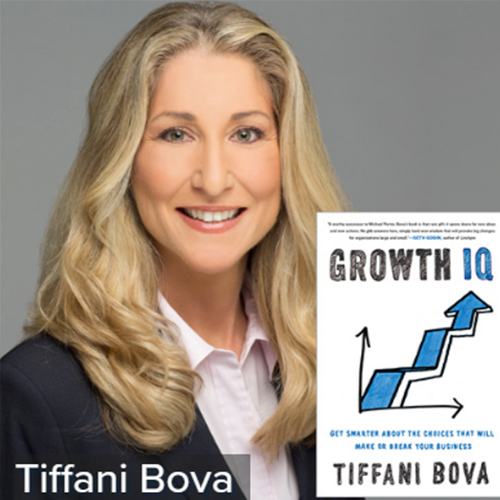
Tiffani Bova is the global customer growth and innovation evangelist at Salesforce and Wall Street Journal bestselling author of Growth IQ: Get Smarter About the Choices that Will Make or Break Your Business (Portfolio). Tiffani has appeared on MSNBC and Yahoo Finance and is a regular contributor to Forbes, Harvard Business Review, Marketing Matters on Wharton Business Radio – SiriusXM and HuffingtonPost in addition to a variety of industry-leading podcasts. She is a top influencer in Customer Experience, Digital Transformation, the Future of Work, and Sales, and she was recently recognized as one of Inc. Magazine’s 37 Sales Experts You Need to Follow on Twitter, a LinkedIn Top Sales Influencer, a Brand Quarterly Magazine Top 50 Marketing Thought Leader, and one of the most Powerful and Influential Women in California according to the National Diversity Council.
Tiffani also hosts the podcast What’s Next! with Tiffani Bova which has featured guests from Arianna Huffington to Dan Pink, continues to rank as one of the top 100 business and marketing podcasts on iTunes, and won top Sales and Marketing Podcast by Top Sales Magazine in 2017.
This is the Athletics of business podcast episode 26.
Welcome to the Athletics of.
Business, a podcast about how the traits.
And behaviors of elite athletes and remarkable.
Business leaders frequently intersect the real stories.
And hard lessons to help you level.
Up your leadership and performance. Now your host, Ed Molitor. Welcome to the Athletics of Business Podcast and I am your host, Ed Molitor. Today's special guest is Tiffany Bova and you might want to put your seatbelt on for this introduction because it is amazing. Tiffany is a Global Customer Growth and Innovation Evangelist at Salesforce and Wall Street Journal, Best selling author of Growth IQ Get Smarter about the choices that will make or break your business portfolio. Tiffany has appeared on MSNBC and Yahoo Finance and is a regular contributor to Forbes or Harvard Business Review, Marketing Matters on Wharton Business Radio, SiriusXM and Huffington Post. In addition to a variety of industry leading podcasts, she is a top Influencer in Customer Experience, Digital Transformation, the future of Work and Sales and she was recently recognized as one of Inc. Magazine's 37 sales experts.
You need to follow on Twitter, a LinkedIn top sales influencer, a brand quarterly magazine top 50 marketing thought leader and one of the most powerful and influential women in California according to the National Diversity Council. Tiffany also hosts an amazing podcast, what's Next with Tiffani Bova which has featured guests from Arianna Huffington to Dan Pink. It continues to rank as one of the top 100 business and marketing Podcasts on itunes and won Top Sales and Marketing Podcast by Top Sales magazine in 2017. Having delivered over 400 keynote presentations on sales transformation and business model innovation to over 350,000 people around the globe, Bova is highly sought after keynote speaker.
Prior to working with Salesforce, she was a BP Distinguished Analyst and Research Fellow at Gartner where she earned accolades from the best leaders in the technology world including hp, IBM, Amazon, Oracle, SAP, Cisco and Microsoft. For her cutting edge analysis and her skill at inventing bold strategies for growth. Boba has also lived in the fast lane of high tech, leading sales organizations, driving growth and creating durable competitive advantages for startups and Fortune 500 companies alike such as Sprint, Intercom, Interlam and Gateway computers. Throughout she learned how to lead sales and marketing teams in hotly competitive markets. She is considered one of the early pioneers of cloud based indirect channel programs and completely reinvented go to market tactics in several hardware and services businesses.
Her high velocity years at the front lines also gave Boba the hands on expertise executives crave and their strategic partners and made her an authentic, passionate and brilliant advocate Committed to her clients, success and prosperity. Tiffany, thank you so much for joining us today on the Athletics of Business podcast. I am, I'm fired up. I'm honored, and I'm very humbled to have you here today.
Oh, well, thanks, Ed. Thanks for having me.
And your journey to me is amazing. I mean, obviously we all believe that success is a journey, not a destination. There are so many things that we can talk about. If you would see my. If you could see my desk right now. I have several pages of notes from different interviews of you that I've listened to and some things I've read. So can you just kind of take us along to the beginning of your journey to where you are now and what you're doing?
Oh, my goodness. Like, we only have.
That's right. I did say 35, 40 minutes.
35 minutes. However.
Yeah, however you see fit, Tiffany.
So I'll give you the Reader's Digest version. For those of you listening who know what Reader's Digest is, I will give you the Reader's Digest version. You know, so I always joke, I call myself a recovering seller because I started my career really in sales. I always found that was something I was naturally good at. And so I started selling technology and sort of grew up there, you know, individual quota carrying sales rep. And then I managed teams and then I managed bigger teams, the bigger teams, you know, and it sort of just grew that way. But then along the way, I expanded my understanding of marketing and started running marketing teams. And then one more step further, sort of started running customer service organizations as well.
So I was a practitioner, if you will, on sales marketing and customer service, both for hardware and software, and very early in the cloud days, sort of 1999 to 2003. Ish, 2004. Ish. And then my last sort of quota bearing role, I ran a division of the indirect sales organization for Gateway computers. And then I landed at Gartner. So I had the privilege of working there for a decade and I left about two and a half years ago as a research fellow covering sales transformation and digital transformation and really go to market models and how companies had to sort of rethink that.
And now I've spent the last two and a half years at Salesforce as the growth and innovation evangelist, having the honor and pleasure of traveling around the world and speaking to so many amazing executives and companies that are just out there fighting the fight on behalf of their customers.
Well, what amazes me, one of the many things that amazed me about you is how do you keep Your message. You talk about going from sales to marketing, working with customer service, and all the year you spent at Gartner and now here you are speaking. You've done over 400 keynote presentations on sales transformation and business model innovation to over 350,000 people. But the thing that amazed me, how do you keep your message? With all the knowledge that you have and all the things that you've learned and shared, how do you keep your message so tight? Is that a challenge?
I will tell you that even during my time at Gartner and now I work from home and I say that in air quotes because I'm on the road so much, but I'm not in an office. The way I am able to one keep the thinking fresh is because of those interactions I have when I'm on the road. Whether I'm speaking to an individual executive on a one one situation or just a company know we're doing an executive briefing or I have a meeting with a Salesforce sales rep and I go and I'm meeting a customer, that conversation is sort of a touch point. And then when I'm on stage and I get a chance to speak, small audience or big audience, you know, I'm feeding off of are people resonating with the message that I'm saying.
You can see it, you know, I mean, unless you're. The lights are such that you can't see it, but you can sort of see it. But beyond that, people will stop you in the hall. And I actually ask, what didn't they agree with? I do that a lot where I'll say, what did I say that you. It just didn't hit home for you. And so each of those, every single day, every single week, every single month over the course of 12 or 13 years, I have this. I guess my superpower, if you will, is this ability to aggregate lots of data points and be able to succinctly put it in a story that resonates with people who I'm speaking to.
I think I always get feedback that those in the audience or that I have a conversation with will say, it sounded like you were talking about my business. It was like you were talking right to me. That's exactly what we're struggling with. And the only way you can stay that close to the pulse of the market in the category that I talk about is with lots and lots of conversations.
That's phenomenal. And when you talk about the message, communicating and talking right to them, as you went from sales to marketing to customer service, truth be Told those can be three different types of languages with how you communicate with people. Is that something that got you ready to speak to all these folks and to be able to communicate all your data points in such a succinct way?
I think what allowed me to do that was being a practitioner and not just an academic that studies. It gave me both sides of the coin because I understood the little subtleties and the nuances of actually being a sales leader or having to run a marketing campaign, or trying to bridge the gap between sales and marketing, or how do you improve customer service? When I've sat in customer service center call centers and listened in on calls and tried to really fix some of the things and amplify the things, we did well. And so I think being a practitioner gave me a really unique perspective as an academic when I spent my time at Gartner.
And that blend of those two things, specifically, as you mentioned, Ed really going from sales and understanding marketing as much as I could, really, and then understanding customer service as much as I could, because my skill is really selling. But what was fascinating to me is if I began to work more closely with marketing to understand what it meant to sell, the easiest way for me to do that was I actually took marketers out on sales calls with me so that they could see the materials that they were putting in front of sales to use as enablement tools in action or inaction, as sometimes the case would be. And it really helped my marketing team understand that they were spending time on things that were not very valuable in the customer's eyes.
And then from a customer service perspective, having everybody in sales and marketing actually sit in on customer service calls, marketing very quickly realized that they should be enabling customer service as much as they enable sales, because after the sell customer service is that touch point. I think that it was accidental, my understanding of those three. But even when I'm on stage, I always joke or when I'm with executives. How I started this out is like, I still bleed sales blood. And I pick on marketing because it's fun to do from a salesperson's perspective. But I want people to really feel the opportunity and understand the opportunity with customer service. And so I've really spent time on that lately.
The ability to be able to go from sales to marketing, though, there had to be some sort of level of trust you had to develop with the folks you worked with. And that obviously takes communication skills. What were the, you know, a couple of the things that you really focused on in terms of communicating when you transition from Sales to marketing in terms of communication?
Yeah, that's a great question, because I would tell you that the first couple of times I did it wrong. I sort of went in and sort of told them what I thought, which was not the right approach. And so probably the second time I did it incorrectly, I decided to change it up a little bit. And I said, okay, how can I communicate this message? And when I say I, I don't literally mean I have to be the one that communicates it, but how can I sort of share this philosophy or way of thinking or the subtleties of actually selling to marketers who already have an aversion to sellers for whatever reason? And so I had some really great advice from an outside company, was helping me sort of strategize on ways to improve sort of the things were facing.
And one of the consultants said to me, look, we just can't make this an emotional conversation. We've got to give the facts and let them come to the conclusion we want them to come to on their own. And it was one of those lessons that I've now applied so many times and in so many ways, where literally the little quick comment I made about having marketers join a sales call, but not as a marketer, literally, I had them go in and act like they were a new hire salesperson so that the customer did not change what they said based on what were saying. Like, oh, I don't want to tell the marketer that the PowerPoint presentation or the collateral was a waste of time because I don't want to hurt their feelings. But the customer would most definitely say it to a salesperson. Right?
So once I did that, it was this miraculous turnaround where I no longer had to argue the point or debate the point. They kind of came to it on their own. They were like, look, we're just spending time on things customers don't value. And I think that's one of the greatest lessons is companies get very stuck in the. What they want to do instead of thinking about what the customers want them to do.
In addition to that, did you. Was there kind of an exchange, so to speak, where, you know, I believe one of the things in communication is going to where the person is, and not just physically, but, you know, emotionally, mentally, what. What their thinking is. And did you. Okay, so they were new hire sales folks and that helped them understand you, that helped them understand the customer. But did you do something along those lines and trying to, you know, figure out and get to know what was Going through marketing's mind.
Yeah. And I would say this, I'd say, you know, while I wasn't, you know, classically trained as a marketer, you know, I remember when someone very early in my career go, well, you know, we have to go through the four P's, and in my head I'm like, what are the four P's? Like, you know, I had no idea, right. So I had to go look it up, you know, and back then there was not the Google, so I had to kind of figure it out. But ultimately, you know, it was a matter of really understanding what they were trying to achieve and putting myself in their shoes as well.
And, and I would say the thing that became really clear to me was the metrics that marketing uses, the way they go about sort of obtaining budget, the ROI on those spends and how they make decisions on where they should spend and how they should spend over time. If we're talking from kind of 2000 to 2006, it was very different. It was search engine optimization was just showing up. Tagging banner ads on the Internet was just showing up. Print and trade shows was still the dominant spend. So it was this massive transition between sort of the standard way, traditional way that things have been done to moving towards this more Internet driven at the time, the World Wide Web, what that was doing. And so were all learning at the same time.
And I think that helped them realize that I didn't know, they didn't know, neither one of us knew. So let's go on this learning journey together. And I think it went a long way for them to use your words, to trust me, that I was there to make sure that they were going to be successful and that it was really about making sales and marketing more successful together.
What were some of the biggest challenges that you faced in that process when you first started doing this?
Oh, I would absolutely say what you said. Right. You know, being a seller, they're like, oh, you know, she doesn't understand us. You know, salespeople don't follow up on our leads. We work hard, we do all the stuff, we're underappreciated like. But then I also had to put a mirror in the face of marketing as well to be like, look, this is what they hear from you. We don't really need salespeople now. Everything's being, as time was going on, driven to the web. People click through a banner and go right to an E commerce page and buy. What do we need salespeople for? That was the wrong approach on Both sides. Sales saying, we don't get good leads for marketing, we don't use the collateral. Marketers saying, salespeople don't follow up on the leads. We don't really need them anymore.
They that we had to find a way where there was sort of this common ground, this sort of zone of respect for each other. And the only way I could do that was to get them to sort of work with each other. So I would assign salespeople to a marketing campaign to say, hey, while they're developing the promo, this salesperson is going to be your point person. And they'd have to run stuff by. So the salesperson would say, hey, I'm telling you that customers are not going to see the value if you waive the setup fee and then charge them three months and they have to pay. Pay three months. That's not really an incentive. I think that's going to work for them. And so marketers would then hear real time feedback. Salespeople would hear, well, no, this is why we do it.
We're trying to get the acquisition cost paid back within 60 days because that's the sales would understand. So then when that salesperson went back to the floor and other salespeople would complain about the latest promo that marketing had launched, that salesperson almost came to the defense of marketing. And then it just really naturally happened, but it didn't happen quickly. It was over time. And you had to find the right rhythm of getting people to engage with each other and get very uncomfortable because salespeople to marketer to salespeople. So I think that went a long way.
So you just said something that is huge to get really uncomfortable. In other words, they need to be comfortable with being uncomfortable. How did you get folks to do that and how do you still get folks to do that?
Oh, I think that's the hardest thing. I think I use a quote in my presentations now from Ginny Rometty, that growth and comfort don't coexist, that you just have to get uncomfortable in all kinds of ways. Sales, marketing, product development, you know, everything right now. Because the pace is so quick that just when you start to get comfortable, it's time to get uncomfortable again.
Right.
And I don't mean everything, but, you know, it's not 100% of the time I'm 100% uncomfortable. It's, you know, I think if you're 30% uncomfortable all the time or for, you know, you have to find your place, but ultimately it's a matter of if you're Feeling comfortable, something's wrong because it's just not consistently that predictable at this point in time.
So all of this contributes to what I would think is a culture that you would consider worth fighting for. In other words, we're doing all this work, we're getting outside our comfort zone. We're creating this environment where we're going to get to the other side of fear now. And I'm going to go back to the new hire mindset. Now you go out and you want to get the best of the best to contribute to this culture that's worth fighting for. Do you compromise that? And I shouldn't use the word compromise, but it comes down to a culture fit through an extremely high level of talent. Who wins the day on that one?
Well, I think this is a very active conversation now around this quote, unquote, culture fit. Because if culture fit means we want someone who thinks like us, then there's kind of no diversity of thought.
Right?
So I'm a huge proponent of diversity of thought because I think it brings in unique perspectives and points of view. So diversity inclusion to me is not just, you know, between male and female or between race or religion or I also look at the way people think. So you have extroverts, which salespeople are tremendously extroverts more often than not, versus an introvert. And so, you know, let's just say the marketer is an introvert and the salesperson's an extrovert and they're trying to have a conversation about what to do, who's going to win that conversation. And I don't mean win like that. They're right. I mean win because the introvert's just like, I'm just not going to have this conversation, which is never good. So culture fit is one that you have to be very careful of.
So they think like us, culture fit, not a good culture fit. Culture fit like. Well, they're really capable of working in an environment where there's not a lot of structure. They're self starters, they're, you know, that kind of thing, you know, but then you need some adult supervision. So it depends what role they're in. So culture fit is, you know, a really interesting comment and sort of thing to think about when looking to hire, especially in a sales organization, that you can't have all of these, to use the sports analogy, right? You can't have for the Ryder cup, you can't have eight Tiger woods, number one. It's not possible. They're all very good golfers.
They're all winners in their own right or do you need all kind of clutch and short game player plus someone who's an overall really good player, someone who's really good on this particular kind of course. Or that you just need mixture because the power is in the combination of the team. And I would say it has to all though have an understanding of what the culture of the business actually is, what the personality of the brand is to make sure that they're always doing what's right to align themselves to those things.
Yeah. And it's funny because when you talk about culture, you don't really realize all the different things that go into it. The introverts, the extroverts. And I guess when I pose that question and I look at culture in my time coaching college basketball and, you know, working in the recruiting industry, when I talk about fits, I'm talking about, okay, are they an authentic human being with a solid foundation of core values? You know, what is their work ethic? And are they going to come in and I don't want them to think like us and they can challenge the status quo, but are they going to value being a part of something bigger than themselves?
And you know, we've all been burnt by where we took the superstar, thinking that we're going to get them to maybe change their ways than what they were like at their previous organization. But all the red flags were there, but we just ignored them. And I guess that's what I'm asking by the culture fit, which you answer, which is it is. It's a very hot conversation. And it's, you know, it kind of sometimes boils down to what came first at chicken, you know, or an egg. I mean, are you gonna not think someone can adjust and buy into the culture or believe it into your culture, but, you know, along those lines, and this is gonna, you know, I talk about a culture we're fighting for, this will seem a little bit ironic, but a safe environment to fail, how important is that?
And when I talk about safe, I'm not talking about soft, but how important is a safe environment to fail?
Yeah, and I think that it is more likely, right, Because I don't need it to be reckless. I mean, I often people will say speed is the new currency. And I, and I don't disagree with that. But I don't need people to be sort of Steve Jobs or Marc Benioff or, you know, somebody who's going to be way out in front of the market. But I need you to be one or two quarters ahead and meet your customers when they arrive. So I don't need speed and then sloppy. Right, so. And I feel that same way around culture. Right. I think that you have to think that there has to be a fit because a bad hire is so much more expensive. Depending where your listeners are in the world, in some regions you cannot fire somebody.
So then you've made a bad hire and now it's your responsibility to find a place where this person is going to be the most effective and successful versus saying, look, we need to be really get really much better at hiring and what kinds of skills do we need? What things are going to make us more successful? And I think that goes back to diversity of thought, but also just are they risk adverse? Are they comfortable? Are they willing to take advantage of things that are going on in the marketplace? And the only way that those kinds of scale fast or scrum teams or agile development and all that is if management allows the freedom for employees, all employees to make a mistake. And it's not going to cost them their job. Obviously if lives are not at stake.
I mean just the general, like that campaign was terrible. Like let's not fire them for it. What did we learn from it? Let's do it better next time. They have to trust the fact. And that goes back to your culture question. If that's the culture and it's someone who wants to try things but has never been allowed to at other places, they might really thrive at your company.
Mm, right. And you know, talking about hiring and talking about hiring mistakes, how do you have to adjust the hiring process mentally in a tight labor market? What kind of things do you need to get really dialed into really good, inefficient.
Well, I think, you know, there's been a lot lately around artificial intelligence being used in the hiring process, you know, to just be able to scan through resumes and really look for the kinds of fits that would then get an interview. And I think that it has a lot to do with understanding what your own culture is and then what kind of fit it would be. Because I think for many people, if we're talking about sales, you know, lots of sales leaders grew up in sales and just because they were really good sellers does not mean they're really good managers. And then they may get promoted again. And now they're like in a senior leadership position and they don't know what it actually means to hire and understand what the culture of their sales force. Two words.
What Their sales force actually is so that when they go to HR and say, look, I need people who are not going to be face to face sellers. I need some that are going to be just really inbound, conversation, relationship kinds of people. So I almost don't want them to have hardcore sales skills. Maybe they were in hospitality, right. Maybe they were in a big. Maybe they came from the customer service organization that they're much more customer focused than selling focused. And I need that kind of personality that would require a manager to really understand the culture of his own, his or her own organization. And I don't mean that it needs to be different than the company, I mean the dynamics within that. Once again, going back to sports, right? You think teams, when LeBron James and Dwyane Wade first got together, right.
That they didn't work well together until they figured out how did we take two a type extrovert, big personality, really capable and skilled basketball players and put them together, or Shaq and Kobe, I mean you can rattle it off, but really well oiled teams, like you'd say, like the New England Patriots, where there are lots of leaders, but the team works so well together and their recruitment strategy is so focused on what can we add to the team. Where do we have needs? Not we need another Tom Brady as a backup quarterback. Like that's not. Why would we use that in the recruitment. We need to make sure he's protected. So maybe we need to invest a little bit more in the, you know, the offensive line as an example. Right.
So I think that understanding what your team is, whatever that is in the organization and then what kind of skills you need and then making sure you really understand the dynamics between the leaders in your team and the high performers. Because it's your job to make sure everybody is on the same page.
So let's say, and I love that, let's go back to LeBron and D. Wade and you have two high performing, you know, a type personalities. It's just not working at first. What kind of adjustments do you need to make? I mean, do you have to get to the singleness of purpose? Do you have to dial into the team or the organizations? Why? I mean, how would you go about doing that?
Yeah, well, I think it comes from both sides and I think that's another message as well, that it's not only the coaches in that particular case. Right. That had to find a way to get sort of the vision of pulling these two players together with a stack with the goal of we want to bring a championship to Florida, right? So it was very much like, what can we do? That's our goal. We're either going to all be rowing in the same direction, because if we're rowing in different directions, it's just not going to work. So from a coaching standpoint, it's. I need to share the vision of what we're doing and what we're made of and why we made the decisions we made. But simultaneously, you also have to. The players themselves, they have to find a way to come together.
Like, it can't just be leadership for expounding this great vision about what they expect from players and the vision and the goal and providing the platform by which they could have a very successful championship team. Like, all of those things were in place and they were dropping a whole lot of cash to do it. On the flip side, the players actually have to want to do it, right? And so it's like salespeople have to want to use the CRM system. The marketing people have to want to work more closely with sales. You know, sales has to want, you know, has to want to understand the relationship between the first sale and then customer service for ongoing lifetime value.
Like if there's no personal commitment that it can't be, everything around you as an individual has to change because you are just going to stay on your course. That's not the culture, right? That's not going to make a winning team, period, Full stop. Unless you're completely an individual contributor listening to this. And you own your own business and you are the sales, marketing, customer service, billing, legal department for your own company. But if you work with other people, going back to uncomfortable. Like for me, growing a business has everything to do with growing as a person. And you have to self disrupt, right? You have to be willing to be uncomfortable yourself and do things you're not comfortable with. So going back to the example, I don't know the. Obviously, I don't know the inner conversations between LeBron and D. Wade, right?
I was not sitting there while they were discussing this, but I'm guessing that they probably had a number of conversations with each other. We've got to figure out how we can make this work. We're the leaders of this team. We've got a whole, you know, city and state behind us with it. You know, the owners have spent a lot of money on us. We've got to. We've got to work out our differences off court. So on court. And it took. What was it? I don't. Because I'm not a.
It took longer than Pat Riley would have liked, that's for sure.
Yeah, but it was like a couple of years, right? It was a couple of years before. Yep, yep. Right. And here wasn't year one, like horrific, like everyone. Yeah. Okay, so I'm trying to do this from memory, but ultimately it took a couple years. So now let's go back to the analogy. In business, you can't just bring in a new leader and expect. When I say leader, I don't mean CEO. I mean someone on a leadership team and expect them to turn around the culture of a sales organization or a marketing organization or customer service, or all three working together in a quarter or in two quarters or in four quarters or in like, let's go back to that example with LeBron and D. Wade. Right. I mean, it takes time. Culture doesn't become toxic overnight, and it doesn't become amazing overnight.
It takes time and it's a commitment every single day. Every single day it's a commitment. Right. Show up to practice, do what you're supposed to do, or you do Kobe Bryant and you show up three hours before practice and get in 300 shots before practice even begins. Right, Right.
Yeah, yeah. And that goes back to the fundamentals and Kobe, it's just, he was unbelievable. And you said something, and Kobe would speak to this too, but you said something that was interesting. Self disrupt. I love that. I mean, you could self disrupt collectively, but also individually because we all believe that, you know, we is much greater than me. But I also firmly believe that in order to contribute as much as you possibly can to we, you have to work on me and how have you in your career. Could you share maybe a story or two or an example of how you've self disrupted yourself to get outside your comfort zone to take your career to the next level?
Oh, yeah. I mean, I would say the biggest adjustment for me, I mean, you know, the sales marketing and customer service, I didn't think was that big of an adjustment for me. I think a lot of that had to do with the company was 130 million- recurring revenue at the time. So big, but not a big multibillion dollar brand I was running. Right. So the teams weren't so massive that I couldn't sort of kind of get my arms around it. What was a really big transition for me was going from being sort of the practitioning practitioner on the sales marketing service side to becoming an academic, quote unquote, on the analyst side. When I went to Gartner, that was a really big adjustment for me. One Because I am a speaker communicator, not a writer communicator.
So I had to learn how to translate how I spoke to paper and writing research reports. And then the whole process of Gartner has something called inquiry calls. And clients would call in for half hour increments of advice and they would ask questions all over the map. So you'd have one call would be, hey, I'm a startup in Barcelona and I'm about to hire my first salesperson. What should I hire for? And you know, you hang up the phone, pick up the phone, dial into another call and it's, you know, I work for, you know, the largest software company in the world and I'm trying to social sell train 35,000 sales reps in one hour. That's the two conversations. And it's like ping pong, right? You got to. Okay, let me put my hat on for that question. Or what about account based marketing?
Or what about indirect channel programs? Or what about inbound selling or outbound selling? Or what about vertical versus geographic? Or what about. I mean, so you had to be like 3 inches deep and miles wide, right? How much you'd have to be able to. So it was this like nonstop consumption of input, both reading Gartner research and just, you know, I'd read one to two to three reports every single day so I'd know what were saying. So if someone asked me about the fourth Industrial revolution or the nexus of forces or whatever, I'd know what they were talking about. So I had to stay up on what were saying. So. But then I also had to stay up on what the big 25 tech companies in the world were doing.
I'd say that was a big adjustment for me to really start consuming information and data and where can I get it and then how do I aggregate it and then how do I get it on paper and then how do I communicate that out in half hour bursts and how do I make sure that the customers are getting value when they engage with me? Because it wasn't an inexpensive proposition to have a client. Ultimately, I'd say that was the biggest adjust. And I've carried that forward. Even now, where I consume a ton of content, people will toss a question at me and I just need to know what they're asking. I may not know the answer, but I at least need to know what they're asking so that I can say I don't really know what's going on there.
But when I first heard about that, I thought this. But it's really hard to stay up on everything that's coming out on a daily basis. It's becoming a student of your profession, whatever that is, whatever you know, that is really important. And I think coming from not being a student in college, just kind of making my way through, if you will.
But at a great school, though.
At a great school, Arizona State, perfect.
School to do that.
Arizona State was a great school, but I did not get a business degree and I did not go on to get my mba. And so ultimately I've had to learn how to be a student.
How did you prioritize with all this different data dump and all this information that you had to learn or read and all the reports? How did you prioritize your day? How did you prioritize what you know, what task you attack first? Because obviously this is something that just kept evolving over time in your career.
Yeah, and I often get asked this question because I put out quite a bit of content, if you will. And I'm pretty active on social, but I'm also very active just personally. So in a given week, I'm two or three places somewhere in the world. Last week I was in London, Oslo and Stockholm. This week I'm going to be in Sydney, then I'm in New York, then I'm in Toronto. I mean, it's just sort of ongoing. Yeah. And airplane time is my most effective use of time because I have no distractions. I was a little bummed when wireless hit airplanes because then it was like.
Darn, people have access to you all of a sudden.
Distracted. Right. So airplane time was when I would answer all my emails and do my writing. And as well, I'd take a stack of magazines and sort of like catch up on everything from a magazine perspective and then listen to podcasts. And so airplane time and travel time is really my consumption time and my thinking time, because I'm not, you know, I can't get up and go walk somewhere like I am where I am. Right. And so that has always been really helpful to me. So I think it's just a matter of finding that place where you can give yourself permission to consume versus putting out. Right. So if it's an hour a day or two hours a day, I mean, I at least spend two hours a day, if not more on that consumption.
And I may only output, meaning between tweets and blogs and presentations, I might output two or three hours. So it's a matter of taking in equally as much as I put out. It's the only way I can stay on top of things, but you have to carve that time out, and you have to give yourself permission to say no to certain things, to allow yourself the time. Because if you're just constantly running, you just. It would be like, you know, playing in a tournament every single day and never having time to practice.
Right. Well, how did you. So there's five hours of your day right there. How did you. Let's talk about the book. Growth iq. Find the time to write a Wall Street Journal bestseller. How enjoyable was it for you? Obviously, you produce amazing content. You love producing content. How enjoyable, how time consuming? I mean, let's dig into the book and what it has to offer.
Yeah, that was a journey for me as well. I mean, when I first started thinking about writing the book, to the moment I wrote the first word of the book was probably two or three years just kind of thinking about if I was going to write one, what would I want to write it about? What kind of book would I want to write? And someone gave me some great advice and said, hey, listen, you should write a book. You would want to read. And when they said that, it put me on this whole path of I actually read. I think it was like 75. It was at least 75. Could have been closer to 100 business books over the course of almost year and a half. Ish of all the best ones that were out there.
And I did it very specifically to say, okay, what's been said? How was it said? What did I think was missing? What did I think my experience could add to the conversation? I didn't want to say what had already been said. Like, how do I tell the story I want to tell in my voice? And by doing that, it really helped set me up for what I wanted the book to actually feel like when someone read it. And so I spent quite a bit of time on that. And I think my publisher would agree I was a little bit stubborn as it related to that because I had a very specific kind of idea in my head about what I wanted that to feel like. Then it was, okay, now I need to write the book, right?
So once again, I'm a speaker, not a writer. And so I kind of gave presentations to myself, recorded it transcribed it, and then it gave myself kind of a rough starting point and got thoughts down on paper. And then I realized that I wanted to keep it in this very specific format that I stamped out through the book. So each chapter has the exact same feel, exact same look. And so as you're reading, you know exactly what to expect. And there's 30 case studies in the book, but each case study is like 2,500 words. Going back to I wanted to write a book I would read that's about how long my attention span is. It was like, if someone reads this story, can it stand alone?
And then if they put it down and pick it up and read the next story, will it continue? Right, because not the goal is to have someone read the book more than like the second or third chapter. Because usually people stop there. How do I get them to want to feel like it's not a heavy read, but very full of valuable content and digestible so that they could jump around or consume it in whatever way they wanted? And so once I landed on what I wanted the architecture of the book to look like, then I had to say, what's the story arc? How do I take people on this journey with me? And then when that started to happen, I think the book really started to come together. And I almost did 70% of that handwritten editing. So I would print it out.
I was working with an editor and I would print out the work, literally. And when I would fly, I would hand write edits and then drop them off at his house on my way home from a trip. And the next day the edits would be uploaded. And so it was this very iterative process, but it absolutely handled happened when I was flying. But the book is, I don't know, 78, 79,000 words, ish, something like that. But it was 95,000 words. And so I had to take 20,000 words out of it. And was that hard for you? Well, it's funny, right? I'm not a writer. And then boom, it's 95,000 words.
Well, it is 30 case studies across 10 growth paths, which is amazing. So. And you said each case there's about what, 2500 words?
Yeah, something like that. Right. It's super digestible. Right. You can read it very quickly. I'm not going to tell the life and times of Red Bull. I'm not going to tell the life and times of Lego or Mattel. Like I'm just, you know, it's a very specific point in time and I'm trying to make a point, an example on the story. I tried to cross section those case studies across various industries as well as, you know, kind of home countries of where they're headquartered. And then you know, small, medium, enterprise, consumer, you know, B2B. Like, you know, I just tried to give it a flavor that everyone could Relate to.
And I think that the feedback that I've gotten so far has been that people found value in all the stories, even those they were less likely to have thought they would find some value in, like, the story of Kylie Jenner or Mattel or something like that, or Sephora, where they'd be like, I didn't think I was gonna learn anything. And I totally learned something from that story. So that was good.
That means you nailed it. That's huge. I mean, that's one of the better compliments you can receive right there.
Oh, I agree. And going back to what I said about, I want to hear what you didn't like. When people say to me, I really liked the book, I'll say, what stood out and then what didn't you like? And so it's only a. Obviously, I'm not talking to everybody who's read the book, but to the people who have been willing to give me feedback online or in person. Only a couple of people didn't like the format and structure and sort of the attention I put to the feel of it with sketchnotes instead of PowerPoint and Excel. You know, it's much lighter in the imagery. And then I highlighted things that if, you know, people like me are not going to read an entire page or an entire five pages if they were only going to read what I highlighted, I was okay with that.
And so I highlighted what I knew I wanted them to get out of it. Because sometimes you just scan through a chapter really quickly, like, once again, write the book you would read. And how did you read the books? Tiffany Bova with, You know, tough to keep my attention for long periods of time. Like, I can't have it be dry. It has to have a little humor. I mean, you know what I'm saying?
Like, absolutely.
How would you keep someone like me engaged in a book like that? And so a handful of people kind of didn't appreciate it, but the majority did, and that was good enough for me.
Well, and that's. That had to be a lot of fun. And still getting the feedback that you're getting has to be. Has to be quite enjoyable. Now, you said something about Red Bull, okay, the story of Red Bull. But that triggered something in my mind. You have a couple nicknames, and one of the nicknames I heard, I believe it was Tom Peters call you was the Blonde Espresso of Growth. Is that correct?
Yes. And that comes from Starbucks. That comes from Starbucks. Blonde Espresso is.
Yeah, I had one this morning.
And because he's the Red Bull of management. So there was.
Yeah, that's what. That's exactly. And then I. Wasn't there a cayenne pepper in there, too?
Oh, yeah, that was Kim from. Yes, from Capgemini. She called me the cayenne pepper of presentations. Like, you know, you're just not going to be bored, you know, if I'm up on stage telling the story. So, yeah, you know, it's. I'll take it, you know.
Well, I love it and obviously a lot of fun, a ton of fun. And I appreciate your time and everything today. Growth it. We'll have a link to that on our show notes@the athleticsofbusiness.com you can also connect to the website, the podcast website through our website, the molotor group themolatorgroup.com But Tiffany, you're active on. Very active on social media. Where can folks connect with you and find out more?
Yeah. So follow me on Twitter Ifani and it's Tiffani Underscore Bova. It's Tiffany Bova on Instagram, it's Tiffany Bova on LinkedIn. And then tiffanybova.com, is my site that sort of shares a lot of the content. I have a podcast called what's Next on itunes.
Great podcast.
Yeah, that sort of goes across the board with all kinds of really cool people. I just had Michael Lombardi on from a sports perspective. He is amazing in the NFL business and really the comments I made about teams came from him. So you should listen to that one. And then I blog a lot and try to give back as much as I can at. At other people's events as well.
Right. Well, Tiffany, I appreciate it. I love your podcast. I love the work you do. I cannot stress enough how grateful I am for your time today and for all that you do.
Great. Well, thank you, Ed, again for having me. It was really a pleasure.
All right, Tiffany, take care. Thank you for listening to the athletics of business. Be sure to give us a rating and review so we know how we're doing. For more information about the show, Visit the athleticsofbusiness.com now get out there.
Think, act and execute at the highest.
Level to unleash your greatness.