
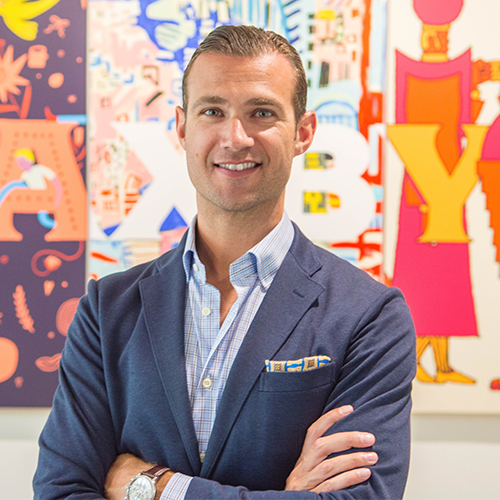
Nick Bayer is currently the Entrepreneur in Residence at Cornell University and faculty member at Drexel University, where he teaches a course in entrepreneurial franchising. He serves on the board of Big Brothers Big Sisters Southeastern Pennsylvania and has been a Big Brother for seven years.
Welcome to the Athletics of Business Podcast. This is episode 28.
Welcome to the Athletics of Business, a podcast about how the traits and behaviors of elite athletes and remarkable business leaders frequently intersect the real stories and hard lessons to help you level up your leadership and performance. Now your host, Ed Molitor.
Welcome to the Athletics of Business podcast and I am your host Ed Molitor along with our special guest today, Nick Baer, Founder and CEO of Saxby's. Nick has always been in the business of bringing people together, whether it's as one of Philadelphia Business Journal's Most Admired CEOs or as a consummate team captain since Little League. So when he created Saxby's in 2005, Nick never really considered it to be a coffee company. Instead, it's a social impact company fueled by amazing food, beverage and hospitality. Saxby's has since grown from one corner cafe to a 30 unit Philadelphia based business with a singular mission Make Life Better. For Nick, Making Life Better began by fostering an odd, outgoing, detail oriented and disciplined team committed to the betterment of the communities it serves and aligned by their shared entrepreneurial spirit and Saxby's core values.
Today, that team spans over 500 members across the Northeast that represent the change makers of tomorrow. To that point, Bayer introduced Saxby's pioneering experiential learning program, ELP in 2015 in partnership with Drexel University, the nation's first entirely student run cafe where students earn full academic credit and wages through a university cooperative education program. Bayer's vision for the program is to embolden the next generation of entrepreneurs, providing undergrad students with tangible experience as a supplement to traditional classroom learning. In three short years, one ELP Cafe has blossomed to five, with several more planned to open by the end of 2018. Nick is currently the Entrepreneur in Residence at Cornell University's School of Hotel Administration, an Adjunct professor at Drexel University, and the Executive in Residence at Temple University's Fox School of Business.
He serves on the board of the Franklin Institute, Big Brothers, Big Sisters, Independence Region, the Community College of Philadelphia, Drexel University's Close School of Entrepreneurship, and Drexel Steinbright Career Development center, as well as being a Corporate Council Member for the Children's Hospital of Philadelphia. In 2017, he was named the Entrepreneur of the Year by the Greater Philadelphia Chamber of Commerce as well as EY Social Entrepreneur of the Year. Nick resides in Center City Philadelphia with his wife and son Nick. Welcome and thank you so much for joining us on the Athletics of Business podcast. I am humbled and fired up. So to have you. How are you doing today?
I'm awesome, Ed. Thank you so much. I'm really excited to be here as well and chatting with you. We've got a lot in common and I look forward to chatting about our past and our futures together.
Absolutely, absolutely. Let's start with, let's get behind your curtain and let's talk about what experiences have shaped you in your life. Because what you have done with Saxby's is amazing. And I've got to think it's a direct result of a culmination of all the experiences and the decisions you made over the years based on those experiences.
Yeah, I would think so. I've been trying to spend more time reflecting on some of those things as the years go by. As you know, you get so caught up in what you're doing on a day to day basis that oftentimes one of the things you cut out is your reflection time. But I'm fortunate to be married to a really talented lady who owns her own yoga pilates studio, is very into mindfulness and meditation and just living a really healthy lifestyle and she's really taught me how to reflect. I think that's been important for me to sort of figure out what's gotten me to where I am today. The bumps, the bruises and the successes.
And I think that when I look back, I think it's like most people, it's sort of those early life experiences that you don't realize probably when you're going through them that are really going to shape a lot of what you do. So I look at where we are today. Today we are. I run a company that is, we like to call it a double impact company. We're equally focused on financial outcomes and social impact outcomes, meaning doing well for other people. And I think that's the way that businesses need to run moving forward. That's the only way you're gonna attract talent, it's the only way you're gonna attract customers is the way that you're going to create a culture driven business that can compete in the long term. And so that isn't something that I like learned in a business school class.
You know, I have an, I have a great alma mater. I went to Cornell, but I was an arts and science guy. I was a government economics guy. I didn't read that, I didn't learn that in the classroom. Like I wanted to create a business that is a double impact company because of my life experiences. My parents were really young when they had me didn't get an opportunity to get an education. And so for my 18 years living under their roof, they preached two things to me, one of which made a lot of sense to me in the moment. The other took me some time to understand. The first one was, get an education.
In this country, if you don't get an education, many doors that you can walk through just won't be opened or won't show themselves to you if you don't get an education. They really preach that on me and my little brother as well. Hence our mutual friend, Coach Marty Gahn. Going to Bennett Academy really changed the trajectory of my life. The second thing that my parents always talked about was, you're going to spend more time working than doing anything else, so do something that you truly love to do. And when my parents took any job, my dad took a job sweeping floors in a warehouse in the west side of Chicago when I was being born. Not because that was all he was capable of doing, but that was the only job that he could get.
He was a young kid with no education, and that's all he could get. And so he's made a life out of logistics, but it's not what he loves to do. And so as I started to go through colle and get ready to graduate college, that second piece of advice my parents gave me, like, do something that you love to do, was really the thing that I tried to tackle. And what I love to do is I like. I like to make a difference in people's lives. I like to do nice things for people. I like to challenge people, I like to give people opportunities, I like to reward people. And I think that's a great way to be able to make a career.
And I chose to do that through business because, as you know, I'm a former athlete, I guess, and I like competition. I'm at my best when I have to bring it every single day. You bring it every single day. But in your heart and your mind and your actions are filled with this commitment to do something for other people. I think greatness can come out of.
That, and that's huge. And when you're an athlete and give yourself some credit, you may not be a former athlete, you're still an athlete, but the elevated level of joy that you feel when you're playing and you're competing and you're involved with the team and the program and you're building something that's bigger, you know, bigger than yourself, how has that played into your business?
Yeah, it's really what we stand for. So like, you know, back sort of behind me. Our mission core values are on our wall. It's 18ft tall, it's 50ft wide, and it's a. And they're all very simple statements. There's one mission statement which is to make life better and there's six core values. Things like we talked about sort of at the beginning. We embrace being odd, outgoing, detail oriented and discipline. You serve yourself by serving others. We're a community serving our community. We care personally and communicate openly. Those are all about human experience. Those are all about what you do with and for other people. And they're not individual to Nick Bayer, they're not individual to the coffee business. They're things that I think transcend me as an individual. They transcend what my business is and what we do.
But they're all very committed to being a good person and doing things for other people. Because I think if you continue to attract five people, 20 people, 500 people are now sacrifices. Almost 900 people. In our company, you bring 900 people together who believe in the concept that you serve yourself by serving others. They're going to be outgoing, detail oriented and disciplined. You bring all of those like minded people together, all of a sudden you've got a real culture. And if that culture is predicated on doing something for other people, I truly believe that you can not only make a business out of that, you can make a really good business that's very hard to convert compete out of that.
Yeah, that's huge. And that whole, the synergy that happens and the momentum you get with that culture has to be pretty phenomenal.
It is, it's really special. You know, I walk around like I'm sitting in center city Philadelphia right now. There's 17 Saxby's within probably 40 blocks where I'm sitting. So it's not uncommon for me to see people holding Saxby's cups. But this morning, like I do Pilates at 6 o' clock in the morning. It's right next to a Saxby's. I see people coming in and out of the Saxby's. I walk my son to school, I walk my floor, different taxes to get to school. I see my street and I tear up. Like I still this day. Like, it's like I'm seeing the only person in the world who's drinking my brand. Even though there's 15,000 people that are gonna experience my brand today. But like I get this like sensation.
That is it, you know, it's Almost second to none to see people that are sort of sharing in your vision and knowing that those people are coming to us because, yes, we have great product, we have even better people. We are in the people business. I know that people continue to, time and time again, come into my cafes because they know that our people are great people who, like, treat each other well and are going to treat our guests well. And that makes me feel really good. And I watch people in my business love what they do. You know, we've got industry low turnover. And it's not because I'm just plucking out the Bennett Academies or the cornells or the pens, whatever schools of the world. 10% of my organization are what we call community hires.
People that we've hired out of homeless shelters, job reentry programs, meaning they've spent time behind bars, high school dropouts. We're giving them the same jobs and the same career development opportunities as those that went to great colleges or potentially studied leadership, management or business or entrepreneurship. So oftentimes, people are getting these unbelievable experiences by people that are well trained and well supported and not even realize that we hired that young person out of a homeless shelter, that 17 years old, that person was living in a homeless shelter. And we hired them, trained them, loved them, challenged them, and gave them an opportunity to really blossom. And that's what's so much more special about this. This isn't a business model purely making money. It's doing good for the world while also making money for our people as well.
That's incredible and very powerful. And I'm going to get back to seeing someone drink out of your Saxby's cup. Okay. And tearing up because you stole my thunder. That was one of my questions about when you walk into a Saxby's. But I want to talk about the homeless. Hiring folks from a homeless shelter. I learned a lesson at a very early age. When I was at Creighton, Coach Brony had us feed the homeless on Thanksgiving morning. We didn't have an opportunity to go home. We had a game coming up. We had an opportunity to feed the. Feed the homeless. And we sat there and we played checkers with them. We played chess with them, we played cards with them, and we talked to them. We spent, you know, almost three quarters of a day with them.
And I realized that they were trying the best that they knew how. They were trying to do things the best that they knew how at that point in their life. So when you hire these folks from the homeless shelter, can you talk about the skills in the sense of the behaviors that they bring to the table that make them successful. Because I did read once where the success rate was. Can you talk a little bit about what makes them successful and how that's very similar to what makes the college students so successful? Yeah.
So, you know, we're very focused. So when I call Saxby's a double impact company, the non financial impact, the social impact, if you will, what we're very focused on is what we call opportunity and education for young people. You know, that's really where our area of expertise is. Because if you don't stand for something, if you don't put all of your efforts behind something, you're probably not going to help really anything, you know. And so I always use the dramatic example that I love animals, but Sachses is not aligned with animal welfare. And that's just not what we do. Because I can't do much with that from a business perspective. I can provide opportunity and education for young people regardless of what circumstances they were born into. So Someone in Philadelphia, 19103 is Rittenhouse Square, center City. It's dense, it's affluent, it's educated.
My son couldn't. He had nothing to do with the fact that he was born into that zip code. And Dante, one of my closest friends, he's like a little brother to me that I hired out of a homeless shelter when he was 17. He had nothing to do with the fact that he was born into a zip code that was the second poorest zip code in America, loaded with violence, doesn't know his father, his mom was in and out of his life. He had nothing to do with that. And so for us, when I talk about hiring homeless, our area of specialty or focus is on young people. And it breaks my heart that, I mean, this morning it's a cold day here in Philadelphia, so I walk my son through some subway tunnels.
Like, once we get to a particular point, we can sort of walk about four blocks under the city because it's like warmer down there. But once we go down there, I mean, we walked by at least six people that were sleeping in the subway tunnels. My son understands what that is now because he sees it all the time and he lives in the city. But, like, we're more focused on keeping those people, the young people who are going to be that guy five years from now get them opportunities when they're 16, 17 years old, so they're not sadly sleeping underneath the city when they're 30, 40, 50 years old. Well, a lot of what we do is on the young people, because on the second side of that is we can mold them.
When I hire Dante out of a homeless shelter about six years ago at this point, I walked in and saw a kid whose flame was still burning. I walked into this homeless shelter, and he still had energy in his eyes, on his face. The flame was still burning. When that flame gets extinguished, I don't know. I'm not a psychologist. I'm not a trained professional in those worlds. I don't know what you can do in those situations. I'm hyper focused on when the flame is still burning in someone, regardless of where they grew up, regardless if I'm interviewing them on a college campus or in a homeless shelter, I'm going to do everything possible to protect that flame and put more power behind it. And that's what we do.
And look, Dante, I use Dante as an example because Dante is probably the longest standing, most tenured person in our company. But he's also a mentor for many other young people that come out of similar circumstances, either from behind bars or from homeless shelters or in some situations, from both situations. And so Dante, nobody really knows when Dante is training people or supporting people or mentoring people. Many people don't realize he came out of a homeless shelter because he has all the intelligence, all the energy, all the capability of someone who didn't come out of a homeless shelter. And so my focus right now as a business and for us, as a leadership group, is to get to people when they're young before their flame has been put out.
So what was it about Dante that jumped out at you, besides the flame, that you're like, this young man has a chance. And then when did you know after you hired him, when did you know.
That he definitely did get it? Yeah. The quick story of that is there's a great organization. It's national. They have it in Chicago as well. It's called the Covenant House, and it's a youth shelter. And so the executive director called me up here in Philadelphia. I think people recognize how much we do for young people and this idea of opportunity, education, and being a social impact company. And so they called me up and said, nick, there's two things that we need to be able to keep doing what we're doing. One is money, and two is jobs for our young people. We need to start normalizing them in society. So can you come in here? We know that you put your money where your mouth is and really hire young people. Can you come into the facility?
I said, I will literally be There tomorrow morning. What's the earliest I can get in the facilities? At 8am you can come into the facility. So I come in. It's in the Germantown section of Philly. Tough, tough area. And I walk in, and they do a nice job with this place. They try to make it feel like a college dorm, but the reality is they have to make it almost like a prison as well. Like, it's very secure. There's a lot of rules. So I come into the facility, they bring me up to the third floor where there's a conference room, and I look in the window, and there's a young man sitting in there all by himself in this facility that I know what it is. It's a homeless shelter, and there's a lot of security around it.
This young man is sitting there early in the morning by himself with a huge smile on his face. I'm looking in there, and I look at the executive director. I'm like, what am I missing? Like, why does he have a smile on his face? And I'm someone who, like, wakes up in the morning with a smile on my face. I'm like, why does he have a smile on his face? Like, Nick, he is one of the nicest human beings I've ever met. So I knew when I looked in the window, I was going to hire him. And so I went in there. I still talked to him about 45 minutes. Lo and behold, Dante was a spectacular high school athlete. He was one of the best running backs in the city of Philadelphia.
Blew out his knee when he was a sophomore, already playing varsity. And he's like, I couldn't play sports. And I feel like sports and school go hand in hand. So we just stopped going to school. And so I go in there and I hire them, and we put them in the location that's ironically about a half a block away from where I live. And every one of our locations is run by a CEO, a cafe executive officer. And I get a call about two weeks in from my CEO, and candidly, I was like, they might tell me that Dante hasn't shown up or this happened or that happened. Instead, they're like, nick, our team members of this cafe actually want to create a team member of the month award. Do you mind if we do that? Of course not.
I guess that's your call to do it, because we really want to recognize Dante. Like, he is unbelievable. And so, for nine straight months, Dante won this newly created team member of the month, and they literally shut the award down.
I have goosebumps right now. That's such a cool story.
He's been promoted. I think Dante's been promoted about six times in the last five years. He's now actually officially into our CEO training program. So in the very near future, Dante will be a CEO in our company. Will he be managing his own team? He'll be fully responsible for his own profit and loss. I mean, he's a team lead three right now, so he's already got significant responsibilities, a critical part to our organization. But that CEO is a culmination of. You are really ready to go, you're really ready to be an entrepreneur. You're really ready to be a business leader. And he certainly has it. Regardless of where he was born, regardless of where we hired him from, he has it in him.
That is really cool. And if, I mean, that's an unbelievable story and I would love to check back in a year from now and see what, where Dante is. Because who knows what he can accomplish, right?
Sky's the limit.
Yeah. So I want to jump back to the story you're telling about. Let's just, let's say you walk into a Saxby's cafe. Okay. I didn't realize you live so close to so many of them. But you walk into a Saxby's cafe and you see it running like a well oiled machine and people just living out that culture. How does that make you feel internally?
I mean, look, it makes me feel great, but at the same time, you know what it's like to be an entrepreneur, to be a business leader. There's that constant pull away from the desire and the commitment to trying to be perfect. And so it's hard for me to walk into a cafe and just be like, this is perfect. This is amazing. There's nothing going wrong. It's natural. I like to call it this idea of having healthy pessimism. Everybody has to have some level of pessimism towards what you're doing. Meaning we could do this better, we could be quicker, we could be smiling, or we could be all these kinds of things. But you have to channel that in a healthy way. Because if you're always down, especially as a leader. Now I have almost 900 people in this company.
When I walk into a cafe, they know who I am. Like I'm 65 with slicked back hair. They know who I am. And so like I can't really be incognito. And so like if I come in there and I'm disappointed or I'm like short with them, that's not gonna benefit anybody. So I have learned over the time that I need to make sure that I'm always looking for. For the pause in those situations, but knowing that we have to continue to strive to better. But walking into a cafe and to our guests, like, maybe some of our guests know me, but a lot of them don't like when we go into these cafes. Like, that's why I like our CEO program so much. I go into our cafes, college or otherwise.
If they want to know what's happening in that business or why that business matters, they're going to go to that CEO and not me as the CEO. That's their business. So I like being able to come in there and just sort of sit down as a guest. It probably unnerves my team members a little bit, but I like that the consumers in there think that I'm just some regular Joe and I get to just sort of share that business, not experience them. And that makes me feel really good.
Yeah. And you just, you said something here a couple minutes back that's huge because, you know, when I was in college coaching, it was that whole you could watch game film after a huge win, right? And your players are out who knows where celebrating, having fun. You're sitting in the office and you need to figure out a way to enjoy it, because you could sit there and you can figure out 25 things that you did wrong as a team on that film. But you have the ability, and I'm going to go back to something. You have the ability to be able to enjoy things in the reality of the situation. And you talk often about being happy at home and being happy at work. Can you talk about that a little bit and where that came from?
Yeah, I mean, it's so. I love my parents to death, you know, I mean, that's your first education, the first 18 years when you grow up in your. In your parents house. But like, my parents sort of match. The way that they came together wasn't necessarily ideal. They were kids who started having kids, you know, without an education. And so growing up in that house was. Was tough, you know, like they. They had some challenges in their relationship, and money was always a major issue. And it was just like this constant sort of fighting and arguing. And I remember my dad telling me when I was, you know, probably in my teens, he's like, look, Nick, the things that we do well, do them way better. And the things that we don't do well, just don't do them, you know?
And so I realized A couple things. When I was going away to college and the first person in my family go away for college, that I was, A, going to get my education, B, I was going to really wait to get married, and C, I was going to wait until I had sort of established myself before I had a family. Because it's one thing when people can sort of look from the outside and see when young people are having kids, it's another thing to sort of grow up in that environment. It is challenging. It's really challenging. And so I really wanted to wait.
And so I was fortunate that I went to a place like Cornell that was just loaded with people that many came from great families who had such great heads on their shoulders, were so committed to not only being successful, but living life to its fullest. And I met Hallie Schreiber when I was a senior. She was a sophomore. And I'd never met anybody like her before. I'd never met anybody with her kindness, her intelligence, her positivity, her, like, just willingness to do things for other people. I'd never met anybody like her. And she had just this calmness to her and this pensiveness to her that was, like, intoxicating. And I knew that I would be a better person by being with her. And so Hallie and I have been together a really long time.
We welcomed our son Luke to the world almost in one week. It'll be five years. And I have such a tremendous harmony in my personal life that I think is the only. I think it's one of the major, if not the major, reason why we've been able to have success in Sachse. I have such a full and happy life 24 7, 365. And I owe a lot of that to her. She's taught me to chill out. She's taught me to see the positive in every situation. She's taught me how to work out better and eat better. And I'm really grateful for. For the life that we've worked really hard to build. And it's challenging. She's an entrepreneur as well. She's got 18 or 19 people that work for her and her Pilates and yoga studio.
And they always have construction in their studio or someone gets hired away to another competitor. She's got all those same dynamics as me, but we have such open communication and we're going through very similar things. And I think because we both love what we do so much, that we're such great supporters of each other's work.
That is so cool. That is so cool. And you talk about being in harmony. And I previously interviewed Richard Sheridan, Rich Sheridan, the CEO of Menlo Innovations and he just came out with the book Chief Joy Officer. And that's what they wrap around their culture around is joy. And he talks about, not mistaken joy to mean everything is fun. And you with Saxby's, you've built this incredible organization but in your, in harmony. But you had your struggles early on. Can we go back to, I believe you're about 25 years old when you, you started this journey with Saxby's and you first franchised it. And let's talk about, you know, talk about how you stayed with it. Talk about how you had the self discipline and thought to actually keep dialing into the process and. Cause it wasn't easy.
No, it wasn't. It wasn't easy and it still isn't, you know, but I think one of at least the good things that I've stopped doing is what I like to call the self inflicted wounds. I was really good at self inflicted wounds. I oftentimes I don't use it as like I don't blame it on. But it's part of the reason why I spend so much time in higher ed because there is just some core blocking and tackling of taking that leap and starting a business that I screwed up every one of those things and I paid dearly for it, you know. And so in higher ed and God, in high school now we're teaching that sort of like core level of starting a business or entrepreneurship. Well, like how do you write a business plan?
Doing your SWOT analysis, your pro formas, how to raise money, who to partner with. I screwed every one of those things up. I didn't write a business plan. I had some really stupid partnerships. We were never capitalized properly. Like I screwed every one of those things up and I paid dearly, you know, and I call those are all self inflicted wounds. Like I could have written a business plan, I could have been smarter with who I partner with. I could have done a better job at raising capital. But for multitude of years I just sort of compounded all of those issues. And I don't know, maybe I'm a glutton for punishment. Maybe I just always choose the harder path and easier one. But I think my upbringing and my childhood and my athletic background I think helped me sort of get through those things.
But I have enough of a brain that I remember all those time, those tough years. 070809 like the third three really hard years. I remember frequently sort of temperature checking myself, being like, okay, you're walking through the valley of death right now. What are you doing? What is your exit plan? And the exit plan was always a little bit different each time. But the one warm blanket for me was that I got my education. I got my education. As I tell young entrepreneurs today, I believe that there's no better resume builder than starting your own business. If it failed. But there's no better resume builder than being an entrepreneur. And so that's what I used to always tell myself, that I'm like, you know what if I fall on my face?
My dark days of 0708 09, if I fell on my face, I still had my diploma and I still had three, four, five years of building a business. Because great leaders fail. Because great leaders love learn what led them to failing. And they have the humility to understand it, embrace it, and do better the next time. People who are afraid of failing never make a difference. People who don't have the humility to understand that they failed and point their fingers to other people will never actually be great leaders. And so I knew that I would have the humility to be able to evaluate those things and pivot my life forward.
And so when I was in about 2007, eight, when I was raising money, I told myself, I'm like, look, if I can't make this happen, if I can't pull together the capital, the business probably isn't going to start survive. But I'm going to use this an opportunity to go to business school. But I was able to raise some money. I still made some more mistakes, but I sort of got my MBA and yeah, on the streets I got my MBA and the school of hard knocks, I guess. And it's tough, but I look back on it like Bennett, with our mutual friend coach gone, who was my basketball coach, baseball coach, great guy and our baseball coach used to always call me Nails. And he called me Nails because I was tough, you know, because I didn't like coming out of games.
You know, I pitched on short reps like I was going to be tough. Like I think it was one of the things that my parents gave to me that I am a resilient person, but I also have a little bit of a brain. You know, it's just one thing to just keep running into a brick wall and it bloodies you and bloody you keep doing it. It's another thing to take a step back and Be like, okay, you know what? There's actually a door over there, dummy. Why don't you move over in the direction of the door? I've tried to pride myself on being. Being tough as nails, but also having a little bit of a brain.
Right, right. That's huge. Now, by chance, was your baseball coach Bone Break?
No. So I was before. I was before Coach Bone Break. But I do. I do know Jeff a little bit.
Hey, nails is something that Jeff would say. That's why I had to. I had to ask that question.
Yes. Yeah, he would. And then my. So my college coaches actually embraced it as well because they got to know him sort of in the recruiting. But, yeah, so I got to know Jeff, but he's a great guy also.
So let's talk about. So let's go into the actual details of what happened and then how you responded to. Because I think that's really significant.
So, I mean, a multitude of things happen, but I think a lot of it ties back to not having a business plan out, raising money, and being in a bad part. So I was in. My creation of Sachs was in a really bad partnership, and one of which was like a family member. And that. That just makes things that much harder. But by 2007, I realized that there was something to this business. Saxby's. But I could no longer just afford it on my credit card. Like the creation of Saks on my credit card. It was a time before the credit. Yeah. The bubble burst, where a young person who paid their minimum credit card balance could continue to borrow money. So I put $150,000 on my credit card. Yeah. But I could no longer put any more money on my credit card.
And so I needed to raise money. So a friend from college helped me write a business plan, and we put it out on the street. We put it out to. I met with 19 different venture capital PE firms because, like, that's all the only place where I knew to go. That's the only place where my connections would go. And my 19th meeting was actually with a gentleman back in Chicago named Laird Koldyke at Winona Capital, an incredibly successful investor. And Laird was really generous with his time and then very generous with his advice. I was leaving the office. He goes, nick, we're probably not going to do this deal because there's three things that we bet on, and it's in these three orders. One, would we bet on the person or the people that are running this business?
The second is, do we believe in this Industry. And then third, is this business ready for our level of investment right now? He's like you. He's like, I'd bet on you in a heartbeat. And that's when I really learned that investors, People believe in people. You know, you don't just read about that. It's not cliche. It is the real deal. It's what people come to join your company for. It's why investors invest money in you. So that was a big learning point for me. Second, I believe in the coffee business, which I was glad to hear because I thought maybe I was just a dummy going into a business that I shouldn't go into. It was dominated by Starbucks, but, like, his confidence, and it gave me confidence. And the third was, Nick, We're a big shop now. We invest in $25 million increments.
You're only raising $500,000. He's like, what would you do with the other 24.5 million? I said, probably nothing good. And he's like, exactly. So he's like, you got to go find a venture capital or angel investor. And so I was able to find angel investor who was a landlord of ours here in Philadelphia, and he invested in the business with the caveat to move the business to Philadelphia. I was living in Atlanta at the time, and so we moved here. And unfortunately, that investment created litigation with former partners that were in my business, one of which was a family member. And the acquisition wasn't handled well, men being men and ego being so at play. Lawsuits started flying around. And for two years, I spent half my day trying to grow and build tax fees and half my day in the courtroom.
And it was just a. I mean, it was a horrible experience. And. But I learned a lot of lessons that I learned that when you get into a courtroom, there's only one party that wins. It's the lawyers. It's neither of the two parties. It's the lawyer. So we ultimately won. Like, we wound up. You know, we won our litigation. We had to. We had to put the company into reorganization. We had to put it into bankruptcy protection, not because we owed creditors money, but because we had litigation that we couldn't get to a finish line. It was just dragging on. And that was part of people that were suing us, former partners. It was. Their strategy was to drag it out, let the company keep growing, and then one day they'll just cut us a big check to just go away.
And I didn't want to do that. I didn't want to share it with People that were trying to destroy us. And so we put it into reorganization to get it to a finish line. So we won. Everything that we were accused of doing, we wound up. We had a thorough judge, probably too thorough because it took us forever to go through the court process. But he was so thorough, he wrote a 34 page opinion letter that proved in very plain terms that everything that were accused of doing, we didn't do any of it. But it cost me a million dollars. I had to put the company in reorganization. I had to spend all that time there in the courtroom. I mean, it was just a challenging thing.
But again, you could sit back and you could cry about those things and be like, oh, poor me, if I only didn't have that, or you can say it happened. What are you going to do now? And now, knock on wood. I love the fact that since that day, 2009, we've not had one piece of litigation as a company, despite the fact that the company is growing. Yeah, hundreds fold. We haven't had one piece of litigation because I learned early on that if there's a disagreement, we're going to deal straight up, man to man to woman, we're going to deal straight up with the situation. And, and I don't want to get in business now with people that I can't do that with. And so I learned a lot of hard lessons in that process.
Most importantly probably being make sure you partner with people that believe in you and that you can trust. And I'm very fortunate that a private equity group invested in tax dues almost five years ago and they've been the partners that I've always dreamed of having. And I'm really grateful for it. And I honestly think that I work instead of working with 99% of my capacity, I work at 100% of my capacity as much for them as anybody else. I have tremendous loyalty and a lot of gratitude to them as well.
So I'm gonna ask you a two part question along those lines. When you put the company into reorganization, okay, chapter 11, how hard was that? How big of a shot was that to you? I mean, I love how you talked about, what are you going to do now? I just did a piece on a solo cast a while back on self awareness. And it's not about what, why is this happening to me, it's what am I going to do now. Right.
So was that, I love to say my phrase along those lines is the world happens for us, not to us. I say that all the time. I like, preach. I love that. I'm like, it happens for us. Not to us talk about that a little bit.
Let's, let's tie that into the reorganization. I think that's awesome.
Yeah. So, you know, back then, it's funny, it's a very different company than it is today. We were 100% franchise owned and operated. And so I remember we kept, like, I would go, ironically, some of the litigation was in Chicago. That's where my family member and the other person were sort of based. A lot of that litigation was there. So I was frequently going out there. And so I'd have to have a lawyer come with me. And we would go out there and there were like all these delay tactics and it would get stalled. It was just craziness. And so one lawyer would come in and be like, I could resolve this, I could settle this. Come in. Like, this is the craziest seven ring circle I've ever. Circuits I've ever seen before.
And so finally, an accountant and an attorney that were working with said, look, guys, candidly, I don't see this getting resolved in the courts. You know, if you think that there's a business that can be resolved here, we would recommend you putting it into reorganization in Philadelphia. So taking the sports analogy, playing all these away games, having to fly all the time and make it a home game with a, with a determined timeline. Because if you think you're right, the judge is going to come to a decision and they do it quickly in reorganization. And so I said, that's exactly what I want to do. But my franchise attorney said to me, he's like, nick, if you put the company in a reorganization, all your franchisees are going to leave you.
They're going to stop paying royalties and the income that you have coming into the business, they're going to leave you. I said, you know what? You don't know my franchisees. You don't know my relationship with them. I disagree with you. And so I went, we filed reorganization on August 5th of 2009. I was getting married on August 15th, 2009. Wow. So I told my wife, I said, on August 5th, we filed, obviously I had a plan going up to that. I said, I'll be in Ithaca, New York, which is where were getting married on August 14 for the rehearsal dinner. But from the 5th to the 14th, I needed to go see. And I went and traveled and saw every one of my franchisees face to face.
And I told them the situation and I told them, I will tell you anything you want to know, blow by blow about the court hearings that are going to come or I just want you to hold the fort down. Just take care of your team members, take care of your guests. I will handle that. But I really need you guys to hold down the fort. And guess what? Not a single one of my franchisees stop paying royalties. Not a single one. So I no longer use that attorney who gave me that advice. They're all gonna leave you. But again, it's another one of those sort of life experiences where I will never ever undervalue the importance of human relations and personal connections and treating people well. Because when you treat people well in the toughest times, they'll be there for you. And they were.
And so we came out of reorganization a way stronger company. Think about that. We went into reorganization fully 100% franchised. We were bought out of reorganization by a 30 year private equity group. Like an incredibly successful, unbelievable track record private equity group who believed in me, who believed in the culture of sacrifice and the talent that we had around us. And today we haven't franchised in years. We're almost 100% corporately owned and operated in many of our locations. Most of our most successful locations are run exclusively by undergraduate students through our experiential learning program. And so it proves that the old adage that people invest in people and that private equity group gave me an opportunity to learn from all those mistakes and have the gumption and humility to do something about it.
And we've built a really beautiful business that I think really matters as a result.
Where did you pick up? And that is an amazing story, but in the way it ties into a. People invest in people believe in people, but that life happens for you, not to you. Where did you pick that up? When did you first start buying into and believing into that whole concept?
You know what, the actual phrase of it is probably only like 3 or 4 years old for me. But I mean I use it all the time. I have it like literally in my journal. It's on the first page. It's like what I always look at. It's like really what my mantra is. But quite honestly, I think that like it's something I learned at a young age, you know, like it's. Life's not handed to anybody for the most part, but it certainly wasn't handed to me. You know, I'm proudly a very self made person and I, you Know, I showed up to Bennett Academy. I didn't go to school like Bennett Academy. I was behind an every single academic subject when I showed up at that school.
And I grew up in a neighborhood that was very different than the neighborhoods that everybody else grew up there. It was a private school. There were uniforms like I showed up there. And man, it was an eye opener. Coach Kahn was just recently here in Philadelphia and I got to share a lot of those experiences with him now as adults. I was a 14 year old kid when I showed up basketball team. And so, yeah, I think I believed in that way back then. But I show up and I'm like, wait, this is algebra. I've never seen algebra before, but I'm here. Like the world is happening for me, not to me. And so I, instead of just like retreating home and transferring and quitting school, I put in the work.
And there were some teachers and my coaches who, I use this example, I gave a speech to the Penn State Alumni association last night here in Philadelphia and use that story all the time. I had some teachers and coaches, a lot of which that were at Bennett, and they're like, Nick, you can either feel sorry for yourself where you can put in the work and we'll meet you halfway to put in the work and you can not only catch up, but catch up in such a way where you could leave here and go to an Ivy League university. And if it wasn't for those people doing that for me, like, I know what it feels like for Marty, I know what it feels like for John Meyer, who used to coach when Marty was there.
Them giving an opportunity to someone like a Nick Bayer and seeing me do something with it is the greatest feeling besides raising your own family, it's the greatest feeling that it is. It matters more than getting a $5,000 bump in your compensation. Like that feeling never goes away. And I wanted that feeling in perpetuity. And so I just have. I feel like I've always believed in this concept that the world happens for you, not to you. But now that I realize that and it becomes my mantra, I try to spread that gospel to everybody else as well.
So how does that translate into the way you lead? Put in the work and we'll meet you halfway. That's a big statement when you really think about that, because that's what great leaders do. And how does that translate into the way you lead and the way you know, your folks at Saxby's lead.
So I think that the core value that is that speaks to that the most for us is care personally, communicate openly. We are some people in the business world, we'll call that like radical candor. Our way of saying that is care personally communicate openly. So care personally means like you care about who we are at Zaxby's and how we see each other and our impact in the world. But if you do that, then you need to communicate openly with people. This is the kind of place where most companies, they review their employees every 365 days. We do it every 30 days. We call them O3s. One ones every 30 days. Every single person in the entire company sits down with their manager and we talk two ways about personal and professional goals.
And we go in and in, over and over about what you're doing well and what you could be doing better. This is a place where you need to have not just thick skin, but you need to want to get better. If you want to come at Sachsby's and stay at the lowest level job for three years, wrong place for you. We're not going to let you do that. We just will not let you do that. And so, and I don't care if you're Dante, who we hired out of a homeless shelter, who now has his GED or whether you're someone who the young lady runs my talent development department, went to Wharton at Penn. We are going to communicate. We are going to care person and communicate openly to both of you. We don't hold Ali to a higher standard than we hold Dante.
They're held to the exact same standard because we believe in greatness. We want people that bring it every single day. Because that's not how you can't compete with Starbucks and all these great brands if you accept mediocrity. And I know that mediocrity is not in Dante. If Dante were born in 19103 or was born in the lower Marion section of Philadelphia, that young man would be an absolute. He would be even farther than he is right now at life. But we're going to help him catch up in life. And so we hold everybody to that same standard. And it's without exception, we have mission core values. Because as the leader of this company, I have to walk the walk. Not just when I'm Nick at work, but 24, 7, 365.
If I walk the walk, everybody else in my company is going to walk the walk as well.
And I look at that, you know, I think authenticity is one of my strongest core values. And to Me, I break down authenticity as honesty and integrity in terms of consistency of doing what you say you're going to do, when you say you're going to do it, how you say you're going to do it. Can you talk about a little bit your ability to be consistent, how that has contributed to your massive success at Saxby's?
Yeah, and I'm actually just walking right now. I've got to get my. My charger, my phone, my computer's about to die. So, you know, the. The authenticity, as you put it, is sort of what in that core value that we talk about is Embrace being odd. You know, so odd for us is obviously the acronym is outgoing, detoriented and disciplined. But we don't skip over the first part, which is odd. Own your uniqueness. Own who you are as an individual. Because especially with a company that's so young. Today, the average age of my company is just over 22 years old. Including in my CEO program, we have young people in high leadership positions with a lot of dollars and cents and profit and loss statements under their purview.
But if people don't love who they are and they're not proud of who they are, and they don't bring their full self to work every single day, I could have the greatest mission, core values. I got the greatest training program. They're not going to be very good at their job. So I don't care if you have blue hair or blonde hair. I don't care if you are gay or you're straight, if you're Christian, if you're Jewish. I don't care. Any of those things are certainly where you're from. I want you to own who you are, but you've got to be outgoing, detail oriented, and disciplined. Because when people love who they are and they feel accepted in what they do, you get the best out of them, you know, and that's something that I think I've always wanted.
And the second thing for me, like, being able to be so consistent, I'm better at this now that I'm a little bit more advanced in my life. But I had to about four years ago when my business started to get really serious. Private equity backed, growing a lot, getting ready to start a family. I realized there's only so much time in the day, and I could no longer just try to sleep four hours at night. Like, I know I'm at my best when I sleep more. I know I'm my best when I eat more. And so I started to really anchor myself to the things that made me great, and I protected those above all else. And so many people, I'll use the example of like, of exercising. So many people are like, you know what?
I put my wife, my child, my job above all else. And then if I have time, I'm going to exercise. I'm like, that is such a stupid thing. Because when you exercise, you're going to feel better, you're going to have more energy. So when you're with your wife, you're more present. When you're with your children or your child, you're more present. And when you're at work, you're on your A game all the time. So I literally set the tone so much, my day starts with a workout every single time. Most people are like, your priorities are out of whack. You should maybe do this. I'm like, no, because when I work out, I feel great. I'm so much better husband, such a better leader, such a better father as well.
And so I cut a lot of things that were just niceties out of my life. They weren't necessities, fantasy sports, or just going to the bar and hanging out with my friends and just talk, you know, shooting the shit about how Jimmy Butler's trade of the Sixers is great. It is great, you know, but like, I don't need to sit at the bar and think about that all the time because that's not adding anything to my life. It's not mission oriented with what I'm doing. So I made a lot of tough decisions in my life to really reorient around those things that are most important to what I do, and I protect them dearly.
That's awesome. And you know, we're going to end here pretty soon. Before we do, I want to. I want touch on. You do a lot of teaching and you've talked about teachers and coaches having a big impact on your life when you teach and talk about where you teach, what it is you teach. But how much of this message you completely try to hammer home and drive home and make sure those students are understanding what you're saying?
Yeah, I mean, I think so. I have been able to be a guest lecture going back quite some time now, probably over a decade, mostly here in Philadelphia, to start the big three universities here, Temple Drexel and University of Pennsylvania, they're all within 10 minutes of where I'm sitting right now. So I've gotten in the classroom there a lot. And then in 2012, Cornell, my Alma mater, has a really fantastic hospitality School, and they created the Pillsbury Institute of entrepreneurship in 2012. One of the critical components to that funding was creating two entrepreneurs in residence. So these entrepreneurs who would guest lecture classes meet one one with entrepreneurs, just be there for the students. And I was truly honored to be one of those two first entrepreneurs in residence. So I'm still an entrepreneur in residence at Cornell.
I then became an adjunct professor at Drexel. Drexel, started the first standalone school of entrepreneurship in the country called the Close Quarter of Entrepreneurship, where you can get a minor major and a master's in entrepreneurship, and then recently became an executive in residence at Temple University here in Philadelphia as well. But I guess lecture. A big part of my experiential learning partnerships with universities is that I and my team then become resources to the faculty. And so we guest lecture on everything. I've got people at Penn State right now guest lecturing on sustainability. I've got people at Temple talking about hr. I mean, we're in the classroom everywhere because this company is way more than Nick Bayer. You know, there's certain things that I can talk about just based on my experiences.
But now we've got so many other people that can get in the classroom and share experiences, because young people, they want to hear more than just one voice. You know, I think it's beneficial to the professors to be able to have people who can sort of talk through terms of industry that reorient back to, like, what a professor is being able to teach. So being in higher ed has been great because again, one of our core values is you serve yourself by serving others. I'm not Mother Teresa. Like, I'm not just in the world of give, give, give. We're in the business that I believe that if you give to other people, you will get more yourself as well. But it's got to be in that direction. Like you're going to serve yourself by serving other people.
And so one of the reasons I get involved in higher ed is because we have our experiential learning program. If I can get into the classroom at a Penn State, as I did for two years, and then professors and the dean and the president call me and say, nick, we love what you're talking about. We love your energy, we love your brand, your core values, could you do an experiential learning cafe here? That's quintessentially. I've served myself by serving other people. And that's what we've done. We created a business out of that.
That's Absolutely. So how far west will you go? Are you going to stay right where you're at?
I literally just came back last night. I was in so last I have been saying on social media like I've slept in seven different beds in the last seven nights. So on Wednesday I flew to Bogota, Colombia. So I just spent about five or six days there on like a coffee buying trip. So I was in Bogota on a bunch of different coffee farms. I then flew to Pittsburgh and I had meetings the next day all in Cleveland. So we're going to be partnering with John Carroll University, great university, where one of my former mentors at Cleveland Cornell is now the president at John Carroll then spent yesterday, the night before and yesterday at University of Pittsburgh. So I was with the chancellor of the University of Pittsburgh. We'll be opening there as well.
So our next sort of big anchor in the ground is going Pittsburgh. So Pittsburgh. And then we look at it as like a two hour radius. So the two hours I'll move people will move resources to Pittsburgh and sort of do what we've done here in the Philadelphia D.C. region. And so Ohio, I believe Ohio has more colleges and universities than any other state in America, are potentially the second most. And so Ohio looks like a really great state for us. But it's about being able to get resources onto the ground. So by anchoring ourselves in Pittsburgh, it gives us the opportunity to sort of draw a two hour radius around that city.
That is awesome. And before I ask you the last question, Nick, can you tell us where people can find out more about Nick Baer can find out more about. About Saxby's.
Yeah. So I've learned to be a pretty big social media user and I would say that the three or four that I use most are one is LinkedIn, you know, like definitely connect with me on LinkedIn. I as a, an unabashed connector. Like I Wish I had LinkedIn when I was especially coming out of college, you know, because one thing that gets business card, you just know something about that person. But I've got 11,000 plus connections on LinkedIn now and it's a great way for me to be able to sort of like network and connect with other people. So LinkedIn's a great place to share a lot about what we're doing as a company. I write a lot of blog posts on there as well. Big fan of Instagram. Instagram is like a little bit of a peek into my life.
And then I think Twitter is just like the best modern newspaper. It's a great Way to get news. So I try to update people a lot on what I'm doing there. And then our website. Our website's a great place because we're constantly writing blog posts and talking about the things that we're doing.
So what are your. I call them handles. That's how old I am. Okay, Handles. On Twitter, Instagram and LinkedIn, it's obviously just your name. Nick Baer.
Yeah, Nick Baer. LinkedIn. Ickbaer. On Twitter and Instagram, I'm ickbayer6. So my old. My old baseball number.
Nice. Nice. All right, all right, last question. All right. Saxby's has evolved. I mean, we've talked about it this whole incredible interview. How have you personally evolved as your organization has evolved? And have you seen the correlation between the two?
It's a good question. You know, I think I've evolved in such a way that I feel like I've always been a, like a friendly person who likes to have fun with people, but I think that I've evolved in such a way that I put other people in front of myself always. Now, you know, like, I think I did that selectively in my life. And I would say over the last three or four years, I approach every relationship with the focus on. I want to provide value and joy to the person or people that I'm spending time with. I approach every single interaction with that now. And I wish I would have done that a little sooner.
You know, I don't think I've ever been a super greedy person or been someone who is like always putting myself out there, but I wish I would have learned that a little sooner. Yeah, I wish I, like, approached every interaction with. I'm going to provide joy and opportunity and happiness to other people and every single interaction. And so I wake up now and I'm just excited to do that. I'm excited to hold the door for someone. I'm excited to jump on a podcast with someone. I'm excited to do things for other people. And I realize now, like, I see how much more that comes back to me and not just like the benefit to me, but how happy that makes me feel. I wish I would have learned that a little sooner.
Well, we appreciate you jumping on this podcast and every, you know, everything that you need to find, you can obviously find@the athleticsofbusiness.com everything Nick and I talked about. We're going to have it in the show notes. Obviously, when you get done listening to this podcast episode, you are going to feel compelled to give a review because this was. This was awesome. I'm going to tell you, this is. And I would love somewhere down the road to have you back and do an encore interview because there's so much more. I took about five pages of notes that we could talk about. You can find out more about what we do here at the molotour group@themolitorgroup.com Our Twitter is hemolitor group. Like Nick on LinkedIn, it's just my name, Molitore and Instagram it is Molitor. So, Nick, thank you. It was an absolute blast.
I appreciated everything that you shared with us and I really appreciate you and what you do. And I'm going to tell you this, and I want to say this in the podcast recording. If you were a stock, I would invest every single penny I have in you because, I mean, there is nothing that's going to get in your way. And keep moving Saxby's west while you get to.
Thank you, sir.
Going a little bit further. But. But Nick, thank you so much.
Thanks, Ed. I really appreciate that. This is really awesome. I appreciate those kind words as well.
Absolutely. Take care.
You as well.
Thank you for listening to the athletics of business. Be sure to give us a rating and review so we know how we're doing. For more information about the show, visit theathleticsofbusiness.com now get out there, think, act and execute at the highest level to unleash your greatness.