

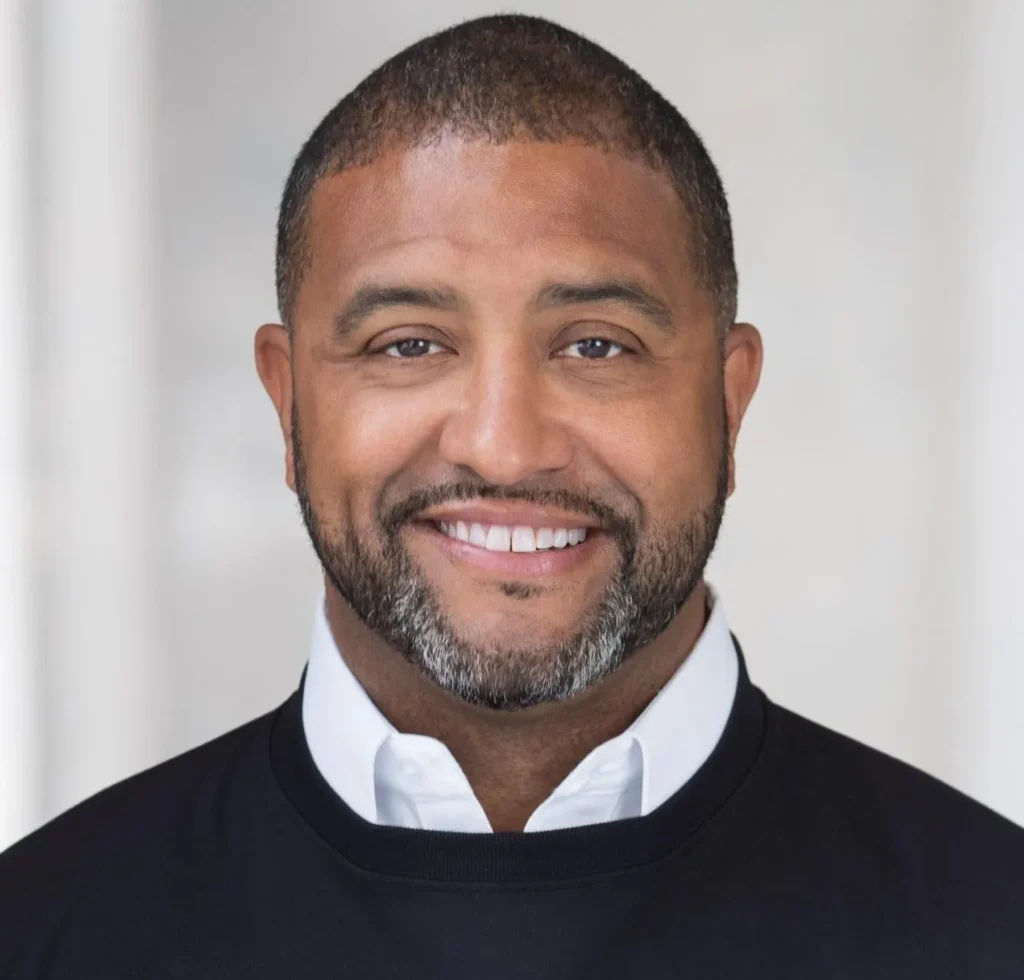
With over 25 years in professional sports, Aaron Ryan is passionate about building businesses and partnerships centered around people that are inspired to drive change through sport.
His work at the NBA, RSG, and Overtime Elite has provided him with life-changing opportunities to lead some of the most exciting and innovative properties and projects in the industry.
As President of NorthRock X, he is responsible for leading a first-of-its-kind financial and lifestyle advisory firm, dedicated to the modern athlete, sports executive, and entertainer, as they seek to master their craft, reduce complexity in their life, and drive impact in the communities that help them achieve success on and off their field of play.
The importance of:
Welcome to the Athletics of Business, a podcast about how the traits and behaviors of elite athletes and remarkable business leaders frequently intersect. The real stories and hard lessons to help you level up your leadership and performance. Now your host, Ed Molitor. Welcome back to another episode of the Athletics of Business podcast. I am your host and CEO of the Molitor group, Ed Molitor. Now, before I jump in today's incredible guest, I have to add a couple things. Because when I work with our emerging leaders in our emerging leader coaching program here at the Molitor Group, I tend to notice the level of value that they put into and that they add to the current relationships they have of where they are at inside of their career. And I share with them constantly.
I'm sharing with them to be intentional about the value that they pour into and the value that they pull away from the relationships, not knowing where along their journey that those connections are going to show up again. Professional relationships aren't fleeting. And honestly, relationships in general, they are not fleeting. They're not something that are in your life temporarily and go all the way forever. You're going to pull a memory, you're going to pull a lesson, you're going to pull a story out of them. And again, you'll never know when they're going to show up again. And there might be this opportunity to do some incredible transformational things together. Now, today's special guest, Aaron Ryan, president of Northrock X, is a direct result of a connection I had years ago.
And one of the things I love about LinkedIn is I follow the success of friends from my past and the great work that they're doing. And Sean Bannon is one of those folks who I have tracked for a while now. And Sean is a group president, director and managing partner at Northrock Partners. And I had the pleasure of having breakfast with him and his partner, Tod Moser, who is partner and advisor at Northrock Partners, and dug into the amazing work that they are doing, the transformational work that they are doing in an industry that is often transactional. Okay, now let's go back to Aaron. And Sean took the time to introduce me to Aaron. I'm forever grateful. And Aaron, as I mentioned, is the president, excuse me, of Northrock X, which is a division of Northrock Partners.
And it's a first of its kind financial and lifestyle advisory firm dedicated to professional athletes, executives, owners and entertainers. With over 140 clients across the globe, Northrock X creates a personal office experience, seamlessly delivering advice and services uniquely tailored to meet each client's needs. Through a trusted team of advisors dedicated to providing expert guidance, customized services and bespoke lifestyle management tools, Northrock X meets the needs of today's elite athletes and entertainers, allowing them to focus on their craft. In other words, they clear all the space and they help them manage and navigate all the different parts of their life so they can concentrate on what drives all of it. And that is their craft, that is their profession. And this conversation is phenomenal. Aaron at a very young age and he shares all of this with us, right?
Realized the value of mentorship and relationships and we talk about his work on the last dance. Now, let me give you a little bit more context about Aaron and his journey before we jump into this amazing conversation because I don't want to keep it to you. Prior to joining Northrock X as president, Aaron was the first commissioner and president of Overtime Elite, which is just an unbelievable program. As you know, there's a lot of changes taking place on the landscape of college athletics. For me, the one obviously that I focus on is college basketball and Ote. Overtime elite is the global basketball league for the next generation of athletes and fans. Think about this.
In the first full year of the league, overtime elite produced incredible results, including hiring NCAA championship coach Kevin Alley, the construction of a 103,000 square foot, state of the art facility in six months. Incredible story that Aaron shares with us and the signing of 27 elite athletes, and I'm not sure the exact number, but signing athletes before they had the facility to show them and the fact that the quality of people they were able to develop that level of trust to bring those athletes on. Now, three of those 27 elite athletes has signed with NBA teams going into the NBA Summer League.
Prior to overtime elite, Ryan served as chief operating officer at relevant Sports, which is the operator of the International Champion cup where he oversaw all internal business functions, focusing on the continued growth of the largest privately owned soccer company in North America and Asia. And this followed a notable 22 year career at the NBA where helped manage business operations of numerous properties within the league, including USA Basketball and the NBA Two K League, the first official esports league operated by american professional sports league, now in its fifth season. Aaron has done so much along the way, he has pulled so much from so many people and what's really cool now is the work that he's doing pouring into these athletes and these entertainers and these owners. So I'm going to get out of the way.
I'm going to let you listen to this amazing conversation. Have a pen and paper ready to take notes because there is so much here. Aaron, thank you so much for joining us today on the Athletics of business podcast. I am beyond thrilled to have you here with us today.
Thank you, Ed. I am, too, and I'm actually humbled to be on. I'm a big fan, have listened to a ton of episodes with some of my mentors and folks I look up to. So I'm just happy that you decided to have the conversation with me. So thanks again.
Are you kidding me? I am the fortunate one here. And it's funny you mentioned it with some of your mentors. Relationships. I mean, our paths were meant to cross from such different areas of our lives, and we won't get into that right now. But how much have relationships meant to you in your career? I mean, all the success you've had, the journey that you've been on.
Yeah. One thing I can tell you is that sports has just continued to give gifts, and probably the most valuable gifts have been relationships. And they start back to when I was a kid. I fell in love with the game of basketball through a mentor that I met when I was five years old who was on the University of Minnesota basketball team. And we'll get into it. But fast forward 25 years later, I got a chance to work with a guy. His name was Andy Thompson. Played on the Big Ten championship team, 83 84. And he introduced me to the game. And the game just keeps giving back. Yeah, we're connected through the game of basketball. I married my wife, who I met at the NBA in 1996.
So there's a lot to be thankful for, not only in the game of basketball, but the industry of sports. And I always look forward to taking advantage of being curious enough to ask people about their journey and to find common connection. And it just has continued to really bless my life and continue to help sort of foster new relationships and value both in my career and outside of know.
And I'm really curious about that. Andy Thompson, right. You're five years old, but I have to think that made this impression on you, whether it was subconsciously, whether it was intentional, whether your mom kept reaffirming it with you, but your reputation precedes you and how amazing and true and authentic you are in the relationships that you develop. Scott O'Neill talked about you before you and I were even introduced on both podcast episodes that we had on with him. Is that like, you're paying it forward? Is that you're giving it back? Is that understanding the true value of relationships and where they take you at your life. Do you think it influenced you at that early of an age?
I mean, think about it. I was an only child of a single mother going to college, and I meet this sort of larger than life figure six.
There's no sort of about it.
It's all there. It's all there. And think about it. A junior and a senior in college to take on a five year old as a mentee and really kind of take me on as a kid brother, take me to practices, go to games, meet coach Jim Dutcher back in the day. In fact, his son just won. God bless. Made it to the final four. But to be around those guys and that culture early in my life really planted a seed. One that if I ever get the chance to have an impact on the next generation, I certainly should take advantage of it. But the second thing is just this idea of how analogous sports is to teaching us about life, about work ethic, about collaboration, about communication, and about consistency.
And so that gift of that relationship has sort of weaved its way not only directly into my career, but just into how I approach my life. So I'm forever grateful for Andy and really grateful for my mom for allowing that to lead to what ultimately was my first day, my first job at the NBA in Secaucus, New Jersey, in 1996.
Your idea about relationships and your belief system just continued when you graduated from Miami of Ohio. So take us through that.
I think the key to relationships, and it's interesting, I just took my daughter on our third trip to check out colleges. She's a junior in high school, and she said something to me in the car. She's like, so, dad, give me some advice on when we're at these schools and we're touring and they're introducing us to existing sort of current students, why do you always have sort of a way about those relationships? I said, because I'm curious. I'm curious about other people, and I'm curious about their worldview. I'm curious about how they're connected to something I'm interested in. And so whether we're at one university or another, just be curious in the process. I always talk about, especially with my kids, but even with folks I work with, it tends to give back more.
When you are more interested than interesting, you have plenty of time to be interesting. But the more curious you are about people's journeys, the more you find opportunities to connect. And so I found that to be a bit of a secret to my approach, which is always ask the next question. It really helps perpetuate relationships well.
And you think about in the world we live today, right? When you get people talking about themselves and their experiences and what is going on in the world, that just develops that level of trust. And for what you folks do at Northrock X, that is so significant.
Yeah, I mean, listen, the way I find myself at Northrock X is really through relationships, once again with Sean Bannon, who, you know, through Rob Nelson, our CEO, really building a relationship and being curious about the business that they've created in Northrock X, not only for high net worth individuals, but specifically Northrock X centered around athletes, entertainers and executives in sport. This idea of a community of common clients who really, there's two things that we try to help them do, which is build a team around them that supports their goals and aspirations in life, but also give them back the most sort of treasured commodity, which is time. By partnering with Northrock X, when I was at Overtime elite, I got a chance to really sort of appreciate the power of mentorship and advice.
Now, when Northrock provides advice to a high net worth individual, call it a CFO, a CMO of a company, that person is oftentimes pretty well versed on, whether it's the markets or their taxes or what types of insurance they need advice, but what they really want back is time. Now, when you're taking on athletes, young athletes, oftentimes with very little proximity to wealth, it really is about mentorship. And so it's about how you advise, educate and really appreciate the journey of young athletes doing something that is really extraordinary. There's not that many people in this world who will have a career path that looks anything like, especially our younger athletes who are part of our client.
Community, when you start to have these conversations, when you start to present to them, when you start to have the discussions with them and the light bulb goes on, right, and the eyeballs get big, how fulfilling is that? How rewarding is that?
Honestly, this is the biggest sort of transition in my career, if I can call it that, which is, I have spent my career really trying to perfect, as close to perfect the idea of systems and process, right. And bigger systems, call it league operations, partnership development, things of those nature, certainly has plenty of individuals and team members, et cetera. But what I find so rewarding about the work we do now is at the individual level, you're really helping young people and their families go through a journey. And when they have those sort of those light bulb moments, as you call them, there's no more rewarding feeling than really seeing them take a situation a little bit more into their hands. Right.
Because when we talk about being along for the journey, it's not us executing the journey on their behalf, it's really being along for it. So what I get excited about is when we have a young athlete who really leans into what we're trying to do to help create the best outcomes for them is that I know I'm going to have a partner along, especially if they're curious about what we're doing together.
And it doesn't stop when their playing days are over. I mean, the things that you are doing, the things that you are putting in place for them, the ease that you're putting them and their families at, not just giving them their time back, their peace of mind, their sense of there's a strong foundation for them that they can lean into when times. Because times are going to be challenging. I mean, we've talked about that. Everyone thinks this is all really glamorous, really sexy. There's some brutal reality to the world that you're living in and you're there for them. Can you talk into that a little bit?
Yeah, we talked a lot about this when I was at overtime elite. The idea of being there for athletes, too, through and beyond their first act, and that first act is being a professional athlete. And so two really is about preparing them for the future that's awaiting them through is really through those career years, right? Like how you help set up the scaffolding for their post career life and beyond, which is really helping them start to cast a vision, set dreams that are beyond the field of play. For a lot of these young people, they've been so laser focused on excellence within the game that they really haven't created a lot of mind share for what they want to do after playing. What are their other passions? Do they have things that they're interested in?
Whether it's building business or building and having impact in community. We try to help them explore these questions and start to devise at least germs of ideas so that if you want to get into business, if you're interested in having impact on community, if you're looking for legacy and thinking about how you might stay in the game, we want to start to at least explore those questions while you're still in the game. One of the things that Tony Parker talks a lot about is the biggest piece of advice that Magic Johnson gave him while he was playing. He said build the relationships in the areas you're going to be interested after basketball because while you're playing everybody will take your call.
And so build those relationships, build that dynamic with folks that you believe are going to have an impact on the paths that you plan to explore post career. I thought that was great advice, and I think that goes for any athlete, but actually goes for you and I and my daughter, your kids, the same.
It's so significant, the very simple line, because when you're playing, everybody's going to take your call. Man, that just hits. That is so true. It's just like in any profession, when you're on the rise or when you're at the pinnacle of your game and you're experiencing success like none other, of course everybody's going to take your call. But after that's over, what foundation have you built?
That's exactly right.
Yeah. I want to go back to overtime elite. I want to talk about your experience there and how that kind of segued into, if you will, Northrock X and what you're doing now, because there's so much commonality in your purpose and your mission. I love how those are married together. Can you just kind of walk us through that? Yeah.
So I met the folks at overtime during the pandemic, and a good friend of mine, Tim Cott, had access to this project that they'd been working on. In fact, he'd been advising them on it. And after signing an NDA, I got exposed to this incredible project, this idea of a disruptive league, a basketball league for 16 to 19 year old amateur athletes seeking to go pro and forego the opportunity to go to college or to be eligible in college by way of the NCAA's restrictions at the time. And what quickly was before me was this opportunity to really help participate in necessary change, disruptive change.
And the idea that you and I can be professionals, plumbers, pianists, even international soccer players, without this sort of opportunity to monetize and learn at the same time, I realized was being taken away from athletes, specifically Us collegiate athletes. And so it inspired me to get involved. And what was great about it is it really spoke to a lot of the things I had done in preparation at the NBA, everything from setting up leagues, which I had helped with early days at WNBA, G League, the two K League, specifically, the idea of marketing partnerships, which I'd also been a part of at the NBA, specifically around USA Basketball, and the entire basketball operation that surrounded that property and that mission.
So we set out to do, really.
The unthinkable, to build a building in nine months, six months, really, to identify 27 to 30 families who are willing to take this really wild pioneering leap and to do it all inside of a global pandemic. Right? And it's one of the most rewarding things I've ever been a part of. Building a team of 110 teammates and staff across basketball operations, business operations, education, health and wellness, and obviously content, which is at the core of what overtime does, is something that I'll cherish for the rest of my life. And it allowed me to have an impact on families that I believe I'll be connected to forever. We are coming into draft season, and the Thompson twins were two of the first recruits that we brought in and getting to know that family, Troy, Maya, amen. And Asar and Troy Jr. Their brother.
And really, I can picture today, orientation in Atlanta, welcoming them to a town and an organization that they didn't know three months before that. We all put hard hats on when looked at the building, and I promised them it would be ready by opening night. And sure enough, it was. And so to think that these two young men are going to probably go top five, top seven in the NBA draft is really surreal for me right now.
That's mind blowing. When you really think about that and you bring me back to this like you didn't even have the facility, wasn't even done. Matter of fact, when you joined, you didn't have a facility, okay? You didn't even have a market. You didn't have a market. So this ability to challenge the status quo and to put on your creative hats and to sit there and to be able to work inside of the boundaries that were already built for you, how did you do that? What did that look like?
One is a credit to overtime and this culture of disruption that they had created. The second is to empower us to go out and do something that hadn't been done and to really help us collectively build a trustworthy proposition not only for people who are going to join us as employees, but also these families who are entrusting us with their children. Having teammates like Coach Ali, Brandon Williams, the founders of Overtime, Zach and Dan. To really build this group of people who were set on this mission was at the core of what it was. It was a belief, it was a sense of empowerment, and it was a sense of obligation that really drove it then. It was just doing the work every day.
It was getting up every day, making sure we had our priorities straight, understood really the time horizon that we had to achieve this. There's something really special about publicizing your deliverables and your expectation, which is we are going to deliver a building and a league that is going to disrupt basketball by that fall. And once you kind of put it out there, it puts a healthy bit of pressure on you to deliver it.
And I haven't been there yet, and I stress the word yet, but I have friends that are in the business that have been there and they said it is absolutely amazing.
Everybody who's been involved in it is incredibly proud of what was done.
But again, let's talk about some of the reality of it. What were some of the challenges like? Was there ever a day, or were there ever days where you're like, man, we put the cart in front of the horse on this one, or do we get out over the tips of our skis? I mean, those rough days, obviously, you dial back into the obligation, the purpose, the sense of purpose that you have. But were there some really challenging days?
Listen, you talk to any operator who is maintaining, growing or building a business during a global pandemic, and there's plenty of those days. I stayed in very close contact with every league official I could to understand how to keep these families safe, how to make decisions for the business, this balance between keeping everyone safe, but also keeping the business going. COVID really put a damper on things in various were. I can remember the day just before Thanksgiving where basically college basketball shut down and in fact, colleges shut down and sent their young folks home. And sure enough, I was faced with the same situation and talking to people at the NBA specifically, who were in the midst of a bubble, who had a lot more to lose. Quite frankly, if you just look at the totality of that existing business.
But for us, it was similarly challenging in that you really don't get to stop and start a new business multiple times. And so the idea of getting through that first year but keeping everybody safe, we had almost no cases throughout the entire time. And we pulled off something that I look back on, and it certainly was a trying time to build a business, but I think we're all better for it.
And not just start and stop any business, but a business where you're entrusted with the livelihoods and the health and the well being, both mental and physical, of 110 young men and their families. Now, question for you. I have to put my basketball hat on for a second, so forgive me. What was the word coming out of the NCAA and what was the word coming from the NBA when everybody heard of overtime elite, what your purpose was, what your mission was, the disruption it was going to cause? We all know that you only grow through right discomfort. I think it's incredible. But what was that like?
The first and most important thing was to use trusted relationships that I'd built over two decades to really communicate what were doing and what weren't doing, because there was plenty of speculation. We were about serious basketball. We were also about content and storytelling. And the reality was both organizations needed to understand the commitment we had made to put experts in every aspect of the organization, from our education being accredited and serious, to our basketball division being well established, skill development focused, very accomplished basketball people. And also that we understood the rules as they were laid out. And we wanted to work with any and every organization that was in the business of supporting and empowering young people. At the core, our common ground was the NBA would be the beneficiary of every great elite athlete who is empowered to pursue their path to pro.
And every athlete, whether you choose to go to college, division one overseas, should be afforded the right to make their own decisions. And so once you kind of strip it down from sort of the protocol and the rules and regulations, and you just break it down to the fact that how do we support young people pursuing their dreams? The dialogue started, and the reality of it is that you always have to start with a common pursuit of understanding one another. And I feel very proud that were able to do that in the first year. And if you think back even to this past week or two down in Atlanta, they're on their third or fourth pro day. They have countless numbers of scouts in the building, tons of marquee college coaches now there because of the scholarship path that's been created.
And so while it's no longer a business I'm actively involved in, it's certainly something that I still am incredibly proud of helping be a part of.
And, you know, it's really cool. I just thought of something that's really cool. You say similar things consistently, and you talk about pursuing their dreams, you talk about their story. And in essence, at Northrock X, that's what you're doing with these professional athletes and entertainers in your division, is you're creating the space for them to pursue their dreams, not just athletically or in the entertainment space, but also in their whole life, right in the big picture and down the road after act one is over, as you say, and you're allowing them to have the capacity, mentally and emotionally, to create the best story for themselves possible. And I think that's super cool.
Yeah, I mean, the reality of it is you're taking something they're passionate about, pursuing a dream. And, oh, by the way, the dream that they're pursuing is surrounded by extraordinary outcomes. We're talking about a first career, probably somewhere between eight and 15 years, if they're fortunate enough. And with that, especially in this day and age, given just sort of the maturity of our industry, we're going to have athletes and we're going to end up with clients who become billionaires well before the age of 40. And it is a blessing, but it's also burdensome to be prepared for that. And so what we recognize is that while the wealthiest people in the world are oftentimes surrounded by a team called a private family office or a multifamily office, athletes now are accumulating the kind of wealth and complexity in their lives that they deserve.
Similar structures around.
Curious about this as they build their wealth, as they foster their entrepreneur spirit, and they have different lines of business, different lines of revenue. Do you find that the more they lean into that and sharpen their skills, the higher their level of performance on the court or the playing field becomes just because of that commitment to leaning into getting better at whatever it is they're doing?
I would almost flip that and say what I find is there's a common correlation between those who are just curious, generally are actually achieving greatness in both. And that curiosity has multiple derivatives, right? Curiosity of your surroundings and access to information, whether it's basketball information, soccer information, football information, you name it. Just this curiosity to get better and to be as sharp as you can call it IQ, but also curious about those that surround you in terms of what matters to them, which is this EQ, this emotional intelligence around empathy, around how to take care of those who took care of you, to reflect back on community, I find that to be an incredible commonality. And then this idea of curiosity, of self improvement, like, how do I just better myself every day?
And am I aware of where I am today and where I want to get to? This idea of self awareness, I think, also is a derivative of curiosity. And so, yes, when you find yourself with a client who's generally a curious person, that curiosity doesn't stop at the world of their future, their next act, their finances, their opportunity for generational excellence.
I love that you can't see it here, but we have a big painting on the wall here that self awareness is the competitive advantage. Do you see that showing up in your world?
Oh, yeah.
And you talk about curiosity, such a powerful word. And when you start talking about athletics and curiosity and other endeavors away, the first person that comes to my mind who I think was way ahead of his time. And the thing that breaks my heart is I think his best years were ahead of him as Kobe. How intentional he was from calling Mike at two in the morning about hoops, from calling Mike at three in the morning about business decisions, calling whoever it was. Do guys talk about that? Do people talk about that? Like, Kobe had it, and now you see these other guys in the NBA that they're getting it, they're doing these things and they're investing in themselves. And not just monetarily, but like you said, they're investing in their emotional intelligence, they're investing in their growth. Do you see that happening?
And you see it even in other aspects of Kobe's legacy, which is of self improvement, and that's health and wealth and everything that surrounds that, whether it's his diet, how he worked out, his ability to tap into a different sort of avenue of his creativity, whether it was storytelling or building and creating a production capability. So I think there's a lot of appreciation for him, and I think you're right. A lot of people talk about the fact were about to experience, sort of really a next chapter that had the potential to be just as beautiful as the first.
To me, what's fascinating about all this is we know the struggles the NCAA has had, right. And I'm not going to go into that. But it's on them, right. Like, they have been slow to change. It's been an ego thing. It's been whatever you want to call it right now, overtime elite, which you folks are doing. You look at the potential of these young men and women that is being tapped into with the nal, deals with just everything and to see it flourish in the positive outcome. Where do you see this three, five, seven years from now?
It's no surprise that most of the leaders I look up to had some proximity to sport in their lives, not exclusively, but a lot of them have. And what I think is a great opportunity for us, especially for those who are interested in leaning into nil and contributing to sort of this evolving ecosystem, is to spend time with student athletes now, using nil as kind of an excuse, but really sort of a platform to have discussions around financial education and your future in whatever endeavors you choose, business or otherwise.
And so there's a world where Nil becomes the unlock for us to really lean into financial education inside of both secondary school, but even middle school, and certainly in college, I envision a world where the idea of a collective or an athletic department actually contributes more than just scholarship equipment schedule, opportunity to play, but actually an opportunity to use as really a deliberate tool of preparation for life. And so even if you're talking to elite, sort of non revenue generating sport athletes, you are speaking to the future leaders of commerce and business and really of community. And so I think it just helps us have a deeper, richer conversation and contribute to young people at an earlier stage.
I love that. And as you look forward and you look at it just keeps picking up momentum. As I mentioned, like three, five, seven years from now, there's this generation, and I look forward to the next generation. Like, what is it going to look like for them? Right? And what are the opportunities and what are the different ways that we can serve them and we can create new ways and how are they going to look? What are the leagues going to look like? What's everything going to look like? Can you talk about disruption?
One of the things that you just brought up is like sometimes it skips a generation, and I think it's going to skip a generation. Not skip a generation, but have more impact one generation from now. Because what I've come to appreciate is that young people actually find their inspiration in their peers or those closer in age oftentimes. And so when you start to see your peer heroes talking about finance and community and impact and things like that, it tends to inspire those around you. And so I can see a world where my kids and their kids are going to be talking about finance and preparing for your future in ways that we never did.
And the importance of what opportunity and wealth can create in terms of impact on those around you is something that I think we're going to hear a lot more about going forward.
When you start having these conversations with potential clients and their families, what is the initial reaction? Normally, most of the time, what is the initial reaction when you start having these conversations?
One, we always start by hearing where they're at in the journey. What do you have surrounding you? Do you feel well supported? Do you feel like you have the time to spend with this? Do you feel like you're equipped with the expertise? And by and large, this type of success is lonely. And understandably, the more popular you get and the bigger the platform, the more skeptical you are of people's intention. And so what you want to do is really understand where they're at in their journey and also engender a sense of understanding that we know that this can be overwhelming at times, and we understand the need for you to have support in your circle.
And so the most important thing is for you to build relationships that are first trusting and have your best interests, but also our relationships that are committed to your education. Not just on instructing you what you ought to do, but actually working with you to help understand how to do it. That's really where it starts to click, is when we're meeting with a family, the mother or the father are still in their day job, but also now having to facilitate things like an estate plan or work through really complicated concepts around insurance or understanding, dissect and translate league benefits. What we say is, we can help you do that. We'll do it for you, but we would want to do it with you so that you understand and appreciate the fact that there's incredible ways to optimize league benefits.
We know the difference between NFL, NHL, MLB, NBA and MLS league benefits, and we understand how to optimize this. We understand through really the way in which we help custody accounts, how your cash flows. We can help you understand how to keep your credit where you want it or improve it to get it to where it ought to be. And that's by simple concepts around paying bills. These concepts of bill pay, cash flow analysis, estate planning are all things that we want to do with the client versus just do, for we certainly will help give them back their time. But importantly, we want to make sure they understand all that surrounds them to the extent that they're curious enough to.
And I have to think that there's a sense of gratitude on their part that you're removing the overwhelm from them, right?
Yeah. All the things you mentioned, there's oftentimes moments of relief. I can think of one particular case in the last year where a mother was doing a lot of this for the first time and feeling the burden that not only had that mother really never been put in a position like this, but at the magnitude of millions of dollars, it's a lot of pressure. And so this idea of really helping become that parent's teammate, one, it gave that parent relief, but it also gave that athlete a sense of calm, which is, I haven't seen my mother this calm and relieved in the last year or two.
The fact that you and your team have the ability to relate to these athletes where they're at, to relate to the family where they're at, to what happens when something pops up on the inner circle and you're not that comfortable with it, and the athlete asks you, like, what do you think? How do those conversations goes? Because you guys do such an amazing job. It's the whole picture, right? It's the lifestyle. And when you have to have those uncomfortable conversations and be brutally honest with them about someone in their inner circle, maybe it's about a family member, whatever it may be. What's that conversation like?
I think you're trying to build a culture of trust and accountability. And every athlete and every family that comes into this incredible opportunity has a history well before we've ever joined them. And you have to be thoughtful and empathetic to the dynamics that are at play. And so I think that the first thing to do is to really empower that athlete to define roles.
Right?
Does a mother, a sibling, a brother, an uncle, a former coach, do they want to maintain the roles that they've had in their lives, or do they see themselves in new roles? And is everybody aligned on what those are? Not only aligned on what they are, but of their capabilities? And once we establish their capabilities, how accountable are we going to all be to what we sign up for? And you start to talk through what accountability looks like in that family. And sometimes the athlete or the core client, the client will say, I really want to be the voice of accountability. Other times, an athlete or somebody at the center might say, I'll handle these measures of accountability, but I really would like you or my parent or my manager or my agent to handle these aspects of accountability.
And so what you really have to appreciate is the customization of that circle, and you have to be comfortable playing the role, whether it be advisor led, agent led, parent led, or athlete led, that each of these circumstances kind of takes on its own form.
So many things are moving. There's so many moving parts. People's heads are spinning. There's a ton of energy. It's a roller coaster of emotions. How are you able to get people to slow down mentally, to really dive into the work that you need to do? As you're mapping this out, it always.
Maps back to what our goals are, right? Establishing goals. What are we trying to achieve in the very near term, in the midterm? And let's cast a five year vision, or let's even cast a ten year vision if they're up for it and they're curious enough. And as long as that's well established, you can always kind of slow everybody down and remind them of what we've set out to do. There certainly will be opportunities that come along the way. There certainly will be challenges unforeseen. We will all have to embrace the curveball. As I say, you'll have to hit it. Act like it's not coming just embrace the fact that we'll have to hit it. And as long as we can always really path back to our goals and our commitments, then we're going to be okay.
But if you never can touch home back to what you set out to do, it's exactly as you described it. It is a version of chaos.
You joined Northrock X, I believe it. Was it July of 2022? That's correct. Okay. July of 2022, which probably all the activity that you have seems like a lifetime ago, does it not?
Certainly does.
What are some of the unbelievable things that have already happened that you maybe didn't imagine, or maybe you didn't think they would happen this quickly that have already taken place? And where does that lead to the trajectory of all the amazing work that lies ahead of you?
I mean, one, it's been great to really sort of call out to my network of friends, colleagues, long standing partners, and really share our mission, but also to do so in a moment where our industry is just going through an incredible time right now. To have everybody, a lot of people in my network recognize our potential in terms of supporting athletes in a new, more holistic way, given how complex their sets of opportunities are, has been really awesome. I've gotten a chance touch base with some folks who I haven't had to deal with for quite a while. I've been able to really go back almost as a homecoming, whether it was summer league or last year's draft, and certainly this past all star in Utah.
I've gotten a chance to really make some new relationships in hockey and in football and really kind of exchange best practices and the cultural nuances between these leagues, because they are certainly different. The way in which athletes carry themselves, the way in which they think about their careers. And so what's great for me is on this desk over here, I'm on my 7th notebook since I started this job, and I'm a pretty aggressive notetaker. And anytime I'm able to kind of be in that state of learning and growing, I'm feeling fulfilled.
That's awesome. Your 7th notebook. So I have to ask you, 22 year MBA career in various roles, had to have a ton of highs, a ton of lows. You had to learn quite a bit. When did the notetaking start? When did the deliberate, like, journaling notetaking, when did that start and how significant of a role has that played in your success?
Well, we're going to bring this thing full circle because I used to be a really good notetaker in college. I got to the NBA and was much more of a hands on operator, especially in production. When I transitioned out of this group called live programming entertainment, and I moved into the group called team marketing and business operations, which was led by Scott O'Neill, Chris Granger, Chris Heck, and Amy Brooks. At the time, it all came back to me. When you see senior leaders taking copious notes on a daily basis, in every session, in every meeting we had, it brought me back to, and I was learning so much about the team business at that time. It really helped me sort of reignite the habit, and I haven't stopped since. And one of the things I learned about taking notes is really kind of.
There's three things that I get out of intense notetaking. One is certainly I find that when I'm physically writing things and I'm a physical writer, I'm committing them to memory, but I'm also capturing sort of a view of that page.
That's one.
The second is when I don't remember it, I can usually find or place it easier. But I also find when you take notes, especially when you're working with other people, is they tell you more as you take notes when you're talking to people, and they find that you're interested to the point that you're committing it.
To paper, they tell you more and they slow down. They slow down and they have the beat, they have the pause so that you can get it, and then they'll ask you, do you have any questions?
That's right.
Not taking notes. They're not going to ask you that.
That's right. And so for me, the act of taking notes certainly is beneficial to me, but it's also. I mean, it's all beneficial to me, but I think there are other aspects of it than just trying to help have a referral place in your life. It's also about these other things.
You've been around a lot of great ones. I mean, you've been around some amazing leaders, some amazing performers. You are right now. You're going to continue to be, is it more difficult, more challenging to get yourself to an elite level or to stay there?
I think at the heart of your question, it's really the topic of a growth mindset. And how I'll answer it is, I think it's more challenging going forward, and here's why. If you use golf as the analogy, they say that if you spend two weeks and roughly commit 4 hours a week to on course in range, that you can break 100 within probably two to three weeks, yet 1% of every golfer on the planet breaks 70 because you have to find the inches, the millimeters of difference, the milliseconds of timing, the additional fraction of focus to really hone in on what is competitive golf standard. And so I found myself in this path of self improvement in golf for the last 20 years. And it was really addictive early because I was able to break 100.
Right?
And then I breezed close to breaking 90 for a long time. And then I finally cracked into the. I've been stuck there for a long time. And what it reminds me is, you got to get back to the range. You got to find those centimeters, you got to find that millisecond, and you got to be in tune with your body and your mind. And I think business is similar that finding the inches, finding that next little thing. It's a finer activity than in your earlier stages of your career. You're able to make larger leaps, yet you can't be unmotivated to do it just because the payoffs aren't coming as frequently.
So you're at an incredible point in your life right now along your journey, yet you are still committed to growing. How do you decide what's next? What do I need to work on next? Is it random? Is it something that just interests you? Or is it something a part of your game, so to speak? It's a part of what you do on a day to day that you feel like you need to get better at. It's not a weakness, but maybe a gap that you want to fill. How is it you go about deciding what you're going to work on next?
Here's what I've come to realize. It's an outside job. And what I mean by an outside job is what I found fascinating by David Stern and similarly, Adam Silver is they were the most read and informed people before 09:00 in the morning that I'd ever met in my life. And I'd say 95% of what they were reading every morning had very little to directly do with the business that they ran. Yet it was a leader's quote or a new innovation shared in an article or a new framework of how to think about things that actually sort of, like, scrambled the status quo for them. And they'd come in and they'd say, hey, if Tesla's thinking about it this way or if Apple's facing this challenge, how does that apply to us?
And I can't imagine that it was only being done at an enterprise level, but on a personal level. And so, to me, I think growth at these stages is as much of an outside job as it is an inside job. I can continue to kind of refine my inner habits, which I do regularly, but I actually think you have to be back to curiosity. You have to be curious to the world outside of yourself as much or more so to find that next opportunity to level up.
One of the things I loved about my conversation with Scott, when he mentioned you and some other amazing leaders know he was a part of their journey. They were a part of his journey. He talked about how intentional were before you're even in a leadership role, how intentional you were in developing those skill sets. So can you talk to the emerging leaders, the ones that know they want to be in a leadership position, but they also know they have a role to execute right now, they have a job every single day to perform it, but they want to prepare. What would be some of the advice that you would give them?
I mean, two things I talk about a lot, and one is perhaps overused, but this definition matters, which is this notion of entrepreneurial spirit. I don't care how big the organization you work in, your bodega is, your cube, your desk, and how you go about that business. If you really envision that as a bodega, you lock the doors at night, you clean the counters, you sweep the mat, you stock the shelves, and you make sure that the till is exactly as you left it or exactly as it's supposed to before you take your first customer. The habits you build with an entrepreneurial mindset is what differentiates you. And you might say, well, wow, I work at some big multinational company. How am I to think about myself.
As a business owner?
Your career is your business. Your brand is really your responsibility. So that's the one thing is, it's like, define entrepreneurial spirit and put it to work right where you are today. The second word I oftentimes focus on is proximity. And I think there's three aspects of it. I think you should do something in your life that is in relatively close proximity to your passion. Like I say that if you're getting up and going to work and it doesn't give you goosebumps every once in a while, you might not be doing the right thing. The second thing is proximity to best in class pros.
And when I say it's professionals, if you're telling me that there's an awesome leader in a division that has nothing to do with what you're doing, but you're constantly curious about what's happening halfway across the building or halfway across the world, find yourself in close proximity to absolute pros, because the closer I've been to pros, the more they rub off on me and the more I want to be around them. Whether it's coach K or Jerry Calangelo or Amy Brooks or Mark Tatum or Adam Silver, David Stern, a number of the team leaders that I've been like that rubs off. And so proximity to best in class pros, I think, is the second one. The third is proximity to how money's made. It's important to be close to.
In proximity to revenue or profit centers early in your career because I think you learn what makes or breaks businesses a lot quicker that way. Those are just some of the early lessons. One is proximity to these things, and two is to approach them with an entrepreneurial spirit.
I love that, and I appreciate you sharing that. We keep talking forever, and I hate the fact that time's winding down. But I would be remiss if I didn't ask you of all the great experiences you've had, of all the great folks that you just mentioned, who you've worked alongside, whether it's the NBA, USA Basketball, wherever it's been. Is there a story that you can share with us now? I didn't prep you for this because this is totally random, right? Is there a story that you can share for us where you actually had almost a leadership aha moment? Like, man, I never thought of it that way because that happens sometimes. It's almost like a spiritual awakening. Something happens, we're in the middle of it, and you just, like, makes total sense.
I feel like I'm one of the most fortunate people to ever work in sports. I got a chance to lead an olympic effort in Athens. I got to lead USA Basketball through two cycles of gold medals. I got a chance to build a league, two leagues, actually, the two K League and overtime elite. I actually think those were amazing moments in leadership for me. What inspired me to lead in this industry, it goes back to my work in 1998 and really, the Bulls project, the last dance, and at that time, it was just called the Bulls. The 98 bulls project, we had no idea called, but 2022.
I was the production assistant that really followed the Bulls around with my mentor, Andy Thompson, who's now an Emmy award winning executive producer of that, and with great mentors like Greg Winnick and Michael Winnick and everybody who worked on that project. What it unlocked for me was the global power of sports and that I wanted to be a part of it. And I thought that much like what the Lake David Stern shared with us is that sports had the ability to change the world. And I think I'm going to say it right. He used to say there's going to be two places of worship left in the world where we go to worship our God and where we go to worship our sports heroes.
And that was important because sports specifically will be at the intersection of most of the change we go through in our lifetime. It'll be discussions around diversity, it'll be discussions about world affairs. It'll be discussions around empowerment. And if you think about the role that esports has played in not only our economy, but even in a moment like a global pandemic, what was a lot for me with the Bulls project is that here we have a project that was 24 years in the making, almost. It was a communal moment during a global pandemic where every Sunday for ten Sundays, the world came to watching, reconnect, and to feel that at 98, that were making a difference.
But then for it to actually come full circle on Sunday nights, in one of the hardest years on record, to be that solace, that moment of normalcy and connecting us to something bigger than ourselves, has to take the cake.
For me, when you were right in the middle of it, in the thick of it, and how cruel was that to do with your mentor? That'd be so unbelievable. But when you were right in the thick of it, in the middle of it, and you're watching these things happen and you're the production assistant, what's going through your head like this is a whole other level. Till you're around that, you don't understand the way those athletes and those coaches and that support staff and everybody involved operate at a whole different level than the average day to day. Yeah.
I mean, one is just the appreciation of how you prepare for greatness, right. For championships, that was incredibly cool. The other thing is how you document important moments and not get in the way of them. This idea of really, truly trying to be a fly on the wall to the point that everybody stays inside their sort of authentic journey and we're able to just capture it as it happens and not to affect it. The third thing was something that Andy told me early on, which is I may get the chance to work on a project as long as I earn the trust of the entire crew, not just because I was a close mentee.
To one of its producers.
And so I spent eight months before that project really trying to earn the credibility of just a hard worker and to work for everybody as hard as I possibly could. And it felt great to be one, forewarned of that, but then two, to earn the ability to be on a project, not because of who I knew, but because of the work I was.
Putting in and who you were. Yeah, that's awesome. So what was that like sitting there watching the finished product on those Sunday nights?
So it's pretty cool because for the first three Sundays, well, for most of the Sundays, we would get on a Zoom about a half hour before it aired with Andy, myself, and a handful of our close friends from central Jersey. But a few times Andy would join us in progress because he was on another Zoom and that Zoom had all of the producers. MJ would occasionally bless the crowd with it, so he was always coming in from a far better Zoom than there.
Are some amazing scenes in that. Well, hey Aaron, I can't thank you enough. This has been incredible. I hope we can have you back on. And as soon as we get done here, I'm going to give Sean a mean like I said, our paths were meant to cross and to be introduced by Sean and to have talked with Scott about you a couple different times and to look back and reflect on your journey and all the amazing work you're doing. And I don't say this lightly, I'm not just saying this because you're sitting here in front of me in this podcast conversation, but the old coach of me has a true appreciation for you and your team at Northrock X and what you are doing for these people. Not just the athletes, but for the people, for the human side of the business.
And man, God bless you and continued great work. And I'll mention in the intro, can you tell us where folks can find out more about Northrock X and all the amazing work that you're doing?
Sure. First of all, thank you so much for having me on. This has been an incredible conversation to follow us one start at Instagram at Northrock X. Certainly would love to sort of share more of what we do there, but also you can find a lot of information about Northrock X at Northrock x.com. Thanks again, Ed. Really appreciate that.
Aaron, thank you so much. I appreciate you. We have to have you back on sometime soon here in the future because for as many amazing stories as you have told, there are many more in the works of being developed that I can't wait for you to come back and share.
Awesome. I look forward to it.
Thank you for listening to the athletics of business. Be sure to give us a rating and review so we know how we're doing. For more information about the show, visit theathleticsofbusiness.com. Now get out there.
Think act.