
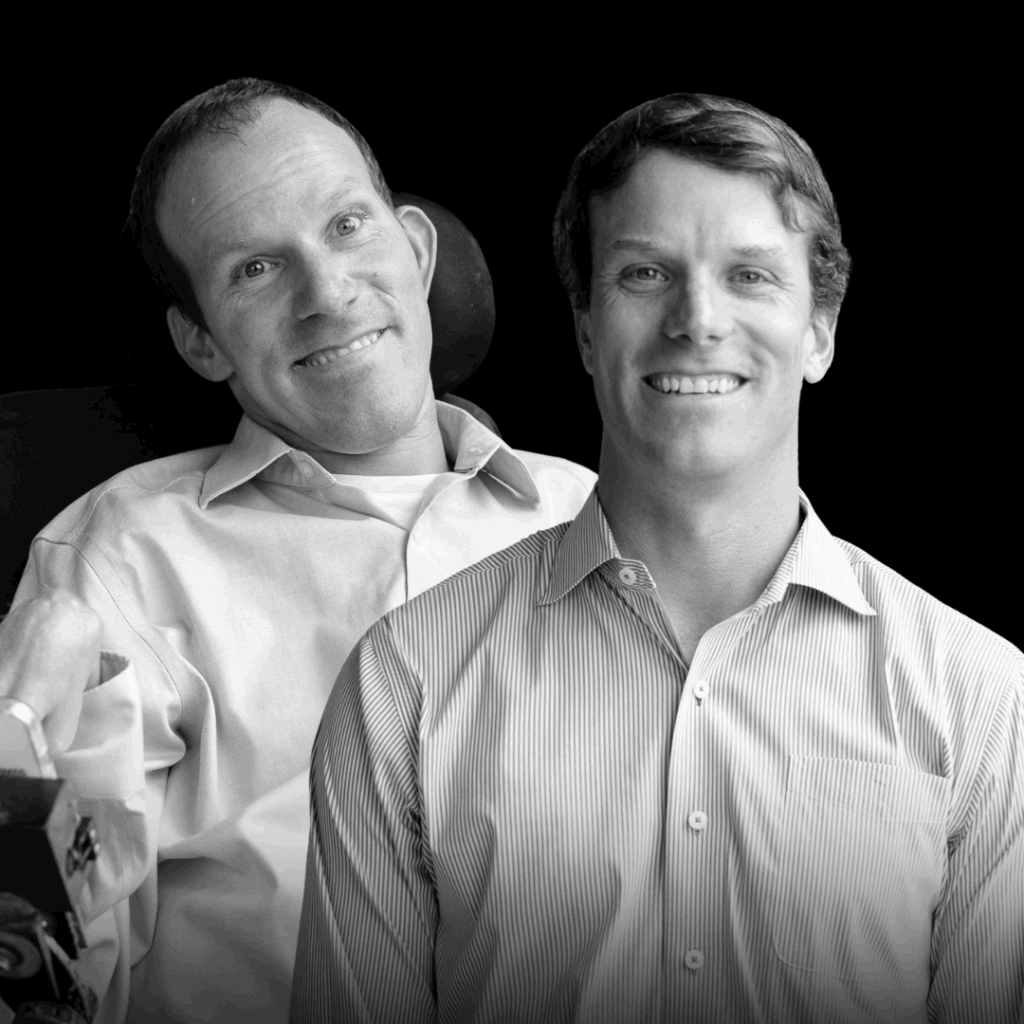
Brent and Kyle Pease are brothers, elite endurance athletes, and co-founders of The Kyle Pease Foundation, a nonprofit organization dedicated to promoting inclusion for individuals with disabilities in both sports and the workforce. Their story gained global recognition when they became the first push-assist brother team to complete the IRONMAN World Championship in Kona, Hawaii. Since then, they’ve competed in over 150 races together, becoming a symbol of what’s possible when determination and brotherhood collide.
Kyle, born with cerebral palsy, has shattered limitations and expectations. With a degree in Sports Management from Kennesaw State University, he not only races with Brent but also works part-time at Publix and Atlanta Braves games, spreading his message of resilience and inclusion. Through the Foundation, Kyle plays a key role in initiatives like adaptive sports equipment, inclusive employment, and scholarships, empowering others with disabilities to chase their goals.
Brent, a Florida State University graduate and seasoned endurance coach, serves as the Foundation’s Executive Director. His leadership has fueled programs like the Inclusive Employment Program, which helps individuals with disabilities secure meaningful work. Brent’s athletic achievements, combined with his passion for advocacy, have helped raise over $10 million for the cause. Together, the Pease brothers continue to inspire through their racing, public speaking, and book, Beyond the Finish, which tells the story of their journey, their mission, and the power of relentless determination.
Kyle & Brent Pease
Ed Molitor
Was it something you thought of? Gosh, we do this and think about the lives that we can impact and the people that we can inspire and influence to do their thing, to find their way.
People often forget that for 125 pound man that sits strapped into a wheelchair for 16 to 18 hours a day, the rigors of an Ironman are incredibly challenging on his body. When you're in the throes of an Ironman for 14 or 15 hours of racing for us, there's moments where just you can't even fathom what the finish is. And when you get to the finish, you realize that it was all those moments that you struggled through that really made it all worth it. What do our struggles and our triumphs represent to you? What can you take from this experience? We want them to come away with action in their own lives.
Everybody you know, cannot relate to doing an ironman. But everybody can relate to perseverance and tenacity overcoming obstacles.
Welcome back to another episode of the Athletics of Business podcast. I am your host and CEO of the Molitor Group, Ed Molitor. Now, if you are looking for something to give you that little bit of edge, something didn't help you or your team members push a little bit farther outside that comfort zone, whether it be physically, mentally or emotionally. Because we all know as humans we truly don't know what we are capable of in any of those areas. Well, I'm going to tell you what, today's podcast is just the episode for you. I am beyond honored to be joined by Brenton Kyle Pease. And they are brothers. They are co founders of the Kyle Pease foundation and they're the fastest push assist duo to complete the Ironman World Championships in Kona, Hawaii.
Now Kyle was born with cerebral palsy and he relies on Brent to be his legs during the races. Together they completed over 150 endurance events. Their mission is to champion inclusion in sports and the workforce through storytelling, grit and real impact. And I promise you, if you listen to this episode, and I mean if you listen and hang on every word that they say and watch whatever video clips that we put out there, go to our YouTube channel, the Athletics of Business and watch the complete video. Watch the way they look at each other, watch the way they acknowledge each other when the other one is speaking and they share the stories and their role in the story that they're telling. I mean think about this. Boston Marathon, April 2025, okay?
They finished second place as a duo team in 3 hours and 1 minute. Ironman world record in 2024 in Kona, fastest push assist finish in that race. They have raised over a million dollars for inclusive employment program. Okay. Through the Kona campaign alone. They're published authors. Grab the book beyond the Finish. We'll have the link for that in our show notes. And I'm gonna tell you what, if you're looking for speakers, grab these guys. They are absolutely amazing. They've spoken for such companies as Google, Under Armour, Northwestern Mutual, 29 029, Everest, and so many more. I could go on and on. Now, listen, I'm gonna get out of the way here. I'm gonna let you listen to this podcast episode. But do me a favor, do your friends a favor, do your team members a favor, share this episode.
Because there is so much here, you know, that I come from a place of authenticity, a place of being real folks. It doesn't get much better than Brent and Kyle. Peace. Kyle and Brent, thank you so much for joining us today on the Athletics of Business podcast. There could not be a better way to start a day than recording a podcast episode with the two of you. So we can talk about all the amazing work that you have done, the incredible journey that you've been on together, and I'm really looking forward to sharing this story with everybody. Thanks for being here.
Thanks for having me, guys.
Appreciate it.
Yeah. So let's just jump right in. Tell us how this all got started. Beyond the inspiration. Right. And beyond the incredible story to tell, there's a reality to it that this is not easy. Like how this came about in the epiphany. You had Kyle and Brent to do this stuff together. Just take us through how all this all came to fruition.
Yeah. So we grew up a real big sports family because sports was in our DNA. But after Brad graduated from college, he got involved into his sports and he invited the whole family to. I did this first Ironman in Louisville, Kentucky, in 2010. And I went up there, and I was just amazed at what transpired during that day. And to see Brett and all the other competitors fighting their way to the finish line was something that I do every day with my theater football team. I went into all, though I asked Brett at the end of the day because people were really curious to do Iron Man. He said yes to the sky, where we are now. I wouldn't have it any other way. And it's a pleasure to be on the journey with Brett.
It's a great story. And I gotta think as you're sitting there that day waiting for your brother to Cross the finish line and seeing all the athletes and seeing the highs and lows of it as that idea was running through your head, Kyle, had it become pretty exciting when French said yes to you and all the possibilities that opened up for all of you guys?
Yeah, it was pretty cool. The high roads are living with a disability or putting paramount. I go through them every day, the highs and the lows to feel. You know, the competition is something that I love. It's something that every storyline that we started together, it's an honor and a privilege to fight for inclusion for people that we represent with the Kyle Peace foundation. And what we do together as brothers is an honor.
I love the words you use. I love the idea that everybody has something right. Everybody has a strength, everyone has an ability, everybody can contribute, and it's how you go about to finding that. So as Brenton, you started this journey. What was the role that you played? Was it firing Brent up? Was it kind of the creative thinking, like, here's what we're going to do. Here's how we're going to do it. How did this all play out for you guys?
You know, I think I'm the type of person that I rise to vacation. I'm not the best planner, but I could tell you that I'm not the best witch person. You know, I said I hate witch kids because my life is so rigid. School, we plan with my caregivers and all that. But I think I rise to the occasion. And every race is a little bit different, Whether it's co keeper or giving him words of information or even yelling at him. Whatever is working during that particular race or event, that's what I focus on. And the ultimate goal is to go off in and help us get to the finish line.
Get to the finish line. And that's so huge. And speaking of the finish line, Brent, I have to think when you cross that finish line in Louisville, to see your brother there and to have him ask you that question, did it A, catch you off guard or Both just move you to this point of there is even more possible than what I have done on my own. There's even more possible together.
It caught me off guard. It was not. I mean, I wanted my family there. The whole family came. It had been this very big transformation for me, moving into that lifestyle of fitness, of athleticism. And so it definitely caught me off guard. And even my initial reaction, I think, was like, okay, well, who can we get to do this with us? I'll do the swim and somebody else could do the bike. And it wasn't even like in. The more we talked about it, the more we realized, you know, how big of a thing this could be just between us. All the stuff Kyle just shared was how it really came together. So it's created a wonderful experience and opportunity for both of us together, just through one small experience and one simple question.
And, you know, sports play such an integral part of your role growing up, right? As children, I getting ready for the podcast, I went back and I watched a video from chapter four, the family chapter. Yeah. It's just so cool. And to see Kyle, to see you guys out there playing baseball. Right? And to see the things that your mom and dad did and to connect through sports and to see how close the three of you were, your brothers. And, you know, as brothers and the different things that you did, that all of a sudden, now you're doing this together, does that take the relationship to a whole other level? Like, I mean, there's a lot of time you guys have together alone, right? Like, this is something different. It's not like you're sitting watching tv, watching baseball and tv.
I mean, you guys are out there doing it, and there's a highs and lows, and in between.
Well, Kyle and I have always been close. The way I always think about it is that it's allowed us to stay on this path together. If we asked you to take us through your day, like, what's a typical day look like for you? Some people would be blown away with the amount of stuff that you've got going on any given day. And imagine trying to spend extra time with the people that you care about outside of kind of the nuclear family. Right? And so Kyle and I have created this. We didn't set out for this in 2011, but what's really special is that we see each other every week. We talk to each other almost every day. And it's not always just a call and say, hey, how are you? It's to call and say, hey, we've got a podcast in 10 minutes.
Where are you?
Right?
And I was like, I'm walking to the office. I'm fine. You relax. I'll be there on time. But it's allowed us to follow the same path together. And that's been really one of the greatest awards of this whole thing.
When did the idea, the foundation really start to form? Was it immediately? Was it something you thought of? Gosh, we do this and think about the lives that we can impact and the people that we can inspire and Influence to do their thing, you know, to find their way. When did that come to fruition?
Well, Kyle always gives me credit as a co founder and I appreciate that. But it was really Kyle's instant reaction to the first triathlon that we did, which was St. Anthony's Triathlon in St. Petersburg, Florida. And his instant reaction was other people need to do this. You know, it was exactly what you saw the video of us playing sports together. But the thing is that it was, you know, the rules were changed the. In the 80s and 90s when Kyle was a kid, you typically would identify the sport as wheelchair baseball. You know, so you would say, here's the thing, wheelchair. And this is what they're doing, baseball, you know, now it's something that we actually believe in. It's like it's the person first. Right. So Kyle is an ironman triathlete. He's not a wheelchair triathlet athlete. And that's pretty cool.
So Kyle got that experience in his first triathlon that he was just like everybody else. You know, he talks about his role in this, but people often forget that for 125 pound man that sits strapped into a wheelchair for 16 to 18 hours a day, the rigors of an ironman are incredibly challenging on his body. And so not only does he have to keep me physically and mentally engaged, he's got to push his body to places he didn't know.
And he.
When he did that in that first race, he was like, this is it. And it. We were very fortunate that it didn't take us long after, I think about six months. And we had a foundation rocking and rolling, ready to serve. So pretty cool.
That's really cool. Very amazing. And Kyle, what is it like? You know, as Brent just mentioned, you sit in your chair at 16, 18 hours a day, but then you go do this, you know, the. The rough ride. Right. And all the things that you do in the ironman to become this ironman athlete. What is that like on you? What's the toll it takes on you physically in the challeng. Mentally?
Yeah, I mean, you know, it feels like you got hit by 18 wheels on three. So, yeah, it takes a while for me to recover. And mentally it gets. It's exhausting to stay positive and try to help somebody that you care and somebody that you love, Keep them focused and keep them engaged. So, you know, I can see how people get there. He gets to go out for the ride. But it's more than that. I'm studying the course before we go on the course, I'm navigating it in my mind, and I'm riding the course before we anchor and do it. So I'm a student of the game, and I love that part of it. The racing is stressful, but it's also fun. The process to get to the race, that's the part I love.
I love that student of the game. Now, let's talk about that. How you take that mentality, right, that mindset and those beliefs into the Kyle Peace Foundation. Okay? What are the things and what's the mission and what are the things that you do to help so many other individuals that are dealing with pieces of adversity and struggles physically.
Improve the rise of people with disabilities to support and beyond? We just want to foster inclusion so that everybody can be involved, everybody can be the athlete, and they can either race for competition or they can race fundamentally and the food afterwards. So wherever our athletes are, that's where we want to meet them and we want to initiate a family. And I think that what we set out to do is way seek. And what we still do is the racing part. We have built a community through the Coyote beach foundation, and that's probably the best thing that has come out of the won't be going together.
Either one of you can take this question, talk about some of the amazing work that you've done with the foundation, right? And when once we talk about that, I would love to jump into some of the incredible relationships that you've built over the years with other folks and other families.
I mean, as Kyle said, like, the core of what we do is racing, and that's about creating inclusive experiences for people with disabilities. And so, you know, some of the incredible things that we've been witness to. I mean, I'll think of two right now. I was actually looking at the picture. It was the first guy that ever did a triathlon with us named Curtis Ward. And Curtis had never been on a bicycle. And all of our bikes are built with people sitting on front where they get to experience the thrill of riding a bike and being a cyclist. And he's got this huge screaming face, right? And this is one of the most reserved kids that I always default to. Kids.
Curtis is almost 40 years old, but, you know, it's countless finish lines like that where people are realizing what they can't do rather than what they can't. I mean, this is the people that are Kyle's age. Age grew up being defined by their disability. Everything they did, it was an inclusive classroom. It was like, wait a second. I have to be in a special ed room. Then I get to go and be included. Why not just include me? Right? I get to play baseball, but I have to do it in the way the wheelchair athletes do. Why not do what everybody else does? The other one that I always think about is another triathlon, which is Justin Knight. We call him J dude around here. And J Dude did an Ironman in 2015.
And upon finishing that race, he told us that he wanted a job. And it was eye opening to us because Kyle grew up in an inclusive environment in a house, and he grew up with two brothers that included him. And, you know, he's. Kyle's had a job since he was 15 years old working at Publix grocery stores. And it just felt normal to us. But we didn't notice that a lot of the people coming through the foundation that were doing 5Ks and 10Ks and the sporting experiences that we provided, they were getting the same stuff we got. You know, reading your bio. If were to flip the interview to you and hear about what sports created, how you've used it to create success in your life. You know, we get so much from it. The teamwork, the camaraderie and the experience.
But the confidence of working hard towards a goal and what that creates for you, the success, it spills into other areas of our lives. You know, find me an athlete that doesn't have, you know, tenacity, and I'd love to figure out why. Right. And so Justin telling us he wanted a job was because of all of those experience that he had been having with us for about three years at that point. And Justin now helped us create what is our inclusive employment program. We now have nine individuals with disabilities that work for the foundation that are doing meaningful work around here. Kyle's their boss. He runs a tight ship. But Kyle wanted them to work, not to just say, hey, Kyle has a job here. What's his job? Well, he stuffs envelopes once a week for us.
No, these people are calling donors and volunteers and organizing events, being race directors and interfacing with our donors. It's really incredible what a simple question could create for, you know, 150 families a year.
And just to piggyback off of that, Jesse went to the office this weekend. And Jesse, Dad, Jesse, over 5,000 test runners a year. And so Jesse, kids, guess who does a lot of work behind the scenes. But I told him, I think Jay, like, your job is so valuable, you know, like, you complete the deal. When we talk to the donors or director of Development, you know, pulled out. Now we wait to give, and then me a break over his dodging them, and then they donate, and then you can't close the roof on it just because you're not interfacing with them. You got to be just as important as any of our jobs. So that's the role that I play with the void. To build them up and to let them know that they are very important and they are valued, and they must.
Just light up when you say those things to them. Right. When you re emphasize their value and re emphasize that the work they do is so meaningful and is having such an impact, what's the response you usually get from them?
Can I have a new boss? No, you're exactly.
I was gonna ask a better question to tee that up for you.
They need the moment where it clicks, and Kyle's trying to help them see that. You know, so Justin came in the office the other day struggling a little bit, and Kyle was trying to help connect with him, to show him where it is. And, you know, usually where it really clicks is at the finishes at the races, because that's where it all comes together. The chairs that we're using have been paid for through the generosity of our donors. The volunteers that are pushing the chairs or pumping tires and doing all the things that bring it together. That's when you realize that it's all worth it. When you're in the throes of an ironman for 14 or 15 hours of racing, for us, there's moments where just. You can't even fathom what the finish is.
And when you get to the finish, you realize that it was all those moments that you struggled through that really made it all worth it. So it's like, Justin, you have a hard job because we're not just letting you stuff envelopes for us. We're making you interface with donors to the tune of, you know, 5,000 individual interactions a year. Know that's important and that makes a difference. So many things get labels now, but that's why with what we do, the person first language actually really makes a difference because you're focusing on the individual. Like we would never, you know, look at me and say, the athlete, Brent, or the ironman guy, Brent. Like, you don't do that. It's, this is Brent. He does blah, blah. It's like, this is Justin. He works for the Kyle Peace foundation, and he races 20 times a year.
So that connection moment happens. And Kyle works really hard to help create that for them.
That's awesome. And when you do that and you see them grow, Kyle, you have to push them outside their comfort zone. That's the thing that absolutely amazes me about what you folks do. You right. And when I say you, I mean everybody because it isn't easy. And you know what Brenton and you do physically, mentally and emotionally in the races on a day to day basis, was it shocking to you when you started to push her? Because you're outside your comfort zone every day, Kyle. I mean it's. Every day is an adventure. Like it's a new challenge, new circumstance, you know, and to do that for others and to push yourself like that, what was that like? Like, what was it like going through the first race? What was it like sitting there? Was it harder than you thought it would be?
Was it about what you thought?
No, it was never hard that I thought it would be, you know, I thought that you would just show up and you would do the race. You're good to your body before the event and all that. So I didn't know how hard it was going to be. But now I appreciate everything that Brett does to make sure that we are as successful as we can. Royal race.
That's awesome. Bern, what is, what has this done for you in terms of your physical, mental and emotional capacity and not just for yourself, but to continue to impact others?
I don't think it's done anything but it bring positivity to all of that, you know, I mean, Iron man is a day that is fraught with adversity. Kyle's life is a series of moments and days and months and years of adversity. And all of us deal with that at some level. And I think about, I'm going to paraphrase the quote very quickly here, but I think about a quote that, you know, basically says, all my life I tried to avoid the struggles until I finally realized the struggles were my life. And that's what this has done for me is it's allowed me to understand that the things that I do experience and there's positive too, right? The finish line is a positive.
All of those things bring more positivity into my world and it's, you know, translates into more success for people here at the foundation, the individuals that we serve, the patients to help them navigate the challenges that are in front of them. Patients as a parent, as a friend, as a spouse, you know, it just, it's done nothing but improve my life. And it's probably why I've continued to seek out Those experiences because I've yet to stop learning and growing in very positive ways.
So speaking of learning and growing, you guys get up on stage and do your keynote. Just. I've heard and read so many different things. Watch video. Video. It's so moving. And it's moving in a very real way, like a very raw way. What's the feedback that you get shared with you from folks that are fortunate enough to experience one of your keynotes?
It depends on who you have.
Yeah, usually like less Brent, more Kyle. I'm the undercard on the stage with him. But I mean, were just talking about this recently because the speaking stuff for us is something we want to grow and continue to improve. We used to do it for free. We used to do it for $50. We would get reps wherever we could get them. And we grew. And it's really evolved from this. Two brothers sharing a story, which was inspirational and a wonderful thing. We would get bookings that way. But we've tried to move off of the. And then Kyle was born with a disability, and then we finished an ironman. Please stand up and clap into this. What do our struggles and our triumphs represent to you? What can you take from this experience?
We want them to come with action in their own lives because, you know, people, when they walk out of that room, their attention is going to move back to themselves. And that's okay. That's normal when they're working on themselves when. When they've moved back into self is to take something away. So a lot of the feedback that we get, that's exactly where it's focused is on the. What they took from that speech. You know, like, a lot of stuff that you might see is like, wow, what an inspiration. I can't believe what it did for our team, what it did for our individual. Right. And so that's what we've really tried to work hard at, is creating real action for everybody in the room.
Everybody, you know, cannot relate to doing Iron man, but everybody can relate to perseverance and the tenacity overcoming obstacles. So we try to make our speaking really life examples for them so that they could take it and do something with it.
I would think in sitting there listening to you tell this amazing story, and I went in there with thinking, like, my circumstances, my challenges, my adversity, whether it's professional or personal, can be overwhelming. I have this anxiety. And then to sit and listen to your story, to the quote that you just shared. Right. And can you say that one more time? So we get that again, about the.
Life struggles, the just that all my life I tried to avoid the struggles until I finally realized the struggles were my life.
Yeah. And if the light bulb doesn't go on for someone, when that is said or that message is delivered, whatever way it's delivered, then you have the heartbeat check. That's it right there. Right. And you know, hey, I'm self centered, Catholic. You know, you grew up knowing that everybody, somewhere, someone has something harder for you. That's just the way you live. But I think the fact that when you realize it's okay to own your struggles and to realize you are what you know, what you have in terms of the current circumstances and just doing the best with that. Right. And Kyle, how have you navigated? And Brent, lean into this too. How have you navigated when you have someone, right.
That you've pulled into the foundation and sometimes they feel like, man, my circumstances aren't as tough as yours, Kyle, or my circumstances aren't as tough as Mary's or something like that. How do you get to them to let them know, hey, you know what? Let's just do the best we can with your situation and make a difference in your own unique, beautiful way?
Yeah, I think that's great because everybody is different. Every circumstance is different. So when I'm talking to an athlete, you know, I always tell them what may work for you, may not work for me. So we have to really take a step back and identify what's good for them. And when we find something that's good for them, then we'll stick with it.
That's awesome. That is great. Now this is gonna be a tricky question. Probably not a very fair one. Over 150 races together. Correct. What are your top two?
That's a very easy question.
Okay, awesome. Yeah.
Boston and Kona.
Yeah.
And if you want to know the order, you flip them Kona, then Boston.
Okay. What was Kona like? I mean, I have heard it's just an absolute nightmare, like, incredibly rewarding, but there's so many different factors. What was that like for you guys?
I'm going to reach Barb first because I always tell the audience when we speak and all that it's the most fun that you never want to have again. To your point, it's very rewarding. It tells you it'd be our way that you. You came and think about.
I read your bio, right. And like, Augusta national is the Masters is kind of the general comp because of the mystique of the island and the energy of the island and the history of the race, you know, started by a bunch of Navy seals arguing over who was the fittest people on the island. So, you know, working to this championship mentality, you know, working hard, like you have to go through so much just for this one small moment to stand at the piece and then it's over. The conditions on the island are what make it so difficult. You know, the Kyle and I have raced other Ironmans that are harder the course. Nothing that is as hard as the race in Hawaii.
Nothing's challenged just like Hawaii has because you have the heat and the humidity and the wind and you're in the ocean and it's the intensity. Everybody there is a championship caliber athlete. I mean, we've done, you know, an Ironman in Panama City, for example, where we beat hundreds of people by mile 90 on the bike last October. I think were by ourselves for almost 20 miles because we had been passed by thousands of competitors. So it's just the island throws so much at you, but the island gives so much to you. It's one of the most magical places that I've ever experienced because of what Kyle and I went through to get there to those moments. I don't know that I've had a more difficult race experience and a more rewarding one.
You know, just, you know, pull to your website, you know, you got a quote on here where it says self awareness is a competitive advantage. And I think that me and Brett are so aware of what we're doing as an individual and as a team, that is one more competitive. And then we have each other get through the good times and the bad times and when it get rough, that's when we rely on each other. And that's what makes Kona so beautiful, is that we have one another.
That's awesome. Now, you know, first of all, you guys, kudos to you because not many guests come prepared in terms of looking at the website and getting background on us and myself. So I appreciate that. That's awesome. And the self awareness is competitive advantage people is so profound and has been so profound in my life, which leads me this is like sometimes you're not really sure how much more you have in you. Right? Like just even in the day to day, sometimes we just don't know like we're at a breaking point. But you have that awareness that we really don't know our potential. It's always going to remain very lightly tapped. Were there any times during the race in Kona where there was doubt that Crept in your mind or that discretionary thinking wasn't going as well. Was it you, Brent, firing up Kyle?
Kyle, was it you firing up Brent? Was it you supporting each other? Like, what was that like in the moment?
So we've done Hawaii twice.
Okay.
One of my favorite stories to share was from 2018, where we started the run without padding that Kyle needed, without the awareness that I was under fueled from a hydration standpoint mostly. And within a mile, I was hobbled with what's known as runner's trot. A kind of a gut bomb had gone off and I was. Was barely moving. I was in and out of porta potties. And Kyle looked at me and he said, okay, can you run to that traffic cone? And I looked and five feet away was an orange traffic cone. And I said, okay, I can do that. And so I kind of waddled over to that cone. He said, good job. Go to the next one. And for seven miles, that's what we did, right?
And the whole time for your listeners and for you, and you're like, well, what is Kyle really doing? Like, he's like, no. I turned my mind off and just focused on what ky because Kyle at this point, this was his fourth ironman, he knew what was going on both with his body and mine. And he knew that mentally I couldn't wrap my head around the idea of running 25.2 miles. Like you said, like you don't know. Like all that self doubt has crept in and I'm thinking we're not going to finish. Right. And so I'm barely moving, but he's got me moving five feet at a time. And to think about how hard that must have been for me, physically pushing £125, £140 with the chair and tile. Right. How grueling that must have been while my body's exploding inside.
And then to think about Kyle, who's missing a pad, who feels like crap from racing for over 10 hours, to think about how mentally excruciating that must have been for him. Cause that seven miles took us over an hour. We were not moving at what would be a considered a. We weren't even moving at an average pace. Right. The other thing that happened, I want to extend a little bit further. Usually that's where we kind of stop and let the audience soak that up and try to connect the dots with themselves. But the other piece, to better answer your question, is for Kyle that in our fourth iron Man, I'd never once heard self doubt creep Into Kyle's voice. It may have crept into his head, but it never in his voice.
And around mile 16, in a place known as the natural energy lab, it started raining. And Kyle said, I don't feel good. And it like, it rocks me, right? Like, like, whoa, wait a second, like you just dragged me for seven miles, like we're 10 miles away. What do you mean you don't feel like? You never express that. And he goes, well, I need something. And I stopped moving. And I said, kyle, we got to figure this out. He said, well, can I have some chicken broth? And went to the next aid station. They had chicken broth. But all Kyle needed was the comfort of knowing that I would support him, right? And it took him four Ironmans to learn that everybody thinks of Kyle as superhuman when they hear some of these stories. Stories.
And quite frankly, he is until you realize that he's just also human. And he finally had the confidence to say, hey, I'm not going to just sit here and suffer in silence and support you. I'm going to give you the opportunity to carry me too, brother. And I fed him chicken broth. And the next 10 miles we floated, we ran, we laughed, we hugged, and finished our first Ironman in Hawaii. So self doubt is very real wheel and it's very normal. We've just had to work really hard over the last 150 races to learn how to get our hands on the wheel of self actualization, of realization of what we're actually doing, accomplishing together.
I mean, it's a hell of a story. And I gotta ask, that was some good chicken broth, huh? That was some damn good chicken broth.
Yeah, yeah.
Did it hit you right away? It felt better. See, I've never done the chicken broth trick. People have told me about it. I haven't done it though.
Yeah, no, it was amazing within the first couple. Said, I go through a different right.
Away, next time you're in the grocery store, grab a can of like general, you know, Campbell's chicken broth and look at how much sodium's in it. Yeah, you'll know why. It's a good trick.
Was that the last chicken broth you needed that day or did you grab some more?
Oh, no, we did a lot more. Yeah,
Yeah. What was Boston like for you guys? I mean that's first of all Boston. I mean, in both Kona and Boston and so many others, the hills had to just be crazy.
The hills were brutal both. We've done Boston twice in Kona twice. And the hills, I still haven't mastered them and nor has Kyle. But, you know, we did Boston both times after the bombing, and it's already a prestigious race. It already has the. Maybe that has a final four feel to it. You know, the. The energy it takes to get to that moment. But when you get to that finish line and you see that memorial for some of the bombing victims and you feel the energy of the crowd, which is sometimes six, eight people deep, and it's so loud, I mean, it's hair raising. You can't help but just feel the energy of everybody else. It's probably, I would say, the one racing experience where it's not just Kyle lifting the team, that it's all the people around us.
Because there's a picture of us from 2021, our first Boston, where I was so happy coming to the finish and Kyle was so happy, I took his hat off and tipped Kyle's hat to the crowd. And you can see Kyle's reaction, and you can see these, like, six or eight people in the background and their reaction. And like, that's Boston, that Boston in a nutshell. It's the energy of the community that lifts that event up.
I mean, they turned out to say every Boston police officer had to work that day. The Red Stars are playing at 11:30 in the morning. Like, it gets everything shut down and every community comes out from the twice is 14 miles. Great.
Well, let me correlate. The second time doing Boston, second time doing Kona. The whole experience, I gotta think, it never gets old. It's always something new, right?
Yeah. Something new to struggle with, something new to be excited about. I mean, like. Like Kona, the finish line in 2018. Our coach saw us as were entering the shoot, and he said, you boys, he said, that was amazing. What a special experience. Make sure to enjoy this. And we both felt like we enjoyed it until went back in 2024 and really took a second to like, stop and look around and see the extra people there for us that were part of our experience and in Boston to notice the places we had struggled or even. I mean, I had full crank ramps from the waist down at mile 21 or so, the second round in Boston, and I'm listening to Kyle and I'm looking at the people screaming, and I didn't see that the first time.
Your eyes start to get a little bit more clearly focused on the other. Like you said, there's always something different to experience. And what a gift and what a blessing to be able to go back and do that again anyways. Not many people in life get to go do that thing over and over again.
So is Boston or Kona in the cards for the next few years? Are those happening again? Kyle, Kyle, what do we got here?
That door is not fully closed, but it's not fully open.
Okay. All right.
We did Kona in Boston in six months this year, and it was a tremendous lift for both of us. Like I said before we started, this is the first time in nearly 13 years that we haven't had a race that's like we're doing this thing right next. Like we said, we're on this path together. We're on this journey together.
And.
And so I know that Boston last. This past April was not our last experience together. Just don't know what the next one is yet, and I'm okay with that.
We did qualify for Boston next year, so that is definitely on the radar again.
There you go. News to me.
There it is. We heard it here first, folks. Unbelievable. Even Brent heard it here first.
Yeah.
You know, we have talks about Iron man in the figure. I don't know what that looks like, but whatever it is, we'll be at it together, so that's great. The most important thing.
Yeah, that's pretty awesome. Let me go back for a second. Speaking of, you said the door is not. It's not fully open. It's not fully closed. Now, Kyle, I've seen this really cool apartment that you have where you can open the doors with Google. Right? How awesome is that?