
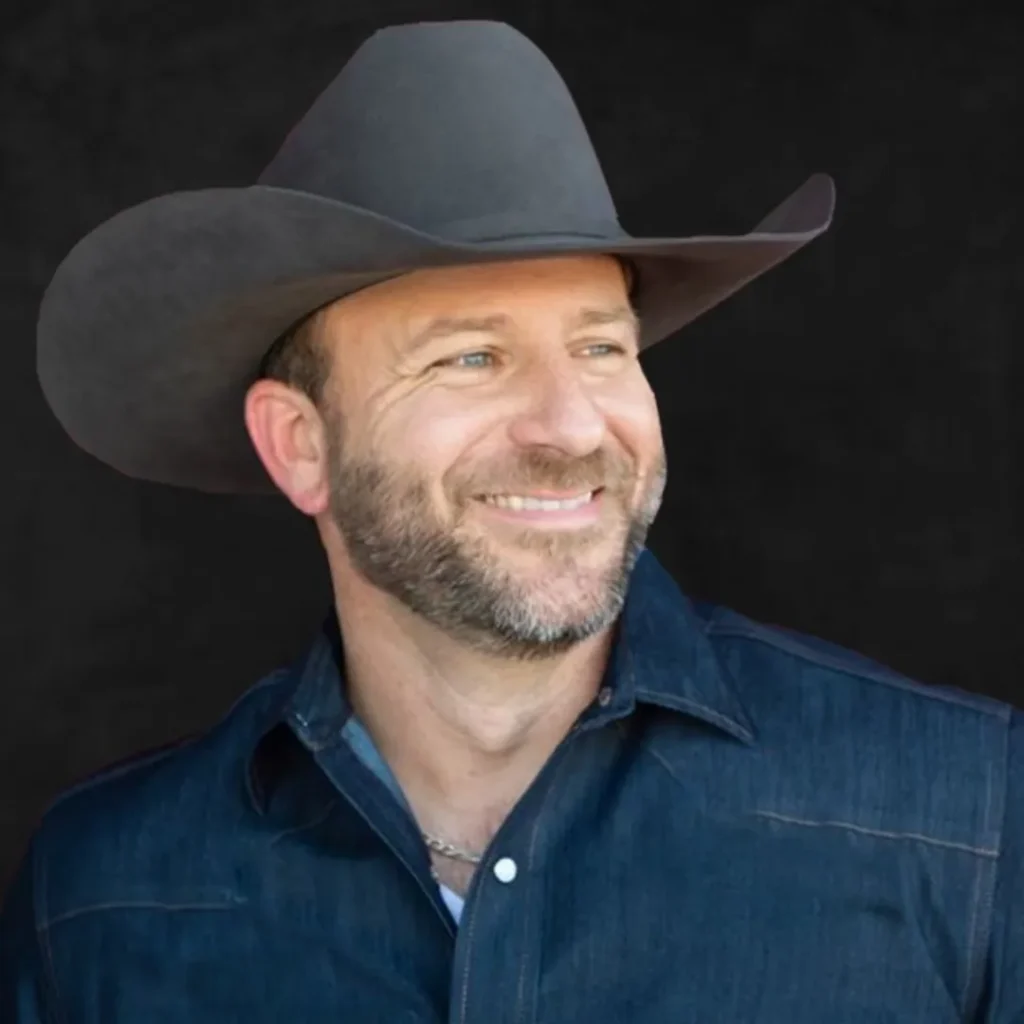
With a passion for rodeo sports and a voice that is not often forgotten Matt West has worked diligently over the years to become a well-known personality in the Western sports world.
The native Oklahoman first began his career with the PBR in 2007 and quickly made a name for himself within the sport’s Velocity Tour and Touring Pro Division. West’s talent rapidly moved him along to work on the league’s premier tour and the milestone of announcing his first PBR World Finals in Las Vegas in 2010.
Today, Matt is an integral part of the PBR team including appearing on RidePass, the sport’s 24/7 western sports digital network, and representing PBR Series in Canada, Australia, and other international markets.
In 2017, Matt fulfilled his lifelong dream of opening his own gym. Westfit is a 24-hour fitness facility, located in his hometown, Nowata, Oklahoma. Westfit’s primary focus is to provide a clean, fun, & positive environment to help people become the healthiest versions of themselves, possible.
When not on tour with PBR or at the gym, West announces a variety of notable rodeos and has expanded into non-rodeo events and broadcast work including his own unique podcast… As the host of the “Matt West Now” podcast, he dives into the lives of personalities from all walks of life, sharing life lessons and more with fans.
Welcome to the Athletics of Business, a podcast about how the traits and behaviors of elite athletes and remarkable business leaders frequently intersect. The real stories and hard lessons to help you level up your leadership and performance. Now your host, Ed Molitor.
Welcome back to another episode of the Athletics of Business podcast. I am your host and CEO of the Molitor Group, Ed Molitor. I can't wait to jump into this conversation with today's special guest. And everything about Matt west oozes humility, which is no shock considering I was connected to Matt through JJ Gotch and JJ has been on the Athletics of Business podcast episodes 82, 88 and 1 53. Just one of the most amazing humans and personalities that we've had here and that I've been fortunate enough to be able to call a friend. Now, if you ask Matt what he does for a living, he's simply going to tell you that he's a shy guy that became voice of the pbr, a TV broadcaster, a gym owner, et cetera.
But let me give you a little bit more context, let me go a little bit deeper and then we're going to get into a couple highlights of what we talked about. I'm just going to turn over to the conversation because Matt has so much to offer here. With the passion for rodeo sports and a voice that is not often forgotten, Matt west has worked diligently over the years to become a well known personality in the Western sports world. The native Oklahoman first began his career with the PBR 16 years ago in 2007 and quickly made a name for himself within the Sports Velocity Tour and Touring Pro Division. Just a great story how he got started that he shares with us.
His talent rapidly moved him along to work on the league's premier tour in the milestone of announcing his first PBR World Finals in Las Vegas back in 2010 and today he's an integral part of the PBR team, including appearing on Ride Pass, the sports24.7 Western Sports Digital Network and representing PBR in Canada, Australia and other international markets. One of the stories Matt really jumps into is his passion for owning a Gym and in 2017 he fulfilled that lifelong dream of opening his own gym and Matt shares a story of what the catalyst for that passion was and where the purpose came from in opening up his own gym. WestFit is a 24 hour fitness facility which is located in his hometown, OH Noah, Oklahoma.
The gym's primary focus is to provide a clean, fun and positive environment to help people become the healthiest versions of themselves possible. Now Inside of this conversation, we're going to talk about so much stuff. We're going to jump into the PBR Team series and we're going to talk about how the PBR Team series has elevated the PBR brand and how being a part of a team and the accountability that comes with it has taken the performance of the riders in the sport to a new level. We'll talk about the new Amazon original, the ride. If you have not checked it out, go check it out. We'll talk about it more here. There's a link in the show notes.
It profiles the world's top bull riders and how they juggle their families faith in a modern day cowboy lifestyle as they compete for the inaugural Team series championship. And we're going to talk about that cowboy and what does it mean to be a cowboy. That's something we discussed back with Kosha Urbe on the podcast previously. We're going to talk about the resiliency determination of bull riders, highlighting their ability to overcome tragedy and continue competing again, the power of accountability, the cowboy culture and the significance of leading by example and working towards a collective vision of success. And we're really going to dive into overcoming self limiting beliefs, self limiting behaviors and self limiting factors and focusing on the bigger picture. Now I'm going to get out of your way.
I hope you enjoy this conversation that I had with Matt west half as much as I enjoyed recording it. Matt, thank you so much for joining us today on the Athletics of Business podcast. I am beyond fired up to have you here with us, brother.
I'm super excited, man. Thanks for having me. It's an honor. And I can't wait to get to it, man.
It's been a few months since we talked for the first time and so much has happened in your world, in the world of pbr Team series, all the other endeavors you have going on. But I want to start with you. Okay. And I know sometimes you and I are talking about this, it's going to be like pulling teeth, talking about ourselves. Right? But you have an amazing story, you have an amazing journey where this all began. First jumped in with PBR. We can start there in 2007. How did that happen?
Let me, let me go back just a little bit.
Perfect.
The beginning of the story actually was 20 years ago, 2003. The very first time I ever picked up a microphone, I was forced into doing it because I'm a super shy kid by nature, man. I'm very introverted. I don't like crowds. I sure don't like being in front of crowds, especially at this time of my life. So, 2003, my neighbor, one of my dad's friends, kind of forces me into announcing a junior bull riding event. So kids 18 and under, I hate it. I absolutely hate talking in front of people. And I'm getting ready to leave, and the lady that owns the little organization, she says, are you coming back next month? And I said, no, ma'. Am. I'll never do this again. She says, I'll pay you $75 cash. If you change your mind, just let me know the next couple of days.
I said, what time do I need to be here? And sort of snowball. And so few years later, PBR was looking for a guy to fill in a couple of roles. And lo and behold, the right person just happened to be at one of these little junior bull ridings called. Somebody said, hey, I got a guy that if he can make this work, he can do that. And it snowballed into me doing my First PBR in 07.
So had someone left, or did they just think you were better, or what was it? What happened?
They were. They were kind of switching some things up, and they were moving pieces of the puzzle around, if you will. And one guy had kind of moved on to some other ventures, and it kind of left an open spot. But in 2007, it was one and done. I got one shot at it, and then I didn't do anything in 2008, did several in nine, several in 10. And then it kind of snowballed into eventually becoming full time.
When did you realize, like, man, this is. This is a good gig? Like, I. I really enjoy this 2023. I mean, it wasn't the 75 bucks you got back in 2003.
What. What I loved about it was the journey and. And the beginning. I had bucket list ideas. And it's crazy how when you start to continue through that process and work through that journey, you start checking things off the bucket list. I skipped over some things. Like, I had a couple of things on my bucket list that I wanted to achieve that I never got to achieve. But instead of worrying about those, these next steps were higher up the ladder. And so when I started marking those off, I was like, wait a minute. This is really happening. And I guess, man, probably 2010, when I did my first PBR finals, is when it really kind of sank in that, you know, we've reached the dream that we had, right? And now where do we go from here?
And that has been kind of the continuation of My entire life, it's like, okay, we checked this off the list. What's next? Where do we go from here? And that's what I love about it.
Were you able to go back and get those ones you kind of skipped over on the bucket list?
Nope.
All right, man, you got a lot of gas in the engine, so you got some time.
Well, and at the end of the day, I look back and I kind of critique myself in the sense that my goals weren't big enough at that time. And so, yeah, I might go back someday and get them, but it wasn't where I would eventually get to. And it made me realize that, you know what, if we're going to set goals, if we're going to have dreams, make them the biggest we can make them. Because if we don't achieve them, at least we put out a hell of an effort to try and we'll never regret the effort. Right, right.
You know what I love about your journey? There's many things, but you don't like crowds, you don't like talking in front of people, you don't like this and that, but you're really passionate about what you do. Like, you know that. How were you able to do that? Like how were you able to overcome those challenges, those self limiting mindsets about certain things and really still connect to your passion and create that drive to achieve the goals?
Look, I'm a fan first and I think in order to be successful at anything, especially in this market, like you have to be a fan of what you're doing, you have to enjoy your work. And I enjoy telling the stories of these athletes. That's my thing, is I, because I'm a fan, I want everybody else to understand why I'm a fan. And when I put that as my priority and telling these stories, I can forget about my self limiting factors. I can completely erase the fact that, you know, I'm shy in front of crowds, that's a past life. Let's put.
I was gonna say that seems to have gotten a little bit better.
Yeah, yeah. Like, like we're past that. Don't get me wrong, there's still a lot of times where I still kind of like to be the guy just sitting in the corner, not talking. I don't like small crowds now. It's weird, but anyways, I put that at the forefront. I want to be the guy that can help a new fan connect with somebody I'm a fan of for the same reasons. And so when you put that passion and that love for anything, first and foremost, you can get rid of all of your own self limiting factors.
Well, what's really phenomenal about that, you think about how you're going to connect a with the fans, right? And you're connecting to what they love about the sport or what they're learning to love about this sport. And I think back to certain baseball announcers or basketball announcers that I've listened to over the years. And you absolutely have those announcers that want to act like they know everything, that they have all the answers because they've seen it all, they've experienced it all, they've been there for years. Then you have the ones that are just so happy to be part of the program, that are so happy to be sitting behind the mic and able to bring you the action and to bring the emotion to you and the excitement to you and the joy that they find in the game.
Like you're talking about with what you do. It's a whole different monster. I mean, it's a whole different feeling and it's a whole different connection.
Look, so many people will talk statistics, talk numbers. Michael Jordan had an amazing career, right? You can talk numbers and records and everything you want about Michael Jordan. But what I remember most about Michael Jordan is the day he had the flu where he could barely keep his head up and he went out and just absolutely became a monster. I mean, they were holding him up during timeouts and when he lost his father and hugging that trophy and motion that came with that's where I really became a fan of a guy. Because you realize he's put all the work in. Yeah, he's great at what he does, but he's also dealing with real life adversity that all of us do. And for him to be able to push through that, you'll forget about all the numbers, you'll forget about all the records.
What you remember are the moments that make you think about something. And that made me think, you know, this guy's dealing with all this and still can be the greatest.
And you know what? PBR has had a unique opportunity, a wonderful opportunity to share the stories of their riders on the ride. Okay, Amazon prime and season one. Is there a date for season two to come out?
Not yet.
Not yet. Okay. Unbelievable. Yeah, Fingers crossed. It's unbelievable. And the stories that they share, can you talk about that and what that has meant to the sport and what it meant to you to be able to sit down with the production, with the writers and to be able to share the Stories and some of those.
Stories, it's funny because you mentioned how well that's done, how good this is at getting into the real life stories of these athletes. I had a guy that was a former UFC champion texted me last night that he was flipping through and he saw this and got hooked and just started watching the entire season. And so now here we are, continuing to grow the sport, continuing to make it bigger and better than ever. And that's. That's the hope, right? That's the hope is more people will start to connect with these guys. Well, when we're going through this season, you start to realize that the sport is the job. They still have real lives. And some of the stories. I don't want to give everything out there, right. But obviously we deal with tragedy, we deal with adversity.
You look at a guy like Chase Outlaw who ultimately lost a. A family member, Ezekiel Mitchell, who lost a family member, but they still showed up. And then all of their efforts went into remembering those family members. And. And that's the ultimate story of wanting someone to succeed. Now all of a sudden as a fan, because they're going through this, I want even more for these guys to win that. The first season of the ride. You don't have to be a bull riding fan at all to be able to be captivated by this. Just give the first episode is all you need because you're hooked and you're going to watch the whole thing.
You know, when Covid first hit, our kids obviously were two years younger and I made a real intentional decision that were going to watch a movie like every other night or every three nights. It was going to be a true movie or a true series. And as we based on sports and true story and you're going to learn something from. But it was also going to be enjoyable. So like soul surfer ride like a girl, you know, on and on. I wish this was around because the kids would have dove right into it. Now we have all these different things going on and a million things, but the stories you hear and I think something that people.
I really want to talk about this because you and I had a great conversation before we started recording about having the ability to just do what we need to do, right? Like get over ourselves and to realize we're part of something bigger than ourselves. And these bull riders, their lives are not in danger just when they compete. They're in danger every single day when they prepare and when they practice. Every time they get up on that bull, they're basically. And this Is not being dramatic. Like they're basically putting their life on the line. Why do they do that?
That's the million dollar question, right? Everybody wants to know what is in the mind of an athlete that knows they could die when they practice. For a lot of guys, it's all they've ever known. For you know, some guys, they watch their dad do it or their grandpa do it or it's been kind of the path the family lineage has brought them to. For others, it's that feeling of adrenaline, accomplishment going through, like you and I talked before we started here, going through the suffering to find that success. You know the old saying of nothing in life worth having is going to come easy. There's nothing that compares to professional bull riding in terms of having to go through work, suffer the possibility of death just to accomplish something that for some eight seconds is a very short amount of time.
But you're accomplishing something that nobody else on this earth can do. And for those guys, I think that feeling of accomplishment and then look, the brutal honesty of it is the guys that are doing this, they're doing this to provide for their families. It is all about taking care of the kids, putting food on the table. It's about paying the bills for you and your wife or your fiance. It's about taking care of life, setting yourself up and trying to provide the best possible living you can for your family. Everybody has a different idea of what that looks like. For these guys, it's getting on 1800 pound.
It's insane. We were at the Chicago team series and were sitting in one of the dirt suites and my kids were shocked at the size and the athleticism of the bulls. I mean, it was absolutely insane. So as I'm sitting there, you know, with the kids, watching this amazing display of athleticism both by the riders and the bulls, Me being me, I thought to myself, what makes a great bull rider? Like what makes one better than the other?
I think that what you put out or what you put in is what you receive, right? The guys that are working diligently all day, every day, we're seeing the productivity guys like Jose Vitor Lemming, who treats this like a sport. He's an athlete. Everything he does in some way, shape or form puts into account what he does for a living. From the meals that he eats, what he puts into his body, to the work that he does in the gym, to his day to day operations. I feel like every move he's making in some way affects his career. There's other guys and again, this is the crazy thing about this sport. There's other guys that the best thing for them to do is not think about it and just react. I think it goes down to anything.
If you truly love what you're doing and you're striving to be the best in everything you do, you're going to see the rewards. And we're seeing that now because you talk about, you know, the kids loving the Bulls and the athleticism and the magnitude of these incredible animals. They are so athletic that if you're not trying to level up on the daily, you're not going to be able to keep up. You can't compete at this level. You have to be the very best version of you that you can be, or you're going to get left in the dust, you're not going to make the tour, you're not going to make any money. And so you have to be putting that work in every day.
How much has it impacted you as a person, in all facets of your life, to be around these people?
Makes me better every day. And that's kind of become the mantra of my life, of my gym is just better every day. And you hear people talk about, just be 1% better today than you were yesterday. I don't even want 1%. I just want to better today than I was yesterday. And I can do that with these guys. Because the locker room we have right now is a bunch of really good men. A bunch of good, kind hearted family man. Don't get me wrong, there's still some kids in there that are athletes. They're living that life. But for the most part, we're dealing with really good, humble human beings that grew up in a rural lifestyle, that grew up with families that had values and morals.
And they still open the door for a lady that still, you know, say, yes, sir, no, sir, thank you. Excuse me. Little things like that, right? But in terms of toughness, I see what they deal with. If you watch the ride, you're going to understand exactly what I'm talking about. When you see some of the stuff they're dealing with and the fact that they still show up, they still take the time to visit with fans, put a smile on their face, that makes me want to better. Yeah. Makes me want to better in the gym, makes me want to better at home, as a husband, everything,
You know, and there's this culture, right? There's this cowboy culture. And you mentioned values. Our foundational program here is victory defined. And the connection I See, behind. Between. Excuse me, the cowboy culture and the way we do things authentically here at the Molotov Group is mind blowing. And when you talk about the cowboy culture, when you talk about be cowboy, that absolutely screams values. Right? And you just briefly went over it. But talk about what that means, and talk about not only what it means to everyone as a person and how they operate, but what that means, the impact that you're able to have to everyone that you touch.
Yeah. It's funny because every once in a while, when you pop on a podcast and you say, hey, you don't need a ranch or you don't need horses or anything to be a cowboy. This is what you need. You have a lot of pushback. Well, you know, that's. You should talk to my friend that goes out and has to brand cows every. You know, whatever. But the way I feel and the way a lot of people feel is the term cowboy has this significance that's pretty easy to understand. You. You be the best person you can be. Those core values that make a cowboy so notable, hard work, respect, admiration for others, willingness to go do whatever it takes to get the job done. That's. That's what a cowboy is all about.
A guy that gets up before the sun comes up to go take care of the herd or to go feed or go start working on the ranch, whatever they're doing, they put all of those things ahead of themselves. And. And that's what we feel like being a cowboy is all about. Just those core principles and values of being a good human being.
And it speaks volumes about the circles they run in. Right. Like you talk about. Of course there's kids. I mean, there's some young guys. There are some young guys, but, man, the men they're hanging with and the lessons they're learning and the fun they're having and that, it's just really. It's a sport that's unique in that you don't see a player. I'm sitting there watching the NBA draft last night. Not to time stamp this podcast. And the way some of these guys are dressed, I mean, there's dude wearing a suit with no shirt underneath it. I mean, call me old school. I don't think I'm old school, but MJ ain't getting up there with no shirt on underneath his suit. I don't know why guys didn't understand that.
One of the things that set Michael apart from others was, hey, he was no angel, but the man was professional. He was a pro, and he was meticulously dressed, and he operated with class. He respected the game. He respected what the league was doing for him, even though he had his battles behind the scene with David Stern in the league. But there was a. There's a professionalism about him, right? Like, it's something that's missing. I think PBR has something that's missing these days, you know, And I love how that shows up, though, in every facet of your life. Because I want to talk about Westfit, I want to talk about the gym, the purpose behind it, how you did it. There's. It's such a cool. And really, the first time we.
We talked a lot about it the first time we talked and some of the. The things that you pull out of it in terms of the stories that you hear.
I want to go back because talking about, you know, fashion and all these things, I think you hold yourself to a certain standard. And I had a gentleman, Jerome Davis or Jerome Robinson, who was instrumental in my career, instrumental in a lot of people's career. He would always show up to the airport up until the day his. He took his last flight, and he was always have his cowboy hat on. He would always have a nice shirt on. Most of the time, he'd have a sports coat on. Because he'd always say, you know, you never know who's looking. You're always at work or you're always on stage. You're always representing who you are and who you're affiliated with.
I thought, man, that was so interesting to hear because so many of us just jump on an airplane and if we throw on sandals or sweatpants or whatever, a lot of people look at it like it's just hurry up and get there and get to your destination, but never know. You never know who you're going to sit down next to. You never know who you're going to be involved.
You never know who you're going to have a conversation with. That's one of my favorite things to do about with traveling. You know, you don't know what conversation you're going to have with who, and you don't know, you know, what connection that you're going to make. And you really never know who's watching, and you never know.
So don't miss that first impression. Don't miss an opportunity to make first impression and a good first impression. But back to your question. Westfield, the. The gym that we have, and like I said, we live in a very small area in Northeast Oklahoma. But how small?
Tell my listener how small.
So the town I live outside of is 300 people.
Yep.
The. The next town you live outside of,
The town that has 300 people. So over here is 300 people, and here's you.
My. My mom and dad live about a mile down the road. They're our closest neighbor. If I could get a little further away.
And they're saying the same thing, too, brother.
Yeah. Oh, I guarantee they are. I just. I like my space. Right. You know, because you. You understand when you're consumed with people and you're especially. This goes back to the introverted me. Right.
Right.
Shy me that wants to disconnect if I'm in a crowd all weekend long and I'm around thousands of people in a downtown city. That's not how I grew up. So I want to kind of disconnect three, four days of the week and get away, you know, be out in the middle of nowhere where we are. And so it's nice to come home to middle of nowhere. But, you know, when I was in my early 20s, I had, you know, some health issues. I had more than anything, just. I was severely overweight, and I was always an athlete in high school, wanted to play college baseball. Life took a different path. So I went to college. I got really lazy. I got really lackadaisical about a lot of things, and I gained over 100 pounds. I was really big, unfit, unhealthy.
I got to a point where, in the blink of an eye, I wanted to change my life. I moved home, joined a gym. And I remember I went to that gym like, five or six times that day, parked in the parking lot and saw people in there, and I couldn't make myself go in there in front of everybody. I was just so intimidated. And I always said, like, if. If I ever got put in a position where I could open the doors to a place like that, where everyone felt comfortable and everyone felt like they were all on the same page and I could help people. I was going to do it. Well, December 1, 2017, we opened the doors, and it has been a. A blessing beyond belief or imagination.
We've seen so many people come through the doors and literally change their lives. And that's what it is. It's. It's a business built out of pure desire to help other people. And I always said, man, that's not my primary income. That's not my primary business. That is a passion project, and if we can get close to breaking even, it serves its purpose.
Right.
You know, and so now we have several hundred people that come in every month.
Let's talk about that, though. How did you do that? Okay. You live outside of a town with 300 and you talked about this all like, was it word of mouth? Was it, hey, this is a place where you can go and be you. It's a psychologically safe place for you to absolutely get after it and start feeling better about yourself.
I was dead set on building a culture of people inspiring each other. We never spent any money on advertisement. We never took out ads in the newspaper or any of that stuff. I got a group of friends together that started coming in and working out with me that summer. We started kind of piecing the gym together as went along. When we opened the doors, there was already rumblings in the community of, hey, there's this new place that's going to open up. We want to go check it out. My thought was, if we can get them to check it out one time, we can get them to try it out. If we can get them to try it out, they'll stay. And that's what I wanted to do. And it all built off word of mouth.
You get the right people in the right place to start talking about the right things, that's going to spread like wildfire. So many times we get caught up in the negativity, and if you're scrolling through Instagram or whatever, you see all these stories that just throw out tons of negativity or shock and awe. There's a lot of good in the world. And I always say, there's a lot of good in the world. Sometimes you just got to look a little harder for it. But when you start telling the right stories and it starts to spread, it's amazing and humbling to see how that works. And that's exactly what happened and couldn't be more thankful for it.
You're intentionally making more good in the world, right? Like, it's so easy to fall in that trap and go down the rabbit hole of all the crap we have going on, right? We've got the red states, the blue states, the states that don't know what they are. We got all this divide, and people sometimes fail to realize that there's others that are capitalizing and monetizing our misery, our confusion, our challenges, and they've divided us amongst each other, right? But when you look for the good in the world, and that's what I love. Like, take the ride, for example. You know, take. Take that whole story. Take the pbr Team series. Take your gym. When you can connect with those type of people, and surround yourself with those type of people, you're going to exponentially impact others around you.
That's right.
Right. I mean, you're an exponentially impact others around you as you travel and as you do what you do. But yet you still have to deal with the pushback, with the negativity, with the. With the hesitancy to embrace the cowboy culture. How do you handle that? Like, how do you stay. Stay even? Like, I work with our clients a lot, our executive coaching clients a lot about staying even. I believe it's kind of a trick that we. It's not a trick, but it's kind of a challenge. Like, I want you to be emotionally attached to your purpose. I want you to be emotionally attached to your desired outcome. I want you to be emotionally attached to the process, but I need you to stay even in the process. How do you do that?
I remind myself I have to stop and remind myself, hey, you woke up this morning. As simple as that sounds, I have to just stop and go, you know what? You woke up today. You've still got the same purpose you had yesterday. You're going to have the same purpose tomorrow, God willing. But you stop and remind yourself that I woke up this morning. That is the constant. And from that point forward, when we open our eyes, first thing in the morning, we have a decision to make. Are we going to make this a positive day? Is this going to be a good experience? Or are we going to sit here and. And we're going to dwell in the negativity? And. And I got to credit my wife with a lot of how I approach the days, because I used to be the guy.
I love politics. I try to take a step back, but I love to dive into politics. I love the. The conversations with people that I don't agree with, because I think that's the only way we can really, truly learn from each other. And I wish more of the world would do that. But I used to get where I'd wake up and I'd scroll my phone, and before I ever put my feet on the floor, I was in a bad mood. And my wife kind of, you know, got. Got a hold of me and said, you got to stop that. It's ruining your days. And I was like, you're exactly right. So I just. I make a conscious effort to. Every morning when I wake up, hey, I wake up thankful that I woke up today.
And I put it in my brain, today's gonna be positive. Today's gonna be good. We're gonna make some good in the world today, no matter what. That's not to say that 15 minutes into your day, the air conditioner is going to go out or something's going to happen, and you've got to stop and go back and remind yourself, I woke up this morning. Let's make that decision again and let's move forward. And there's times where you got to do it 100,000 times a day. You just keep reminding yourself why you're doing what you're doing.
You know, one of the big things I firmly believe in is we don't go through adversity. We grow through adversity. What's been something in your career, your life, that was an incredible challenge. It was a really difficult circumstance. It was a really big piece of adversity. I mean, heck, it can even be walking into that gym the first time, right? But what was it? And how did you grow through it? What was it that you did?
You know, I think with anything, there's several of them. I had one most recently, where no matter what you do and how much you love it, if it's a business, there's still the business side of what you do. And I went through that last fall, and unfortunately, I wasn't really happy. I didn't feel like I was able to provide best for my family and the situation and climate I was in. And I had to put a lot of faith in God. I had to bet on myself and make a really difficult decision of, you know what? I'm going to step away from this path that I'm in right now. And that was the hardest decision I've ever had to make professionally. When I did that, I had come to terms with it, and I had come to terms with, you know what?
I'm quitting this dream job. I'm walking away because I'm not completely satisfied with where we are. And it's not just. It's not just about money. It's not just about any certain things. It was. I just didn't feel like things were where they needed to be in my life. And so I did. I walked away for about an hour. And within an hour, there was a text message that said, hey, can we visit about some things? Within three hours, I was deeper in than I had ever been before. But it took me having to realize that I'm not completely satisfied with where I'm at right now. So I've got to make that choice. Do I just keep biting my tongue and bury my head in the sand and keep trying to move forward or Do I stop and go, something's not right.
Something has to change where I've got, you know, completely bet on myself and go a different direction. Once you get to a point where you're not scared to bet on yourself, that is where your biggest growth can come. Because when you have full faith in God and in yourself, you can start to move forward at a. At a pace faster than you ever dreamed imaginable. Right? And that's what. That's what I had to do. That, honestly, that was the hardest thing I've ever had to do professionally is go, I'm not in the right space. I need to take a step back. I need to run away from this dream job and go see what I can do on my own. And the second I made that decision, God went, okay, you proved that you would have faith in me. So here you go.
And this new opportunity and bigger growth than I ever could have dreamed.
It's awesome. And your. Your faith is very important to you, and it has played an instrumental role in your success, both as a. In your career and in your personal life. How has that shown up in your world? Like, in your. I mean, that is a perfect example. But I. I guess what. I'm just. How awesome is it when you're in arena announcing and you say to prayer before the. The event and. And talk about that? I've heard you talk about this before. I know there are podcasts. I mean, it's just. I had goosebumps when you made the point. I'm like, dang, that's really cool.
I got to say a prayer on National Day of Prayer live on CBS Television. At one point in my career, that is the biggest testimony of faith that I think anybody could ever, you know, in my role in. In my line of work, that I could ever live. Because there's so many people in the world that want to take prayer out of everything. I got to say a prayer in front of a worldwide audience on network television. And I always say, as much as I love the sport, as much as I love telling the stories, that minute and a half, two minutes that I get to stop everything and pray with an entire arena full of thousands of people, that's the best part of my job. I grew up, like I said, small town, Oklahoma.
My mom and dad were adamant about getting me to church every Sunday morning. They instilled that into me at a very early age. We, you know, we grew up believing, and the older I got, I start to be around guys. I mentioned Jerome Davis earlier, who had a Terrible accident, riding bulls in a wheelchair, permanently, you know, paralyzed from the chest down. But I'm around that guy and I see how much he loves his God and how much faith he has that I'm here for a purpose. And it makes me continue to grow in my faith and get stronger and realize that, you know what? God has a purpose for all of us. And that purpose is not to be average. That purpose is to be the best version of you can be. I say we're put on this earth for three reasons.
One, to glorify God. Two, to be the best version of ourselves that we can be, and three, to help as many people as we can. The best way to do two and, or the best way to do one is by following through with two and three. So if you become the best version of you and you help as many people as you can, that's the best way to show your faith.
And I'm coming at you here from a. I'm going to turn a little bit here because I just thought of something as you were answering that question. I mean, it was amazingly articulated or articulated amazingly. But when you are working alongside or you are leading someone through something and they don't have the faith that you have, they don't have the spiritual connection that, you know you have, how do you handle that? And here's why I asked that. Because we live in this society where, like, if it's black and white and if you are spiritual and I'm not, well, then screw you're wrong, and you're an awful person and we can't coexist together. Whereas I'm guessing you come from a point, is like absolutely like our happiness and our success is not mutually exclusive just because we stand somewhere separate on faith.
In the business world, how do you deal with that?
Lead by example. No different than you would be if you were starting a brand new company and your other investors or your partners didn't believe in your vision. You go out and you work towards that vision. You go out and you work towards showing and proving that this works. This is the path to success. I don't have to sit and argue about my faith with anybody. You know what? I'm going to keep being me. I'm going to lead by example and I'm going to stay the course. And eventually you're going to look at me and go, there's something different about that guy. Whatever it is, I want to find out. You're going to circle back, we're going to have this conversation not in an argumentative fashion, like some people like to do. But it's going to be a simple question and answer.
Let's figure this out. But lead by example. I think that's the best way to do it. I think that's the best way to attack it.
And it can get to a point, and it often does get to a point when people are willing to make themselves a bit vulnerable. It gets to a point where it's like, hey, I might not get to where you are faith wise, but where I will get to is accepting you for who you are and realizing the fact that we can absolutely be massively and wildly successful together as a team. And I think that's such a powerful thing.
You talk about Democrats, Republicans, earlier. You know, everybody has their side. Everybody has, you know, whether it's National League, American League, if it's Dallas Cowboys, Kansas, whatever, I don't care. Packers, Bears, they just, right, I couldn't last. I don't watch hockey. I'm kidding. But at the end of the day, if we can sit down and we can talk about things, you talk about business. If everybody has the same finish line in mind, everybody has the same goal, who cares what road we take, right? Let's just stop and let's look at a map and go, hey, we could go this way. Yeah, but there's going to be some storms over here that we can avoid and actually go this direction. Like, let's stop and talk about those paths. And if we don't agree, we can go separately.
As long as we know the finish line is the same.
You know, in a great segue into the finish line is the same. And we're in this together. PBR versus PBR team series. What have you seen? How have guys embraced the team series and that whole dynamic?
It's incredible, man, because you know as well as anybody that accountability is a big piece of success. And we're seeing a new level of accountability because these guys have always ridden as an individual, it's always been about, what can I do? For me right now, I've got to be the best I can. But now you're starting to look at strategies. You're starting to look at a whole team of guys now, a coach, a general manager, ownership that are all dependent on what you do. And that's. That's a whole new level of accountability that we've never seen before. The guys are loving it because the camaraderie becomes even stronger. Everybody's always kind of helped everybody, but now you've got that core group of guys that you're willing to do anything you can for, you're going into battle with.
And you know they're thriving in this situation because they know that if they don't do their job, they just let the four other guys down.
And that's huge. And I'm sitting here thinking, I just wrote down producer versus leader, right? PBR versus PBR team series. How much have the guys enjoyed embracing the role on a team? Like they're not the lone wolf anymore. Right. Like they're accountable to their team members, and they realize they're a part of something bigger than themselves, but they're still able to. You're going to have that person in a team that, well, on day of competition, wall themselves off, go in their own space, get in their quiet mind. They're not going to be the one that's. But it's okay because that's their role. That's who they are. How much have you seen that show up?
It's crazy. It's. Every single athlete in that locker room has risen to a new level. I truly believe that. And I think it just boils down to that new level of accountability. Every guy has a smile on their face. I feel like the entire hallways back in the back of these arenas are a lot more fun, jovial. Everybody's excited about it. Yeah, a lot of it is because it's new, but the majority of it is because they've truly embraced the concept. We all grow up in or around a team sport when we're kids. Even if it's just watching something on television, we can all connect with that team. If you're married, you understand that you're a better person because of your partner. If you're in the right relationship, these guys, they. They see that. They know that. You know what?
If I'm on a team with a world champion and I'm a rookie, I have to prove that I belong in the same locker room with that guy. I'm putting in the extra work. I'm putting in the extra time. I'm trying harder. Because if you're an individual, there's times that if you're on the path by yourself, you can kind of check out and let yourself get away with it. If you're riding in front of a team and you check out now, you've got to duck your head and go back to the locker room and try to look those other guys in the eye. If you can't look those guys in the eye and say, I gave it everything I had, then you're missing something. You don't want to be the best. You don't want to be as good as you can be.
And that is what's changed the game. I do. I think it's the future of the sport. Everybody's getting better.
And this is the epitome of. Because I'm thinking that the PBR team series has absolutely raised the level of value and experience of the brand of PBR itself. This is the epitome of you become better individually by become better collectively. Right. Like, in other words, the team is absolutely going to make each individual rise, each individual better, and this just screams it. And do you think that the folks who came up with the concept came up with the idea of having a PBR team series? Do you think they understand the significant impact it would have on PBR itself and the individual competition?
Yeah, 100%. Let me tell you why. Because if you live in Nashville, Tennessee, and you've never seen bull riding in your entire life, and you show up downtown Nashville to watch PBR teams, you don't know any of the guys, you don't know any individual athletes, you don't know that this guy's a two time world champion. But, oh, there's a team in blue and yellow that is the Nashville Stampede.
Right?
Sweet. Who are they playing? Oh, they're playing Kansas City Outlaws. Well, I don't like orange and black. Or they're playing the Austin Gamblers. I don't like black and green. I'm cheering for Nashville. That's all you've got to know. You cheer for the home team and that brings in so many new eyeballs, so many new interests. We've seen in one season. The amount of growth in people just wanting to get interested in this because now they can connect with a home team.
And it's funny because the way you just explained that is so seamless and obvious. Where I was coming from too is with the riders themselves. Right. Raising the level of their game, raising the level of quality pbr. But you know, you just mentioned something. The Austin Gamblers.
Yeah.
So jj is curious. J.J. gotch is curious.
I don't know that.
Who. Who your second favorite GM is in the team series behind jj.
Well, that's wrong. That's. You got some false information. My favorite general manager in teams is. It's easy to say who My number one is because there's only one female GM in the entire team.
Ladies.
Tinabatic Nashville Stampede.
JJ's.
JJ's in there, man.
Yeah, he's the best He's.
I think he's so good for the sport. And you talk about leveling up the pbr. A guy that comes from the background that JJ Gotch and the Austin Gamblers has his sports background. He's seen it in other worlds. Now he can take the. The good and the positive from those other ventures and bring them into our world. And that's what this is all about, man. Everything from the office to the coaching staffs to the athletes to the Bulls, everything is going to benefit from PBR teams because we're getting more outside influence. Not in a negative way, but we're taking the positive. You know, you take the things you like from everybody else, you put them together and you build what you want.
It's really. It's been really cool watching him transition from Ryan Sanders Sports Entertainment into the Austin Gamblers and the passion he has for it, the joy he's taken in it. And I've been blessed. I've been able to spend some time with JJ down in Austin a couple times here in the last year and just sit and listen to him talk and explain it and explain the sport and how he's completely immersed himself in all of the intricacies of it. It's been. It's been super cool. But let's. I want. You know, you brought up a great point. The only female GM in the sport in Nashville. How does she do it? Like, how is she doing in a sport that's got just a bunch of men in it and a type personality is incredible human beings, but yet still, that's trailblazer right there.
She's passionate, same way the guys do. She's passionate about the sport, she's passionate about her teams. If you love something, it's hard not to succeed if you're putting everything you've got into it. I don't care if you're male, female, robot, alien. If the people around you see how much you care about something, then you've instantaneously gotten their respect. Look, we. We talk about being in a group of guys. Well, if you show up and do what you're supposed to do, it doesn't matter. It really doesn't. You know, male, female, whoever. She's put together a great team. She went out and got an incredible head coach. She went out and got a guy they called Moneyball, that Keith Ryan Cartwright, who is one of the most analytical guys our sports ever seen. He used to be a sports writer.
He knows the stories, he dives into their personalities, starts thinking about who fits with who and then they go out and they get the exact team that they want. You want to know what is perfect about Tina Battic being my favorite gm? Because they had the worst record in the regular season. The Nashville Stampede had the she hates. When I say this, they were just absolutely, statistically the worst team in the league. When you watched them, you didn't get that feeling. But wins and losses, they were the worst. When we got to the finals, the playoffs, if you will, they win the whole thing. That's going through adversity because most teams would have hung their head and gave up. But when they got to the point where it mattered the most, they were ready. They were battle tested.
They had been through the fire, they had climbed mountains before, so they knew they could handle it. And she, along with her coaching staff, they helped instill that into those guys that, you know what? We went through all the hard stuff. Now let's go have some fun. And they ended up winning. It was the ultimate Cinderella story.
That is so cool. Speaking of stories, I mean, your life is full of stories, right? PBR Team series. You're on tv. You're telling the story of the sport. Your podcast, let's talk about that. Let's talk about before I, we wrap this up, let's talk about where people can find out more about Matt West. Find out more about your podcast, the gym, everything, Social media.
It's simple. It's Matt L. West. L, my middle name. There's a lot of Matt west out there. But you throw in the O, you can find me my podcast. I, I started this podcast and it's in the beginning were one of, if not the only western sports completely driven podcast. And like everything else, the market gets flooded. Now everybody has a rodeo or bull riding podcast. We've taken the last six months off to kind of regroup, rebrand and restructure what we are doing. We're going to launch, relaunch here in the next few weeks. It's called Matt west now. My goal now is to change the world one story at a time. And if that's changed the world for everybody, great. If that's changed the world for this sport of professional bull riding, great.
If that's just changed the world for one person that listens to one of the thousand episodes we're going to put out, great. But I want to change the world one story at a time. I want to have a positive impact on somebody somewhere. And we're going to bring in guests from all over the world. We're going to Bring in guests that are stand up comedians that are professional athletes, ufc, hall of Famers, things like that. Like, I just want to bring different people in that I'm a fan of and let other people see why I've connected with these people.
Yeah, that's so cool. Well, I can't say how much I appreciate you, brother. Appreciate you taking the time to jump on here so much here. What's next? We talk about the bucket list, we talk about the different things, and you've had this amazing journey. Part of me feels like you're only getting started, Matt.
Yeah, I do too, actually. And as far as what's next, I don't know. I've gotten to a point where I've gotten to where I wanted to be and now we're looking to see what's next. Yeah, I mean, everybody wants to be the CEO of some company somewhere someday. I own my own business. For me, what's next is just simply trying to make the world a better place. I know that sounds cliche and a little cheesy, but. But I truly do feel that in my heart, like I want to do something to put as much good in the world as I possibly can. I want to continue to grow. We're starting to build an empire. Everybody's got what they want in life and we've got one gym. I want to end up having 10 gyms, 20, 30.
Whatever God's calling for me to do is what we're going to do. We're in the process right now of looking at other gyms, but as far as professionally, I'm just going to keep loving what I do. I get a front row seat for the toughest athletes in the world every weekend and. And I get to be the one that they've entrusted to tell their stories.
Well, Matt, I appreciate it and I look forward to. We are absolutely going to connect. When you come into Chicago this year, I'll come out to Rosemount, we'll go grab some dinner, and we'll massage JJ's feelings a little bit after. He really. I'm kidding. I can't do that.
Let's sit down and do this again when we come.
Absolutely. That would be a blast. Actually, I would love to get both you guys on there and maybe some other folks and we could have a really cool conversation.
I love that, man.
Thanks so much. Appreciate you, my friend.
Appreciate you, buddy.
Thank you for listening to the athletics of business. Be sure to give us a rating and review so we know how we're doing. For more information about the show, visit theathleticsofbusiness.com now get out there. Think, act and execute at the highest level to unleash your greatness.