

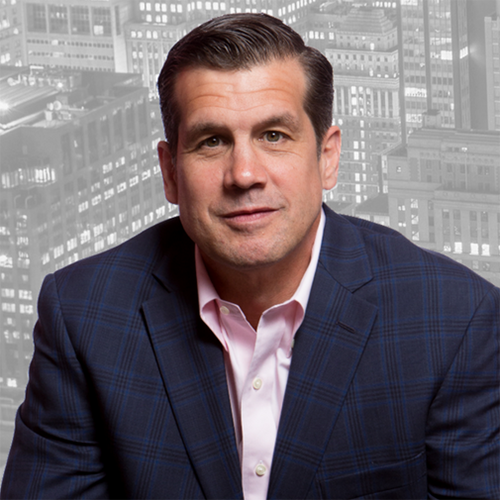
In the last 26 years, Ed Molitor has developed his leadership skills in both athletics and business. From working as an NCAA Basketball coach at Texas A&M to becoming the Vice President of a national recruiting firm, Ed has taught countless athletes, coaches, and business leaders how to THINK, ACT, and EXECUTE at an elite level. Ed has a unique set of skills to deliver leaders across the country a purposeful, positive, energetic, and refreshing experience to unlock their true potential.
In 2016, Ed launched his company, The Molitor Group, in order to reach and add value to a larger sphere of ambitious individuals and help them achieve their goals every day. Through The Molitor Group, Ed has guided all types of leaders to achieve success. From entrepreneurs and executives to teams and companies, The Molitor Group specializes in empowering individuals and groups to achieve at the next level. Through Leadership Performance training, coaching, and speaking, Ed’s goal is to supply people and organizations with the necessary tools to move forward from where they are now to where they want to be.
Welcome to the Athletics of Business, a podcast about how the traits and behaviors of elite athletes and remarkable business leaders frequently intersect. The real stories and hard lessons to help you level up your leadership and performance. Now your host, Ed Molitor
Welcome back to another episode of the Athletics of Business podcast. I am your host and CEO of the Molotor Group, Ed Molotor, and I am so fired up to jump into episode number 111 today. And although I have an incredible list of podcast guests coming up, I'm going to grab the microphone myself today because there's some things that I'm working on with my clients and some feedback that I've received on letters that I have sent to my VIP list. And if you're interested in getting on the VIP list, email me at Edemolator Group. Just putting out content every single week and you'll receive two to three emails a week from me. It is not a sales funnel. No solicitation.
It is straight up content pulled from podcasts, pulled from work I'm doing with my clients, pulled from things I have read and reading and listening to, watching. Okay. In addition to things that are happening in our world, things that are going on with work with my clients, feedback I'm getting on my VIP list. I came across a quote from Coach McDermott, Creighton men's basketball. And I was putting together constructing an email last week, and I thought it was very fitting because I was sharing a story about my time as a young college assistant coach and a young man that we had signed at our school that was a transfer. And I'll share that story with you here shortly.
And I thought it was very relevant to what we are living through right now, an absolutely unprecedented time in our life, you know, in our history. Not just the pandemic, but also what is going on politically. No political stance is taken here. This is not a political podcast. It will never be. But the day this podcast drop is very significant because it is the inauguration day of President number 46, Joe Biden. And there's a lot of change that's going to be taking place, but there's also a lot of healing that we need to do as a country. And part of that is getting to know each other and helping each other and serving each other, and it's all sort of ties together. And this quote I'm going to read you from coach Greg McDermott.
And obviously I have a bias towards Creighton men's basketball, but it's just incredible, the journey that they have done and the athletic director and what he's built there, Bruce Rasmussen. And here's a quote, and this quote was given at a press conference after they beat. I believe at the time it was number eight, Xavier or number nine, Xavier. I could be wrong on that. It was before Christmas. And it's just, to me, it hits the nail on the head. And he says, this is a tough year for everybody. This pandemic is tough. Everybody's life has been turned upside down. If there's ever a time in our history where we should think about caring for other people more instead of less, it's now. Let me reread that.
If there's ever a time in our history where we should think about caring for other people more instead of less, it's now. How can you impact somebody's life in a positive way when everybody's going through this crap because everybody needs it? Now's not the time to talk about our petty differences. Now's not the time to complain because something isn't exactly the way you think it is. Now is the time as a country to come together and say, you know what? I'm going to do something to try to make somebody's life better instead of trying to make somebody's life more difficult. I'm going to do something to try to make somebody's life better instead of trying to make somebody's life more difficult.
And if we all do that, just think how we could come out of this pandemic a much better country than went into it. And that's really powerful, and I think it goes really long. This past Monday, obviously, was Martin Luther King Day, and he has a quote that I love, that he said many years ago that holds true today and just resonates and aligns with Coach McDermott's quote. And that is this life's most persistent. An urgent question is, what are you doing for others? Now, let me circle back to the story I was going to share with you today, and then we'll jump into a couple other things. I'm going to give you some other podcasts that you may not have listened to that will align with the message that I have and the lessons I have for you today.
And the way I tell this story, it's one of the great lessons I learned early on in my coaching career. And I was. I mean, admittedly so. I was one of those young assistant coaches who thought he had it all figured out, knew he had a lot to learn, but thought he had enough figured out where he was really good. But I Will tell you this. As a young assistant, there wasn't a whole lot that I feared in terms of recruiting. Okay, that the level of talent, the kids I would recruit, the relationships I would get into, where I would go, see kids play. I'd go anywhere at any time. It didn't matter if it was on the west side of Chicago, the south side of Chicago, if I was going somewhere.
We had never recruited before and were unknown, and I had to develop relationships. It really didn't matter. And in those gyms is where I forged of the deepest relationships with coaches, players, and parents. Okay. A lot of this took place inside of these gyms that were in neighborhoods where there is a world going on, something that I could have never imagined. I was somewhat familiar with it because of my college teammates. And I had heard the stories. I had heard the names, didn't know the faces, didn't really know the environment. But I got to know them really early on. I remember one time early in my career, it might have been 92, 93. I'd have to go back and look at what was Kevin Garnett's senior year in high school. And you talk about a high school team. Kevin Garnett, Ronnie Fields, Michael Wright.
And Farragut was playing in the city championship, and the city championship game was sold out. But I got a ticket through Farragut High School, and I had to go there to pick up the game ticket. Now, just a week before, I was at Farragut's quarterfinal game for the city tournament. And back then, only one team from the city of Chicago would make the. Make it downstate. Okay? Things have changed now, significantly. It was a huge deal. I mean, a huge deal. At the quarterfinal game, someone pulled out a gun in the gym. People started running for their lives. There's a gang fight taking place outside. They evacuated a gym, which ended up being a disaster because of the fight that took place outside. So there was always something around this. And I go to Farragut to pick up the game ticket.
And at the time, and I haven't been back many years, but at the time, rival gangs were across the street. One side, I believe, was Latin Kings, and the other side was. It was either Vice Lords, Bloods, or Crips. I don't remember exactly, but the rival gangs, Hispanic versus the blacks. And you would've thought driving down that street, honestly, that you were in a war zone. Okay? But there was a situation. Not a situation. There was an experience I had really early in my career, my second or third year in coaching, that Impacted me profoundly. Although it was not a dramatic experience, nevertheless it was significant. We had a young man transferred to our school from a Division 1 school who was under investigation for NCAA violations.
Admin major, had a lot of talent, had a pretty successful run going with the coach that was there before this current staff. And he was not. And his staff was not cheating, was the new staff. And the gentleman, the young man that transferred our school, call him Q. Q was part of the investigation, okay? And Q came from a school on far south side of Chicago. His dream is to play college basketball and go get an education. And Q left. And I can't remember exactly, it was his junior or senior year. He came for some reason, I feel like he had one year with us. And he lived in a housing project in Chicago. And I go to pick Q up in the housing project and he's ready to roll, right? His mom's sleeping on the couch, Q's ready to go.
And all he has in his hand is a pillowcase. Stuffed pillowcase, I mean, stuffed. And I'm just talking about a regular old pillowcase, not one of those super big ones that you see these days that could put a whole mattress in and of itself, but just a regular pillowcase. And I looked at that, I looked at Q and I said, hey man, you got everything. Thinking maybe he left a suitcase or a duffel bag or something his bedroom. His eyes looked because, oh man, yeah, coach, I did runs in a room. I'm thinking, great, there's another bag here. Comes out with his alarm clock, okay? And he throws it in. Think about this. Here's a kid who's completely used by the system of college basketball. Not even one of the big money schools, right? Not even one of the high profile schools.
It was a mid major, okay? He was used by a system of college basketball, a coaching staff who cheated to build a program, and then a university that did not fight to keep him as a student so they could provide the education which was promised to Q. So now we get my car and we're driving away. And I look in the rearview mirror and I look at Q and I say, you good? Very simply he replies, I'm good. And I thought to myself that his mom did not even wake up to say goodbye to her son. No, see you soon. No, stay safe. No, work hard and do what the coaches tell you. Not even a hug, Nothing. Alright. I mean, this punched me in the gut.
And you know that feeling you get when you're watching a movie and you're like, oh my God, this can't be happening. You get that sick feeling in your stomach and your heart. Just. I was living that, okay? Living it. So after a few minutes, I asked him if he was ready to roll. You ready to go? You ready to get to school? You ready to get going? And I just wanted to know what was going on in his head. And after I asked him that, I just shut up and I listened. I drove and I listened. And what happened was really interesting because I learned just as much about myself as I did about Q. Now, that conversation took place almost 30 years ago. And to this day I go back to that conversation. I go back to that emotional feeling I have.
And I do that to get back to center. And I do it especially when I find myself judging others in a business transaction, judging others that I may be leading, judging others in my life, whether it be family, whether it be friends. And I think that I had the situation all figured out. And then I asked myself, what else is there that I need to know? What is it that maybe I don't know, what's their pillowcase? That stuff than what's inside their pillowcase? And I guess you could say as a college coach, not guess. I mean, my education in life went to a whole different level. Yeah, I wanted to win. I mean, I recruited to win, I coached to win, I led to win. But I learned compassion and empathy.
I learned how to see a person's world through the lens of reality and take off whatever rose colored glasses I have been wearing, think about how relevant that is in our life right now. See a person's world through the lens of reality, and that reality might not be what your expectations are, which is exactly why you should not have those expectations of others. And I learned that I can learn something from everyone. Now listen to this. I learned that I can learn something from everyone, no matter their socioeconomic status, their title, their background, or where that person fits into my life. I learned that everyone has a story, and everyone's story is very powerful. And I learned that everyone has a story and they have way more going on in their life than I could ever imagine.
So it is my responsibility to never forget that. I learned that everything people say or do to me is not personal. And it has a lot to do with the circumstances of their current life and their past experiences. I learned to get to know people and be genuine. Now, these are things that I learned, and this doesn't mean that I've done it very well, sometimes for the last 30 years, but these are things I learned As a college basketball coach that have completely empowered me in the business world, okay? I learned to get to know people and be genuine. And yes, now this is true. The way people treat you is indeed a direct reflection of their character. But I learned something far, far more valuable. And something that will serve me, will serve you.
It'll serve your team and help you become a much better leader. And that is the fact that the way you treat others, no matter what the situation, no matter what the circumstances, right, wrong or indifferent, the way you treat others is a direct reflection of your character. Now, just like Coach McDermott talked about, we are living in a crazy time right now and we must continue to keep things in perspective. As a matter of fact, I'll put in the show notes, I'll put a link to that press conference, to that statement, and there'll be a little bit more. And then all of this was in response to a question a reporter had. What led the Creighton men's basketball team to put the word equality on the back of their jersey and what that meant to them. And it's one of the things I love.
One of the many things I love about what I do is I get a ton of feedback and please, and you want to send me feedback about this podcast or any podcast episodes that you've listened to, please do not hesitate to do so. Ed at the Molitor Group, I love it. And I received a letter, a couple emails right away after this letter went out and then I received one, gosh, three, four days later on a Sunday morning. And it is from a gentleman who I've gotten to know over the course of the last year and a half after he started listening to my podcast. And we've had some great correspondence, great communication, and he is a director of business ops and development in the manufacturing space in the manufacturing industry. Very, very successful, progressive, dynamic manufacturing organization.
I want to read his email to you because this is how keeping everything I just talked about front and center right in your mind and getting to know other stories and understanding, there's always more there that can help you be a better leader. And by being a better leader, you empower them to become more successful. And it's a transformational relationship all of a sudden. And this email really just hit me like, this is really cool. And again, this is why I love what I do. That was a great email, Ed. In manufacturing, there are a lot of similarities. People from all different ethnic backgrounds and social issues working in mainly an English speaking environment and for low pay, sometimes they just don't get a fair chance as many people just look at them as a minimum wage workers in manufacturing.
The people on the floor are the first responders, so to speak. We middle management and upper level management should be supporting them too many times. Middle management and upper level think it's the other way around. Let me repeat that. We middle management and upper level management should be supporting them too many times. Middle management and upper level management think it's the other way around Sometimes a good morning hello. A smile can go a long way in someone's day. Now let me pause there for a second.
One of the things I'm going to do at the end of this podcast is I have a list of, oh gosh, 1, 2, 3, 4, 5, 6, 6, maybe 10, 9 or 10 podcast episodes for you to listen to that are directly aligned, related, relevant, whatever you want to say to this message and to these lessons we're sharing today. Okay. All right, let's get back to where I was. Okay. Sometimes a good morning, a hello, a smile can go a long way in someone's day. One of the key things that I have done is implementing shift huddles at the company I am currently working at now. We've talked about this in many podcast episodes. The power of the huddle. Okay, a very new concept for everyone there at various times.
They have tried it over the years and then when I asked various people why it hasn't stuck, it was the same reason for everyone. It turned into a finger pointing session from above which resulted in finger pointing within the shifts and against the shifts. Now we've been doing these for six months. Slowly I have been trying to get more and more people involved in the meeting, having them respond for key metrics, updating data, talking in front of their peers, and trying to get engagement going. When there's a bad day or shift, we move on. Tomorrow's another day. When there's success, we celebrate. What I found fascinating is that asking people what they think and what they would do is very powerful and it's very scary for all involved.
I try to explain to the group that we can't fix all the problems or implement all the ideas, but what we can do is keep trying things here and there. The one thing that is constant among all people is that we all have problems and we all have issues. The complexities of those problems are different. What might be a problem to someone else might not be a problem to you. Everyone lives in a different world, but having a self awareness to listen, have empathy and compassion is the key, they don't teach that in college. Anyway, I just wanted to reach out and say, great email. And if you're listening, which I'm pretty sure you are, thank you so much for that amazing email. But that's it right there.
What I found fascinating is that asking people what they think and what they would do is very powerful. And then you go down to the one thing that is constant among all people is that we all have problems and issues. The complexities of those problems are different. Get to know people, get to know their stories. And when you do that, you're going to get them to know them at a deeper level, know what makes them tick. And that's going to give you the opportunity to have a bigger impact on their life and to put them into a better position, to be successful, more successful, both in the office and away from the office. It's going to impact their families, it's going to impact their relationships with their mentees, it's going to impact the relationships with their mentors.
It's just going to keep snowballing and you're pouring into not just their lives, but other people's lives. And that's it. Don't let the nonsense that we're going through get in the way. Don't let their struggles and their challenges being different than your struggles and your challenges get in the way of you leading them in a very authentic and sincere and real and genuine way. You know, this sounds great because it is, but here's the reality, like we talk about the lens of reality. We are in a fight. We are in a battle. We are every single day waking up to a new piece of news that's going to prove to be adverse to either us or someone in our life, whether it be our family member, a friend, or the people that we lead inside of our organization.
What are you going to do with that? And are you going to get so wrapped up and dialed into focusing on how it impacts you? Are you going to keep working towards impacting others, leading others, doing for others, being selfless, having the servant mindset keep pouring into it? You don't just pour into people when it's easy, when it's convenient, you make it become a way of life. You become intentional. It becomes your default as a leader. Some of the podcasts that would be great to listen to, these podcasts are fun. I mean, we have some laughs, some very serious stories, some very real stories, and some great takeaways that you can implement right away. Ron Alvest Ever of Service Express. That's podcast episode number 22, the Powerful Culture. The service expressway. And I had Ron on for an encore interview.
And that was podcast episode number 67, empowering your leaders to solve problems and to help people. Another great podcast episode number 87, Rich Panico. And the title of that is building a culture of integrity with heart and intellect. Okay. And it talks about leaving not only people's hearts, but leaving their minds. And then Tom Walter of Tasty Catering, finding the answer from your frontline workers. And John Sabatello. John, unbelievable. Had him on twice. Episode number 62, Lessons on Teamwork from the locker room to the boardroom. And then on episode number 100, when things were just blowing up with COVID 19 and pandemic, John got real, I mean, very real in our conversation. And the title of this is Talking above the storm. And then Rob dubake, episode number 75.
And then Michiel Haggerty, number 78, leading hearts as well as minds and just aligns with which Rich Pinico. And so much great stuff here, and there's many more, but these were the ones that just came to mind that talk about the exact things that I just shared with you. And as we wrap this up, I want to leave you with a few things, a few takeaways. As a matter of fact, let's consider this a challenge to think about these three questions. Okay? As you continue to lead your people, what is it that you can learn from them? As you continue to lead your people, what is it that you can learn from your people? How can you facilitate those conversations? Think in terms of time of day, think in terms of environment, think in terms of setting.
And most importantly, what will you do with that information? How can you take that information and empower yourself to have a greater impact on their life? Now, remember, during these challenging times, continue to be the face your team needs to see and the voice your team needs to hear. We're going to come out the other side of this period in our lives stronger, smarter, and more compassionate. And I encourage you again, the reality go to battle every day to dominate the goals in front of you.
Thank you for listening to the athletics of business. Be sure to give us a rating and review so we know how we're doing. For more information about the show, visit The Athletics of Business.com now get out there. Think, act and execute at the highest level to unleash your greatness.