
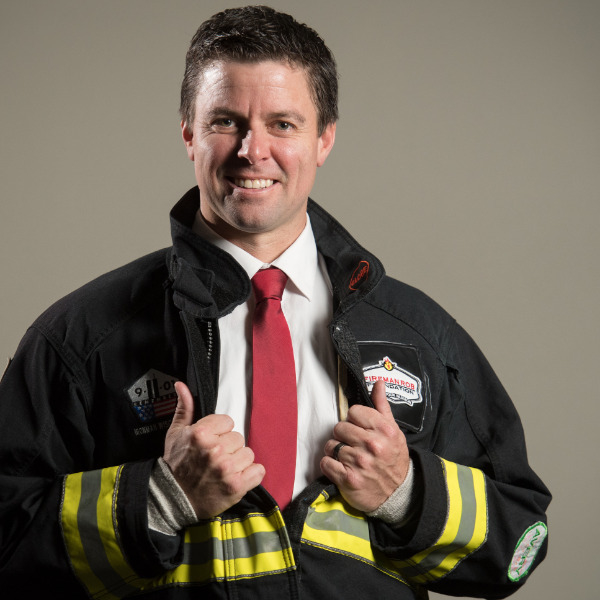
Rob Verhelst, otherwise known as Fireman Rob, has established himself as an inspiring voice for following and defining your passion, then putting it to action. He lives and speaks on the principle of Action Based Living through Engaged Passion. His life experiences range from performing 8 days of search and recovery after the September 11th attacks to being a 15 year career firefighter in Madison, Wisconsin to having served in the United States Air Force. In 2015, Fireman Rob became the Guinness World Record Holder for the Most Ironman 70.3 Triathlons in one year, while inspiring tens of thousands by doing each run portion in his full fire gear.
Since 2011, Fireman Rob has solidified himself as a key motivational influencer worldwide through doing over 18 Ironman, 28 Half Ironman, and numerous endurance races in his 50 lbs of firefighter gear for all of the running portions of each race. Along with motivating others along the way, his passion is about his children and others. In 2013, the Fireman Rob Foundation was created to help children in hospitals throughout the world with a SMILE by delivering Gund Teddy Bears. Fireman Rob understood the simple act of putting a SMILE on a child’s face dealing with illness or depression is medically proven to strengthen their immune system & create a positive effect on their minds… if even for a moment. He has created a movement in which people from all walks of life are finding their passion and paying it forward through their own positive actions. The mission of Fireman Rob is clearly defined by his speaking, his actions, and his drive: “Your strength is in your passion, now go and make your life ABLE.”
Welcome to the Athletics of Business, a podcast about how the traits and behaviors of elite athletes and remarkable business leaders frequently intersect. The real stories and hard lessons to help you level up your leadership and performance. Now your host, Ed Molitor. Welcome back to another episode of the Athletics of Business podcast. I am your host and CEO of the Molitor group, Ed Molitor. Now, we have had some absolutely incredible guests on the Athletics of business podcast, along with some phenomenal conversations. And every now and then, you get done recording an interview and you think to yourself, man, this episode is going to be a home run. And that's what this episode with today's special guest, Rob Verhouse, otherwise known around the world as fireman Rob, is. It is a home run. A little bit about Rob. Okay.
Rob's life experiences range from performing eight days, okay, 20 plus hours a day, eight days of search and recovery at ground zero after the 911 attacks. 15 plus year career as a firefighter in Madison, Wisconsin, still going strong to this day. And he has served in the United States Air Force. And since 2011, fireman Rob has solidified himself as a key motivational influencer worldwide through doing over 18 Ironmen, 28 half Ironman, and numerous endurance races. Now, you might be thinking yourself, okay, those are good numbers. Those are solid, those are impressive. First of all, they're mind blowing. But what's really mind blowing is this. He has done the run portion of each of those races again, 18 Ironman, 28 half Ironman, and numerous endurance races in all 50 pounds of his full firefighter gear. Think about that.
All 50 pounds of his full firefighter gear. And along with motivating others along the way, his passion is for his family, his children, and the children of others. So in 2013, he established a fireman Rob foundation, which was created to help disadvantaged children in hospitals throughout the world with a smile, by delivering gun teddy bears. Now, I will tell you, I think those are the softest teddy bears there are. But here's the thing. Smile. It is, in fact, an acronym. Simple moments impact lives every day. Because fireman Rob understood the simple act of putting a smile on children's faces that are dealing with illness or depression is medically proven to strengthen their immune system and create a positive effect on their mind, if even only for a moment.
So Rob has created a movement which people from all walks of life are finding their passion and paying it forward through their own positive actions. And again, talk about some super cool stuff in this interview. Things such as why purpose and passion is such an important catalyst when forming an elite, mentally tough leadership mindset. We'll talk about why ownership is just as much about what you don't do is what you do. How Fireman Rob's foundation brings to life the acronym smile, which I just mentioned to you. And this is one thing we really, you know, we talk about. Forged in the fires. Okay. Rob has. Hes an author, has an incredible new book out forging the fires.
And we talk about how to develop faith in yourself over the fears in front of you and what tolerance training is and why it is so significant. And Rob gets really vulnerable with us. Okay? And he shares with us how he has navigated the waters of severe PTSD and high anxiety that are resulting numerous events in his life, including his search and recovery work on 911. I don't want to take up any more time. Please enjoy this conversation with Fireman Rob. Rob, thank you so much for joining us today on the athletics of business podcast. I am fired up to have you here.
Oh, it's so great to be here. You know, as a father, a son of a coach, we're in the same boat.
We are in the same boat. Well, and you being a firefighter. My grandfather's a lieutenant, Chicago fire department. Obviously, like I told you earlier, I have a big plan of my heart for firemen and all that you do. Your story is mind blowing. I mean, your journey is mind blowing. The service that you are to people, not just in your profession, but in your other career, and what you do and your passion. And this is long overdue. We've been trying to connect for a while, so thanks again for joining us.
Oh, yeah, no, I'm excited to be here. And, you know, I think it's. The journey is always the biggest part of who people are, and I think that really lays out the whole framework of, you know, like, I think you and I were talking earlier about. You know, I talk about the seven catalysts, and in the book that I had the forge and the fires, and those are not things that I just were like, oh, that sounds like a good idea. They're things that I live every day, and without them, I actually probably wouldn't be around.
Now, think about that. And it's. It speaks to your authenticity. Right. And it speaks to the. To the level of how passionate you are about what you do, because it's what makes you go. I mean, it's what makes you operate at such a. Such a high level. Can you give us a couple of those catalysts and how you. How you're leaning into those right now?
No, definitely you know, the first one is purpose and passion. And the hardest thing with that is that we have purpose and passions that change throughout time and say, no different than me. You know, you see a shiny object or a squirrel, you're going to go after it. And the problem is that you have to take the time to actually look at what your passion is and what your purpose is to be able to, you know, function daily. And that's for me, you know, I deal with PTSD. I deal with major depression and anxiety. And for me, I need to understand what my purpose is each day. It's not an option to not. And I think for most people in today's society, with what's going on, they need to find what that purpose is to continue through the day.
And, you know, the second one that I always love is ownership. And it's the least utilized catalyst of anybody in this world. And it's ownership of what you say, what you don't do, what you don't say. And I think for me right now, being able to be on your podcast, being able to talk about what's going on in my mind and the struggles every single day, I'm owning what the issues are. And to be able to do that's how I can keep going forward. And it's not easy. You don't get a day off.
And that's. And that's hard to see the emotional scars that were talking about earlier. But let's talk about the PTSD because you have a very significant case of it, and let's talk about where that came from and how that really ties into your passion and purpose.
Yeah, you know, so my PTSD, it's actually numerous. And that's the hard thing is, like, back when I started out in the fire service in 2000, I was a rookie. And then one morning we had a fire in the morning, and that was the morning of September 11. And we got back to the station, I went upstairs and I was taking a shower. And at that time, were listening to radios, and. And on the radio they interrupted the music and said, you know, the trade tower has been hit in New York City. And I was like, okay. Didn't think anything of it. You know, it's like, okay, then went downstairs and the tv was on and, you know, that's when the second trade tower was hit. And at that point, they're like, it's a, you know, it's a major catastrophe and everything's going.
So at that point, I was going home and I got called by the rescue team that I was a part of and said, hey, can you get to New York City? And I was like, okay. No flights were going or anything like that. So went home, got my stuff, and drove straight, got there on the 12th, and then performed search and recovery. At that time, there wasn't really much rescue at that point.
Right.
And it was recovery, and it was. It was about 22 hours a day. I mean, we slept on the pile when you could. It was.
What was the scene like when you got there? So you're driving, first of all, what's going through your head for that drive? Cause it's not really a short drive.
Yeah. You know, the interesting thing about the mind is, like, you forget a lot of things. And I think on the drive there, as. As a young firefighter, I was excited to be a part of it. I was excited to, you know, be able to help out. And then when you get there, it was a surreal feeling because they have all these huge lights and it doesn't look real. It looked like a movie set.
Movie set, yeah.
And when you start walking and start doing stuff, you start seeing the faces of individuals and. And just the beaten down. And as it progressed, you started to feel the same way. And, you know, doing everything from doing bucket brigades to doing searches in the tunnels, it just wears you out. And one of the things I always talk about is, you know, one of how tired I was. One of the days I was in a jumpsuit and we had a helmets on, and I went to the porta potties that was set up against one of the buildings. One of the buildings that. One of the huge pieces of I beams in it and everything. So you're just. You're just surrounded by devastation. I walk into the Porta potty. I get done.
I walk out, and as I'm walking back to where I'm working, I started to pee my pants. I was so tired and focused on what I was doing, I forgot to go to the bathroom when I went in there.
Wow.
And you and I talked about this. It speaks to the. How powerful our minds are to fuel our bodies, to do whatever we need to do. It changed me. I mean, I've been divorced twice now. I have a wonderful wife now that she's made me a better person. I went through many dark years. Troubles with drinking, troubles with just functioning. And, yeah, it's to be out on the. I'm not on the other side. I think that's the hard thing, is, like, with PTSD, and I think this is a major point that a lot of people don't have it or have, you know, just been diagnosed with it. It's. It's a constant. It's not just a one time thing. It can continuously have more and more events.
And then, you know, like, there's places in Madison I don't like to go to because of bad calls that we had there. And so it's a, it's a struggle, but it's. It's a struggle that if you understand yourself better, that you hopefully can get through every single day.
So how do you manage that? How do you navigate those waters?
You know, it's really tough. And I think, you know, I've tried different things throughout the time. I've tried to stay busy. Like, I used racing as a means of coping. You know, feeling the pain made me feel still alive. It sounds weird to a lot of people, but it made me feel alive. In addition, speaking, being able to go out there and maybe help one person, I would say that it's not about changing lives. It's about giving somebody the tools to be able to change their own. And that's the biggest thing that I always like to tell people is, like, when I start my speech, I always say, you know, I'm not here to change your life. I'm here to give you ideas. If five of you fall asleep, that's great, because you needed to sleep, and I provided that.
I tell you talk about a humble person right there. You and I both know there's speakers out there that will zing something at them and wake them up.
Oh, yeah, no, I let them sleep. I let them sleep. If I'm that boring, they deserve it.
That's awesome. Yeah. Well, then let's talk about that. It's a great segue, you know, forged in the fires and all the work that you do in your foundation. You mentioned the racing, and obviously I, within the intro, I prefaced and briefed the listener on what you do. Can you talk to us about where the concept and the idea, and we're going to talk about your Guinness world record. We're going to talk about all the races you've done. The. As long as the stats are up to date, how many miles you've run in your full gear, how many miles you've biked, and how many miles you swim. Where did that come from?
You know, it all started, back on the 10th anniversary of September 11, and it landed on Ironman, Wisconsin. And I wanted to do so. I was still hurting. I was still just not in the right frame of mind. And I wanted to do something that would both impact people, but I didn't want to talk about it. I didn't want to, I didn't want to tell anybody about, you know, what to feel, what to think, what to be. So what the best idea? I came, I mean, I could have came up with a better idea, but I came up with running the full marathon portion of it in firefighter gear, 50 pounds of gear, the jacket, the pant bunker pants, the helmet and the air pack.
Now, I. You're not a small guy, but I mean, you're already, what, two and a quarter or.
Yeah.
Okay. Yeah. When you're erasing. I'm sorry. When you were racing, you're not supposed to ask. No, I'm not. Apparently, I missed the manner section of childhood, but you know what I'm saying? But you throw another 50 lbs on there and you got some stuff going on.
It's a real challenge. It's one of those things where I always say that, you know, like, I don't look like a triathlete. I look like I went into transition and I ate like, two or three of them. You know, it's, it's not something.
That, I don't know if we have a. This might be something I have to get to the crew. I don't know if we have a collection of best one liners on the podcast here in the last hundred something episodes, but that it doesn't look like I'm in the transition. It's like I went in or came out of it. It looked like I went in there and ate two of them. That's good. All right. Sorry.
Yeah.
Interrupt you, but I couldn't let that go.
No, it's, you know, and that's the thing is, like, you know, I, I started this and I wanted to do something impactful. And I was like, I didn't know nobody had ever done it in the world. You know, it had never been done before. And so I was like, okay, well, lets try this out. But I wanted to do a test run. And so I went to Racine and I did a 70.3, which is half the distance, you know, 1.2 miles swim, 56 miles bike, and a 13.1 mile in my gear. But like I always say, im not the smartest block in the room. And I didnt look at the weather. I didnt think about Racine at that time. It ended up being 110 degrees with the heat index that day, so.
Oh, man.
Yeah, so I. Swim's fine. I swam since I was young. The bike was. The bike was fine. My, my coach always says I look like a bear at the circus on the bike, but besides for that, I'm good. But then I get to my bag and transition, and it's on this, in this parking lot, and it's like, you know, asphalt.
Yeah.
And I have this huge black bag, like, everybody else has these little bags because they want to stay light. I had this huge black bag full of gear, and it was like the cartoons where you zip it out and you see the heat waves. I was exactly like. And at that time, I'm thinking in my mind going, this is the dumbest thing you've ever thought about. And I'm putting on the gear and I'm getting hotter and sweaty, and I'm like, okay, I've got 13 miles in this stuff. So I'm feeling sorry for myself and feeling pain going out. And about a mile and a half in, this guy comes across and starts giving me a hug, and he goes, thank you for being out here. I'm a retired fdny firefighter. I retired after 911. And you know how I talked about purpose?
Yeah. Yeah.
A lot of times we feel sorry for ourselves. We feel the pain of what we're going through at the time. And then you go, oh, this is why I'm out here. Suck it up, buttercup. Keep going. And I kept going. I finished that race, and then I got to Wisconsin, and again, I didn't know if I could do it. It was, it was one of those moments where you go, okay, I didn't tell anybody I was doing it. And then Iron man found out, and they started talking about it, and I was like, oh, crap, now I gotta get out.
Which is good, though, because it brings the awareness piece.
It does. But at that time, it also puts.
In a ton of pressure.
Yeah, yeah. I was like, you're all in now.
Like you thought you're all in before. You are all in now.
Exactly. And so now I get, you know, the swim, nobody knows me. It's bike, nobody knows me. So I got done with the both of those, and I get on to the run and on the bike. Something happened at the beginning of the bike and transition. You know, I have to fuel this body. This isnt built on the goo or the bananas that they have on the course. I have to have real food on the bike. And as I was heading out of the bike transition, all my nutrition must have fell out of my pockets in my bag. So Im about 1015 miles into the bike and I go, Im reaching back in my back and Im going, oh. I don't know. I mean, my nutrition. And here we go. 112 miles on bananas and water. So I get to the run portion.
Which does not work.
No, it doesn't work. It doesn't work at all. So I get to the run portion and I get all my stuff on. I'm already depleted and I'm like, I have 26.2 miles to go. But as soon as I left that transition, the amount of people and the amount of, I mean, I get chills still thinking about it. And it wasn't that I needed to know that they were proud or that they were taken away, but from a little child to a 90 year old grandma, I knew at that moment that they had some, they were thinking something positive and that's what it was about. And crossing that finish line under the time limit that you got 17 hours to finish it. And so I can't run in that. I run every once in a while when I have to, but for the most part.
So most of it you walk?
Yeah, most of it I'll walk. And I'll walk at about a, you know, 1716 minutes pace. And then, you know, if I have to run, I'll run. But throughout that whole time, it was amazing. It was amazing to see the response. It was amazing to see everything that happened across that finish line. And it started something that I never thought I'd ever do. You know, being a motivational speaker, being. Going out there, and I've done 23 full ironmans and 29 half ironmans, three marathons, four half marathons, and, yeah, in little over, what is it, 2010 years.
I mean, that's. It's amazing. I mean, it's nothing short of amazing. So in that event right there, all of a sudden, the light bulb went on like, hey, I've got something here and I'm going to do this. Now, you mentioned 29, 70.3. But 23 of those 29 you were nutty enough to do in one year, and you set a Guinness World record. Talk to us about the decision to do that and what that was like because everyone thinks, oh, cool, he did it. But there had to be at some point because we all struggle in training as it is, right? It's like, do I really need to do this? Do I really want to do this? And you go back to your purpose and yes, right. There had to be some point like a number 14 or 17 or nine or whatever.
It is where you're like, what in God's good name am I doing?
Oh, I think it was after one, let's be honest.
So how many months did it take you to do that? How many months did it take you to get. Because the Guinness world record was, what, 22?
I went from January to November in 2015. And the hard part was, is there was actually two, those three races that didn't count that I did. And that's the hard part is, like, it was all the logistics, and the premise behind it was like, okay, how can I create even more of a buzz? How can I go out there and inspire even more people? And so I went to some of my sponsors. I said, what if I did this? And they're like, why would you want to do that? But, you know, it was one of those things. It was like, nobody's ever done that. And I called Guinness World Records and I said, hey, can I have a separate one, like, at ten? Or, you know, can you set it at something? And they're like, no, you have to do it.
And I was like, all right. So that was a challenge. It was like, you know, the person that had it before did it in their Lycra. And, you know, that leaves nothing to be imagined by the audience.
That's lovely. Yeah. I'll take you in your fireman gear. That's fine. But so let me get this straight. So you really, if you think about it, and I think this is actually. I saw this somewhere, you actually have two Guinness World Records because you have one for just doing the most 70 point threes in a year. Yep. And then one for doing the most 70 point threes in.
Yeah, yeah. And so.
And not a Lycra outfit, by the way.
Not a Lycra outfit. There's a lot.
There's.
The hard part with wearing the gear is I actually have to wear full leggings all the way down because of the chafing. So that's another heat barrier and a full top. And so what, how did.
You do that, though? Cause some of. Some of those races were extremely hot. Yeah, awful. How did, how did you manage the heat?
You know, I. I don't know. Like, realistically, like, I look back at that year, I don't even know how I finished all those because I was still firefighting. I still was a parent. I still was speaking, and I had to travel. I travel on the weekend. Some. Some races, I would get exemptions to be able to put my bike in the day. The morning of the race because I'd fly in the night before and then do the race and then fly out because I had to work the next day. I remember a race in St. George that year. I. We had a huge fire that were on for about 2 hours, and I have bad asthma as it is from 911. And I was just beaten down.
And then we got to the race, and I got done with the race, and I had an asthma attack. And, I mean, there's. There's just so many things at Miami. This is another one at Miami. There was a race. I was around the miami speedway and super hot that day. Just ridiculously hot. Got done with the swim and the bike on the bike. My seat broke, so it was all the way down, so I looked like I was a low rider.
How was that on the knees and quads?
Oh, it was beautiful. It was beautiful. So I get onto the run portion, and at mile one, it was like a turnaround. I remember I went over to the aid station. I'm standing over the aid station. I'm just kind of dizzy, and I just lost everything. Threw up everywhere. And my mom was at that one. She's like, she's looking at me, and she knows my mentality. And, you know, and I was like, okay, just give me a moment. The people at the aid station, like, do you want us to call in ambulance? I was like, no, no. Just wait. Took some water, started walking again, and I finished that one, you know, with help from the homestead police officers. They walked with me. I mean, the fire department came. I mean, it was. That's the coolest thing, is, like, when you look at.
When I look at that, I always say, the Guinness World Records neat, but it hangs on my wall and I have to dust, and that kind of pisses me off. Right, right.
Yep.
Biggest thing about that whole year was the journey and the challenges that I went through. But at the same time, the people that I got to impact and that impacted me. And I think, for me, that was the biggest part of that Guinness World record year, was being able to do that and go around and, you know, it wasn't. I didn't like the hoopla, and it was. It was. It was what it was. But to be able to do that and then, you know, another race that, in that year, that super close to me and it tied the world record at 22 was. I had to add some races at the end of the year, and one of the races that I had was 70.3 in Arizona. And that race, I got called by individuals.
I don't know if you said granite mountain hotshots, the 19 gentlemen that died in granite Mountain, they had a movie of only the brave. One of the dads called me up and said, would you be willing to carry the flag for our brothers? And so for that race, the gear wasn't heavy. It was the flag that was heavy. My wife was out there. It was so powerful to be able to cross that line, give them the metal and just have carried that flag the whole way to know that they're not forgotten. And it's stuff like that there where it's like, you know, it's so much bigger than just yourself. And that's the key.
I can't imagine what that felt like. I mean, I don't mean physically, I mean emotionally, you know, just the things going through your mind as you're doing and the relationships that you have developed over the years and the cause and the awareness it brings. I mean, let's talk about some of the, you know, some of the folks that you've helped out along the way, some of the causes that you've really been a champion for.
Yeah. So, you know, a lot of the different causes I've done helped different causes throughout the time, like Bonner's one man, one mission foundation, as well as code three for a cure, as well as helping out racing for childhood cancer. And then my foundation, the fireman Robb foundation, where we deliver teddy bears to hospitals and children throughout the globe. Weve covered almost all 50 states. Weve been to four different countries, delivered bears and being able to facilitate helping others, help others. Its kind of a cool, its a cool philosophy. And its one of those things where its like, theres no competition in charities. I think thats the one thing where I always got frustrated. Some charities were trying to, you know, get the money from other charities, and it's like, no, let's all work together to get that common goal.
Now back to your charity. And I love what you just said, the common goal and the cause and in helping children throughout the world, right, who are disadvantaged with the teddy. Where did the bear come from? Like, what was the story behind the bear?
You know, the biggest thing with a bear, everybody had a teddy bear when they were growing up. You know, when it was a comfort. A lot of kids, a lot of kids carried around just as a comfort tool. And, Gund is the teddy bear and it's one of the softest teddy bears around. And I was like, you know what, let's just do something simple. And so the acronym that we use for fireman Rob foundation is smile, simple moments, impact lives every day. And that is one thing that I've taken to heart, is that so many people try to do grand gestures, and a lot of times, it's just a teddy bear. And so what we do is, you know, if somebody donates, so it's $10 for a teddy bear, and that's shipped to. And so people will donate $100.
I'll send them ten teddy bears. I don't keep any for the foundation. Everything goes out. I always have a zero balance. And the biggest thing is having other people feel that impact, too, of delivering those to the kids. And that's what it's about, is pushing that envelope of saying, hey, if I make a donation, I'm seeing the tangible difference coming back, that I get to be able to do this right. And that's. It's so fun because I've gotten a message. Some individuals took some bears to a hospital in Denver, and I don't like media from it or anything like that. I'll just say, take one picture. We're good to go. You know, it is what it is.
I get an email or a message in Facebook about two, three weeks later, and a picture of this little boy with an iv in his arm, holding this teddy bear, just gripping this teddy bear. And a message from his mom saying that, my son's been in the hospital for a long time. I had all these tests, and today he received the teddy bear this morning. He would always not want to get his test done, but he's been holding on to the teddy bear all day, and he's been amazing. She's like, I can't tell you what this means, but thank you.
Wow.
And it's. It's just cool stuff like that.
But it's right there.
Yeah, it's. You know, when you want to. I have three kids, and I want to show them that this world isn't as bad as what you see on tv. It's not as bad as what you see on all the social media.
Yeah.
It's. You know, 90% of our world is actually good people trying to make good things happen.
Well, speaking of good people trying to make good things happen, you reference Bonner. And we've got to talk because Bonner has asked me to, or instructed me to ask you about a couple of things. Okay. Number one. All right, we talked about, but you need to share with the listener. Okay. Now, Bonner, I mean, he's been on the podcast twice. I'll get you those episode numbers here in a second. But the story here is Kona, all right, the ironman of all ironmans. All right? Just, it's an accomplishment in and of itself. But what Bonner and you had to go through Bonner with his, you know, story, you with your story. How did your paths cross and what happened from there?
So, yeah, were at the, were at a, like a joint Ironman foundation panel interview for the media. And we're both telling our stories and there's a few other people there, but Bonner and I just hit it off. We have the same personalities at that time. Were struggling to find it, find ourselves, you know. And, you know, we kind of kicked off that relationship. And then during the, you know, during the race, I didnt see him on the swim or bike, and then on the run were about 2 miles from the finish. Im just, im spent my minds gone. You know, ive been looking at the beautiful Kona ground of the queen K for about, you know, a few hours. And then I start to hear this, the steps behind me. And it's not the normal steps of a human being.
It's the steps of Bonner as you.
As you referenced it earlier. Bonner Shuffle, Jeff.
The Bonner shuffle, exactly. The Bonner shuffle. And it just keeps getting closer and closer. And we're on incline, so all of a sudden, he gets up right next to me. He goes, Rob, we're going to make it. But I can't stop or else I'll fall over. And I'm just like, oh, man. Oh, it was beautiful.
If you don't know Bonner story, if you've been listening to podcasts for a while, you'd know. But if you don't go to episode 90 and 91, okay, and Bonner just another amazing person. But it'll make what Rob just told us about that. It'll make that line by Bonner even that much more funny as possible. So then what happens, though? So then Bonner, so Bonner just kicks.
My butt, finishes, does an amazing finish line, if you ever want to look up an amazing finish line, his best picture ever. And you ask him, like, how'd you do that? After the finish line? He's like, I don't know. And then I just collapsed. But he beats me. And I come in and I turn on the, you know, were talking about this earlier, and I turn onto the queen k or not the Queen K, but Alehi drive, which is the last drive. It's about a mile to the finish line. And I just mentally blacked out.
Insane.
That last mile. I don't remember. I mean, I don't remember all the way until I hugged my wife after the finish. And that was way after. And, you know, I was hoping I didn't do anything stupid. I had to watch the repeat on. There's a lot of videos of it.
But like, a bad night out in college.
Yeah, exactly. Exactly. You know, like, you know, there's a guy from Newton that said, oh, so.
Great to see on the lady.
I was like, oh, yeah, it's great. You know, even Rennie, we had dinner with them the next day. Miranda Carfrae. And she's like, oh, that was such an amazing finish line. It was great to see at the finish. I was like, mm. He's like, you don't remember, do you? I was like, nope. But, yeah, but it was really, it was really cool, that finish line. But then I saw Bonner in the med tent where we both belonged, so.
Yeah. And he still, and you have to go look the picture. I'm telling you, folks, you gotta look at the picture. But he still had the cowboy hat with him, right?
Oh, yeah.
Oh, yeah.
It was next to him. We were a little less, our excitement levels went down and we're like, okay, just give us some bags of fluid.
Yeah. Where, where did that cone, so what number was that for you in terms of Ironman that year?
Was. What was that about? I want to say, like ten or eleven because then in 2012, I was set out to do ten or eleven races. And so that was the second to last one that year.
Yeah. That's unbelievable. So another thing bonner wanted me to mention to you, by the way, something we were talking about nutrition earlier. Right? And I still don't know how you did. Yeah, I still don't know how you did 112 miles on the bike, on bananas and water and then went and ran. But cheeseburgers. Oh, cheeseburgers.
Had to mention that.
He had to mention that. And I, again, I will stop talking because he did not tell me the entire story. So what? I really don't have a leading question to ask. I just am going to say cheeseburgers and get out of your way. So what did he mean by cheeseburgers?
Okay, so there's been numerous races that I've needed food and, like, I've been depleted because I have to get out of the swim and out of the bike in a certain amount of time because it's about a seven, eight hour, like, walk, slash, run, slash, shuffle for me in my full gear and the marathon. So in Kona, I was. The Kona winds on the bike are just ridiculous. And like I said before, you know, if you're a grizzly bear on a bike, you're going to get hit by every single wind that comes through. So I get out onto the run, and I'm about a mile and a half, 2 miles in the run, and one of my sponsors from Xterra wetsuits comes out, and it's the president of Xterra. And he comes out and he says, rob, are you okay? Do you need anything?
What do you need? And, you know, I'm not competing to win. I don't think I've ever done that. But I go, I could use a cheeseburger. He's like, all right, sounds good. So he runs back to his house, and I'm still going. I'm like, okay. I don't know if he's. He comes back with two cheeseburgers. It's like I salted them and everything. So, yeah, so I'm eating one of them, and I stuffed the other one in my jacket.
Best cheeseburgers you ever had?
Oh, best cheeseburgers I ever had. And like I said before, I am not the typical triathlete. Yeah, you don't see them out there.
Some guys drink chocolate milk, you eat cheeseburgers. It is what it is. I.
Chocolate milk and cheeseburger.
Well, better.
And so the story goes is I got done with the race, and Dave Deshain, who was the head of the foundation at that time, is helping me get out of my fire gear. And he opens up my jacket and out pops that second cheeseburger onto the ground.
The look on his face. What did he say when that thing fell out?
He just looked at. I mean, he knew how weird I am as it is, and it was just one of those looks of, like.
Oh, God, Jeff, that's. That is awesome. Well, let's. Let's talk about. So all these things. Like, how does this, your message that you deliver must be so impactful. Can you tell us about that? Like, what is the crux of. Of your meshes? I mean, obviously, we talked about the seven catalysts. We can go back into that, too, but I'd love to hear about that. Yeah.
Realistically, what I do is I talk about seven different things. So you gotta have purpose or passion in your life. And once you can identify that, you can start owning your life. You can start owning your actions. Your decisions, the things that you don't do. And then once you have that ownership, you're starting to make actually good decisions in your life that are actually starting to transition you into what your purpose or passion is. But along the way, you're going to have, like, shortfalls that you're going to have to overcome and have emotional control in the moment. You can't always just dive into something without having the control of your emotions because that's not going to build you to be resilient. And that's the one big thing, is that resilience is going to continue on to the next level.
To have faith in yourself over the fears that are in front of you and which inevitably builds that mental strength that you're constantly building throughout your life with experiences and those, that's how the seven catalysts really tie together to be able to build that.
You know, we talked about, I love the faith in yourself over the fears in front of you. We talked about mental toughness earlier. Right. We talked about your training in the military and what happened there. Can you share that story? But can you share what you said with me about the fact of putting yourself in as much of simulating as much of the situation you'll be in the heated competition or the heat of the moment, whatever it may be, and I guess it goes back to us defaulting to our training. But how you do that.
Yeah, so I call it tolerance training, and I've been doing it for a while, and I started it when I started doing these races. And realistically, what it's doing is it's putting yourself into a mental framework. You're obviously pushing your body physically every time you go train. But unless you put yourself into a mental health deficit, into a place where you. You're not willing to go all the time, you're not going to be able to pull that out when you're in a competition. And so being able to have that tolerance and put yourself into that, the way I did it always was with heat suits. So I would put on those plastic wrestling suits, and then I go out. I still mow my lawn in my weight vest.
I can only imagine with someone who doesn't know, you strike through the neighborhood, sees this cat mowing his lawn in 95 degree heat in his. His weight fest.
Oh, yeah, it's. Yeah, I mean, it's one of those things where it's like, you know, I don't. My kids always go like, really? You got to do that again? But, you know, if you can put yourself into those situations. And everybody has different levels of tolerance. So a lot of people's maybe less than mine, but theyre going to know best how to do that. And the biggest thing that I would say to people to be able to build their tolerance is to first identify what your threshold is and to identify your threshold. You dont have to go up there and do things. But what do I not like to do? What is my goal and what do I would not want to do to get there? Thats how you can do that.
It doesnt always have to be that physical attributes or things like that. For me, that's what it is. It could be other things. Like if somebody is going through school is a basic example. If somebody's going through school and they hate to write papers, well, you know, what you do every single day is you challenge yourself to write 400 word paper every single day. You know what you're going to do is you're going to make it not as painful when you have to do it. It's no different than kids cleaning their darn rooms. You know, if you say Sundays, you're cleaning your room, it's like, no, we're going to teach them. We're going to have them clean it every single day. So now its not that bad.
So its simple things like that we can break down to be able to make it more tolerable.
Jeff and what I think we do, especially in a corporate world, I think we check boxes, right? Like, oh, I did it once, I can do it, I got it. Its good. No, youre not good because its repetition. Its repetition, its repetition. Do it, do it, and do it. And all kidding aside, youre talking about cleaning room. Hey, I fall guilty to that, right? Like once a week youre going to clean your room whether you like it or not. Well, why not make your bed every single day, right? Why not do something every single day? And I mean, we see that all the time with the clients I work with. It's all about checking boxes when it's complete, you know, because the minute you check it and stop doing it, guess what? That box is unchecked, right?
And I think it's interesting, like box checking. Because if you think about box checking in life, so you have a, you have a born date and a death date, right? And then you have the dash and it's all about what you do in between those two dates that may, that your life means something. So if youre putting together like a to do list or something, that you want to do and you have a checkbox. Well, is that the extent that you want to do it, or is there another level that you could have done it? We limit ourselves by just saying, hey, get this done. The creativity in the corporate world is probably one of the most limiting aspects because we say, hey, we just need to do this.
Sales, you need to get this many at this time and this many at this time. How many people just go ahead and get that lower level? They just reached the mark and they're like, 100% sweet. Okay, well, 100% of what? 100% of what you could do, 100% of what the worst person could do we have in the fire service, which is kind of funny. I'll probably get in trouble for this, but we have what's called personal standards. It's minimum standards. It's the minimum that you have to do to be able to continue with the fire service physically. But it's like, okay, well, what is that? Teaching people, okay, train to the minimum.
It is so funny you say that. I was just on a coaching call at the client of mine, last Friday, Thursday or Friday doesn't really matter, but this gentleman replaced someone at a very high level and very high level in a very, high pressured industry, rewarding industry monetarily. Who and the person he replaced had some serious issues and was dropping a ball on every possible thing he could drop on. Right. So this gentleman replaced my client, replaces them. And I asked him a question. He said, well, they're really happy because they never had this before. They never had this type of relationship. I go, that's great, but here's the trick, right? Because that's awesome.
And it is awesome, but you don't fall into the trap of allowing that to be the standards you set for yourself as the leader, because now you're doing what you're talking about, the minimum. Because at some point, and I said this to him, I said, at some point, okay, something bad is going to happen. Something is going to blow up. But you want to have, you want to set these standards. You want to exceed standards that you set up here much higher for yourself, and you want to develop that level of trust and deepen that trust. Dont just be that. It was just good enough because its better than what they had before. And I think when we check boxes, thats what we do.
Jeff, youre completely right in that perspective. Its like, yes, is there some things in corporate people are probably going, oh, we have boxes we have to check. Theres hard costs. Yes, of course there is. Nothing is absolute. And if you do deal in absolute, you're, you might want to reevaluate your life because everything is dynamic. And I've learned that in the fire service as well as when I was in the military. Everything is dynamic. Nothing is straightforward. The only thing that you have in your ability is who you are and what you can do. And who you are relies on your belief in yourself, because that correlates directly to what you can do. Because if I don't believe I can get any higher than what that person asked me to do, that I'm done.
And, you know, especially with looking at my kids, they're going through school right now, high school and college is, there's such a standard of, hey, get an a or b. And, you know, and it's, I have a little different philosophy of, like, learn to be creative, learn to learn how to advance the grade doesn't really correlate to who you're going to be when you get out of college. I mean, most businesses nowadays are smart enough to know, hey, if I have a 4.0 student, it doesn't mean that they're going to be a great person or a great worker. I have to train them once they get here, and then I'm going to.
Find out, no, and I agree with you. And you might not be an a or b or student. That's just reality situation. It doesn't make you any less of a person. But what do you do with the knowledge that you do have and what, you mentioned creativity. Why aren't we teaching more about creative thinking. Right. And how to think outside of the box and how to think like an entrepreneur and how to pivot and how to fail a thousand times, but yet, you know, you stay in the fight longer. Who, that 4.0 student who might never have missed a day of school. Right, right. I mean, but they never had to really battle. No, I mean, maybe they have.
I mean, I'm not saying all 4.0 students, but there's so much to be said about what you're able to do with the skills that you have. How do you see that on the fire department? Like, just curious, like, how do you see that show up, you know, on.
The, on the fire department? It's, it's one of those things. It's, it's a very challenging because it's life and death. Not all the time, obviously, but it's life and death. And so realistically understanding every time that you go into work that you're not only responsible for getting yourself home, but you're responsible for getting the people that are on the rig with your brothers and sisters. And a lot of times it's in the moment that you learn what you don't know and what you can't do. And so that's where you have to have the ability to overcome to those either with somebody else or, you know, I was on the rapid intervention team for a long time, and what we did is when the fan, were the ones that went in to help other firefighters.
So always when we were training in dynamic environments so we would train. Okay, if this happens now, go. And it wouldn't be that were planning for it. It was something that the lieutenant would say, hey, this is what you're going to do right now.
Go ahead.
You got 15 minutes to get them out. Those are the kind of things in the fire department that I see as beneficial. The hard thing is that as we transition in the fire service that we get so rooted in our sogs, sops that, you know, you have to. This is how we're going to run a high rise. This is how we're going to run that. You lose the creativity of the individuals within the fire. You lose the creativity of the individuals in the back of the ambulance. And that is where the biggest assets are kind of in the fire service is that when you have somebody that can think outside the box, like if you have somebody that's stuck in a hole that's two by two, how do we devise something that's going to creatively bring them out and help them to survive?
Well, it's your frontline people, and they're the ones that are boots on the ground that are in the middle of the scene. And they're, they see things that sometimes as leaders, we can't see. Right. And we don't see it doesn't mean we're not capable. It means in the moment, I mean, we both know, I mean, life is a series of. Right now is like, what are you doing right now? Yeah, right. Like what? What are you doing? What are you doing right now? And how are you going to make the most of that situation? How much of that showed up in your mindset? I know I'm bouncing back a little bit here, but how much that showed up in your mindset of that journey you've taken yourself on because you truly, you took something, a very dramatic experience. Okay.
You chose to drive to New York, right. But you did not choose what you saw, what you experienced, what you felt, and what you were going to suffer from and continue to. But what was it in your mindset that allows you, empowers you to really focus on the right now and keep doing all the amazing work you do?
That's something that I ask myself every single morning. And, you know, I always end my speeches by saying, you know, life doesn't get easier. You just get stronger when you follow your passion. And what drives me right now, and I've really become a lot more vulnerable to talking about stuff, but is my family and my dad who passed, is that every single moment, every single day, I need to find a way to move forward in an impactful way. Whether it's me working out for myself to be able to stay healthy for the family, whether it's spending time with the family, whether it's giving a speech, whether it's putting out an inspirational post on social media. Do I get the instant gratification? No, because if you're going for that, it's not going to beneficial to you.
It's not going to be something that's going to be sustainable.
Right.
I have to believe that I'm doing what is best. Yeah, it's. It's not easy.
You know, it's so cool. There's a bunch of stuff going through my head right now because you said a couple things that triggered. Triggered some thoughts, but we talk a lot with our clients about leave your jersey in a better place.
Yeah.
Right. So you and I both had a shared experience in our own worlds of playing high school basketball for our fathers and the things that go along with that. And we're both a little bit older now. We get to look back and reflect. And I think when I was in the moment, I knew it was something very unique because of the way the values my dad coached based off of how hard he worked us, what he expected of us, the standards. And I also knew, as his son that I had to exceed that every single day, no matter how I felt, because there's eyes all over you, and that was something that you referenced. And I got to think that has a little bit to do with you being so focused on your family now.
And we shared a couple of stories before, and I think. I think that's awesome. But what. What are some of the things with your dad passing a year and a half ago that really crystallize? Like, God, I'm. I'm doing this now. And that my thought on this is a result of that. When I was younger, have any of those thoughts played out in your head?
Yeah. I mean, when we had my dad's celebration of life and the amount of people that came, his players, sportscasters, I mean, everybody. And they all had a story of how he impacted their. And I never knew this stuff, but how he impacted their lives or saved their lives or was always there for them when they needed it, or that their greatest spot in life was when they played for Monona Grove. That you want to live the same kind of ideals that your parents did. You want to make them proud of you. You want to make them feel that what you're doing is what they led you to do, you know, like, helped you to be there. And definitely for my dad, I mean, his.
His legacy is just amazing, like, just who he was, how he shaped young boys into men and, yeah, it's. It definitely weighs on me. I have pictures of my dad, like, just above my computer, so I see him every day.
How much fun did he have on your journey when you're doing all these crazy races and all the gear and eating cheeseburgers in Hawaii on the run, which. How many people can say they cheeseburgers on? Seriously?
Yeah.
Let alone had the president of the organization that's sponsoring him. Right.
Make the cheeseburger.
That was a plug, by the way. All right, make cheeseburgers. Go back. Make the cheeseburgers. And be conscious enough to put salt on them.
Yeah. That's unbelievable.
But your dad must have really enjoyed that ride.
Yeah, they went everywhere. It was so much fun. They were. They were my sherpas. They were my support. My dad and some of the smaller races, he would walk with me, and it was like, one race, I remember, like, the first year that I was doing it, so I did Wisconsin, then I was going to do ten of them, and went to Naples, Florida, as a hits race. And Naples, florida, it was my mom and my dad and Noah, my son and myself and my mom. They were down there living in Florida at the time, and so they came out and they were taking care of me, and, you know, I wasn't. Again, it was always hot when I did these races. I mean, it was just dumb how hot it was.
But I'm going out on the run portion, and I get these blisters, like, really bad blisters. And I'm like, you know, my dad's like, do you want to switch shoes? And so he actually switched shoes with me during the mid race, and so I switched shoes, and then it didn't work, and then I switch them back, and. But, I mean, he was always there, and, like, you should have seen the blisters. They're about that big on both feet, but I walked through them, and they squeezed out after a while. But he was always there. And one story I'll tell you. So my dad always, never wanted to be at the finish line. He never wanted to be. He always wanted to be a mile out.
And that's why I always say that a mile out is always when I feel like I finished, it's not the finish line.
That's cool.
And there's one finish line that my dad was at was Ironman, Arizona, and one of the ironman staff took a picture.
Oh, man. Wow.
And I had that put into a tattoo, and my dad. My dad always said, hold on tight and everything will be all right. He's told my kids that for years, and I put that on my arm because then I can remember that every day. But that was the only finish line he was at.
And that's why the mile out. What was his thoughts? I know there's something significant about that.
Because he knows that it's kind of the coach's mentality. It's like, you know, it's easy to do the last 20 steps. It's hard to get to the last 20 steps. And that one to 2 miles out is the hardest point because you can hear the finish line, but you're in so much pain. And so he always wanted to be there to make me realize that. He'd always say, you're done. You're done. You don't have to do anymore. And, yeah, I still remember that to this day. He did that at Kona. He did that, done that at every single race that I've done.
I don't want to be presumptuous, but I got to think that Arizona finish line with the flag, with your dad there was the most memorable.
Yeah, by far. By far. It was one of those. It was one of those that just. Yeah, it. It impacted my life in so many ways. And just being able to have him there, that was like, okay, that's. That's what I need.
Well, and speaking of impact and really cool things, you have a big ride coming out. You want to talk about the rise? The rise of hope that you have coming up?
Yeah. So amazing. 911 ride of hope. We're going to be riding from New York City to DC. It's going to be 23 riders. We're doing it for the Quell foundation, who helps with mental health, with first responders as well as removing the stigma that mental health is something that we can't talk about, something that should just kind of. We should deal with. We're kind of going away from that. But the qual foundation is doing some amazing things to be able to help with that. And Kevin lynch is the CEO of the Qual foundation.
He'll be riding along with some other great people, like Bob Gray, who is the fire chief at the first one to be at the Pentagon when I was struck, and Chris Fields, who was the gentleman that a lot of people saw on the Time magazine cover carrying the baby out of the Oklahoma City bombing. We've got some physicians, we've got some unbelievable other amazing people that are going to be on the ride as well.
Yeah, that's unbelievable. We'll put the link to the qual foundation as well as a ride of hope. We'll put that in the show notes. Okay, perfect. Let's talk about your book, forged in the fires.
Yep.
Tell us about that. Obviously, we touched on a little bit, but I want to make sure we get that at its proper time.
No, definitely. Forging the fires was a process. It really goes after my speech, and what I wanted people to do is have it be a workbook for them. And I'm not a huge reader. I don't love reading. So I. I made it for myself. So it's really short. There's short segments. It tells you about the seven catalysts. It tells you stories of why those seven catalysts are important, and then it also gives you action steps. And so what I want people to do when they. When they get the book is. And there's many people that have done it. They. They write all over it, and they're able to use it as a tool. And the fire service, it's one of those things. It's like we don't have one tool that does everything.
You got to have many tools to be able to, in essence, find the success, find the potential, find the opportunities in your life. And this is one of those tools that a lot of people have used to help them on that, to identify, what am I owning? How do I own it? There's so many different valuable assets in there that. And I put it at an affordable price because realistically, when I look at the things that I'm doing, I want to make an impact. You know, life is about an impact. It's not about a $10 million beach house. It's about making impact in life. And that's why I love going, speaking and every speech that I give a discount on the books so that people can have a takeaway so that they can leave that place and go.
I'm not just got that information now. I can actually make it my own. And so that book is really that aspect that I use in my own life to be able to document, to be able to look back, to reflect.
Jeff. Well, and that speaks to what you said earlier, which is one of the things I love about you. You said, I'm not going to change your life, but I want to give you the tools to help you change your life. And that's, you know, the book is an amazing tool. Now it's on them. What are you going to do with it? You know, you're not trying to provide seminar sunburn. You're giving them something of substance and a takeaway that, like we talked about instant gratification. To me, the instant gratification of what you're giving them is them actually jumping in and doing the process. Yeah, there's your instant gratification. The rewards will follow.
Yeah.
Yeah, that's. That's awesome.
It's interesting. There's a great motto of nothing in life is given to you. Everything is earned. And it's so true because if something is given to me, it's not as valuable. And I don't know if you feel the same way. It's like if something was given to me, like, I appreciate it, right. But I want to earn it. I want to have it mine when it. And when I've earned it, then all of a sudden it's something that's greater than myself. I'm pushing myself beyond the limits to be able to obtain that. And that's where people, a lot of times they're looking for the easy route. They're looking for that quick fix to change their life or to help with their mental health. It's not going to change unless you change.
Right. And you have to do the work.
Yeah, put in the work.
You have to put in the work. And we'll have a link to the book forging a fires in there as well. And I. Man, I appreciate you. I mean, we can talk. We can talk all day. We're going to have you.
I love it.
Okay. No, we're going to have to do. We're going to have to get Bonner and you on the same podcast.
Oh, my gosh. We'd have to have a lot of censorship.
That's fine. We can do that. I pay extra for that. Okay. Yeah. I pay extra for that. But, but seriously, Rob, thank you. Thank you so much. We'll have all this information in the show notes. I appreciate you taking the time and I really appreciate all the incredible work that you do.
Thank you so much for having me and thanks for having a voice out there.
Thank you for listening to the athletics of business.
Be sure to give us a rating and review so we know how we're doing.
For more information about the show, visit theathleticsofbusiness.com. Now get out.