

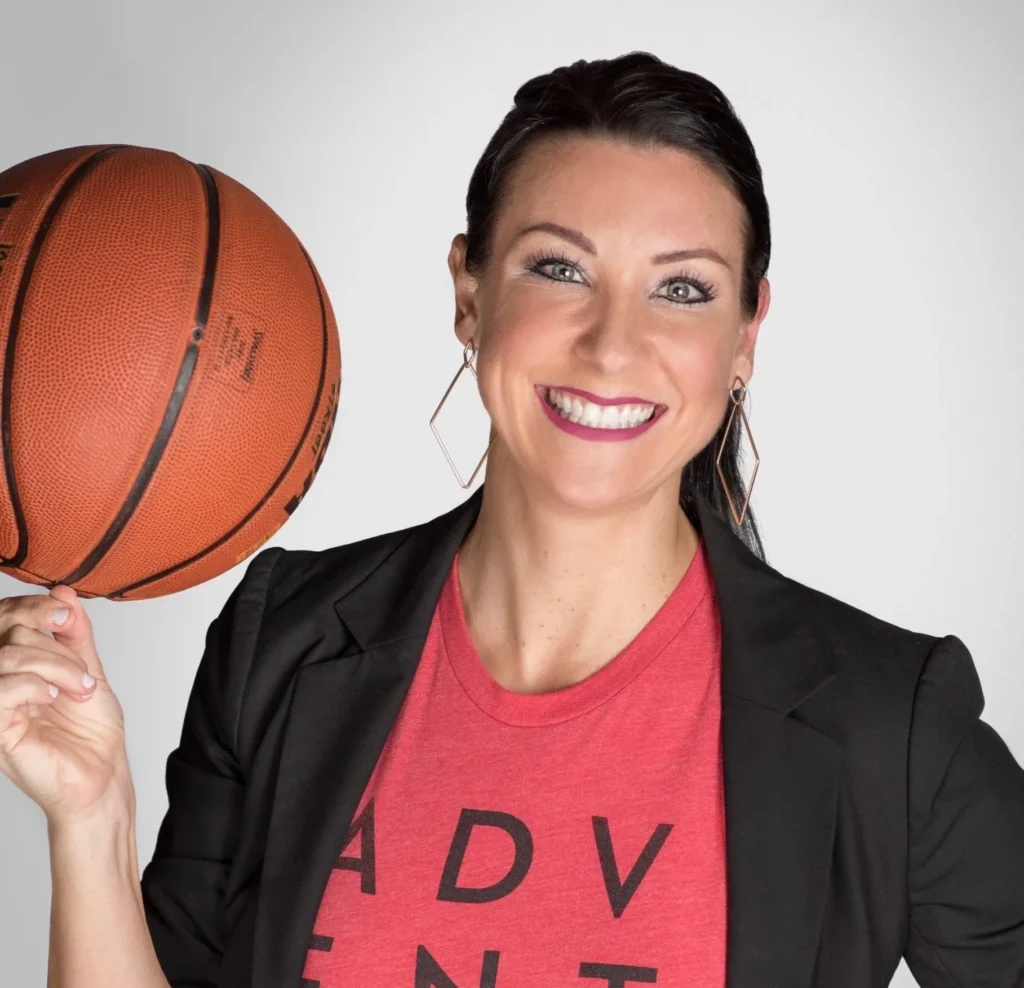
Anne O’Neil is a former WNBA player for the Sacramento Monarchs and Division 1 Academic and Athletic All-American at Iowa State University. She was a 3x national high school All-American breaking state records including the Iowa High School State Scoring Record and was later introduced into the Iowa Girls Basketball Hall of Fame.
Following a stint in Division I basketball coaching, Anne transitioned into international business honing in on research and training in the neuroscience and performance psychology fields.
She coaches and consults athletes and executives looking to elevate their performance by focusing skills/mindset training development. and works with the C-Level centered on business alignment strategies for Palo Alto Networks. Anne is also a TV Analyst and Sideline Reporter for Women’s and Men’s Basketball games.
She is the host of Get Busy Livin’ Podcast where the conversations focus on a growth mindset and giving back.
Welcome to the Athletics of Business, a podcast about how the traits and behaviors of elite athletes and remarkable business leaders frequently intersect. The real stories and hard lessons to help you level up your leadership and performance. Now your host, Ed Molitor.
Welcome back to another episode of the Athletics of Business podcast. I am your host and CEO of the Molotor Group, Ed Molotour and I am thrilled to be joined by today's special guest, Ann o', Neill, who absolutely oozes our brand, the Athletics of Business and entire mindset that the traits and behaviors of high performing teams, elite athletes and high impact coaches are key to your success in life. And is a former WNBA player for the Sacramento Monarchs and she's a Division 1 academic and athletic All American. At Iowa State University. She was a three time national High School All American, breaking state records including the Iowa High School state scoring record and was later introduced into the Iowa Girls Basketball hall of Fame.
Now, I don't want to give away the whole episode because there is so much here, but we talk about how our circumstances don't define us right, but our past experiences absolutely shape us. And this leads me to the next step and the next part of Ian's journey which was this. Following a Stint in Division 1 basketball, coaching and transition into international business, honing in on research and training and the neuroscience and performance psychology fields. And if you've been with us here along the road with the Athletics of Business podcast, you know how much I believe in that, how much we implement it with our clients. It is so critical and she does a great job talking about it.
Ian coaches and consults athletes and executives looking to elevate their mindset and works with the C level center on business alignment strategies for Palo Alto Network. Ian is also a TV analyst in sideline reporting. I'll tell you what, she is a damn good one. Okay, any chance you have to listen to Ann next year during college basketball do so she absolutely brings it and she is a treat to listen to. Okay, so let me back up. I apologize about that. So she is a also a TV analyst and silent reporter for women's and men's basketball games. She hosts her own podcast called Get Busy Living where the conversations focus on growth, mindset and giving back. A couple of things that we'll talk about inside of this podcast are this the power of our inner language, focusing on what's possible.
So many times we think about what's not possible, we start eliminating all these things that we can accomplish. Okay, Ann is she really talks into not giving up on Your dreams, keeping your dreams alive, doing everything possible to work towards those dreams. The story she shares are so powerful. Ann talks about reflection, the questions you should be asking yourself, and then we dive into short term vision. Obviously, we all want the long term vision. What is it that we want to accomplish? What is it that's out there that is a dream of ours. But we talk about the significance of short term vision and how that helps frame your day. Now I'm just going to stop talking, get out of the way, and let you listen to this amazing conversation with Ann o'. Neal.
And I hope you enjoyed half as much as I enjoyed recording it. And thank you so much for joining us today on the Athletics of Business podcast. I am beyond thrilled to have you here with us.
Oh, Ed, thank you so much for having me on. It has been just literally an honor to get to know you in our couple conversations before and now to be able to do the podcast and help your listeners get a couple of small takeaways from our conversation.
I think that's an understatement. They're going to get a ton of takeaways. I mean, our first conversation several weeks ago, I still have pages of notes from it, and it was just a casual. It was just a casual conversation. But your journey is fascinating. I mean, you and I are so aligned in what we've taken away from our journeys and where we're going. And we, you know, we talk about the fact that our circumstances do not define us, but absolutely our past experiences shape us. And I would love for you to share what's gotten you here. You know, what is it that has brought you here to this point and has created this amazing leader that is making such a difference?
You know, I absolutely love that quote and that sentiment because it's so true. I think one of the things I've always grown into, even when I was a kid and just always had that kind of growth mindset, but it's bigger than almost growth mindset. Sometimes people think it's positive thinking, but for me, I look at something, I'm like, what can we create out of this? What is possible? Because I really think if you can have an elevated emotion and the will and conviction in your heart to be able to do something, you can make anything happen. And that's kind of what my beginning was like. You know, I was just an extremely curious kid. I loved science, I loved art, I loved music, I loved riding my bike. Anything I could do, I would raise my hand and immediately go do it.
And one of the first things I got into was playing soccer and I was on the Olympic Development program. O D P for any of your listeners that know that they probably have kids that are in that program. Absolutely, yeah. Where it's an elevated high level competition. And I was playing with all boys at that time. There were no girls teams at all when I was playing. And so when I played with the boys, you know, they were a little bit more physical, they were a little bit faster. And I always had to up my game. And that started at a young age. And I was very competitive to see how far I could push myself, to see if I. Whatever goals were possible for me. And that experience really kind of helped me out.
I was able to hold my own and absolutely love soccer. I still love soccer to this day. And watch the World cup, you know, relentlessly and watched Lionel Messi and how amazing he was with Argentina. But that's my soccer background and living in Iowa. I'm from Cedar Rapids, Iowa. My parents still live there. Soccer is an outdoor sport. And so it got so darn cold in the winter, I had to find something else to do. Yeah, exactly. And I started playing basketball and that is where, you know, kind of my upbringing started to be. It was very similar where I was playing with girls that were just really great girls, AAU team at the time. And I just saw other kids that were taller than me and bigger and faster than me.
And I'm like, well, if they can do that crossover between the leg, let me see if I can do it. So I was the kid that would come home and practice it until I could go back in the gym the next time and show someone that I could do it too.
Did you have any idea where the game of basketball was going to bring you when you first started playing the game?
No, I didn't. I just loved being able to compete. And I think there's something when you're get. When you're a grownup and you're doing business and you're even pursuing other pursuits that you love, it's something to really get lost in. Like when people are great writers or great musicians or great artists, they kind of lose track of time and they, you know, stop any kind of weird thinking about the world. You just kind of are being great or practicing being great, you know, some of the best athletes in the world. And so I just love the game, the competition, the teamwork, the leadership, you know, when the buzzer would sound, the strategy. And I just always wanted to be in the gym Trying to get better.
Because I think one of the biggest things that really helped me out was always playing against kids that were older and better than I was. And that really set the bar for me higher. And so I kind of just kept reaching and reaching until, you know, my goals started to be, you know, the girls that were in college when I was in high school, and how could I set my sights, you know, on that? So that was really one of the biggest things for me.
So. So speaking of high school and college, amazing high school career, right? And women's basketball, girls basketball, women's basketball in the state of Iowa is king. I mean, obviously this year, amazing Final Four run, but it has always been that way. So walk us through what that was like, because it was really interesting what you did after high school.
Oh, my gosh. So, yes, the game of basketball in Iowa went back all the way to six on six. So we're talking all the way. In the 1920s, the women and girls were playing high school basketball, which is unheard of in some other states, but they were creating these opportunities. So the history was very rich. Some of the best players, many of you know, I just mentioned how great the University of Iowa was. They have this superstar, Caitlin Clark, right now, if you watched her in the Final Four, and thank goodness we have another season to watch her. But just names like that were incredible. And so when I started to be a freshman, I'll just give you a background of one of my games.
I came in as a freshman on the varsity team, and I had been practicing, you know, all through middle school and playing up levels. And so I kind of thought I'd get in on my freshman year and maybe just surprise a few folks. And we ended up. This is a. This is my very first game, my high school career. We ended up playing Des Moines Dowling, actually, where Caitlin Clark went to high school. But Des Moines Dowling was one of the. Des Moines Dowling Catholic was one of the best programs in all of high school for Iowa, they had just won the state championship the year before. We walk out on the court and they're in a box and one on me. So they already had one player defending me in a zone defense for the rest of them.
And I kind of looked around and I was like, oh, I'm not going to be able to just kind of sneak my way on here. People had either kind of watched game, film or heard of me before in middle school. And that's what my experience was like right from the get go, all through high school. But, you know, it just that competition or that drive or the extra attention on me from multiple defenders or things like that just made me hone in more of how am I going to get around them? How am I going to get this. This jumper off with a crossover and get it off between two defenders? And so just from that point forward, I always had my sights set on just getting better inch by inch.
Well, and then obviously, after high school, you did what every girl in the state of Iowa does. And you went to the University of Iowa or Iowa State University, correct?
Actually. Actually. And I went to the University of Illinois. Was my first year.
Yeah. Unbelievable. I mean, well, I won't get ahead of myself. Cause I had something I was going to say, but I'll wa next part of the story. Yeah, you go to the U of I. What happened there?
Oh, my gosh. So, you know, I get recruited by these incredible programs. I have just amazing stories where, if you've heard of Pat Summitt, who's one of the legendary coaches from the University of Tennessee, she flew on a private jet to watch one of my high school games. I had Gino Ayama from UConn come in and watch one of my volleyball practices, because that was when it worked in his schedule, him and his assistant, Chris Daly. So I just have these incredible memories of just being recruited at some of the top programs. And that's just such an honor because you're talking about some of the elite players of the time. And so when I got to be a senior, I narrowed my list down to five schools. I was looking at Illinois, Iowa State, Duke, Purdue and Stanford.
And so I went on an official visit to all of those schools. And all of them were unique and had incredible opportunities for a great program and also a great school. So, you know, that was part of the deal, too. And I'll tell you, my dad was an elementary school principal, so my focus was definitely on basketball. But those grades didn't slip, so we had to. We had to focus. If were going to be great at one thing, we had to look at all the ways we could be, you know, great and challenging ourselves. So school was one of those as well. Illinois had a great program. We had the second best recruiting class in the nation, and they had no seniors, and they had went to the NCAA tournament the year before.
So everything was set up for just an incredible program at Illinois. And like they say, some things don't always go as planned. And that was my freshman year at Illinois. We had a lot of great players, but we just hadn't had the time, the chemistry to all work together and have it all fit and work that year. But for myself, I had a pretty decent year. But one thing that was really big that happened to me and it kind of propelled the rest of my career forward, backward and forward actually is I was a jump shooter all through those years where I was getting off the ground. Oh, you know, like some of those NBA guys are if you just watched air, like Michael Jordan, you know, getting off the ground. And. And that was how I shot.
But they wanted to turn me into. The coaches coaching staff wanted to turn me into more of a set shooter. And if you can imagine being a kid, which is our practice, by the way. Yes, I know some of your listeners know that it'd be like changing a golf swing after you've practiced it a million times or after a baseball.
At what point in the season did they want to do this?
It was about a month or two before the season started. So, yeah, so usually if you want to, it's very small changes that you're looking at. Maybe how you place your hand on the basketball and just think of any sport. There's small nuances that you can perfect and get a little bit better at. But this was a complete full body change from my feet all the way through my core, all the way up to my release. And so of course, it didn't work out for me. I couldn't get my mental game figuring out how to do my physical body because my lower body was doing one thing, my upper body was doing something else. And so that year I only made four three pointers out of 33 games. And so that's kind of unheard of for a guard.
Whether you're a point guard or shooting guard, you got to be able to knock threes down. And it just, you know, kind of took one whole avenue of my game away. And so I only really shot inside the three point line and.
Well, I think it's important to point out for the listener, though, because we talk often about compensating factors and intangibles. Right. Apparently you were doing something okay. Because you did make first team, all Big Ten freshman team.
Oh, my gosh. Yes. Yes, I still played a lot.
I mean, but that's amazing. How did you do that, though? How did you. How did you mentally deal with the fact that someone was trying to break that something that wasn't broke or fixed something that wasn't broke? Excuse me.
Mm.
Right. And then still have it in you to come out and perform every single day at that level.
Oh, you know, I loved the game so much that I. I just had to make, you know, huge adjustments on the fly because it was right before my freshman year and this was something I had always worked so hard at. And so instead of completely shutting down, I just moved my game inside. So I was kind of like a 16 foot or inside game. Instead of being 25ft and having that long range, I just would take everything to the rim, get fouled or try to make a jumper, you know, those kinds of things. And yes. Yeah, barely. I was like, it just doesn't work at all. I mean, you know that as a coach. So it was, you know, I was trying to do other things, rebound or steal the ball. You know, were just.
There's a lot of different ways that you can still get great at something or still excel at something, even if you have a couple weaknesses. And that was just what I had to do to manage that freshman year.
And then what happens?
Oh, right. So then I decided to transfer and I decided to go to Iowa State and, you know, the Cyclone program there, which I know we talked about Iowa, but the Cyclones have one of the best women's basketball programs. They average over 10,000 fans a game. And that was something I did really love is because you put in all those hours over and over again by yourself in the gym, or in my case, with my dad in the gym, rebounding every night. And so when it's time to perform, it was fun to be able to play in front of other people. So I wanted to go to Iowa State and play in front of that great crowd.
But there's a great moment at the end of the Illinois season where I am shooting by myself in the gym and I cannot hit the rim or the backboard from the three point line. So I no longer even was close at shooting. I was just airballing left and right. It would hit off like the back of the back wall. And it was just wild to me. And I remember stopping and staring at the backboard and at the rim and I said, somehow I'm going to. This is in my head to all those, you know, people, whoever, you know, have certain thoughts where you're creating a new life for yourself and a new future.
I said, somehow I'm going to figure this shot out and I'm going to be in the ESPN three point contest one day and I was the only one in the gym and no one else ever knew that. I said that until the very end of my four years later of my senior year. But it was a long process from that moment. But it was so pivotal because I knew I was going to figure it out. I wasn't sure how. But you had like, I already had that kind of insight of where I wanted to be in the future.
Where did that come from? Was that something you did as you're developing as a player, as you're developing in the academic world and just the people that's really. Where did you learn that from?
You know, I have incredible mentors and they were my parents and they were always people who, gosh, I'm so grateful for that. They, they let me put anything on my walls. So in. When I was a kid growing up, you know, from a young age all the way up through high school, every inch of my bedroom was covered in motivational quotes, in posters of people I wanted to emulate in maybe really great, you know, camp thing I had done, you know, so it just was always a reminder of anything is possible and you can go and do that because if somebody else has done it, of course you can go try and do it.
I mean, I had pictures of Dick Vital up there and Pat Summit and Michael Jordan and Sue Bird and Jackie Styles and you know, I'd have lists of, oh, just so many great quotes. You know, you can see back here this John Wooden best Pyramid of Success. The pyramid of Success. And it's actually signed for me. My dad got me that and I still carried it with me to the day. It says for Anne from John Wooden. And so it was just one of those things that they always helped me believe in my dreams. They never said, you can't do that or maybe you're reaching too big. If I said I was going to the gym at 6am or 8pm they were like, okay. You know, they just always believed in that.
So I think when it was when things aren't going great or I'm really in a low spot, this is also in life for all of you listeners. And you can hear it in the story of the three point shot of me not even being able to hit the rim or the backboard or, you know, I lost my job at one point during COVID I know many people can relate to that and I can talk about that, but sometimes I always think when it feels like there's not any opportunity that actually you can take your focus off of the one thing that's not working and you can expand your focus and be like, Maybe what's possible here. And then all of a sudden like kind of a blank canvas, because when you have nothing, it's like a blank art canvas.
And then you can start thinking, maybe I'll add that color, maybe I'll add this color, you know, to try to give you a metaphor. And that really helps me start creating what it might look like. And how am I going to feel when that thing happens when I am practicing it on that journey and it just starts moving away from the negative thing or maybe the low thing that's happening in my life and really kind of reframing it and seeing what's possible and where do I want to be in that next six, you know, 12, 18 months and working that reverse engineering backwards from that. And I've done that for almost my entire life.
And I love, obviously we've talked about this, I love the reverse engineering, right. I love the reframing. But one of the things in terms of like embracing change, I call it running to the fight. Some folks don't like that, but I love to embrace change. And obviously you want to have this vision of where you want to go and what your dreams are. Right. And always believing them. But can you talk a little bit about the significance? And this showed up so much in your journey about that short term vision, like, okay, this is it here. But what's my week look like? What's this month look like? What type of player am I going to be or what projects am I going to nail? How significant is that short term vision as well?
Oh, it is. It's so huge because it frames your day and it gives you the baseline of where you want to go. Because of course, sometimes when you're thinking, I have to, I'm going to be in the ESPN three point shooting contest, that almost feels like, well, how the heck is that going to happen? And so you have to break it down into bite sized pizzas, you know, or pieces. And that really helps my day. You'll hear about one of the things in my journey along those next four years because I transferred to Iowa State and I ended up having to sit out a year. That was back when the transfer portal wasn't around and you had to sit out a year and life was normal. Yeah, right. And then you're right.
At the end of that year, I tore my acl, which is my knee, you know, and had a really hard injury. That's something where you're learning how to flex your quad muscle, you know, not learning how to shoot jumpers anymore. And so that is probably one of the biggest things where I had to take a calendar and it was like, okay, I'm doing how many, like, you know, 90% squats on this day or, you know, and crossing each day off and they're like, okay, at 120 days you should be able to do this. And so that was where I was at. And then how do I work back from 90 to 60 to 30? Because the first 30 days it was like we're just flexing our quad, you know, and lifting five pound weights.
And so when I got to see that small progress and I'd look back and I'm like, wow, now I'm walking without crutches and now I'm squatting and now I'm kind of doing defensive slides with the knee bracelet. You could see it in the physical realm. And sometimes that really makes a difference. So whether it's for all of your listeners out there that you want to get in shape or you want to eat better, it's not like, throw everything out and just start eating broccoli. And it's not like, let's go to the gym for 10 hours, just break it up into 15 minute increments or I'm going to have and count all of the times that you're successful and you're a champion because your brain and your body will learn that process over and over.
Like, oh, I had that one protein shake this time, or I ate vegetables for dinner this time and I felt good, maybe I'll do that again. And it starts building on each other where you start having these layers of success. And that is one of the biggest things for me. It's something I still do to this day of when I'm trying to study something. Right now I'm trying to work on a three day training manual, you know, where you're just able to script it out without looking at your notes. And that's a lot. You know, how do you do, you know, 12 hours, 18 hours like that. And I'm like, no, it's just one sentence at a time. It's one paragraph at a time. It's one concept, one module.
And you just keep moving forward like that and you're like, okay, I got that, and then I'm going to repeat that. And so that's kind of the things of small bites will make a difference. Just like, you know, we talked about Maddie doing 10 minutes of dribbling a day. That's it. That's all you need. You don't need any more than that. But eventually, once you start, this is kind of the kicker, where it really gets great, is once you have a little bit of success on that, you notice yourself doing it without even having to have those milestones. You just kind of start having this way of being in your life, of being like a person who works out or being a person who eats healthy or being a great basketball player who knows how to dribble really well.
It just kind of shows up like that.
I love that. I mean, I love the fact you remember Maddie's name and she. You know, it's funny though, because I'm really curious.
Yes.
Were you able to recognize and understand the significance of small victories, of small g. Little incremental progress before your knee injury? Or is that something that experience taught you?
And I did. I was able to see this, you know, mostly when I again, I give. Can give you some academic things where you're studying and you have a lot to study, but maybe you just need to learn a little bit at a time. And so that was always one of those ways that I ended up being successful and helping train other people of how do we get, how do we study? How can we learn this? Everything has a strategy to it. Whether you want a new life or whether you just want to learn how to dribble a little bit better, it can have a strategy and you can do it by small incremental parts.
So when I was young and I was learning how to do an in between the leg and then a crossover, and I wanted to get real quick at that, I could see the difference in one week if I just practice it over and over. I would work on my footwork, I'd work my ball handling, and then I would work on my stance, you know, so I would see the difference. And then I, you know, back then I would be able to see small incremental changes. Because this is. Again, maybe this will be part of the thing everyone can take away from is as you keep doing it and progressing it, you just start to become it. And it becomes so natural, you're not even thinking about it anymore.
So that's where that is so huge right there. Can you repeat that? Because it becomes a way of life.
Yes. And that is. And you and I talked a little bit about this before in some of our conversations, but I am, as, you know, as an adult and I think I was, you know, a nerd. I've always been a nerd back then, but I didn't know what it was called. And I study a lot of neuroscience and Performance psychology. And it's like everything that shows up for you that you want to create, it's going to take a little work where you have to think about it. You have to put your attention and intention on. On something. And then you start doing it little by little. And then you actually just start becoming it and you start to be so natural. Right now I could spin the ball on my finger and I wouldn't have to think, okay, this is how you spin it.
This is how you catch it. This is how I'm supposed to keep it going. I don't even have to think about anything anymore. It just is a natural state of being. And that's where people can really change their life. They can create a great career for themselves of whatever they want to be. It just takes a little bit, inch by inch of moving forward with your attention on something. Attention is, you know, I'm not looking at my phone. I'm not thinking about that basketball game that was just on. I'm focused on this one thing I want to create. And that's what great artists do, great musicians do. And when you see Lady Gaga or, you know, Tina Turner, who just was on there, they don't have to think about where they're placing their foot or how they need to sing that note.
They just go and sing it, and that's what ends up happening in any kind of career or life you want to create.
What advice would you give the folks? Because you've been down this road, right the little by little, and you're doing the right things, you're doing them the right way, you're being consistent with your effort. You're not feeling it yet. It's not showing up yet. You're not getting the results that you want. Now what?
Oh, so I think it all starts off. I think you can at any point in time not say it's not showing up. I wouldn't. I'm somebody that's really big on language and how we're speaking to ourselves, the thoughts that we're thinking. Because you can make your thoughts so real that your brain changes. Like where I would have a game and I would say, we're going to win this game, and I would just repeat this over and over while I was brushing my teeth, while I was tying my shoes for two weeks before the game would even happen. And I had trained my brain of that's already what was going to happen. And I think you can do that as well.
So just because maybe you're not in the game, you're not in that meeting presenting yet, but you can train yourself of what does it look like? Who am I? What am I feeling? And a lot of times for me, I'm like, oh, one of the things is I'm like abundant. I know everybody talks about affirmations, but then you kind of walk through your day like that and not let all the little annoyances get after you. You're like, I've already got this project completed, or I've already changed my shot, whatever that is. I always think of, I already have the progress, I can keep moving forward. And if there's ever a time where you're feeling low, I would just go back to what's possible and write it out. And this is another great trick that I've talked to a few different people about.
I've trained a few people on ED that maybe your listeners can try out as people talk a lot about vision boards, which I love. You know, kind of like when I was a kid with all the posters. But I have a folder in my photo album. Everyone has a cell phone. Make a photo album of where you want to be in a year or who you want to become and put all the pictures and the feelings of what that looks like in that photo album.
So then at night or in the morning when you're thinking about scrolling Instagram or TikTok or listening to the what's, you know, not great in the world of the news is you'll start remembering what you set out your intention to be a great speaker or, you know, a million dollar business owner or a podcast host or a great athlete. And you see those pictures of yourself and also of other people that you want to inspire to be like, you know, and then maybe some quotes in there that you want to keep remembering for yourself. That's something I do. Especially if your question was if, you know, you kind of don't feel like you're getting on track sometimes. And actually I kind of want to say all the times, but sometimes it's not always about the action that you're doing.
It's about your internal state that you're adjusting into, being ready for that attention, being ready for that action.
And in your athletic career, you dealt with this. And we're going to keep going through Iowa State in your professional career as well. But we're dealing with the pace and rate of change unlike anything we've ever seen. And it's not going to slow down. It's only going to excel mentally. How is it that you are able to do what you talk about, to embrace that change, to stay true to, you know, where you want to be in a year, where you want to be in three years, where you want to be in five years. What are the significant decisions you have to make? For example, who you surround yourself with. Right. What you read. Can you talk about that? The other things that you should do to help you moving forward in the right direction?
Yes, I love this question because I do feel like I'm doing this quite frequently. It's one of those just kind of life things that you end up doing. I really take. Well, let's stick with basketball for all of your listeners, or athletics. Anytime you want to be great at something, you have to spend a little bit of time observing it. So a lot of times you would watch your game film. If you're an athlete or if you're a performer, you'd watch yourself and be like. Or listen back to your podcast. And how do you know, how do I ask that question there? What? Maybe I want to, you know, steer someone in this direction, whatever that looks like. Same with speaking in front of a group. I'm trying to add a bunch in so people can understand that.
You would take a little bit of reflection period, and that has been huge for me. So you would look and be like, maybe this isn't working. And let me look at maybe what's not working so well and also what is working well. And you'll start to see the gaps between what's working well, how I feel great. And maybe what's not working so well. And maybe, ooh, I don't feel as aligned to that thing that's happening over here, maybe that group of people or maybe just, you know, that business decision, and it will be almost a little bit of an internal antenna for you, but that reflection period is huge because you're contemplating on what works and what doesn't work, and you're able to move and navigate your life and your decisions a little bit clearer.
And that's one of the first steps I definitely always take. It happens for me a lot. We can get so kind of caught up in the external world of, well, that dream's never going to come alive because of this industry or there's so many people already doing it. How is, you know, how am I ever going to get to be an influencer or a great athlete when there's so many great athletes? But I'll tell you this, and maybe, Ed, if you've ever looked back whenever I'd made Had to make a really big change in my life. The first thing I did was I would go internal and I would get real clear in my inner world of what it looks like that I want to create.
If I started creating based on what somebody said or somebody's done, it just didn't have the same effect and long lasting kind of conviction for me. And that has probably been one of the biggest pieces that I've always looked back on. I'm like, okay, when I made that huge leap from not being able to shoot a three pointer to being able to make one, it only took a second. And I said, I'm going to change it right now. And I knew how to do it. I got aligned into my new shot and changed my three point shot. And when I didn't have a job during COVID you know, many people, you know, I know a lot of people of your listeners maybe got let go or maybe have had a friend that's gotten let go. That happened for me.
And I had to shut my computer and be like, where do I want to be in six months? Who do I want to be? And it gave me the space to contemplate, to go inward, to not just throw my resume and call a million people. It really helped me kind of build up a little strategy. So that is always number one. And I do think it helps propel you forward faster because you hold on to that vision that you have and all of the outside people, things, you know, times and places, what other people say, it doesn't have as much of a fact. You say, no, that's where I'm headed and that's where I'm going.
And that's been one of the biggest discoveries that I always try to lean on because it's so easy to get lost in comments or concerns and all that kind of thing.
Right? Yeah. We talk all the time here in this house about it's conviction, not convenience. When people tell you that you can't do something, you can't accomplish that dream, what they're really telling you is they can't.
Yes.
And when you really go internal, and I love how you said that. And by the way, let me pause for a second.
Yeah.
Kudos to you. Love the piece and Thrive Global that you wrote.
Yes.
Three ways animal intuition led me to my dream job. That will be. There will be a link to that in our show notes. So listeners, you go grab that. It was great. We won't get into it right now, but I loved it. It was so well done.
Thank you. Thank you see, I am a nerd. They'll. They'll learn my animal psychology. But I call it animals.
Okay? You can call whatever you want. I call it skill. I call it mad skill. Let's. Speaking of mad skill, let's go back now. So here we are. Iowa State couldn't hit the broad side of a barn in champagne when you're sitting in the gym by yourself.
Yes, Yes. I remember it so clearly. Have you ever remember, had a moment where you're like, something's got to change and I'm, you know what?
The. You remember the sounds, the smells, the. Yeah, you felt internally.
Yeah.
So now you're going to aim. You rebuild your three point shot. You have the knee injury. You go through that adversity. Here we go. Because I have a list of everything you accomplished.
Oh, my God.
This other screen.
So you.
You better. You better do yourself right, do yourself proper and tell us about that piece of your journey. And we've got some great stuff to talk about that you learned there too.
Oh, okay. So we're painting this picture for everyone. So I get to Iowa State with no shot, with no three point shot. But I do have a new team and a new hope. And I'm so excited to play for the Cyclones. The great coach, one of the best in women's basketball. I tear my acl, so my focus goes from trying to get my three point shot right to fixing my knee and just being able to run up and down the court, you guys. So you have to listen and you just have to be able to run again and jump again like you were before. And so I will tell everyone, it took the entire three years, so the sit out year and then two more years until I changed my three point shot.
And that is why my senior year was such a big one for Iowa State. And so what happened was it was the off season. I had one of the best coaches I've ever had assistant coach. His name is Jack Easley. He literally just texted me this weekend. I love him. And he had just a kind of ease about him where he just kind of walked by one of my free throws that wasn't, you know, I was shooting maybe 60, 70% on the free throw line, which isn't great for a guard. And he goes, annie, that's just not going to cut it. And that's all he said. And he actually said it in passing. It wasn't like he was having a conversation. Yeah, he just kind of said it just kind of very nonchalantly. And I said And I knew it.
And I go, it's time, it's right. And so I took my bulb. And for any of y' all that have kids and you took them under the rim the very first time they've ever shot a basketball and they're right underneath the rim. I was doing that again like I was 6 and 7 years old. And so I was shooting one handed shots one foot away from the rim, just. And I was like, okay. I remember when I was a kid I did this toe, knee, elbow ball. That's all I did in my head. And so that's. If you think about it's a lot about alignment and how we can get in alignment with ourselves. And that's the basketball term. But I know that golf, you know, baseball, soccer, they all have the same football, they all have the same kind of balance and alignment.
And so I got underneath the rim, I moved back to the free throw line. I said, so far that one handed shot has been working. I'm just going to shoot my free throws one handed. And so I did that. So I shot free throws one handed. And that year I shot like 88, 89% and led the Big 12 Conference. And I go, okay, keep it going with a three point shot. And so I pulled back and I did it from the three point line. And pretty much I shot one handed from the three point line. I had my guide hand but it was barely there. Like you'd see it and then all of a sudden it would just be Tony elbow ball. And it worked so well that year for a couple of weeks, I led the nation in three point percentage.
I was able to expand the court which helped our team so much. It made me more of a dynamic player because they had to guard me, you know, 25ft out. And all of our team started to play more cohesively and align basketball. And we actually made it to NCAA tournament. The first time in my entire college career. I even had NCAA or bust written on my sneaker. Cause I was like, we're going to the NCAA tournament no matter what. That three point shot really helped propel me forward, our team forward. And it was all about just getting back into alignment. And when that happened, once you get into alignment with your inner world and your attention with your goal, it can happen so fast. And that's exactly what happened to me.
It didn't take me long to get it all back in rhythm and making shots. So that's the three point shot. And I'll have to tell everyone, since you guys are waiting that at the end of that senior year, the senior women's athletic director came up to me and she goes, ann, you've been selected to the ESPN three point shooting contest. And I like have never cried so hard. I just was like, oh my God. Like I tear up right now because I was like, I had set that goal out and I hadn't really thought about it besides just trying to fix my shot. I didn't even think about it. But it was somehow still in my world, in my inner world of, we're going to make that happen. And I ended up being in the ESPN three point shooting contest, which was just amazing.
At the men's final four in St. Louis. I got to hang out with J.J. redick from Duke, who I loved.
No, no, no, no. J.J. redick got to hang out with you. Let's get that started.
Okay, let's go. Yes. Yeah, yeah, exactly. You know, it was just such a fun experience. And I got to play. I actually was on TV because they cut some of the first rounds and I was in the second or third round and got to be on tv. It was just like absolutely a dream. But it was mostly that moment when she told me. I was like, know, I figured it out. I got it back together because it was almost like for four straight years after my high school career, I really wasn't in any kind of rhythm or championship level player that I was when I was in high school. And that senior year really set it apart. It all started clicking once I gotten back into alignment.
I even got drafted into the WNBA by the Sacramento Monarchs, which I didn't even have my sights on because again, for everyone, I could barely shoot from the three point line. So that it just propelled my, you know, life forward. And it was just one of the also the biggest lessons I had of how to set a dream, how to get alignment, and how to, you know, never forget what's possible. You know, once you kind of listen to your inner world of creating what's possible. That was a lot, Ed. Hopefully got it.
No, it's amazing. But you kind of fell short of everything you really, truly accomplished. Okay, I'll put it in the show notes. But honestly, it's amazing to hear the thing that you remember of all your accomplishments. Right, Okay, I lied. So you're Iowa State Female athlete of the Year, right?
Yeah. Okay.
Okay. First team Academic All American. As a matter of fact, you graduated magna cum laude, right. With a 3.86 grade point average, which is nothing to kind of just like not mention you're pick 30th, as you mentioned in the WNB draft by Sacramento. You represented Team USA in the World University Games in South Korea, which had to be an amazing experience.
Yes.
And all of this was possible though, because despite the fact an assistant who probably had the best intentions at heart, instead of getting you to lean in your strengths and realizing don't fix something that's not broke, which affected the downstream effect that had on you not only as a player, but as a person, as a student, as a everything. Okay. I mean, great lessons for leaders out there.
Yeah.
Don't think you reinvented the wheel. Okay. And try and do things like that. And then to have that moment where your assistant athletic director tells you've been selected to play in a three point contest is pretty cool. Now, I'm going to throw a question out at you that I didn't plan on throwing at you. But I'm curious, what if that wouldn't have happened, all the other things happened, but you wouldn't have been selected to shoot in a three point contest, would you have felt fulfilled with all the amazing work that you have done and who you had become by the work that you put in?
You know, what a great question. So the funny thing is, I didn't remember it until that moment she told me about the three point contest. It was like it brought back that moment back from my freshman year at Illinois. So it was buried somewhere in, you know, my being after all that time. So when she told me, I, I, that flashed. It flashed for me. But during that senior year, I was so focused on getting us to the NCAA tournament because I didn't get to go at Illinois. The two years I played before at Iowa State, they were pretty average years. We went to the WNIT one year and one year we didn't make a postseason. So the only thing I really was zoned in on was making an NCAA tournament.
I was like, I can't go my entire college career and not be in the NCAA tournament. So that moment that happened, it was like I got to remember it. And that's what makes it really cool because it wasn't really in my being. It was more like I just knew I had to fix it. I knew I wasn't as good of a player and I wasn't. This is probably, maybe other people can relate to this for any kind of leader or something. I just wasn't the full expression of myself as an athlete. And then when I got back into alignment and was able to play from the three Point line to three point line and just be a full dynamic player. I was now like my, the expression of who I was always meant to be.
And I think that happens in careers and that happens in other pursuits of art, music and hobbies is, you know, when you're in your flow and you're the expression that you were always meant to be. And that's what showed up that year. The NCAA showed up. The wnba, which was never even in my world of thinking about showed up. And then when that three point shot happened or contest happened, I was like, oh my gosh, I remember that moment. So that's what I would say.
So, and now here you are, okay, doing all this amazing work and I want to make sure that we get to that. I mean, can you share with us, with the listener, all the incredible work that you are doing right now? You're about to embark on an incredible trip to Africa and you're making a difference in people's lives and not just, I mean, you're making a significant difference in people's lives. Can you talk into that?
Well, yes, Ed, thank you so much for creating that. And I'll give everyone just a quick synopsis that after I got done playing basketball, I was, you know, injured a little bit for the wnba. I coached basketball for a couple years at Eastern Illinois as an assistant coach. I did TV color commentating for a couple of years, which I loved. I get to see the different angles of the game. But this will be a really great one because it's going to come full circle is that at that moment I was like, I've done everything I can with basketball right now. Let me see if I can learn some new skill sets. And so I got into business and I worked there, enjoyed that. But it kind of just didn't like that fire underneath me.
You know, even hitting sales quotas, it still didn't have that thing for me. And then I got into business consulting and that really started to. I'm just going to kind of get everybody to kind of get back into alignment. This is kind of the same thing as a three point shot of what happened with my career. And then I can tell you what I'm up to now. And the business consulting felt a little bit more in my wheelhouse, like that warm feeling like the hot and cold game. If anyone is confused when I say alignment, think of the hot and cold game and you get a little bit warmer. You're like, oh, that feels right. Or that's where we're at.
So I got a little bit warmer with business consulting because I got to see how teams operate together on a shared vision and how they really were able to communicate and collaborate and respect each other. And I really liked that. It really had the kind of feeling of basketball teamwork in there then. So since then, you know, I've been doing that also with my current job. I work at Palo Alto Networks. I work the same kind of business alignment and it is right in the wheelhouse. But some of the things I'm doing on the side are where I'm starting to get really warm and I'm really getting into alignment. And so that would be. I started a podcast called Get Busy Living. It was with the intention to discover what ignites people to be bigger than themselves.
And so people came on and shared what they do, but really one of the biggest things was like good vibes, their growth, mindset and giving back. And so everyone came on and shared a nonprofit that inspired them to be bigger than themselves. I absolutely love that because we can do so much, but it's all about amplifying and helping others people see a big vision. So I started that and I was like, maybe I should try to get back into the TV commentating. And I did end up doing that this year. I did about five games down here in South Florida for Conference USA and the American Conference and I loved it. And I love it because you get to share people's story and bring excitement and energy to the game.
Everybody that would watch that three point shot about me, no one would know that backstory or you know, the struggles of torn acl. But when you can tell people stories of where they've been and what they've, where they're at now, I loved that. And so that's something I'm doing. And then you just mentioned what I'm up to in a couple of weeks. And so I am headed out to Africa. Four different countries in Africa. I'm going with the NBA Indiana Pacers superstar Jordan Awara and his foundation. And we're going to go back and give back to kids in Africa just doing basketball camps and also going to orphanages and bringing them a bunch of supplies.
And this is like where I know it gets really warm and hot for me, where I'm really in alignment because they called me and they're like, do you want to go? And maybe some people can relate where usually it'd be like, okay, do I need a vaccine? What hotel? What should I wear? How long am I going to be gone from Something. And they called and they were like, we're looking for a female coach. You know, how. Have you ever had a call from, like, where you think the universe called you itself and is like, do you want to go? And that's what showed up. For me, it's only been about three or four weeks ago that happened. And we'll be over there for about four weeks. And I tell you what, Ed, that call came in and I go, I'll be there.
Count me in. It not a question of all the things that usually we think about. Again, that goes back to your question about the outer world of the people you hang with or, you know, when people might say, why are you doing that? Or that? And I just said, no. That is really hits right where I want to. Like where my dream is of being able to give back, being able to see other kids, other people thrive and excel and go chase their dreams. Like, that is where, you know, I want to be an amplifier and really kind of impact the world. So that's something I'm up to.
And it absolutely screams sense of purpose for you, right? I mean, it connects with you. And before we go any further, yes, you're awesome at commenting. Okay. The clips you sent me, I listened to. You are so good, and you are what the game needs. Because so many times I'll say this for you, but, you know, it's true. We sit there and we listen to color commentators who are trying to prove how much they know instead of sharing the stories of the people that we are watching. Because that's what makes the game. When you can get people emotionally attached to what they're currently involved in, it makes such a huge difference. Right?
Oh, I. I love that. I. I think of that. That means so much. Thank you so much for the compliments. I. When I was a player and also when I was a commentator, and I'll just let you know, because your leaders out there that are listening to this. I'd always think about, what if one person has never seen me or this team play before? So if I came out for a basketball game, I was like, it might just be one. When I'm commentating, it might be someone's first time watching this team. It might be their parent in Italy or Cameroon, which I called might be watching it on a stream, and how can I bring energy and story and just complimentary basketball for them? And that's really where you hone in on.
I mean, obviously you do it for the kids and the coaches who are amazing, but even if you can Think of that one person that might be listening and how they're going to respond. That really helps put things into perspective. Of it brings me energy, it helps me generate energy, and just an even bigger love for the game. Because, you know, even when I go to Africa, I'll think about, oh, my gosh, who's going to be there? Who are these kids, and where are they going to be at in 10 years? You know?
Right.
So, yeah, and I love that you said that, and I just want to come back to that real quick. About purpose is one of my main things I tell myself when I'm waking up in the morning is I am on purpose. That is one of the biggest things I will say when I'm out on my meditation walks, whenever I'm feeling like I'm doing something, you know, that doesn't feel, I'm like, I am on purpose. And I keep always coming back to that. So y' all can try that in your life. About what feels hot and warm, the hot and warm game or alignment game for you.
You know, I love your energy. Okay. And I think that's something that we all wish we had more of. Like, people think they want more time. Well, here's the deal. You're not getting more time. Okay? It's 24 7, 365. You get what you get. But how do we develop this resiliency in life? And how do we develop this bandwidth and capacity to be more to people and have this level of energy? And sometimes when I'm talking to clients and we've really niched into biopharma, biotech, life science space, it's been amazing. And sometimes I'm talking to them, they're like, I just don't know if I have the bandwidth to be intentional. And on all day, and we talk about being your best. We had Kevin Eastman on the podcast, and being your best even when you're not at your best.
Right.
But can you talk into the fact that being on purpose, living life, intentional living life with purpose as well, that's not what exhausts you. That's actually what energizes you. That's what actually gives you the push and pulls you along? Can you talk about that?
Oh, yes, absolutely. I think it all starts with, how do I want to walk through my day and who am I being, you know, with? Am I grateful? I'm abundant, I am kind? You know, all of the words that you want to embody for that day, and of course, write it down. But you kind of start your day off that way. The default way is a survival mechanism. Our brains are wired to survive exterior things. I think, you know, neuroscience proves that about the way that our brains are structured to survive outside forces. But they're also there when you focus on it, to generate energy and generate purpose and abundance and kindness and just going through that way, just like you mentioned when I set my day out on that intention, more things show up that are abundant and happy and kind and healthy.
You know, when you're kind, more people show up kind. When you have energy, more people start having more energy. And I think you can hold that attention, and I say attention with your focus. But that intention of being on purpose, of being grateful and full of gratitude and full of energy, I think you can generate that the exact same way as you can generate being tired or being resentful or whatever those other words are. You can choose. And I know that doesn't sound like it, but just try it on. Try it on for an hour, Try it on for a half hour and see how you feel. See if you go on a walk, what shows up differently for you know, and then be like, okay, more things kind of start showing up that way.
I tell my kids often, and I'm not sure they're listening sometimes, but I think if you want someone to show up better in your world, show up better in their world. Oh, you know, and I just love how you do that. Now, I have one more question for you that might take you a few minutes to answer, but before we get to that, and we'll have a lot of fun with it, but before we get to that, can you tell our listeners where they can find more out about you? The work that you do, the podcast, everything?
Oh, definitely. So across social media, I'm at H e y Ann o'. Neill. So it's H e y a n N e o N e I L so it's like saying, hey, Ann o'. Neill. Come say hey.
Which I love that. Where did that come from? Yeah, where. Where did that Hey.
I was. I was like, you know, hey, if you go on all these different platforms and I am a late bloomer to social media, I only started posting, I think, in like 2019 or 2020. I had to figure out how I wanted to be in the world, you know, and how do I want to amplify? Because at that time, it just felt like people were just taking selfies or showing what's better in their life, and I didn't know how to play that game. But I realized again, what you look for can be there too. And there's a lot of people doing great work out there like you. Podcasts that have great advice and energy, just like different social media channels. So it's like that's what I'll be creating and putting out into the world.
So across all of those different social media platforms, you can say, hey, Ann o'. Neill. My website is Annonil Co, and there's a lot of different information on there on the things I'm studying and the places I've been, where I've traveled and where I'll be up to traveling here coming up in a couple weeks.
So where are you going?
That's so cool. Yeah, yeah. Where I'm at a.
You just referenced the work that you're doing, the things that you are studying. That's what I want to wrap this up with. And I'd love to invite you back to do a deep dive on this because I think we can have an incredible podcast on this subject. Can you talk about the significance of neuroscience? Not just not in athletics as much right now, in business. Because I think it is. So it's really part of where the brand, the athletics of business came from.
Yes.
Is the belief that how significant the mind is in your ability to lead people. Right. And in your ability to perform an extremely high level consistently.
Well. So good. And you said I had a lot of energy so I wouldn't talk too fast for everyone. I wanted to make sure we got it all in. But next time if we get we do a deep dive, I'll talk a little bit slower and can be more.
You're perfect.
I was like, oh my gosh, I'm here. So the mindset. Yes. And athletics of business. It just when. When we got together, it worked so perfectly because it was like, this is exactly the same thing that happens in business is the same thing that happens in athletics and the athletic team. And it's the same thing that happens in a symphony or an orchestra. That's kind of how I love to think about it. If you think of the symphony, everybody is playing a different instrument, but they're all playing the same song. And if you mess up and you're not playing that song, you're going to miss out on the song moving forward. And you know, if you're thinking about the person next to you or what they're playing or they're getting too much, you're not going to be a part of the big song.
And I always think of that when it comes to business, teams and alignment is that you can be in the moment and you can be a part of a vision that's bigger than yourself and where you're headed. And a lot of that comes down to the neuroscience. Again, can be a survival mode of your teammate. But you can also come in with, they have such complimentary gifts to me. And it's just a little tweak. It's not a lot. You can tweak your brain and we can get into all of it, but you can tweak your way of being of the thing we just talked about showing up in the world of being like, that person has so many great skills. I can't wait to work with them today.
So maybe if you have a list of things that aren't working well on your team or people that you're working with and you want to write those down and then start a different column and rewrite it in a way that is open minded, complimentary, and can really help your vision out. And if you kind of start embodying that list like you just mentioned to your kids, people will show up differently on the way that they work. And that it is about science and about how your brain works because you have a state of being that you can change. An alter of being in gratitude and just being like, you're great. Thank you for being a part of our team. And you have a bigger vision for something than just a quarterly number. But, you know, how are we all working together?
Like a Swiss watch. So I love that. I love the way that you had created the athletics of business. It's so true. No matter if you're creating Nike sneakers or if you're creating a new piece of AI technology, it still takes people communicating with each other through an email, through a meeting, through a zoom call to get things accomplished. And so how are you going to be in that email and writing or being on the zoom call with your teammate of trying to get that accomplished and that's all. Then again, about your inner game of how you're showing up.
I would love to have our next conversation when you get back from Africa. You get settled in everything. I would also love to talk about with the leaders that we work with, amazing leaders. We talk about being the face and voice that your team needs to see and hear. I would love to talk about how neuroscience plays into that in the business world as well.
Absolutely. I would. I would love to dive into that. It's. Oh, man. As you listen to this back about the waves and the, you know, path that we took from the very beginning of doing small nuance changes, of seeing small incremental changes, of, you know, leaning into the warmth instead of the cold, which is the same as it's all going to tie together of who you're being in the world is what's going to show up for you next, you know, and so that is like how leaders want to be. You can't be a great leader and think everyone around you is not good enough or you don't like so and so or you don't think this plan is going to work. You're going to have to go in with the idea that anything's possible with each person and with each plan.
And so I think this whole conversation for leaders, for athletes, for kids, who's ever listening, if you listen to it back, it's all going to have that thread of showing up the way you want to be in the world. And other things will start showing up for you as well.
And I can't thank you enough. This was awesome. I look forward to having you back. Safe travels. Safe travels. Keep doing the amazing work that you are doing. And from the bottom of my heart, I wish you all the luck in the world and I really look forward to getting to know you even better.
Oh, yes. Thank you so much for having me. It's been an honor. I've listened to your guests before and gosh, there's some of the best in athletics, in business. People, you know, just listen to the guy who climbed Mount Kilimanjaro. It was like, oh, my gosh. It's just people are making a big impact. They're overcoming things. They're creating a new future for them. And you have such a great avenue and a way of sharing their stories. And I just thank you for sharing mine as well.
Oh, I appreciate that. Well, so much respect for you and your journey.
Okay, see you, Ed.
Thank you for listening to the athletics of business. Be sure to give us a rating and review so we know how we're doing. For more information about the show, visit theathleticsofbusiness.com now get out there, Think, act and execute at the highest level to unleash your greatness.