
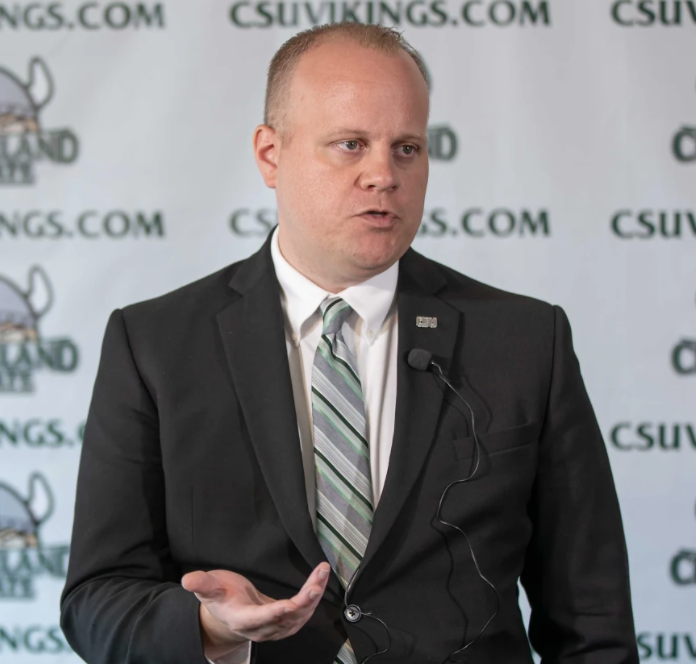
Cleveland State University announced the appointment of Scott Garrett as its seventh Director of Athletics on April 8, 2019. Garrett was formally introduced at a press conference in Cleveland State’s Student Center by CSU President Harlan M. Sands.
Garrett came to CSU after nine years at Kansas State University, where he served as Executive Associate Athletics Director with responsibilities in fan experience, fundraising, business operations, sport supervision and more. At CSU, Garrett will provide leadership and oversight for all of CSU’s 18 NCAA Division I sports, $13 million operating budget, and over 330 student-athletes.
“Scott Garrett is a very successful leader who has had a tremendous impact at every level of athletics administration he has touched. He is all about building a winning culture with integrity and values – both on the field and in the classroom,” CSU President Harlan M. Sands said at the time of Garrett’s hiring. “We are very excited that he will be joining our team, and I look forward to working with him as we build upon the athletic and academic achievements of our student-athletes.”
“I am privileged and honored to be named Cleveland State University’s next Director of Athletics,” Garrett said upon taking the position. “Throughout the search process I have been extremely impressed with President Sands’ vision for CSU, the positive energy around campus and the numerous opportunities to move CSU Athletics forward.”
In his first year with CSU, department accomplishments under Garrett’s leadership included:
Prior to arriving at CSU, Garrett served as Executive Associate Athletics Director for External Operations and Chief Revenue Officer at Kansas State, where he was responsible for various aspects of department administration, including strategic revenue generation initiatives and fan experience programming. In his nine years at Kansas State, Garrett provided leadership that generated 46 sellouts in football, national Top 25 attendance rankings in men’s and women’s basketball, women’s soccer, volleyball and baseball and a 40 percent increase in overall ticket revenue. Garrett’s duties at Kansas State also included management of a donor portfolio accounting for over $1.5 million in contributions annually and over $2 million in major capital gifts over a two-year period. Garrett also spearheaded the department’s strategic planning efforts on three separate occasions, while his duties also included sport administration oversight, including coaching personnel evaluations and search management.
Garrett’s previous stops in intercollegiate athletics include serving as Assistant Athletics Director at Wichita State University from 2008 to 2010 and Director of Sales and Ticket Operations, with fellow Horizon League member University of Illinois at Chicago, from 2003 to 2008.
Garrett graduated with a bachelor’s degree in business administration and marketing from Illinois State in 2002 and proceeded to earn a Master’s in sport management and athletics administration from Indiana University in 2003.
A native of Channahon, Ill., Garrett and his wife Kristy have two children, Matthew (13) and Audrey (9) and reside in Avon, Ohio.
Welcome to the Athletics of Business, a.
Podcast about how the traits and behaviors.
Of elite athletes and remarkable business leaders frequently intersect. The real stories and hard lessons to.
Help you level up your leadership and performance. Now your host, Ed Molitor. Welcome back to another episode of the Athletics to Business podcast. I am your host and CEO of the Molotor Group, Ed Molotor. Man, do we have another phenomenal guest for you today from the athletic world. Scott Garrett is the athletic director at Cleveland State University. And for such a young athletic director, he has had an incredible journey. Now, he was named athletic director at CSU on April 8th of 2019. So start doing the math there. And right at the 11th month mark, okay, right before his one year anniversary is when everything changed in Covid Hit.
But the things that he and his staff, his administrators, his coaching staffs, his student athletes, his support staff, the things that they accomplished in the first 11 months that Scott was on board there are absolutely remarkable and they're too long to list on the introduction. So I will have those in the show notes, but take a minute, go look at those. Like I said, truly remarkable. Prior to coming to Cleveland State, Scott had spent nine years at Kansas State University where he served as executive associate athletics directors. And his responsibilities there included fan experience, fundraising, business ops, sports supervision, and of course, a whole lot more. But we jump into some incredible stuff. And you know, the athletic director in a college athletic program is the CEO and there's so many things involved.
And Scott really gives us a peek behind the curtain of what his world was like those first 11 months and how it changed and how they adjusted the vision and how they adjusted their leadership style in his first 11 months. I will share this with you. He hired six new head coaches, including men's soccer, swimming and diving, men's basketball. Dennis Gates. Incredible, incredible man. I remember Dennis from when he was playing basketball way back in the day in Chicago. Lacrosse coach, women's golf and track and field. Also hired nearly 30 individual staff hires which included two deputy athletic directors. And what I find really cool, we talk a lot about this, is Scott developed a new athletics Director's Leadership council, which is an exclusive leadership program, a collection of student athletes nominated by the head coaches in their sport.
And we're going to talk about those things. And we're also going to talk about what Scott looks for when he's hiring a head coach, what three things he looks for when he's hiring a head coach. We'll talk about how he adjusted his leadership style after Covid hit and Keep in mind, he was only on the job for 11 months. So the amount of trust equity that he built up quickly there at Cleveland State with his people is phenomenal. We'll talk about who Scott's biggest mentors were, how he intentionally picked those mentors, and what the biggest lessons he has learned from them over the years. And like many of the podcasts we've had in the last just about 12 months, we'll talk about vulnerability and why it is so critical.
And Scott will share with us how vulnerability showed up for them and how it was so significant in helping his people, helping the leaders inside that athletic department respond to the crisis. And then Scott shares a great story about where he developed his passion for leading college athletic department. Now, I'm going to get out of the way. I'm going to let you listen to this conversation. But there is so much here. So without further ado, Scott Garrett. Scott, thank you so much for joining us today on the Athletics of Business podcast. I am fired up to have you here. How are we doing today, dad?
It's good. It's great to hear your voice again. It's been about a decade, I think, since we talked last. It's great to see you. Great to hear from you. Excited about this opportunity to visit with you today.
It's outstanding. That was back at the Missouri Valley tournament. It has been 10 years. Time flies, but you've been busy for those last 10 years. Okay. And you have. I mean, congratulations on all the amazing things that you have accomplished in such a short period of time. And it's such an interesting period of time as the athletic director at Cleveland State. But can you just take our listener through your journey a little bit and then we'll jump into where you are currently and what you've done in the last 22 months since you've been at Cleveland State?
Yeah, sure thing. So I grew up in suburban Chicagoland, split time between the north and the southwest suburbs growing up. Went to Minooka Community High School. Football player, band member. Didn't do those at the same time.
Great trick, though.
Yeah, that's right. Play your trombone in football pads. Fortunately, they didn't make me do that. But I went from there to Illinois State University, undergraduate from 98 to 2002, marketing and business administration. Went from there to Indiana University grad school and their excellent sport management program. And then throughout my career in college athletics, I've spent time at uic, University of Illinois, Chicago, the Flames, Wichita State University for a couple years as an assistant athletic director. I spent A little over a decade at Kansas State University in a variety of different roles, all on the external side, revenue generation, marketing, fan experience. And then had the awesome opportunity to get my dream job and be a Division 1 athletic director. Was recruited here to Cleveland State and have been here 22 months now. Who's counting?
Well, yeah, and a few things have happened in those 22 months, but right from the start, I mean, you made an immediate impact, right. And you pull from all the places you have been and all the mentors that you had. But coming in your first year, six head coaching hires. Okay. Which is mind blowing in men's soccer, swimming and diving, men's basketball, lacrosse, women's golf and track and field. Okay. Now if that is not enough in and of itself, you went ahead and hired 30 individual staff hires, including your deputy athletics director, Tyler Jones and Kelsey Gorey. Did you know coming in you were going to have to take on those. I don't want to call it a challenge, but that opportunity to bring on so many of your own people.
Yeah, and we one, we don't use the word challenge here. Everything's opportunity. It's all positivity. Although that's been much harder over the last 10 months to not view challenges as opportunities. But I think we're doing okay. I did know that we had several vacancies in the department that I was going to have the opportunity to inherit and have the chance to initially shape from a head coaching perspective, kind of what we'd be looking for first in swimming and diving and men's soccer and then the administrative staff as well, starting with the two deputy athletics directors and laying out our staff structure, what the organization would look like, what folks responsibilities would be. And so a number of those. Yeah, I knew coming in.
So I had a chance to think about shaping the department through my leadership style and what was going to work for me, but also knowing that I was going to need some initial time, right. To assess the lay of the land and not just come in with a preloaded, here are people that we can plug into these holes. It was, you know, I know I have these vacancies, but you know, I need to get here and learn about, you know, the individual support programs or what the needs of the department were, what the strengths and weaknesses of the existing staff were to help kind of plug those holes responsibly in a way that would help us.
So what did you look for? And we talked a little bit about this before we started recording, but what did you look for in the leaders in terms of the head coaching roles, what was it beyond the metrics, right. Beyond the accomplishments they had at the previous stops? What was it that you were looking for them from a leadership standpoint?
Yeah, I think for me, it's three really important things. Right. It starts with values. Why are they in the business? What is it about helping student athletes that really motivates them and makes them passionate about their job? What do they see as the reason why we have intercollegiate athletics? Why does it exist? How can you affect the future of a student athlete's path from an academic perspective, from a community service standpoint, and then from a competition lens as well? Second is, why do they want to be at csu? So you might be a really good coach, you might have really good values, but you have to be able to articulate, what is it about Cleveland State? What is it about this athletics program or this swimming and diving program or this basketball program that really makes you passionate about being here specifically?
And then third is energy. And I think if you look back now at all the hires that we made, and if you could focus one thing besides, they're really passionate about being at csu, and they have really strong core values, and they subscribe to our mission of delivering transformational student athlete experience. They come to work every day with high energy. They just bring it, right? It's people who are going to grind. They're going to roll up their sleeves, work really hard from a servant leadership perspective, but they do it with positivity and energy all the time.
And that's when you talk about energy. I think sometimes that's where folks get confused. It's not just bouncing off walls and losing your mind and running all over the place. It's that positive energy. It's the fact that you're able to connect and not just exude the energy, but also share it and lift everybody else.
How?
In the hiring process, what were some of the tells when you sat down across the table with a candidate? Okay. What were some of the tells for you to really pick up on the fact that they had those three things?
Yeah, that's a great question. And it's different for different people, right? I think you say it well. That doesn't necessarily mean you're extroverted or introverted. I mean, we've got people that we hired that are really outgoing, right. And have really strong personalities that we have others that are reserved and more quiet. And they think, to me, it's kind of the question. And I learned this from John Curry, who's the AD at Wake Forest. John's an incredible mentor and a friend. And when I interviewed with John, and hopefully he's okay with me sharing this, but he asks a question to folks when they interview about who are people around you that are really influential in your life? And you think that's the purpose of the question is just to identify those people.
But the follow up question is if I ran into those three or four people that are really influential in your life, what would they say you're not very good at or what you need to improve? And so it's more of like what's your weaknesses Question, but it's not necessarily what do you think your weakness is, it's what would other people say your weakness is? And that to me, the way people respond to that question is the biggest tell. Right? I don't know necessarily what I'm looking for. It's in that question other than one, are they introspective? Can they self evaluate? Are they perceptive of how they're observed by others that are going to be around them?
And then the follow up questions you get into as you dig into their response of if that's something that you think other people would think about you, what have you done to correct that? Or what are you going to do to get better? What are the things that you do to make sure that you've evaluated whether that's a true assessment and how do you get better at that thing?
That's unbelievable because when you really think about it, you're sitting here fighting like heck trying to get a job, right? You're fighting for this opportunity, trying to get this head job. And someone also pings you with that question and here comes your level of self confidence, here comes your level of self awareness and your ability to articulate that, yes, I am okay with being vulnerable. I do have some weaknesses. But here's what I'm doing now in my mind, I tell you those things. I'm spending the next two weeks wondering what you thought about what I said. Because you're really opening up and kind of exposing yourself a little bit. And when you have a candidate, go ahead and walk through that. What is that like?
Yeah, it's interesting one. I think you're right. It's how willing are they to be transparent? And sometimes you don't really know these people. You're sitting across the table from somebody that you really might have had a couple phone conversations with. This might be the first time you've ever met in person. And can they open up with that level of transparency and vulnerability. And. And it shows. It helps assess what's that relationship going to look like? How difficult is this going to be for both of us to kind of break down that barrier where we can have honest conversations about coach, what are you going to need help with? What do you need from us from a mentoring assistance from an evaluation perspective?
And then how willing are you going to be when we're sitting across the table a year from now or six months from now or six years from now where you need help? How open are you going to be that this is a partnership? This is administration, helping coaches helping lead up and asking for help. We don't have 18 individual sport programs that are operating in each of their own individual silos and that are led by a CEO 18 different ways. We're one institution, Cleveland State, that has a mission of providing an engaged learning experience. We're an athletic department that has 345 student athletes, that our goal is to deliver each and every one of them a transformational experience. Now, that looks different in the field of play, that we have 18 different sports.
But by and large, the mentality, the mission, if a coach can start to articulate ways that they can affect that, through that question or others that you might ask in that interview process, you get a really good feeling of, okay, this is somebody that fits our values and our mission.
And I have to believe, as their leader, as athletic director, that helps you minimize a little bit the surprises that come up. Right. Like you have a better idea of a what makes them tick, a what their challenges really are. And am I as a leader, do I have the strengths to optimize a relationship with this individual?
Yeah, there's no doubt that whole process, and sometimes that takes, you know, a month or six weeks. Other times, like a men's basketball coaching hire, it takes, you know, 10 days or two weeks. And so the time that you spend on that is much more condensed to make that assessment of whether there's going to be that opportunity to help in that conversation down the road or what that's going to look like when those folks do need your assistance from a leadership perspective. But certainly it's a chemistry question. Are we going to have chemistry working together and how much chemistry is there where this is a great building block for us to start building that relationship so that I can help you, as coach, do the things that you want to do and accomplish the things you want to accomplish.
Yeah. And this is going to serve as a really good segue into our current time now, because one of the things I remember as a college coach when I recruited kids, we all want to know if we can win with this kid, can we win with this person? But I think one of the more powerful questions is, can I lose with this person? Can I go through adversity with this person? Are we going to get better? Are we going to grow? Are we going to continue to improve? So you have all these amazing accomplishments, which I will put the accomplishments in the show notes because as I told you previously, if I were to mention them now, that will put another 20 minutes onto this. Okay, we have some great stuff to talk about.
But you do all these amazing accomplishments and then just under your one year anniversary of being at Cleveland State, right, the second week of March, Covid hits. How did that change your world? And how did you, as a leader who had accomplished so much with his people, how did you all of a sudden shift this mindset and realize, okay, we've got a major situation here. We were doing A, now we have.
To do B. Yeah. So it was, I think, yeah, just under 11 months in and I came in with really a hundred day plan for a transition hire. All those open positions that we spoke about, go through a strategic planning process, build relationships on campus, build relationships with donors. And I had gotten through the bulk of all of those things. We weren't where we wanted to be. It's a cycle and an evolution and were starting to evaluate what are the next steps that we can do, what can I do from a leadership point, strategic visioning perspective for this department and how we move athletics forward. All of that pauses immediately. Right? It shifted to crisis mode and it shifted quickly over the course of about a week from what does this look like? We really don't know what we're talking about.
How unsafe is this virus? What are the potential ramifications? Can we get through the rest of the semester to hey, let's pause our sports for a little while and see what this looks like? To hey, we're shifting off campus entirely until further notice. We're going to finish out the spring semester remotely. All of our sports are canceled into. We don't know what next year looks like and we don't know when we'll know what next year looks like. And so for me, it was continued accessibility and conversations, whether that was one one conversations with each of our coaches and staff throughout that time period or continuing our rhythm of bringing people together. Right. So if we have a in person senior athletic staff meeting once a week, it was important to keep that on the calendar.
And that's gotten harder, to be honest here, as we get into almost a year into this. Everyone's zoom fatigued virtual meetings are not ideal. We've learned how to deal with them, but they're getting shorter, more efficient, and we're trying to be mindful to make sure we're using the time wisely, not just getting on zoom meetings for the sake of doing it, but initially it was, this is how often we meet with our head coaches. This is how often we meet with all of our staff. This is how often I reach out, and probably now more so individually to folks, the hardest part of that has been you were only 10 months in, you had started to really build these initial relationships, and now everyone goes away and you're doing this remotely. And so we have not made.
I personally have not made as much progress on one relationship development with our staff members because we've just been managing day by day, hour by hour, this crisis, and then externally, how do we move this department forward? There's a lot of heavy lifting to do with CSU athletics to build our future and really make sure we're affecting the university in the way that we expect to. And so I do feel like now we're shifting from that day to day, hour by hour crisis mode back into sort of we see light at the end of the tunnel. We can start to think about what it looks like strategically moving forward, but still the challenges of. It's all about relationship development internally and externally. And this has really stalled our ability to do that.
It changes the way we do it, but it's definitely slowed the way we do that because this is not an ideal mechanism to build relationships.
And that's so important with not just the coaches and the administrators inside of your athletic department, but the student athletes themselves. What did you see your coaches do that was so powerful with the student athletes? Because mental health, obviously is such an issue. The social aspect of college athletics is so significant. What kind of things did your folks do inside the Cleveland State athletic department?
Yeah, engagement is really key. Right. And that's particularly hard when you've got, I don't know what the number is. 80 to 100 freshmen. Right. That maybe they didn't even get a chance to visit campus before they came on campus in September because of recruiting. Dead period. And all of those complications that this year looks really different. And so engagement from our coaches, either one one with their student athletes or as a team. And then as things started to improve from a Covid perspective, we've kind of got our arms wrapped around what are the different things that we can do from a risk mitigation standpoint. Right. Wearing masks, socially distancing. How do we construct limited opportunities for our coaches to make sure they can get their folks together in person and have some sort of team building or relationship building?
How do we get them ramped up from a practice perspective and getting these students in, doing what they love, Right. They're here, they're going to school. School might look a little bit different, but as we've progressed and evolved, the ability for the coaches to get back into what looks like pretty normal practices by the time we got to October. November was important, but it started with the relationship building. Coach Gates, Coach Dennis Gates is our men's basketball coach and he's probably the best at this. Better than certainly I am or any of our staff are about relationship building. Organic, genuine relationship building of just picking up the phone and FaceTiming with guys or their parents or his assistants.
Anybody that you're going touch from a leadership perspective, whether it's me, to our staff and our student athletes or those around campus, or Coach Gates and his student athletes and their parents and recruits, that FaceTime, literally and figuratively, that FaceTime is so important. Right. It's easy to text, it's easy to email, it's easy to ignore those things. But if I call you and with FaceTime and you answer, I know where you're at, I know what you're doing. I know how engaged you are in that conversation. I mean, it forces some genuine relationship building. And so that's just one example.
Many of our coaches have done many other things in terms of bringing in outside speakers and not necessarily talking about COVID Talking about things that, from a personal and professional development standpoint, things that we'd be doing in person, you just try to deliver in a different way virtually without burning the student athletes out.
Right. And it's no shock that Coach Gates was incredible at building organic relationships. Right. And doing the things he did. And the fact that you guys are. Are you 16 and three right now?
I think 15 and three, yeah. Going into this weekend with a chance to win a regular season championship, which, you know, who would have guessed that a year and a half ago, it's amazing.
I mean, it is amazing. And the reason I say it's no surprise that are in a position you're in right now, because I really believe as we create our stories together, as we go through this adversity, as we grow through this adversity, you have the ability and the opportunity to leverage this right now, because I think you're closer, I think you're connected at a deeper level, which I think you fight harder for each other when your back's up against the wall. Have you seen that a little bit?
Yeah, I have. I think it's interesting. It's how people respond in crisis. Right. And some folks, their natural inclination is our backs against the wall. Let's rally together and let's figure out how to do this. Other folks, either because of a lack of experience, I mean, nobody is experienced in Covid, but just step back, whether it's specifically Covid or some other crisis mode, the fight or flight mentality. And how do you identify the folks that are going to need a little bit more help to be able to persevere through this and spend that time together? Whether it's the student athletes that need the arms wrapped around them a little bit tighter, or our staff, who's handling this really well and who's not handling this really well. And I was vulnerable with our staff.
There were a couple times during this I just shared with folks either broadly or those folks that report directly to me of like, hey, this is really hard. And I'm not going to have all the answers. You guys aren't going to have all the answers. We're going to craft plans and they're going to change. They might change every single day for a period of time. And we don't know exactly what this is going to look like, but the way we overcome that is communication. Let's get all the questions out. If I don't know the answer or you guys don't know the answers, don't be afraid to say, I don't know the answer. And that's been really hard as a leader to not have all the ANSWERS.
That first 10 months here at Cleveland State, whether I did or not, I felt like I portrayed from a leadership perspective. I've got all the answers. And that may not necessarily have been true, but it was important to present that way in this crisis. I have not been afraid to admit I don't know. I really don't know.
Well, that's very powerful for your people too, because now they feel it's safer. They feel more comfortable in opening up to you. Right. And then as their leader, know what they're going through, right?
Yeah, that's right.
You know better how to help them out. You know, talk about the ones you can't talk about. But what were some of the bigger challenges that you saw come to the forefront during the first, let's say, nine, ten months of the COVID crisis.
I mean, initially it was just managing through the decision making of. We had a swimming meet here on campus in the heat of the moment when we shifted to remote operations, we had like 400 swimmers and know 30 teams from across the country here on site. And so went from, hey, I think we can get through this. You know, are there ways and strategies that we can make sure everyone remains safe to get through this? Yes. Two, we need to send everybody home and shut this down, like literally within the span of 24 hours. And so we made that decision to do that. You know, we had a national championship eligible wrestler Evan Cheek qualified for NCAA nationals. They're getting ready to go on that trip. You know, he was a senior and that opportunity vanished in days.
To go represent Cleveland State as an All American, to potentially win a national championship and to have that grasped, you know, taken out of your grasp, out of your fingertips is really hard, right? It was hard for our coaches, it was hard for Evan, it was hard for his family. And then how, you know, how do you navigate making sure, you know, is everything okay? And then you can, you know, you extrapolate that experience into others, right? We had no summer workout programs. We didn't have any athletic activity on campus for months until kids got back in August and September. And then it was like, you're coming back to school, but this experience is going to look totally different, right? A lot of your classes are going to be online. You may have a couple classes in person.
We've done a remarkable job to be able to deliver as many in person classes at Cleveland State as possible. But your experience looks different, right? Our expectations for you socially are totally different. You're not going to have an opportunity to develop strong relationships with your teammates like you would normally do. You're really essentially going to be in your dorm room or in your apartment and trying to do this in a way that looks very different and that's been very difficult to navigate through. Now that we've got, you know, all 18 of teams back in action and competing this spring, it looks a lot more normal and it feels more normal.
But those months from shutting things down in March to bringing kids back in September looked so much different than anything we've ever done, that it was the first time to experience that for everybody.
And you talk about things are getting back to normal and there is light at the end of the tunnel, but yet we still have so many unknowns and there's still the challenges of, okay, someone test COVID positive on the other team. We got to shut down for this many days with these poor kids. They do everything you ask them to do for the most part. And they still have these challenges and they still have these things that are presented to them. And that's why, as were talking about earlier, I really believe there's a difference right now in how we continue to grow through adversity. I think psychological stamina is such a big thing. We always talk in athletics and in a business, what are you willing to sacrifice to be successful?
I think now we're at that point where it's about what we can endure and the persistence. Right. And I think there's a little bit of the edge, the defiance that, no, we're not going to back down. We're going to continue running to the fight and doing what we need to do. But how have you seen sort of the ebb and flow of how you've had to lead? Now you're trying to get back to the original vision you had, but now you're still enduring some different challenges? Yes, there's light at the end of the tunnel. We just don't know how far down that tunnel that light is. How has that been a different challenge for you?
So shifting from that day to day mode and getting through those crisis and we still are dealing with that, right? You're testing all of the student athletes. You're going to have pauses, you're going to be quarantining. Folks, I think we've settled into a rhythm where our sports medicine team, our health and wellness department on campus, the folks internally from an athletics perspective, we've defined all the roles and we've got now a rhythm to the step by step of if this happens, then here are the next steps in terms of pausing activity or quarantining roommates or doing confirmation COVID testing, what implications does it have from a communication with our conference or teams that may potentially be on our schedule? We've been through that enough now that now it's natural to work through those things.
And I don't necessarily have to be as involved day to day. I'm able to shift back into how do we grow this department? What's our budget going to look like? How are we going to capitalize on the success of men's basketball that we've experienced this year and make sure it's sustainable? How do we make strategic decisions long term from a sports sponsorship standpoint or a budget perspective or growing athletics facilities, recruiting more Student athletes affecting the mission of the university. I'm finding myself now able to shift more because we seem to have a responsible way to handle the day to day decision making. Even though it's Covid and even though it's really serious and it's a public health issue.
We've got the right resources and the right roles and the people in place to be able to manage those on a day to day basis. And I can do what I think athletic directors are supposed to be doing, which is evaluate the department, evaluate your people, figure out where you're headed from a strategic vision perspective, and then find ways to deliver that. So that shift is occurring now, really here we are at the end of February and it feels like that shift is able to start occurring. We're not all the way there yet, obviously, but you know, hopefully by this summer, next fall, things look, you know, so much more close to what they looked like, you know, a little over a year ago that we can get back into that type of rhythm.
How big of a challenge has it been for you along these lines with, you had this incredible, compelling vision when you got the job. You had the a hundred day plan, you had this incredible, compelling vision and obviously that changed and it's completely changed now, but now it's time to recreate another vision. How big of a challenge has that been for you? Helping with opportunity? We don't use the word challenge. My fault.
That's all right. I appreciate you catching yourself. I don't have to do it. There are still some unknown things. Right. We don't know what the long term budget impact is or what enrollment is going to look like necessarily. We're really strong. We've got incredible leadership with President Sands and my colleagues on our senior leadership team and great teamwork in chemistry to persevere through those things. But there's still a lot of unknowns about what exactly this is going to look like from a strategic perspective. So as you make that shift back into things, there may have been things on that list. When we did our strategic plan and were ready to deliver it back in February or March last year, and we paused on those things.
To get through this crisis, we've got to go back and revisit all the things that were on that list. Let's say it's a five year plan that we might have prescribed timelines to and goals. I have to do a reassessment and make recommendations to our leadership team here at Cleveland State on whether that original plan was realistic. Do we need to deviate from that plan? Are there new things that we need to think about putting into that plan moving forward that are responsive to the issues that maybe Covid has created? So they are opportunities, and it's an opportunity to reset. But we need to calibrate. I need to provide that leadership in calibration of articulating to our department with as much certainty as you can at this stage. What is this going to look like moving forward?
And are there impacts that have occurred from a Covid perspective that we should plan on carrying forward? And those are decisions that we'll make here over the next few weeks and months and probably have some certainty going into the next fiscal year, kind of where things stand from a vision standpoint.
It's pretty amazing when you think of all the things that you've dealt with that you've had on your plate since you took the job 22 months ago. And it's obviously something that you never envisioned that you would deal with. But it leads me to ask you, at what point of your early journey, when you're in college, when you're getting your master's at Indiana, when did you really realize that this is what you wanted to do, this is the dream job that you spoke of, that you wanted to be an athletic director, that you wanted to lead a Division 1 athletic department? When did that real. You realize that? And then when did that start to come take shape and come to fruition with some of the different roles that you've had in the past?
Yeah, I know the exact moment I knew when I wanted to become an athletic director. I was at Illinois State. It was my freshman year. We were in a. I think it was our first men's basketball game of the year. In fact, it was actually. We played Oakland University, who's in our conference, the Horizon League, and I think it was their first win as a Division 1 basketball program. They beat us at Redbird Arena. And watching kind of that whole scene unfold, right? And then really knowing, here's all these people that work at this table that are operating the game. Here's some administrators walking around. And I was in the pep band.
And so, you know, most pep band members aren't observing all of those things, all the moving parts and pieces of what, you know, how do you deliver a men's basketball game at the Division 1 level? And then watching the celebration of that team in a very closely heated contest. Just what athletics was all about in that moment. It was like, I want to do this for the rest of my life. I never want to Leave this moment. And so I've been able to repeat that moment over the last 20 plus years in a lot of different ways. So I started to seek out mentors, whether it was people that worked in the Illinois State athletics department, guys like Patrick McNeil, who was an early on mentor. He's an AD, I think at Arkansas Monticello now, and somebody I remain in touch with.
Leanna Bordner, who is the deputy AD and senior women administrator at Illinois State and still is there was an early mentor. And just picking those people's brain for advice of, hey, I think I really want to be an athletic director someday. What does that look like? What do I need to do? What do I need to get involved in? And the advice they provided on things that I could get involved with while I was at Illinois State and then how do I translate that into a career at some point? And then really until I got to about year two or three, maybe even year four at Kansas State, did I really feel like I had the chops at that point? I've had enough experiences, I've been promoted enough.
I've got the right scope of work where I feel like I could articulate my vision, have the right set of experiences to be able to compete in an interview process is when I thought that I could do it. I was wrong. I was fortunate to get a couple AD interviews probably before I was really ready. And that was helpful to get in the room and listen to a search committee or a university president start to articulate what are they looking for as in the next leader of their program. And that gave me some things that I really felt like I needed to shape and mold and work on before I had the opportunity to come here to Cleveland State and get this position successfully.
It was that time period of about another four or five years at K State where, okay, I understand what folks are going to be looking for and how do I prepare to make sure when I do get that opportunity that I'm aligned with what that university's expectations are.
Back to your interviews before you were really ready and you saw what the search committee was looking for, the questions they asked, the things they wanted. How intentional were you about making note of that sitting down and after the process was over. Okay, here's what I learned. I mean, did you really get real with that and really process it or is it. It's in the back of my mind. I got to think you're a little bit intentional about it.
Yeah, super intentional. First, it was more kind of documenting from an Intentionality standpoint. It was like I need to remember all the questions that I've been asked. Right. In those couple interviews. It was more of like a preparation so I can rehearse answers to those questions and feel more natural when I provide them. So it doesn't look like it's the first time I've ever been asked that question. But then the introspective part of identifying, okay, what are those things that I really need to work on? Yeah, I was intentional about my takeaway, my assessment of why did I not get that job, what was it about my specific background or answers that I provided.
And certainly if you're working with search partners, they'll provide that assessment or if you're able through that process to develop a good relationship with the search chair at that institution or somebody that's on that search committee and get some genuine feedback about, hey, this is why you didn't make it to the next stage or why ultimately you weren't selected. Here are some things for you to think about. And then I would go back and whether it was John Curry or Gene Taylor who was the AD when I left K State and asking them for opportunities that would help make you more well rounded. Right. Here are some deficiencies I have either from a background standpoint point or situations that I haven't necessarily been fortunate to have the opportunity to have a seat at the table when we dealt with those things.
And articulating, hey, I think I'm really close, but here's some things that I feel like I need to get specifically involved in. And then having great mentors like John and Gene and Laird Veech, who's the AD at Memphis now, and people that took me under their wing to provide those opportunities to become a more well rounded professional and be able to compete and win a job at some point.
So why Cleveland State? Obviously you're very passionate about Cleveland State. It's a wonderful place. But what was it that really drew you to this position?
Yeah, initially it was familiarity with the brand. I had spent five years at uic, so I knew from my time in the Horizon League a lot about Cleveland State, certainly the basketball history. And so getting my foot in the door and articulating my interest was really born out of that familiarity. For me, the game changed when I got on campus for the first time for my first interview, to sit across the table from President Sands and some folks that were helping him with the interview process, walking around campus, going on the tour with one of the student ambassadors that gave tours, she took me on the tour, I got to sit in the welcome center and talk to students. That part affected me in a way that I felt walking away from that first interview, that this place is special. The leadership is strong.
They have shared vision and values for what I think would make me a successful athletics director. And through that assessment, this is a place where I can make an impact. I really felt like I could come here and do something and really be really good at this job with the right help. From a leadership support perspective and from a organizational perspective, all the folks that would report to me that I would work with throughout my time here. And so far, in 22 months, it's done nothing but deliver on that assessment.
That's awesome. And it did not disappoint. I mean, what a great run. You've had so many opportunities for growth inside the athletic department and so many incredible accomplishments. But one of the things I absolutely love that you put together, Scott, was the athletic directors leadership council for certain student athletes. Can you talk into a little bit about that? Where the idea came from, what it is and what the benefits you have seen?
Yeah, it was something I wanted to start early on. And we had the opportunity to get it going a couple months in. Essentially asked all of our coaches to identify either their captains or student athletes that had captain like leadership qualities. Some of our teams have they name specific student athletes that are captains of their teams. Others don't necessarily have that. That structure, but they've got student athletes that they lean on to help affect the culture of their programs. And really it's a way for the department and one, for me to get to know those student athletes. Right. Get to know them by name and recognize them and understand their journeys personally to develop a stronger relationship with that leadership group. But two, how do we help our coaches affect those student athletes ability to lead in their program?
So they might understand their coach's expectation. They might be used as a communications tool and mechanism to relay information to the team. But how do we help improve, from a personal development standpoint, leadership skills in those student athletes? And so that was the intent. The first exercise that we did a couple leadership development opportunities with that group that I led. We did a leadership walk exercise and some other things that are kind of out of Leadership 101 book type stuff just to see is this thing going to work? Are they going to participate? I was blown away by the way, by their participation in the first couple meetings. And then we had them help with our strategic plan. We did a session where we split that group up into a number of different, smaller focus groups.
And what should our strategic plan look like from the perspective of a student athlete? And so we had their input. When we got to the point where, okay, we have a five year strategic plan, how are we going to get student athlete input into this? It wasn't drafting a strategic plan and presenting them a bunch of slides. It was active participation of what's your experience like as a student athlete at csu and how could it better and what, you know, if we're going to make a five year plan, what should be in it? And so hearing that directly from them had a great effect on what our plan looked like and will look like moving forward. I'm looking forward to getting that group back together. Hopefully it's more effective, obviously in person.
And they've got so many zoom commitments that we've kind of dialed down our engagement with that group. But it's something that moving forward will certainly continue to do and continue to personally lead that leadership council so that we can build those relationships and get that perspective from student athletes on a regular basis, think about how powerful that is.
And you and I both believe that athletics are a microcosm of life. And that really a huge part of college athletics is preparing these student athletes for life after their sport once the ball stops bouncing, so to speak. And to do that is absolutely so powerful. But I'm curious, can you tell me the leadership walk exercise, what is that?
Yeah, great question. So I'm trying to recall exactly what we did. Basically it was a little bit different. You're supposed to line up and have a bunch of leadership qualities and read those, and if somebody feels like they've displayed that quality, they step forward and you do that 15, 20, 30 times and then eventually identify who is really strong from a leadership perspective. Maybe who hasn't gone as far on that walk and has some things that they need to work on. We did it in a little bit different way in which we had everyone write something that they feel like, what does a captain mean? Or what does leadership mean as a student athlete? And how you would affect leadership in your program? And we put those all in a hat.
After they've written out two or three of them, we collected, I don't know, 50, 60, 70 of them. And then we would randomly pick them out and we did a scoring system where we would read it. And if you had exhibited that leadership example at some point in your career, raise your hand and we'd give you a point. But really the bulk of the value in that exercise was having them talk about it. So if you raised your hand, you needed to be prepared that were going to call on you and you were going to describe a specific way that you had activated that leadership quality. Really it was more of a conversational sharing, just letting student athletes listen to other student athlete leaders of how do you provide leadership to your program? What does that look like?
Because everyone's definition's a little bit different. And hopefully the exercise was walk away with five or six or 10 things you can do as a captain that I can take back to my team that I wasn't doing already, that maybe I can deploy now and feel more comfortable now because I've heard it from another student athlete, one of my peers.
And then when you see that happen, how rewarding that must be.
Ed, I thought that it would be like pulling teeth trying to get student athletes to participate and share. And I thought they'd be nervous that, hey, I know if I write this down on a piece of paper and I raise my hand, I'm going to get called on, so maybe I won't write anything. I was so encouraged by the strength of leadership and collaboration and participation that to me it was an assessment of how strong is the leadership in our sport programs, how far along in that process are they in terms of affecting their teammates and providing that value. And I was so encouraged, one, by just getting the engagement, but two, seeing that they saw value in it. Right.
I mean, this is, you know, some 40 year old ad doing this stupid leadership exercise and you know, I just want to get out of here. It was so counter to that I walked away with. I'm so glad we did this. This is such a cool program that I think has ways that it can affect us really in a positive way moving forward.
Well, kudos to you for the value that you're adding to the student athletes. I think sometimes they get lost in the shuffle in college sports and you know what I'm talking about. And the fact that you're adding this tremendous amount of value and that they're embracing it even, I mean, when you start talking about the strategic plan, I mean, that's incredible. So kudos to you for doing it and I appreciate you taking the time. I need to get back on campus. I haven't been to Cleveland State since I was a freshman at Creighton and we played Mouse McFadden. So it's been a few years. Okay. We won't say exactly how many years it's been, but it's been a While. But I need to get back. I know that place has grown exponentially, and you have some beautiful facilities now.
Well, we just this weekend celebrated the. I'll say it, the 35th anniversary of the 1986 team and had them on a virtual meeting. And it was. It was a lot of fun seeing those guys.
All right, so I wasn't there in 86. I was there in 89. I will say. Okay.
Okay.
We saved a few years there. What an incredible run that was. That'd be pretty cool.
Yeah. And a couple of our older homes brought in some memorabilia last weekend. As we celebrated that, I flipped through, really, a book that had a lot of the pictures and news clippings and things from that 86 team. And it's special to go back and revisit that history. Right. For people that weren't here and share that with our coaches and our current student athletes and especially when they're on this run, that we have a chance to kind of recreate that at some point. I really believe, moving forward and to go back and look at that legacy and that history and see what kind of impact it's going to make when we do climb that mountain back. I'm really excited about the opportunity to do that and create those memories.
And I think the way you're doing it right now and the way things are at Cleveland State and how you folks have gone about doing it, the success that you'll achieve, and not just in men's basketball, but all sports will be something that's extremely sustainable, which is really powerful. And it's really, I think, a true gauge of how well leadership is doing.
Well, we certainly hope so, and I appreciate you recognizing that. And hopefully we get a chance to visit again down the road and we can talk about the championships we won and the great student athletes we've graduated.
Well, you know what? Maybe we'll be talking in April. Okay. We'll see what happens. Everything, you know, in the Indianapolis bubble, so to speak, who knows, right?
Yes, sir. Yes, sir.
Well, hey, Scott, thank you so much for taking the time. I know your world's crazy. You've got so many things going on. I really, truly appreciate it.
I appreciate the opportunity. Enjoyed visiting. Good luck with everything. Thanks. Thank you for listening to the athletics of business. Be sure to give us a rating and review so we know how we're doing. For more information about the show, visit theathleticsofbusiness.com now, get out there, think, act and execute at the highest level to unleash your greatness.