

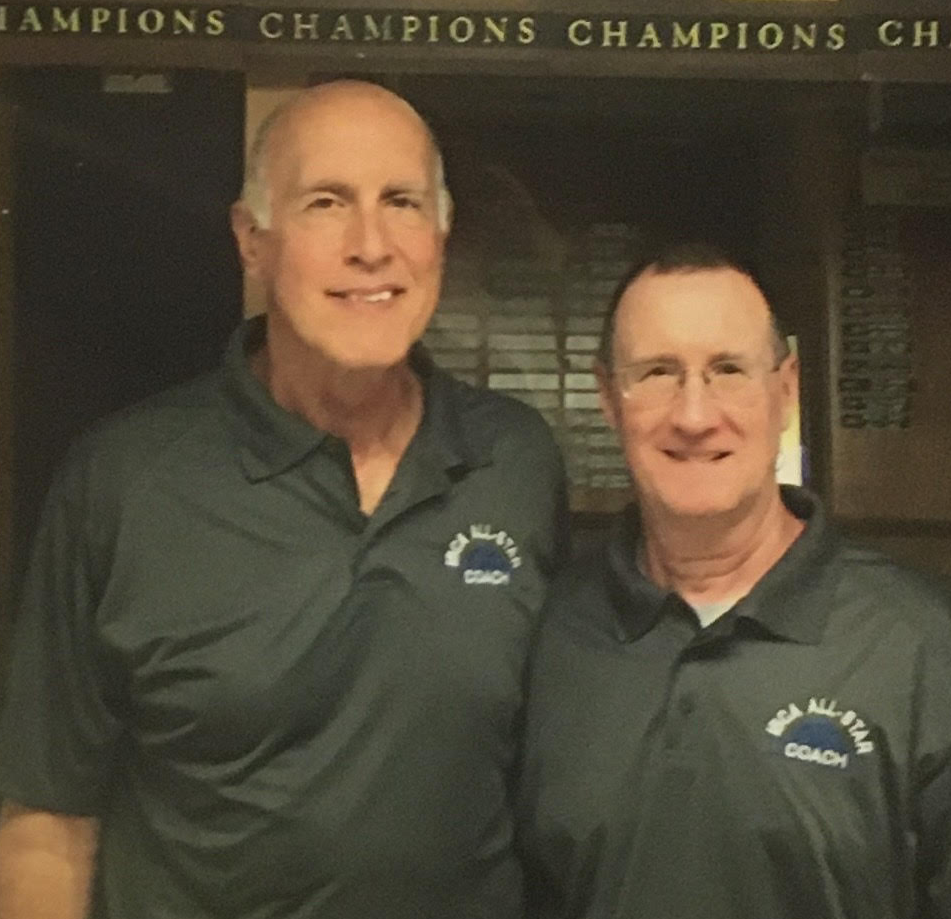
Tom Anstett was a four-year player at Boston College and an Illinois Basketball Coaches Association Hall of Fame inductee as both a player and a coach, Tom Anstett completed 42 years as a high school coach in 2014 with 21 years as a head coach at three schools. He also taught English during that time and served as the department chairman for fourteen years. Tom was a Golden Apple nominee as a teacher and earned district coach of the year numerous times. He published his first book, Stop Whining; Start Winning (for teachers and coaches) in 2017 and just completed his second with co-author Tom McCormack (Victory Is in the Details). Currently retired, Tom still tutors individual players with skill development in the Green Bay area. He also provides English workshops for teachers through the Joliet (IL) Professional Development Alliance. Tom has been married to Susan for 32 years; they have two sons and two grandsons.
Tom McCormack just completed his 50th consecutive year of coaching. He has coached at every level from grammar school to head high school coach. He played on the DePaul University freshman team as a walk-on, graduating from DePaul with a degree in Physical Education. He spent 33 years as a head high school varsity coach, one year at Immaculate Conception High School where he served as Tom Anstett’s assistant for the previous six years, and thirty-two years as the head coach at Conant High School. During his years as a high school head coach, he received numerous coach of the year awards from the Mid-Suburban League and the Illinois Basketball Coaches Association. He was inducted into the I.B.C.A. Hall of Fame as a coach in 2010 and ranks first in all-time among Mid-Suburban boys’ head coaches with 576 career victories. He is now retired and conducts player development workouts in the Schaumburg area. He has been married to Mary Alis for 44 years; they have two daughters, two sons, and seven grandchildren.
Welcome to the Athletics of Business, a podcast about how the traits and behaviors of elite athletes and remarkable business leaders frequently intersect. The real stories and hard lessons to help you level up your leadership and performance. Now, your host, Ed Molitor.
Welcome back to another episode of the Athletics and Business podcast. I am your host and CEO of the Molitor Group, Ed Molitor. And man, am I fired up to be joined by two very special guests today. If you've been listening to the podcast for a while, first of all, thank you. I appreciate it. Really appreciate you. And secondly, you've heard me reference the giants that I grew up around, specifically my dad's friends and coaches, the ones that were in his inner circle, the ones that I spent a tremendous amount of time with, whether it be as a kid going scotting with them or coaches clinics or campsites in my high school playing days and really a lot in my coaching days, and loved picking their brains, loved just listening to their stories and their teaching methods and just talking hoops.
But the thing that we talked a lot about, too, was life and the impact that athletics, specifically basketball, can have on a player's life and on your life as you coach. And today I'm joined by Coach Tom Anstead and coach Tom McCormick, over 92 years combined coaching experience. Now, when you see them, you're going to say, how can they have over 92 years because they look so dang young. But Coach McCormick, 33 years, 32 of them at one school. So he was a head coach for 33 years. One year he spent that Immaculate Conception in the western suburbs of Chicago. And 32 years he built just an unbelievable program at Conant High School.
And then Coach anstead coached for 42 years, 21 of which he was a head coach at three schools, Immaculate Conception, where Coach Mack was his assistant, and then he went on to Glenbrook north and to York High School. And they have given so much to the game. They've given so much to the young men they coached, and they've given so much to me. And that's why it's so special to be joined by them today. And we are going to jump into their new book that they wrote together, Victory is in the Details, Building a Basketball Program. And this book is for everybody. It's not just for coaches. It's for players and it's for parents because it really gives you an insight and it provides an insight of what goes in to building a basketball program, developing players and again, most importantly, developing people.
And there's a lot of humor There's a lot of great stories and their strategy shared inside of this podcast episode. We're going to talk about why you coach and knowing why you coach, why that is so important. And we'll talk about the love of competition. And if you know these two gentlemen, they are never shy about looking for a reason to compete in a big part of this conversation and talk about the transformational journey that is coaching. One of the lines that I really, I kind of poke Coach Anson about, that I want him to bring out because it shows up, I believe it's on page 142 of this book when he talks about the four steps or the four levels of preparation.
And he says that daydreaming is not equal to imagination, and daydreaming is not imagination and why that's so important in becoming a great player. And then we're going to talk about messaging. And I think this is so huge today because I think in the world we live in, and all you have to do is go on social media, turn on the news, and you'll see this. But in messaging today, when we deliver messages to our people, to the people that we are leading, whether it be your family, whether it be your players, whether it be your coworkers, whether it be your business team, it's so important to not create a victim. And we'll jump into that. So without further ado, I'm going to step aside, let this conversation just both entertain, educate you.
And again, I hope you enjoy listening to it half as much as I enjoyed recording it. Coach Anstead, Coach McCormick, thank you so much for joining us today on the Athletics of Business podcast. I am beyond excited to have you here.
Thanks very much, Ed. It's great to be with you.
Thanks for having us, Ed.
Absolutely. We've been talking about this for a while, and there's so much to talk about. You know, we're going to jump into your new book, Victory is in the Details, Building a Basketball Program. And it's an incredible read. It's so valuable. But before we get into that, can you share with our listeners your journey? I mean, individually and collectively? Because this book really started years ago. And I'm not talking a few years ago. It started years ago. And you guys have had an amazing journey together. You've had an amazing journey individually with your own basketball program. So if you could just take some time and fill us in on that Age before beauty.
Okay, I get it. I get it.
I'm shocked. Hey, I'm shocked he didn't say to.
You, keep Talking, then I'm just going to say we're going in alphabetical order.
There you go.
Well, my journey individually really probably started with wind sprints in Quigley Nord's gym in 1967 when I was in high school for my hero and idol, Bill Shaffer, who, you know, just saw something in me that I never knew I had. And as a freshman, when I was a freshman, he kept after me because I was pretty tall. I was about 64 as a freshman and had trouble walking down the hallways without colliding with something. And, you know, it was just a matter. He was kept after me. You got to try out. You got to try out. And I put him off till sophomore year. And then I tried out and, you know, just became acclimated to the game as a sophomore. By acclimated, I mean I got the crap beat out of me most of the time.
And, you know, it was something like, you know, along those lines because I played with pretty good seniors and upperclassmen. So between sophomore and junior year, I grew a little bit and really improved my game. But it was sitting in the gym for three hours a night after working for my dad for eight hours during the day and got fortunate enough to play ball at Boston College. And I always knew I wanted to teach and coach, being an English teacher and coaching. And I was the head coach at three different high schools. And that, you know, the coaching end of it was really important for my development mentally. The basketball part helped me physically a lot, and mentally, of course, but the coaching really helped me understand what basketball was about and how to help kids.
And then I was fortunate enough to probably meet Mac very innocently at Cragan park in Chicago. And I don't even think we knew each other and shoot around a little bit and whatnot. But we got together at Quigley north under Bill Schaefer, and Mac was doing the freshman. He was there a year before I was. I did the sophomores, and we had a great time with Bill coaching there. And then I got the head job at IC in 76. And the first thing I did was walk into my or. One of the first things was to tell my athletic director, Jack Lewis, that we had to hire this guy, Tom McCormick, because Mac was going to be instrumental in helping us build a good program at ic. So we did that after a year, and the rest was kind of history there.
And we did really well. And Mac took over for me after I left IC to go to Glenbrook. And so our journey together has been one of togetherness. I mean, just all the way through. Mac helped make me a better coach, and he certainly did a fantastic job at Conant. We talked about writing the book for a long time, and Quarantine encouraged us to do that.
Well, you certainly made a positive out of a negative.
Yes, definitely.
Yeah. I mean, just a great book and so much there. And Coach McCormick, how about you?
Well, Tom had mentioned how we initially ran into one another in the parks.
Where was Craigen park at? In the city?
Northwest side? It was around Laramie, between Diversey and Fullerton.
Right.
Just west of Laramie, Very close to Weber High School. But years later, a few years after college, we met really through Bill Schaefer, who brought Tom back as his assistant. And I was fortunate enough to meet Bill through a classmate at DePaul. Bill, like myself, was a walk on at DePaul back then. Freshmen were eligible. So you played on a freshman team. So, I mean, you got to love those walk ons. Absolutely nothing gets handed to you. You either love the game or you find something else to do.
That's right.
Bill hired me over the phone, and I immediately fell in love with it. And then a year later, Tom came on board and we coached together at Quigley. And then we kind of went our separate ways for a while. I was coaching at a grammar school in Evanston, St. Athanasius, which is the same school, by the way, where the movie Home Alone takes place when they're in the gym.
I learned something new every day when.
I talk to, like, Kitty Corner from what used to be called Dyke Stadium, the football stadium in Northwestern. I had to coach football there, of which I knew zero about. Learned on the fly. So I also coached football for 42 years, which was very helpful in keeping kids involved in more than one sport and showing kids that they could do a couple of things and then in some cases, it could actually be healthy for them. And then later on, we got together with Tom and a big part of Jack Lewis, who was one of the all time cool, great as a high school football coach. Legends hires me, and I think it had a lot to do. First of all, it had mostly to do with Tom, but also the fact that I coached football and I was a member of his football staff.
After Tom left, we had six great years there together, and Tom left and I took over as head coach for that final year and then went on to Conan after that, where I stayed for 32 years.
Yeah, a great run there. So, Coach Anstead, you alluded to it. So the book, Victories in The details. Pandemic. Inspired. Was that the word you used?
Quarantine.
Quarantine. I'm sorry about that. Yeah. Quarantine. Yeah.
So.
But no, in the story, the stories of you two writing a book together. I asked you two, in our conversation last week, what was more challenging, coaching together or writing a book together? So does age go first here? Does beauty go first?
Maybe I'll go first this time.
Okay. I'll wet you.
Yeah, get the shot in while you can.
Well, fortunately, Tom was the English major. I can't tell you how many times he told me during the writing of this book, when I would send him my. My piece, he would say, did you ever take English when you were in high school? So I kept telling him, well, I'm the idea man here. I'm. I'm letting you clean everything up.
You're complimenting his strengths is what you're doing. Yes.
He's already written another book on the subject. Just like always. I was following his lead.
And keep him out of trouble.
Well, yes, that's important.
It is, it is.
But did you guys ever feel like this just popped in my head. You guys ever feel like you were going back to that relationship, though, where you were working together and you had that. That chemistry, right. Like, where you could sense what the other one was thinking and. And you built off an idea that the other one presented is.
You know, that. That happened all the time.
Yeah.
With me. You know, I mean, he was. He would say something, and, you know, I would. I would really be thinking of it. And I'm sure it was vice versa. Our. Our chemistry was instant. It was like instant coffee. You know, back at Quigley, I mean, I think Tom's like a brother to me. We hit it off right away. And anytime you coach together, you learn a lot about people. You know, you learn a lot about each other. And the chemistry, as I said, was never, ever in doubt. And as we. To go back and answer your question, what was harder, you know, writing a book or coaching together? I think writing the book was actually a little tougher because going back and forth and trying to figure out what goes where, and just a ton of decisions.
Not decisions that had to be thought of instantly as if you were on the bench. To me, that's almost more difficult, having to think about it over a long period of time. But, you know, we did a really good job together. I thought Tom said it. Well, the other day, if. If ever we interviewed for another coaching job, which is highly doubtful. Okay. And they wanted to know what were about. Well, here it is, you know, I mean, you can't do much more than that.
Yeah. You know, you said something really cool and you talked about anytime you coach together, you learn a lot about each other. And there's a sense in something. I mean, you've both had a tremendous impact on my life.
And.
And one of the things I loved about being around your group of coaches and your group of friends was the sense that no matter where you were at in life, no matter where you're at in your coaching career, you were in it not just with each other, but you're in it for each other. Right. Like, you guys were always there for each other. And in the book you talk about building a basketball program. Can you just. For a second, we're going to get off on a tangent here, but it just popped in my head, how significant is that for a basketball team? I mean, any team, for that matter, but for a basketball team to play, not just to get in the trenches with each other, but for each other.
Well, from my perspective, and I don't actually never want to talk for Tom, but from my perspective, playing for each other starts at the defensive end of the floor. I mean, I just believe that, and I make the remark in the book that I don't believe that if you can't play half court defense well, you really don't have a team. And I think defensively, you. You find out who's going to put his body or her body either way on the line for each other, for your teammate. I just think the idea of playing for a program also gives the idea that as a coach, you're not happy with just one good team.
And I think that was one of the building blocks of the book, that you want to have a sustained success year after year, really, no matter what level of talent you have. Because in high school, the talent level will vary. Of course, as Max says it so well, you know, you have to take who walks in the door when you have that. It's very challenging for coaches, but if you sustain fundamentals well and really teach defense well, I think you're going to have a pretty good program year in, year out, you're going to be in games.
And I was exposed to a lot of great coaching role models along the way. Your dad, right at the top of the list. The two most important ones in my life were Bill Shaffer and Tom Anstead as mentors. And basically what you learn from those two guys is that the best programs you don't work for Somebody, you work with somebody. And when you learn to work with people, you buy in, you take ownership, you just don't punch a clock, you go the extra mile. That's a great life lesson too, that I think that comes out of the book, not only in team building, but when we talk about developing leadership and leaders who don't ask others to do what they don't do.
You know, there's plenty of examples of that in the book and I think that's one of the really important lessons that we try to establish as far as building the continuity of program. Not just a great team here and there and a lot of up and down valleys over the years.
Eddie, could I build on that?
Absolutely. Please do.
You know, we have sections as to why you coach in the book, which is a very formative question. I mean, the why is just as important as any question you can ask. I mean, when players ask why, hopefully it's not during a game, but when players ask why after a game, it's a great question. When they ask why during practice, it's a great question. But coaching is really a transformative journey. It's a transformative job. You know, as coaches, we transform kids from immature kids to young adults who are going to be held accountable for what they do on the court and off the court. And I think that's one of the biggest responsibilities for coaches. They teach that transformation through the fundamentals, through defense, through execution on offense. I mean, all those pieces that go into actual basketball.
But also the really good coaches transfer that to life lessons because basketball doesn't last forever, as we know. Consequently, kids need to see those parallels. Coaches need to talk about those parallels constantly. Because I think it makes the why much more meaningful. As to why kids play, it's not just an immediate gratification, it's more of a long lasting one.
Well, and I think that's a big piece of the puzzle too, with the mental toughness aspect of it. Because the beauty of athletics is as a coach, you have an opportunity to push kids outside their comfort zone and to get them to grow through that discomfort and grow through that adversity. And that's what I love about the book, Victories and the details as we talk into for what my brand is the athletics of business. I'm looking up on my whiteboard and it's so funny, the things that you just mentioned. Our core values for our organization and Molitor group is transformation, fundamentals, compassion, mental toughness and vision. And that's something that you talk about in this book. That's something that you walk the walk every single day you guys were in the coaching profession.
But I'd love to dive a little bit deeper into the question, why you coach? Because you both have great stories behind why you coach, and you both have great stories about what coaching means to you, and not only to you, but to your families and your families being your extended families, the players that you have coached. So if you could take a turn here, each of you, and just talk about why you coached and what it meant to you and what it means to the folks that you led over.
The years as a young person, all young people are searching for an identity, search for what they want to do. And fortunately, at a young age, when I was a senior in high school, actually, I decided that I wanted to teach and coach and pursue that aspect of it, primarily because of some of the teachers and coaches that I had in high school that influenced me. I saw the type of life that they led and got to know some of those guys, and that was kind of an inspiration for me. But there's one aspect of it, and I guess this doesn't have to be just sports, but there's one aspect of it that really, I think is the first step. It's just that our love of competition, our love to keep challenging ourselves, whether it's an athlete or.
Or a coach playing that chess game on the bench and trying to dominate the competition. That competitive aspect, I think, is what lights the fire. And then it's just gotta be channeled in the right direction. And I think, fortunately, I ran into some people who could channel me in the right direction. They teach you that it's not all about you. It has to be done as a team. And what goes into building teamwork and leadership and that kind of thing. Now, as far as my family is concerned, I would suggest for anyone getting into this, and there's all types, all different types. There's people that are married, people that are single for a while and then get married. But your spouse let them marry for.
A while and then become single.
Yeah. Well, your spouse, okay, really better be bought in and understand what's going on, because the whole family has to make the commitment. My wife Mary and I were fortunate enough to raise four kids, and she was the wind beneath the wings man in terms of making sure stuff got done with the family and that kind of thing, and they all bought in. But I think that's one of the big reasons why coaches get out, is that doesn't work for some People. And there's good reasons, good and bad reasons, but there's good reasons. But that buy in a family is really important. And fortunately enough, my wife and kids and heck, my parents were at every game. She knew all the officials by name, and.
They liked her a lot more than you.
It's been everything to us. You know, you see a family picture right now. Everybody's wearing Conant gear and that kind of thing. And I've got grandkids that want to talk about going to Conant or playing high school basketball wherever they play or whatever it is they want to get into. But it's definitely a family buy in.
Well, they say behind every great coach is an even greater wife. And for you two, that certainly holds true.
Absolutely.
Make sure they listen to this podcast. By the way.
I can echo that with Susan. And it was even hard with us because were both working the whole time. It was very challenging because of the hours you need to spend as a coach to do it correctly. And your wife has a full time job as well. It was challenging to say the least, but we did it. And my wife had a lot to do with the successes, any successes I had.
You know, if I could interject there too. Ed, your dad retired from palatine at what, mid sick when he's in his.
Mid-60s or so, a little bit younger?
Yeah, yeah, I retired at age 65. And what was really interesting was what, when I look back, the Next. There were 12 coaches in the league, six in each division, and the next oldest guy was about 40 years old. In that span of time. What is it? I mean, there were some really good coaches, but why weren't they coaching anymore? A couple of them got dismissed, but not many of them, most of them,
Because you kept beating them, Coach McCormick. That's why they're not coaching anymore. Koenig kept drilling them. That's why.
Well, I think it was. It actually had something to do with all the pressures that are on families and what it takes for the teamwork effort there that it takes to build and sustain a program.
But I also think a part of it attribute to you guys was what we're talking about now, why you got into coaching, what your values were and what really drove you. Yeah, you won a lot of games, but that was a byproduct of how you did things. And I think your sustainability, my dad's sustainability, why Coach Wolowski has been able to be at friend for so long. It's a lot to do with what you stand for. And I think when you stand for something you can navigate the waters of. I say this with all due respect. Crazy administrators, crazy parents, different challenges of the times, how society evolves, how kids change. And I think that's why it was so sustainable for you guys.
And I think that's such a tribute, and I think that's why this book is so significant, because you guys, I mean, you said this is. If you want to know what we're about, this is it. And I think this would be a great time to jump into the book and let you two take some turns on how you put it together, what's in it and who it's really.
Well, I just want to make one more comment about why I coach. When I was in college, I knew I wanted to teach and coach, and I knew what basketball was giving me in college. And when I was in high school, as you know, I went to a seminary. I was going to be a priest, and getting a college scholarship talked me out of that because I saved my parents a whole 25 grand for four years. I don't even want to tell you what BC costs for one year now, anyway. That was a fortune to my parents back then. But I knew I wanted to do something in service. I wanted to serve. And I thought, if I'm not going to be ordained one day, I want to teach and be with kids, I want to work with kids.
So I thought I owed something to basketball. And I always felt that as I coached through the years, I owe something to basketball because it's given me a good life. And I have met people I would never have met in another area. Very, very lucky to meet mentors such as a Pat Sullivan, a Hubie Brown. To hear these guys over and over, Rick Majeris over and over again, to really get to know them personally a little bit accelerated my desire to coach. I mean, I just kept saying I want to be like them. It was kind of like when you have a good program and you have good seniors, you take your freshmen and sophomores and you say, these are the guys you want to be like, you know, And I think that's part of having a great program, too.
Those seniors are models for the rest of the program. I just wanted to mention those things as part of why I coach or, you know, why I have coached and even why I still am a little bit, you know, because I just enjoy the feeling of, can I help kids a little bit, you know, here and there.
Well, you can take the kid out of the city, right? But you can't take the city but you just, and you just mentioned something that's so, you know, I was blessed. I was so fortunate to grow up. And I consider you guys Giants. And, you know, you mentioned Coach Majeris, you mentioned Pat Sullivan, the Bill Gleason's of the world. To me, that was just a way of life. Like just making an impact on somebody's life was just the way you were supposed to do things. That's just. That was it. And to see that. I think that's what's so great about this book is it's a resource where it brings a lot of clarity about not only how you can do it, but what the right way to do it is.
Well, we think it's a right way. I don't know if it's the right way because what we say at the beginning of the book is we take that acronym program and the P is for preparation. For example, 10 other coaches might come up with a different word for the P or the R or the O, but the seven that we came up with and that constituted the structure of the book. Because every book needs an organization, you know, and it needs a target audience. Our target audience was mainly coaches, but we think, as Max said before, that it's very valuable for players and parents as well.
And we can talk about that as we go on, but we just thought that with that structure and that voice in it, and then combined with the reflections that we have, we both think really substantiate all the X's and O's and the drills and whatever that pertains strictly to basketball in the book, that it becomes a pretty valuable commodity for those three audiences.
In talking about the book itself and the chapters, each one of those. I'm not saying that there will be another effort here, but each one of those could be a chapter unto itself. You talk about preparation and everything that goes into making. And really for us, it's what goes into making a lasting program and then resilience. Talk about a life lesson. You're in coaching, you're going to get knocked down. How do you get back on your feet? How do you handle it? Heck, my first year at Kona, were on 24. I mean, Owen 24.
Yeah. That's a long season.
Yeah.
Those lessons and then off season has a lot in it for players on individual development and that type of thing. There's a lot in there in terms of workouts. And then Tom has his four elements of working out listed there at the end of that chapter, which is really hits the nail right on the head.
Well, it does, and we will go through that too. I need to say it properly and listen when I say it because I don't want to get censored on this one, which has happened before. Not because of me, because of a guest, but. Yeah, but we will definitely dive into.
That, you know, in the guts. Talking about the defense. Tom gets really excited. He can see him start to sweat when we talk about defense. And then the rebounding chapter, too.
Well, I'm surprised.
Yeah, I can just see him going out on the floor telling some, scared to death, don't do it this way. You do it this way. And then the last two chapters, which I think are kind of our favorites in a way, attentiveness and mentality, where we go into more of the reflections and that type of thing. Again, each one of these could probably be a chapter unto itself and hopefully will provoke a lot of thought to the point where we get some inquiries. I know a guy that had a big influence on my coaching career. Besides the people we just mentioned was Coach Cheney. At Temple I got the opportunity to meet Tom, took us all to a medalist clinic, and he was on the floor of the ballroom there throwing a basketball back and forth 40ft with Eubie Brown.
But then I got to talk to Coach Cheney, and he was a famous morning practice guy. Got the idea from him, gave him a ride to the airport, got to talk to him. And we had corresponded over the years. Fifteen years later, I was able to meet him in an N1 clinic at DePaul, sitting in the first row. He walks out. Now I haven't seen him for 15 years. Sees me, there he goes, Tom, how you doing?
Wow.
And then we proceeded to talk after the clinic there. So, yeah, there's those kinds of things.
Yeah. So let's go back to that for a second. I mean, there's a lot there. I mean to. A lot of it happened in his life, in your life. But for him to remember Tom right after just a ride to the airport and the conversation is amazing. But the morning practice thing. Okay. He had his reasons for doing it. And you thought that was such a great idea. What did the administrators of 2:11 think when you told them that you were going to practice at 5:30 in the morning every day?
Well, not only my administrators, but my coaching staff.
Well, I was going to get there. Yeah.
Some of them, the younger guys were quiet and usually they'll go along with anything, you know, but they were quiet. So that meant they were like. And some of the older guys were like, Are you crazy? But going back to what Bill said, you know, when they start telling you're crazy, you know you're getting somewhere.
Getting somewhere.
That's where Don Crandall came into play. Don Crandall hired me, was like, tom, if this is what you want to do, we'll make it work. Because selling it to the administration was a big deal.
Right.
But after we did it for a couple of years and it went really well. And I'm not saying this is. This would work for everybody and all instances, it can't work, but some people can't make it work. But certainly worked for us. We had the main gym all to ourselves without any distractions. It was the first thing of the day. And I think what the players liked about it was we all have a tendency as coaches, if we're that last practice of the day, to stick around till you get it right.
Yeah.
And you should never get it right. Players knew at 7:45, I had to.
Let them go because they had to get to class. They had to go eat and they had to get to class. Yeah.
But for our family, it worked out great. I got to see our kids, you know, I lost a little sleep, but got to see our kids at bedtime. Got to get out to some of my son Pat's basketball games when he was playing at University of Dubuque. Division 3 Dubuque, which I never could have got to if we had practices. So family wise, it worked out wonderfully too.
Did you like with playing on Friday nights, Saturday nights? Heck, back then, even Tuesday nights, did you ever change practice up to make it later towards closer to game time, so the bodies got acclimated. Was that not an issue?
I don't know if you remember, but back Tuesday is a relatively new.
We had like one or two Tuesday games.
Yeah. We wouldn't have many, and some guys would schedule them. We scheduled mostly Friday, Saturday, so we didn't get interrupted. But later on, towards the end, we had some more Tuesday games and we wouldn't practice on Wednesday morning after a Tuesday game. We would usually come in Wednesday after school and watch. That'd be a film day, maybe a day when we got in the weight room. It really was not a big interruption. It worked out fine.
Well, while we're talking about practicing, while we're talking about preparation, I think this is a great time to get into page 140 of your book. And I gotta be careful here. I'm gonna say this the right way. Okay. And it's a special note to Players, the four levels of preparation and level one. And I'm gonna say it for you, and it's. I'm gonna spell it F O, O, K I and apostrophe fuking around. Can you take us through the four levels of that?
Well, I guess I better, since it was kind of my idea.
Like you said, Coach Mack, this hits the nail on the head, and it's got coach Zanstead's amazing sense of humor written all over it, yet it still teaches you something.
Well, I don't know exactly how the idea came up, but when were talking about preparation so much, and this chapter is so fundamental to the book, because every business, every organization, there's talk about preparation no matter what. Well, level one. I just think the first sentence might say it. This level sits just above the vegetable. You know, I mean players at this level. And before I say another word, this part directly is tuning in one of the primary audiences of the book, which is players. You know, you ask players, do you think you really work hard when you prepare? What, you know, what you're doing in the off season? How about your workouts? Do you self evaluate your progress? Well, okay, well, here it is.
Here's a four stages where you can really honestly evaluate where you are in terms of preparing primarily in the off season. And in our book, the off season has plenty of workouts, individual workouts you can do that will challenge you physically, mentally, and emotionally if you do them well. Anyway, level one is fuking around and, you know, there's really no vision or no focus going on.
Can I. Can I. I'm sorry to interrupt you, but you say something. I want to make sure we hit that I love, and I wrote this down, is daydreaming does not equal imagination. Can you talk about that for a second? That's. I think that's really interesting.
Well, I think imagination implies focus and modeling, you know, because you are. You see something you want to imitate. Well, it could be that freshman who sees a senior make a great move in a game and saying, I need to get that in my game. That's where imagination comes in. And it's imagination that has a. You know, it's. The mind has a purpose for improvement. You know, daydreaming, there's no focus going on. You could be thinking of 10 things in the matter of. And that's kind of how the mind works anyway. But that's what makes average players into good ones and, you know, good players into great ones. You know, they have that ability to discipline their minds to attaining the next step toward their own improvement. Mac had a great line to add in the Level one.
He said the most important thing for these players is that their earbuds are working properly, because, heaven forbid, those things aren't working. We would never want that. That's Level one. Level two is playing around. They can hold their vision for longer periods of time, but any distraction could become a major social activity. And there's more of a woulda, coulda, shoulda with Level two than there is with Level one. There's work for a while, but kind of lose interest after a while, too. And Level three is working out. These players have some good qualities, but they're not quite at a championship level where a level 4 one is. They maybe don't follow through on evaluating what they're doing and really determining if their workout was successful. They might not work out. They'll work out hard for a while, maybe for an hour.
But once again, they don't approach discomfort. And I think discomfort is important when you're trying to get better. I've been training a kid from a young man who's a sophomore and is doing well. He's going to be on varsity at Preble, the school I'm helping. And Mac met him when he was up here and were talking about the book. I made him do push ups because he missed two layups in a drill. And I said, all right, do 20 pushups. He does 20. And I asked him, how many pushups did you do? And he goes, 20. I go, oh, not 21, not 22. I said, you always do more than the minimum. Always do more than the minimum. And that's the only way to stretch yourself. And I think if you're in a Level three, you never approach that Level four.
They go above and beyond. There's concise application of detail in their techniques and in their workouts. It's kind of like the definition of integrity. You do the right thing when no one's watching, and I think no one's watching you. You're still going as hard as possible for as long as you can. These players are rarely outworked. Rarely outworked. And I don't think many high school players are in this category, mainly because they haven't been taught and maybe haven't been challenged enough by coaches.
Well, and that's what bothers me. I mean, when coaches sit here and talk about how much kids have changed, it's because we've enabled them to. You know what I mean? Because coaches as a whole now there's some great coaches, don't get me wrong. I think at that level, at the high school level and at the younger level, obviously, and we're not going to get off on a tangent of AU basketball yet, but they're not held accountable and we've enabled them to change. Right. And that's why, I mean, when's the last time you've seen someone do fingertip push ups?
Yeah, right. Well, you know, remember Mr. Miyagi in the karate, you know, and Mr. Miyagi said no such thing as bad student, only bad teacher. And that rings true in a lot of areas. It was one reason why my students in my English class, in college prep class would say to me, Mr. Anstad, you know, we're not an honors class. And I said, yeah, I know that we still have to get after it here, but I think those four levels are a good platform not only for players to evaluate what they're doing, but for parents to read and to consider as a way to discuss, well, if you're not playing, if you're sitting on the bench, why not calling the superintendent about the coach? But good coaching is not about equal or more playing time, it's about development.
I think parents who read this book will appreciate all the plates coaches have to balance. Even the preparation chapter alone gives parents an idea of all coaches responsibilities, which I think a lot of parents don't get. You know, everything was really laid out for him and I just think it creates a good, as I said, platform for discussion on where you're going, how you're doing it and why you're doing it.
You know, part of the levels of training here is, you know, between level three and level four, if you can get a kid, if you get somebody to level three, they can get to level four. Getting to level three is like a big key for kids because now all they need is some direction and some accountability. And I think the biggest difference between level three and level four is when they get to level four, they'll need direction, but they'll need less direction. And the accountability will be self accountability, not accountability to the coach or anybody else. So they'll be holding themselves accountable once they get to level four. And we all know those kids are pretty special.
And Coach Mac, you know where I'm coming from with this being walk ons. But this is, I think it needs to be said. Like there could be parents listening, coaches listening, but yeah, what if my kid doesn't play? What if they're just, you know, what if they're on the bench. Like, what if they're just a role player? You still want to be at a level four. You still want to be pushing yourself, you still want to be able to hold yourself accountable, you still want to be committed. Because that's what part of being a great teammate is, right? And that's part of what the whole challenge to yourself and competing. And when we talk about competing, it's also competing against ourself. I mean, sometimes we're our own and I don't want to say our biggest enemy, but I mean, sometimes we can't.
We can get in our own way. And that's why athletics is so significant, because of the lessons that it teaches. But can you guys talk into a little bit about. Because I think that's a big piece. Because the majority of the people that read this book, their kids aren't going to be the superstars, right? Or their players aren't going to be the superstars. If they're a player, they might just have a sign, you know, a certain role on a team. But this all still applies to them.
Yeah, I, you know, and I know Matt can probably talk about this too, on a personal level, but my older boy, John, you know, when he played four years at Lincoln Way east and he didn't play much at all as a junior, you know, and he sat the bench a lot, you know, he wasn't as strong as he needed to be yet. He had a pretty good mind for the game, but he just wasn't. Wasn't ready, you know, wasn't quite ready. So, you know, he worked hard in the off season and as a senior, he was not the best player, not by any means. There were, or three kids, probably better athletically, but he played a great role as a four man and he just developed over time.
And I think that's the level of encouragement parents can give their players who are riding the bench. No matter what year. It's a process and you have to develop, you have to do the extra things that are going to help you improve and make every practice your game. I mean, you have to come ready to go at practices and compete, you know, learn how to compete. That was one thing your dad Eddie always was big on. We gotta teach kids how to compete. Parents just have to put the pressure on the kids, you know, not so much on the coach, but put it on. The coach is gonna have it there anyway. But good coaches are going to feel that want to improve their players, but the kids need to have that sense of, it's my ball I've got to do something with it.
Part of it for us, once were able to get established at Conant after those first couple of years, Ed, you can remember this. Playing in the msl, we had a great JV program in the league, more so, I think, than some schools. But were really able to emphasize kids developing through that JV program and trying to earn a role in the rotation. Not necessarily starters. I never use the term starters. People would ask me who your starters are, and I'd say, well, if you want to know who our best players are, let's see who finishes the game. Because kids always want to be a starter. And I know that's important to some, but really, when you think about it, who are the finishers at the end of the close game? Who do coaches really trust at that point?
It breaks down all sorts of barriers. It's not about any kid's background. It's all about, hey, who can we trust to get the job done in this situation? And then when kids accept their roles as JV players, I think what really contributed to some of our. The majority of our success was the fact that our practices were so competitive. When went into drills or 4 on 4 or 5 on 5 in practice, those kids in those learning roles were so competitive that it was a great look at practice. You know, if you have two or three really good players, but then the rest of you, there's a big drop off and you can't compete at practice. It's hard to even compete at games.
So selling those kids, and Tom uses this term, it's a great term to be stars in their roles and to be valuable without being most valuable. Or what's the term?
Being invaluable without being most valuable.
Valuable without being most valuable. Selling those kids on those ideas, that those roles are really important. It takes a lot of salesmanship. And parents will fight you one of the times. Well, they don't. If they don't play or they don't this. That's why at JV games, we all went, you know, some programs, the starters or the kids that played last night, they were at the game. No, for us, everybody was at the JV games, whether it was around the road, too. And the guys that played the night before were the water boys the next day.
I love that. Yeah. And that's what it's about right there. Speaking of which, I mean, you have a great story on page 207 in the book, Coach Mac, about when you're at Conant. I mean, as A role player. You don't know. You don't know when your number is going to be called. Right. You don't know when you're going to be most needed. And that's why you come to work every day. And you did something that took a lot of cojones. And I would love for you to walk us through that story.
Well, we had a very talented team. And what I'm about to say, I would not suggest necessarily for.
Well, Bob, I'm going to tell you. Let me. Let me set this up, though. When Coach Max says he is a very talented team, it means they were loaded because they had some players that competed that could play that were talented. So. And I know which team he's talking about. And very talented might be an understatement. You were stacked, so let's go with that.
Yes, we had a good JV team, but we had a bit of entitlement started to creep in. We had some guys that were asking some players to do things that they would not do, and weren't going real hard at practice, and we became a little stagnant. We had just underachieved and lost in the championship game of our tournament at East Aurora, where we didn't even really, I feel, compete. And then in practice, it was just lackluster. Our second team was taking it to our first team. And this is where you need to be careful. I kind of painted myself into a corner. All right, we're going to scratch.
First time ever.
Yeah. But not the last.
And I thought I had made a safe spot to land. I said, we're going to play to 25 points. And the first team there that wrote. And we had like a rotation of seven guys in one group and seven in the other group, which was basically our JV team. And I said, whoever wins this scrimmage is going to play in the game Friday night. And were playing a really. And were playing a pretty good opponent. And whoever doesn't is going to play in the JV game is not going to play a second. And sure enough, the JV team beats the first unit. So now I'm. Now I'm back to new was going.
Through your head as that was happening.
So went with it. And you can imagine the. The uproar that. That caused people walking in the game like, what the hell's going on? And you know. Or I'm sorry, what the heck's going on? So here we are, and we played a game every second of the game with our JV team. Who was used to really getting after it. And it didn't matter what the outcome was. Okay. But somehow, some way, they managed to win that game, which, in a way,
Which helped you out tremendously, by the way. Yes.
Fortunately, the athletic director had my back, although I didn't do a great job of letting other people know what was going on, especially my AD and other people. And today we sort of laugh about it and that kind of thing. But without giving too much more away in the book, I told my staff at that point, you know, that was something we had to do. We couldn't let the players or anybody else hold us hostage. We got through it. And don't ever let me do that again. But guess what? And I'll leave it at that.
Yeah, yeah, exactly. Exactly. And I love. I love the story you share about Hoosiers in there or the line from Hoosiers. But. But. And read the book, because it is a great story, and you did do it. And I don't know if that works today. What happened was your starters learn from it. But not only did your starters learn from it, your role players, it got reinforced to them that they absolutely were significant, they did matter. They were valued, and they were going to play a part in the championship. You were in the process of winning.
You send the message for two reasons, and you don't want to send the message and create a victim. Use somebody as an example. Okay, to me, that's counterproductive. But when somebody needs a message sent to learn from it, then you need to send that message. And you can't let anybody else hold you accountable. You know, as a byproduct, that team ended up making it downstate, made it to the Elite Eight. And like I said, I won't go any further. There's a little bit more to the story that people can read in the book. But, you know, every coach is going to run into situations like that. Tough decisions are going to abound. There's all sorts of people that have suggestions. The head coach got to make the decision.
And I guess this would be a good point to bring up the role of assistance in this case. You know, you want input from your assistants. You want, you know, especially the experienced ones, everybody with a voice, but as an assistant, and I felt like I was always able to do this as Tom's assistant for so many years, and he was so great at it. He would really listen to what you had to say. But then when the decision is made, everybody's got to be on board most of the time.
I was listening because I didn't know.
What the hell to do.
So you know, or you didn't have a choice, you know, and I think this is great. As we begin to wrap this up and I hate doing this, I wish we had about two more hours to keep talking as we begin to wrap this up and Coach Mac, I want to thank you because you just enlightened me to something. The value of assistance. But what I see in today's game, and correct me if I'm wrong, I see too many good guys getting out of it at too young of an age. And I think there's various reasons. That's not where I'm going with this. But I think one of the things that's so critical, the stage of game, these high school programs, any level, but these high school programs are the assistant coaches.
And I believe that there's too many assistants that are doing it for the stipend, that aren't doing it for the right reasons. But I do think there's some assistants that are in it. A good number of assistants are in it for the passion of the game, for the love of making an impact on kids lives for the right reasons. So if you could each take a turn, like what advice would you give, regardless of age, to an assistant coach on how to best serve the head coach, how to best serve the kids, and at the same time how to best serve, you know, their career path that they're trying to follow?
Well, I just think with an assistant it's empowerment. With an assistant, you want to include that person within the threads of the program. You have to be willing to listen, you get to know them. And I think another baseline question for them is why are you coaching? We talked about that question earlier. Why are you coaching? Let's talk about that and get an idea of where that individual's coming from in terms of that. And no matter what the answer is involving that person with decisions, like Max said before, and helping that coach improve his or her coaching, I think those things are paramount to making an assistant feel valued and wanted in the program. Your head coach has to make the decisions, the final decisions. That's true.
But you have an idea as a head coach which assistants are with it and which ones are just kind of going along for the ride. But I think just like you do with players, you've got to challenge them to improve, you got to meet with them individually. That's a sign that you're very interested in them, in those people and that you're very interested in their getting better. As a coach, because, you know, it's the kind of thing I used to say this as an English chair, you know, we're working together. You might see me as the boss, but I don't quite see it that way. Unless it's a decision. You're working with me and I'm working with you. You know, you're not working for me at all.
Right. And that's fantastic. And Coach Mac, I'll change the question up a little bit to you. You've had some great assistant coaches over the years. I mean, some incredible men, great guys. What made them such valuable assistants? What was it that they did? You know, what was it that. That Matt did at a young age to become a head coach? And what was it the roles that the other guys on your staff played? What was it that they contributed?
First of all, there's no one size fits all. I mean, you can find great assistants who are players. You can find great assistants that weren't players. And they come with different goals. Some come with aspirations to be a head coach. And if they're putting in the time, if they're doing the work as an assistant coach, it's really a responsibility, a head coach, to try to help them every way we can, to help guide them, to move them along. As valuable as they are, we need to be willing to let those guys go and reach their potential as coaches. But it's so important that in the very first part of the book preparation, the very first thing we talk about is putting the staff together and how critically important that is. In Matt's case, he was a player in the program.
It's great to have a few of those guys come back as players that were real believers in what it is you were doing. And it's really cool to see those guys come in and put their little twist on it. They have immediate credibility with the players who grew up watching them play when they were younger. So that was a great stepping stone for Matt. But they come with different skills. He was a great people person. Some guys are great X and O guys. And that's another thing Tom alluded to. You take a guy or a girl or whatever, a coach, an assistant. You evaluate what they're good at, what their strengths are. You give them some responsibilities in those strengths. Strength might be X's and O's. Strength might be scouting. Their strength might be motivation. Their strength might be relationships with. With kids.
You identify what their strengths are. You really let them use those strengths, and then you try to build on what they need to develop and as a whole, there's a whole section. And the very first part of the section of preparation is on developing a staff.
If we move away from, I mean, in addition to the skills, but the behaviors that drive the skills. Right, so the assistants, what do you look for them? Is it, is it the commitment? Is it, is it the drive? Is it the passion? What is it that jumps out at you the most? Like the assistant? You just alluded to studying the game. I think the profession as a whole, I shouldn't say it's not the profession as well, but I think it's not what it used to be. The medalist clinics, the Nike clinics, the clinics are still out there. Now the focus is on these guys making money on what they're selling online as opposed to sitting down and then going into the bar afterwards and actually on a napkin. What about studying the game? What about the preparation?
What about kind of earning your stripes as an assistant?
Well, you really need to go overboard. You have to show that willingness, okay, to go beyond what's asked. You know, it's not. And I think this is what you alluded to a little bit earlier with some guys that are maybe just in it for the stipend or everything. As soon as practice is over with, are they gone? Are they out the door? I mean, this might be asking a little bit much for some, but for my staff it was with coach Hildebrand most of the time and then others, various other guys that were on the staff. Our meeting time was Sunday morning. You know, for a lot of people that was family time. But for us from 9am to about 1 or 2 in the afternoon, that was game film evaluation, putting in preparation for the week, getting ideas.
We would have the assistant coaches who were responsible for the scout of the team coming up have to come to that meeting and use their input to put a scouting report together and that kind of thing. And commitment to put in the time is the main thing. If people are willing to put in the time, okay, they're usually not going to waste it. Commitment to putting in the time is the main thing. If you can get people to putting in the time that it takes, and it takes a lot of time above and beyond. It's an eight day a week job, not seven.
But it's not work to us. Right? I mean it's not. If you're passionate about it, you're doing it for the right reason. It's really not viewed as a job. It's really not viewed as work.
No, there's an element of trust that doesn't happen overnight. And trust has to happen within a staff as well as between a coach and players and I think one another. Just to dovetail off what Max said, a question you can evaluate your assistance with is just how well do they fulfill their responsibility? How well do they do that? And I think that's a sign of how much they care. Are they open to criticism? Do they fulfill their roles well? What kind of attitude do they bring to practice every day? Do they ask a lot of questions? Things like that can really be indicators of the level of commitment that an assistant coach has.
Yeah. And you know, something else along all those lines, we talk about preparation, going beyond what is asked and a level of trust. You know, on game day, are the coaches engaged in the game? When a kid comes out of the game, are they teaching the kids something, even if it's not their scout? Did they respect the work that one of the other assistants did, study the scouting report, know the other team inside and out just like they would, as if it was their scout? Is that something that's pretty significant?
Well, I. You know, I think when you have an assistant, you. You want them to have certain responsibilities during games. And once again, that's something that you can talk to them about as to how well they're doing it. And once again, I go to that sense of empowerment. You know, this is how you're going to help us compete. You know, how you're going to help us win. I just think it's all part of what you give them and how well you communicate with them. Always as a head coach, always trying to communicate to them that you're here to help them grow, like they're there to help you grow.
Whatever responsibilities you give assistance, okay, say it's a scouting report or something like that, you need to use it. What will really, I think, resonate a lot with them is if not only you give them responsibility, but they see that you're using the fruits of their labor. And, boy, does that get guys to buy in. By the same token, and Tom never shied away from this, when somebody does a lousy job, player or assistant coach, you let them know and. But an equal amount or even maybe an overboard amount of praise for a job well done. And I know when Tom used to send me out to do scouting reports when you were younger, the feedback that I would get is like, it was way too overboard. There's too much detail.
I'd much rather hear that than say, well, what happens here, what happens there? And then I have to go, duh. You know,
Well, guys, I love this. Now Victory's in the details. Building a basketball program. Where can folks find the book?
It's available on Amazon. It should be available in most bookstores. It's available in print and ebook on Amazon. So we think it's selling pretty well right now. It seems to be getting a reach across the country too because we've been doing a lot of self marketing with trying to find high school associations across the country. We're really focusing on the Midwest right now. Mac and I are trying to divide it up as best we can and sending out emails of information to both state associations, basketball advisory committees and the like. And also finding conferences within the states and picking out a few schools from each conference and sending the head coaches emails when we can find the emails. Sometimes it's a little difficult, but that's where you can find it. Would make a great Christmas present, man. Even after Christmas.
Yeah. Great way to kick off the new year. Right here. A great way to kick off the new year. Great Christmas present. Great seconds. I know. The other day I was Talking to Kevin McKenna, Associate Coach at University of Oregon. He was in the process of reading the book. Matter of fact, the day after they beat Washington at Washington, he sent me a text early, especially for where they're at up in the Northwest. And we're going back and forth about a section of the book. And I don't think he got to the fucking around part yet. Otherwise I'm sure there'll be another text. But the book's awesome. I mean, the book's unbelievable. We will have the link in the show notes if you don't want to bounce around and go to Amazon.
So when you get done listening to this phenomenal conversation, go to the show notes and the link to purchase victory is in. The details will be there as well. So Coach ann said, Coach McCormick, I cannot thank you enough. I appreciate everything. Congratulations on a job well done and all the success that I am sure is to follow with the book.
Thanks, Ed. Really had a good time. Thanks for your time and your commitment to helping through your organization, business people as well as coaches, parents, leaders. You're really doing a great job with your. With the Molitor group and appreciate that. Really love you.
Well, thanks. Love you guys.
Echo that. You know, as were going through all this, I can still see you getting down and slapping the floor defensively.
Yeah. I don't know if I could do that now. That's a long ways to bend over. But you will be happy to know that Grandpa, Papa does have those kids slapping the floor here at 5:39. Yeah. Yeah. All right. Thanks, guys. I appreciate you.
Thank you for listening to the athletics of business. Be sure to give us a rating and review. Review so we know how we're doing. For more information about the show, visit theathleticsofbusiness.com now get out there. Think, act and execute at the highest level to unleash your greatness.